How to Import Aromatic Rice From Bangladesh in 2026: Complete Buyer Guide
A full buyer guide to importing aromatic rice from Bangladesh: how Kalijira, Chinigura and Kataribhog differ, what to specify for fragrance, milling and moisture, how to sample and test, and which HS code and export papers each shipment needs.
Short answer
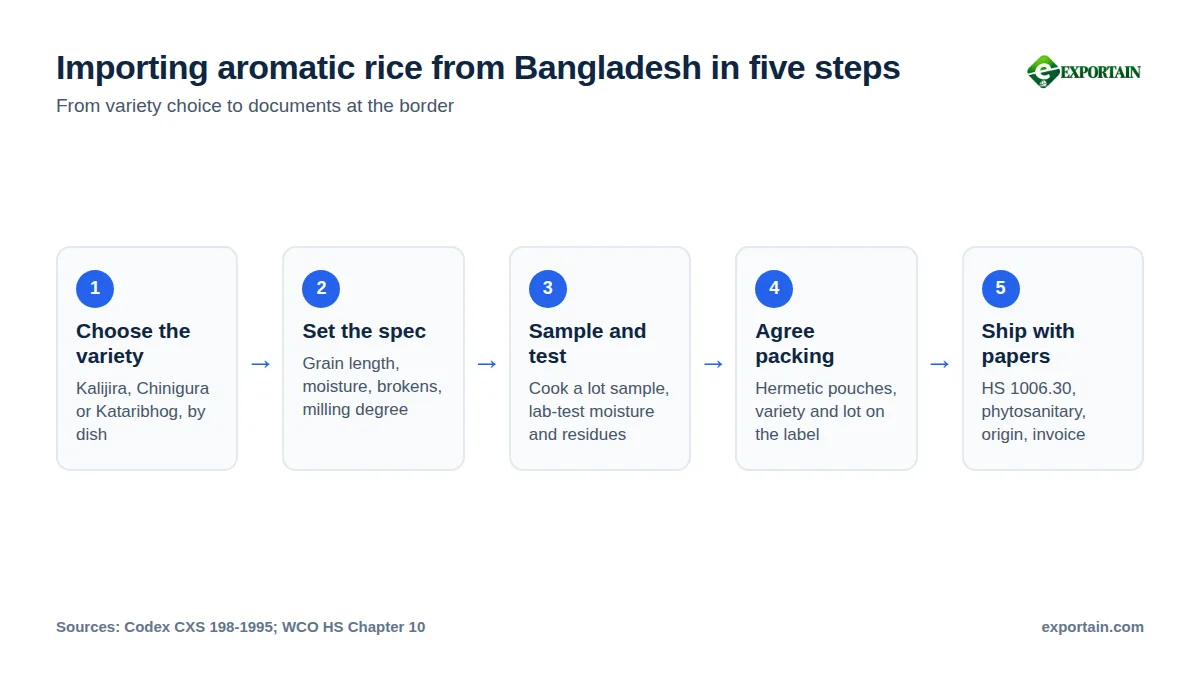
To import aromatic rice from Bangladesh, choose a variety such as Kalijira, Chinigura or Kataribhog, set grain length, moisture, broken grain and milling specs in writing, and test a cooked sample from the lot. Ship milled rice under HS 1006.30 with a phytosanitary certificate, a certificate of origin and a lot-specific lab report, and check EU pesticide limits before loading.

On this page
Key takeaways
Kalizira, Chinigura and Kataribhog are short-grain aromatic varieties, and their fragrance comes from 2-acetyl-1-pyrroline, which fades with heat, time and heavy milling.
Put grain length, moisture, broken grain and milling degree in the order, and test a cooked sample from the lot before you commit.
Most retail aromatic rice ships as milled rice under HS 1006.30, with a phytosanitary certificate, a certificate of origin and an invoice showing the ERC number and HS code.
For the EU, check pesticide limits under Regulation (EC) No 396/2005 before loading, and test the lot in an ISO/IEC 17025 accredited lab.
A buyer who orders aromatic rice from Bangladesh is buying fragrance first and grain second. Kalijira, Chinigura and Kataribhog are short-grain aromatic varieties grown for polao, biryani and payesh, and they behave differently from the long-grain Basmati most importers know. This guide covers the buying journey: variety, specs, sampling and testing, packing, and destination rules.
What makes Bangladeshi aromatic rice different from Basmati?
Bangladesh grows indigenous short-grain aromatic varieties prized for an intense floral fragrance, unlike the elongated Basmati or Jasmine types that dominate international trade.1 The fragrance comes from 2-acetyl-1-pyrroline (2-AP), a volatile compound that gives the rice a sweet, popcorn-like scent.1 That compound is fragile: it fades with heat, time and heavy milling, so the buying spec has to protect it.
The grain shape is the first visible difference. Chinigura measures about 4.2 to 4.6 mm, Kalijira about 3.8 to 4.2 mm, and Kataribhog about 5.2 to 5.8 mm.1 Under the Codex classification, short-grain rice has a kernel length under 6.2 mm, so all three sit in the short-grain class.2
A second difference is supply. Aromatic cultivars are grown during the late monsoon Aman season, and the traditional varieties are low-yielding, which keeps volumes small relative to ordinary rice.1 Most aromatic rice therefore moves as a speciality product in small retail packs. See our guide to the tea and spices trade, which puts rice in that same speciality export basket.
Which aromatic rice variety should you buy?
Start from the dish your customers cook. Chinigura, Kalijira and Kataribhog are all known for fragrance, fine grain size and use in biryani, polao and payesh.1
Variety | Grain length | Aroma | Main growing areas |
|---|---|---|---|
Chinigura | 4.2 to 4.6 mm | High, long-lasting | Dinajpur and Sherpur |
Kalijira | 3.8 to 4.2 mm | Very high, intense floral | Mymensingh and Netrokona |
Kataribhog | 5.2 to 5.8 mm | Medium, subtle | Dinajpur plain |
The grain lengths and growing areas in this table come from a Bangladesh market report on aromatic rice processing.1 Chinigura is the commercial name for rice from the BRRI BR 34 variety, grown in the north of Bangladesh including Naogaon.3 Kalijira is also known as small Basmati and is not sticky.3 Kalijira and Kataribhog are described as geographically indicated products of Bangladesh.3
Do not buy on the variety name alone. Kalijira is sometimes sold under the name Chinigura, so the name on the bag is not proof of the variety inside it.3 Put the variety, the grain length range and the growing region in the order.
What grain, fragrance and milling specs go into the order?
Write the spec before you ask for a price. A spec that only says "aromatic rice, good quality" leaves every decision to the seller.
Moisture comes first. The Codex Standard for Rice sets moisture at 15 percent maximum, and notes that lower limits should be required for certain destinations in relation to climate, duration of transport and storage.2 For a sea shipment to a humid market, ask for a lower limit in the contract, such as 14 percent maximum.
Broken grain comes second. Codex defines head rice as a kernel at least three quarters of the average length of the corresponding whole kernel, with large, medium and small broken kernels defined as fractions below that.2 Ask for the head-rice and broken percentages, and state which definition the contract uses. Some export packers use optical colour sorters to remove chalky or discoloured kernels and target under 2 percent broken content.1
Extraneous matter comes third. Codex sets filth at 0.1 percent maximum, other organic extraneous matter at 0.5 percent maximum for milled rice, and inorganic matter such as stones and sand at 0.1 percent maximum for milled rice.2
Milling degree comes fourth. Codex classifies milled rice as undermilled, well-milled or extra well-milled, depending on how much of the germ and bran layers have been removed.2 Heavier milling gives a whiter grain but removes bran, and with it part of the aroma. State the milling degree you want. On the Bangladesh side, BSTI lists BDS 952:1981, Grades on milled rice, among its standards for cereals and their products.4
Fragrance itself cannot be graded by eye. Ask for a cooked sample from the same lot, and judge aroma, texture and grain separation after cooking.
How do milling and ageing change the aroma?
Aroma is lost in drying, storage and milling. The compound 2-AP is volatile, so it escapes by diffusion, and the loss is faster at higher temperatures.5 Rice dried at 55 °C air temperature lost more aroma than rice dried at lower temperatures, and rice stored at 27 °C lost more 2-AP than rice kept at 14 °C.5 The loss is fastest in the first five weeks of storage and then levels off, as the remaining 2-AP is bound in the starch.5
Milling cuts aroma in a specific way. Free 2-AP sits mostly in the bran, while bound 2-AP sits mostly in the endosperm, so removing the bran during milling reduces the 2-AP level.5 The bound portion is released on exposure to high temperature, such as cooking.5 That is why a heavily polished grain can smell faint in the bag and still perfume the kitchen once cooked.
For the order, ask how the paddy was dried and at what temperature, because high-temperature drying is where aroma is first lost.5 Some export processors use low-temperature drying below 42 °C to preserve the 2-AP compound, with multi-pass polishing and optical sorting.1 Ask for the milling date and the storage conditions, and prefer a freshly milled lot. Agree the packing too: nitrogen-purged hermetic retail pouches are used by export packers to protect graded aromatic grains.1
How do you sample and test before you commit?
Never place a first order on a catalogue photo. Ask for a sample of at least 1 kg from the lot you would buy, and cook it the way your customers will. Check grain length against the variety you ordered, and check aroma, texture and whether the grains stay separate. Kalijira is not sticky when cooked, so a sticky sample points to the wrong variety.3
Then test the lot in a lab. A certificate of analysis for the specific lot should cover moisture, broken percentage, extraneous matter and any pesticide residue screen your market requires. Test reports should be issued by laboratories accredited to ISO/IEC 17025, and for EU acceptance the accreditation should come from an ILAC-MRA signatory body.6 Ask that the report reference the lot number, the invoice and the packing list.6
For the EU, check the pesticide limits before you ship. Maximum residue levels are set at EU level under Regulation (EC) No 396/2005 and apply to all food placed on the EU market, whether produced in the EU or imported.6 Where no specific MRL exists, the default is 0.01 mg/kg.6 Products that exceed an MRL are refused entry, withdrawn from the market or destroyed, and violations are notified through the RASFF system.6 For rice, tricyclazole is one of the actives commonly flagged, and a multi-residue screen is the usual starting point.6 Check Implementing Regulation (EU) 2019/1793 as well, because it lists products subject to increased border checks.6
What HS code and export papers does aromatic rice need?
Rice sits in HS heading 1006. The WCO nomenclature gives four subheadings: 1006.10 for rice in the husk, 1006.20 for husked brown rice, 1006.30 for semi-milled or wholly milled rice, whether or not polished or glazed, and 1006.40 for broken rice.7 Most retail aromatic rice ships as milled rice under 1006.30. Our HS code guide for aromatic rice works through the same heading, and our HS code guide for Basmati-style rice covers the neighbouring classification.
Confirm the full national code with your customs broker, because countries extend the six-digit code with extra digits. The code on the invoice, the packing list and the certificate of origin must match.
The export file from Bangladesh has a standard shape. The commercial invoice must include the Export Registration Certificate (ERC) number and the HS code of the goods.8 The certificate of origin, issued by a local Chamber of Commerce or another authorised body, certifies the country of origin for duty and trade-agreement purposes.8 The packing list sets out each package type, quantity and weight.8 For agricultural products, a phytosanitary certificate is required to confirm the goods meet the destination country's plant health rules, and it is issued by the Department of Agricultural Extension.8
How should aromatic rice be packed and shipped?
Packing protects fragrance, so treat it as part of the spec. Codex requires rice to be packed in containers that safeguard its hygienic, nutritional, technological and organoleptic qualities, and sacks must be clean, sturdy and strongly sewn or sealed.2 For retail, 1 kg and 5 kg pouches are the usual formats, and hermetic pouches with nitrogen purging slow aroma loss.1 For bulk, use new multi-wall bags with an inner liner.
Labelling needs the same care. Codex requires the product name on the label to follow the definitions in the standard, and for non-retail containers the name of the product, lot identification and the name and address of the manufacturer or packer must appear on the container.2 Put the variety name, the milling degree, the lot number, the net weight and the country of origin on every pack.
For shipping, FOB Chattogram suits a first order because you control the sailing and the freight. Our Incoterm guide for tea, spices and rice shows which term suits this product group. Keep the rice dry and cool in transit, and ask the forwarder to confirm the container is clean, dry and free of odours before loading.
A worked example: one trial order of Kalijira for a UK retailer
Example figures: a UK retailer orders 5 tonnes of well-milled Kalijira from a mill in Mymensingh, packed in 1 kg nitrogen-purged pouches, 20 pouches to a carton, FOB Chattogram, HS 1006.30. The order names the variety, a grain length of 3.8 to 4.2 mm, moisture at 14 percent maximum and broken grain at 2 percent maximum.1 2
Before loading, the buyer cooks a 1 kg sample from the lot, then receives a lot-specific certificate of analysis from an ISO/IEC 17025 accredited lab, including a multi-residue pesticide screen checked against the EU MRLs.6 The seller supplies the commercial invoice with the ERC number and HS code, the packing list, a phytosanitary certificate and a certificate of origin.8 The buyer approves the label artwork, which names the product Kalijira, shows the lot number and the packer, and states the country of origin.2
Which mistakes catch first-time aromatic rice buyers?
Ordering "Basmati" and receiving Kalijira, or ordering Kalijira and receiving a blend, because the variety was never written into the order.
Judging fragrance from the raw sample only, and missing that heavy milling has already removed the free 2-AP from the bran.5
Accepting a moisture result from the mill without a lot-specific lab test, then finding mould or off smells after a long sea voyage.
Shipping without a phytosanitary certificate, because nobody checked that agricultural products need one from the Department of Agricultural Extension.8
Printing labels before the artwork is approved, then finding the variety name or the origin is wrong on every pouch.
Skipping the pesticide screen for an EU delivery, and learning about the MRL breach after the goods arrive.6
Each of these is cheap to prevent before loading and costly to fix after arrival. Our aromatic rice quality control checklist covers the inspection points lot by lot.
Next steps on Exportain
Open a request for quotation naming variety, grain length, moisture and broken limits, milling degree, packing and destination.
Attach your spec sheet; ask each replying seller for a lot sample and a lot-specific certificate of analysis before agreeing a price.
Compare replies with mills in the Exportain supplier directory.
Sources
- Aromatic Rice Processing: Chinigura and Kalijira Packaged Exports. BD Market Insights (accessed )
- Standard for Rice (CXS 198-1995). Codex Alimentarius (accessed )
- 14 Top Rice Variety in Bangladesh. Bangladesh Branding, (accessed )
- List of Bangladesh Standards (BDS) on Agricultural and Food Products. Bangladesh Standards and Testing Institution (accessed )
- Aroma loss in rice as affected by different conditions during postproduction operations. SEARCA (accessed )
- EU Maximum Residue Levels (MRL): Test Report Guide for Agri Exporters. All Frontier Global (accessed )
- HS Nomenclature 2017, Chapter 10: Cereals. World Customs Organization (accessed )
- Essential export documents for shipping from Bangladesh. DHL (accessed )
About the author
Sourcing from Bangladesh?
Post a request for quotation and suppliers on Exportain can send you their quotes directly.
Post an RFQ