HS Code for Aromatic Rice: Classification Guide for Importers
Aromatic rice points indicatively to heading 1006, to be verified: husk state, milling degree, parboiling, broken-grain share, and grain length decide the line, and the full national code must be confirmed on the entry date.
Short answer
The indicative heading for aromatic rice is 1006, to be verified for your product and destination. Aroma and variety names do not decide the subheading. The deciding factors are the state of the grain on arrival: husk retained, husk removed only, semi-milled or wholly milled, or broken. Confirm the full national code in the destination tariff for the entry date before filing, and do not copy a full code from another country.
On this page
Aromatic rice has no heading of its own. Aroma is a trait of the grain, not a heading text, so the question is "what state is the grain in when it arrives." This guide covers the indicative heading, the four international subheadings, the factors that move rice between them, and the national lines to confirm in the United States, the European Union, and the United Kingdom.
Quick answer: indicative HS heading (with verify note)
The indicative heading for aromatic rice is 1006, to be verified. Every line below is indicative only: verify it against the grain as presented.
Aromatic rice product | Indicative subheading | Verify note |
|---|---|---|
Rice in the husk (paddy or rough) | 1006.10 | Verify the husk is still retained, to be verified |
Husked (brown) rice | 1006.20 | Verify only the husk has been removed, to be verified |
Semi-milled or wholly milled rice, whether or not polished or glazed | 1006.30 | Verify the milling degree, to be verified |
Broken rice | 1006.40 | Verify the fragment-length test, to be verified |
No single 8-digit or 10-digit code covers all aromatic rice: each national line is a line to confirm on the entry date.1
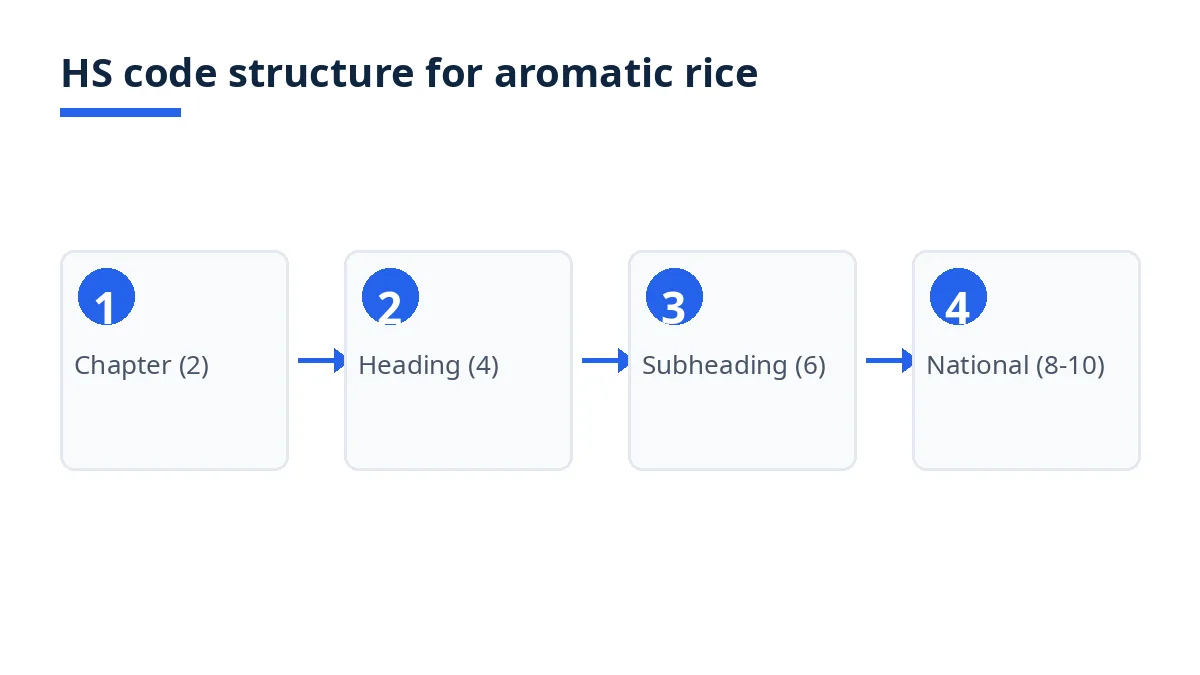
How HS codes are structured (2-4-6 digits)
The Harmonized System is a multipurpose international product nomenclature developed by the World Customs Organization (WCO). It comprises more than 5,000 commodity groups, each identified by a six-digit code, and is used by more than 200 countries and economies for customs tariffs and trade statistics.2
Level | Digits | Meaning for aromatic rice |
|---|---|---|
Chapter | 2 digits (10) | Cereals |
Heading | 4 digits (1006) | Rice |
Subheading | 6 digits (1006.10, 1006.20, 1006.30, 1006.40) | Rice by husk state, milling degree, or broken character |
National extension | 8 to 10 digits | Set by the importing country, to be confirmed on the entry date |
Classification follows the heading texts and the chapter notes first, and only subheadings at the same level are comparable.3
Factors that decide the code for aromatic rice
Answer these questions from the specification and the grain on arrival.
Grains present, and the rice exception. Chapter 10 products are classified there only if grains are present. The chapter does not cover grains which have been hulled or otherwise worked, but rice that is husked, milled, polished, glazed, parboiled, or broken remains classified in heading 1006.4 3 Processing alone therefore does not push ordinary rice out of the heading.
Husk state. Paddy rice is rice which has retained its husk after threshing, while husked rice is rice from which only the husk has been removed.3 Grain still in the husk is a 1006.10 question, to be verified. Grain with only the husk removed, bran layers still in place, is a 1006.20 question, to be verified.
Milling degree. Semi-milled rice is rice from which the husk, part of the germ, and the whole or part of the outer layers of the pericarp, but not the inner layers, have been removed.3 Wholly milled rice is rice from which the husk, the whole outer and inner pericarp layers, and the whole germ in long or medium grain rice, and at least part of it in round grain rice, have been removed.3 The 1006.30 text covers semi-milled or wholly milled rice whether or not polished or glazed, so polishing or glazing creates no separate six-digit subheading.4
Parboiled. Parboiling is a treatment applied before milling, and parboiled rice remains classified in heading 1006 under the chapter note.4 There is no separate six-digit subheading for parboiled rice. Whether a parboiled lot sits in the husked or milled line depends on the finished grain state; any national parboiled split is a line to confirm.
Broken rice. Broken rice means grain fragments, the length of which does not exceed three-quarters of the average length of the whole grain.3 The test is a measurement, not a trade description. Measure a sample before filing, to be verified.
Aroma and variety. Aromatic character and variety names such as basmati-style or jasmine-style describe scent and grain shape. They do not appear as six-digit subheadings in heading 1006. In the United States schedule opened for this guide, basmati and jasmine appear as statistical breakdowns inside the husked and milled lines.4 Aroma does not, by itself, move rice between subheadings.
Grain length. The United Kingdom additional chapter notes define round, medium, and long grain rice by grain length and length-to-width ratio: round grain does not exceed 5.2 mm with a ratio of less than 2, medium grain exceeds 5.2 mm but does not exceed 6.0 mm with a ratio of less than 3, and long grain exceeds 6.0 mm.3 Grain length therefore decides national lines in tariffs that split by it, and it is a line to confirm in the destination tariff.
Seed, sowing, and further working. Rice for sowing is a different use from rice for eating, and the United Kingdom notes make sowing classification depend on seed rules and intended use.3 A paddy shipment for sowing is a national line to confirm, not a routine 1006.10 filing. Once rice is worked beyond the forms the chapter note keeps in heading 1006, the question leaves these four subheadings.
Worked examples as classification questions
Each example is a question, not a settled code for an unchecked shipment.
Milled basmati-style aromatic rice, polished and whole grain: 1006.30, to be verified. Deciding factor: milling degree. Husk, pericarp, and germ removed to the wholly milled standard, with whole grains, points to semi-milled or wholly milled rice, to be verified.
Husked aromatic rice, brown and unmilled: 1006.20, to be verified. Deciding factor: husk state. Only the husk removed, bran layers still present, points to husked rice, to be verified. "Brown aromatic rice" supports this reading only if the mill confirms no further milling.
Parboiled aromatic rice, then milled: 1006.30 as a question, to be verified. Deciding factor: finished grain state. Parboiling before milling creates no parboiled subheading. If the finished grain is semi-milled or wholly milled, the question is 1006.30, to be verified.
Broken aromatic rice as a boundary question: 1006.40, to be verified. Deciding factor: fragment length against the whole-grain average. Fragments not exceeding three-quarters of the average whole-grain length point to broken rice, to be verified. Measure a sample first.
Paddy aromatic rice still in the husk: 1006.10, to be verified. Deciding factor: husk retained after threshing. Grain that has kept its husk points to rice in the husk, to be verified, unless it is for sowing.
National codes: US HTS, EU CN/TARIC, UK commodity code
The first six digits are shared internationally; the rest is a national line to confirm.
System | Where to check | Confirm on the entry date |
|---|---|---|
US HTS | Harmonized Tariff Schedule of the United States, Chapter 10 | The full HTS line for your husk state, milling degree, and grain form, as a national line to confirm |
EU CN/TARIC | Combined Nomenclature and TARIC tools for the member state of entry | The full EU line for your husk state, milling degree, and grain form, as a national line to confirm |
UK commodity code | UK Integrated Online Tariff, heading 1006 | The full 10-digit commodity code for your husk state, milling degree, and grain form, as a national line to confirm |
Only the first six digits are used worldwide, and product-specific decisions are particular to each country.1 Do not copy a United States full code into a European Union or United Kingdom entry. The United States schedule and the United Kingdom tariff both list the same four subheading groups in heading 1006.4 3
How to confirm the code officially
Write the full description: variety, husk state, milling degree, parboiling treatment, broken share with measurements, grain length, and intended use.
Read the heading text for 1006 and the Chapter 10 notes, including the rice exception and the milling definitions.4 3
Compare subheadings only at the same level, starting with the four one-dash subheadings in 1006.
Extend the six digits in the destination tariff for the entry date, and record the date checked.
Where a boundary point remains, ask a destination-country broker, or apply for a binding ruling before shipping.
In the United Kingdom, an Advance Tariff Ruling must be applied for before all customs procedures have been completed, since decisions cannot be made retrospectively, and a separate application is needed for each type of goods.5 HMRC replies in 30 to 120 days with the ruling decision, the correct code, and a reference number.5 For Northern Ireland or the European Union, a Binding Tariff Information decision is the corresponding route.5
Common classification mistakes
Copying a supplier full code: only the first six digits are used worldwide.1
Classifying from aroma or variety name: scent and variety do not decide a subheading.
Treating parboiled as a subheading: parboiling is a treatment inside the husked or milled lines.
Treating broken fragments as whole grain: measure fragments against the average whole-grain length before choosing between 1006.30 and 1006.40.
Ignoring grain length at the national level: a tariff that splits by grain length needs the length and ratio recorded.
Copying a full code across countries: a United States, European Union, or United Kingdom national line does not transfer to another territory.
Skipping the chapter notes: the rice exception and milling definitions decide cases that the heading word "rice" alone does not.
Filing a sowing shipment as food rice: intended use changes the national question, so state it and confirm the line.
Using an old quotation: tariffs update, so re-check the line for the entry date even for a repeat shipment.
Related duties and documents
This guide states no duty rate. A commodity code works out customs duty and import VAT, taxes, and preferential rates, and the tariff tool also shows whether a licence, quota, or other measure applies.1 Those treatments are national, so read them in the destination tariff.
Keep the entry file aligned with the classification reasoning. The invoice, packing list, and import declaration should read the same way on variety, husk state, milling degree, parboiling treatment, broken share, grain length, and intended use.
FAQs
What is the HS code for aromatic rice?
The indicative heading is 1006, to be verified for your product and destination. The subheading turns on the state of the grain: 1006.10 for rice in the husk, 1006.20 for husked rice, 1006.30 for semi-milled or wholly milled rice, and 1006.40 for broken rice, each to be verified.4 3
Is the HS code the same in every country?
The first six digits should be the same internationally, because they come from the shared WCO system.2 1 The full code is not the same everywhere, because countries add their own digits after the first six.1 Always confirm the full code in the destination tariff.
How do I confirm the correct code?
Describe the grain fully, read the 1006 heading text and Chapter 10 notes, compare subheadings at the same level, and extend the six digits in the destination tariff for the entry date.4 3 Where a boundary point remains, ask a broker or apply for a binding ruling before shipping.5
What happens if I use the wrong code?
Customs can reclassify the goods, reassess the duty and taxes on the corrected line, and delay clearance while the classification is corrected.1 Tell your broker promptly if you find an error.
Next steps on Exportain
For the shared structure behind every code in this guide, read HS Code (Harmonized System Code). For the method, read How to Find an HS Code. When you are ready to compare suppliers, start from the supplier list at Exportain suppliers and share the full grain specification with each supplier and your broker before filing.
Sources
- Finding commodity codes for imports or exports. GOV.UK (HM Revenue & Customs), (accessed )
- What is the Harmonized System (HS)?. World Customs Organization (accessed )
- Rice in the husk (paddy or rough) - UK Integrated Online Tariff, subheading 100610. GOV.UK, HM Revenue and Customs (accessed )
- Harmonized Tariff Schedule of the United States Revision 18 (2026), Chapter 10. U.S. International Trade Commission (accessed )
- Apply for an Advance Tariff Ruling. HM Revenue & Customs (GOV.UK), (accessed )
About the author
Sourcing from Bangladesh?
Post a request for quotation and suppliers on Exportain can send you their quotes directly.
Post an RFQ