How to Import Black Tea From Bangladesh in 2026: Complete Buyer Guide
A full buying journey for black tea from Bangladesh: CTC and orthodox grades, the Chattogram auction, estates and blenders, sampling and cupping, packing, HS code 0902, and the EU and US rules that decide whether a shipment clears.
Short answer
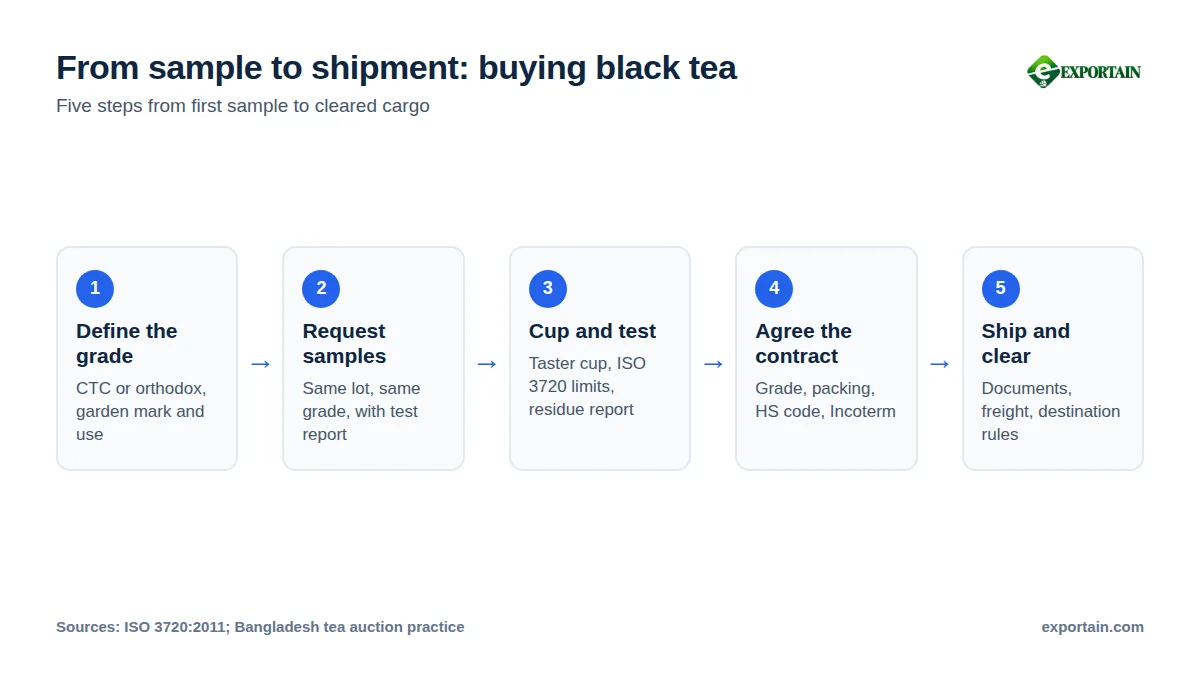
To import black tea from Bangladesh, first choose the grade: CTC leaf and dust for strong tea-bag blends, or orthodox whole leaf for loose-leaf packs. Buy through the weekly Chattogram or Sreemangal auction via a registered broker, or direct from an estate or blender. Cup samples against ISO 3720, agree the grade, garden mark, packing and HS code 0902.30 or 0902.40 in the contract, then check your destination residue and labelling rules before the tea ships.
On this page
Key takeaways
Bangladesh makes mostly CTC black tea for strong milk-tea blends, with smaller volumes of orthodox whole-leaf tea.
Most tea sells at weekly auctions in Chattogram and Sreemangal through registered brokers, by garden mark and grade.
Cup every lot before ordering, and write the grade, garden mark, packing and test limits into the contract.
Bulk black tea usually ships under HS 0902.40 and retail packs under 0902.30, with EU residue limits and US FDA filings at destination.
A buyer who wants black tea from Bangladesh is buying into a market where most of the crop never leaves the country. National output runs between 95 and 102 million kilograms a year across 168 registered estates, and domestic drinkers absorb nearly 95 percent of it.1 The lots that reach foreign buyers are usually sold by grade and garden mark, through a weekly auction or direct from an estate. This guide walks through the whole buying journey, from choosing the grade to clearing the rules at your destination.
What kind of black tea does Bangladesh produce?
Bangladesh makes black tea from the tender shoots of Camellia sinensis, by withering, leaf maceration, aeration and drying.2 Commercial processing is dominated by the crush, tear, curl (CTC) method, which gives the strong grades suited to the local milk-tea habit.1 A smaller share is orthodox whole-leaf tea, and the premium segment is seeing growth in specialty green tea, orthodox grades and organic white tea.1
Fresh leaves are withered for 12 to 18 hours, dropping from 75 to 80 percent moisture to roughly 65 to 70 percent.3 Then comes maceration. In CTC processing, the leaves pass through rollers turning in opposite directions and are crushed into tiny, uniform pellets. In orthodox processing, the leaves are gently rolled so the leaf stays whole.3 The leaf is then fermented for one to two hours, dried at 82 to 104 degrees Celsius until moisture falls to about 3 percent, and sorted by particle size into market grades: brokens (BOP), fannings (PF, PD) and fine dust (RD, CD).3
Grade group | What it is | Usual use |
|---|---|---|
BOP (broken orange pekoe) | Broken leaf, larger than fannings | Loose-leaf packs and strong blends |
PF, PD (pekoe fannings, pekoe dust) | Small fannings | Tea bags and quick-brewing blends |
RD, CD (red dust, churamoni dust) | Fine dust | Strong tea-bag blends |
Grades also vary by growing valley. Moulvibazar lists BOP, GBOP, OF and dust as its primary grades, Habiganj lists pekoe fannings and CD, Chattogram lists orthodox and CTC blends, and the northern plains list CTC dust and fannings.1 Moulvibazar alone yields about 55 percent of national output.3 Ask the seller which valley and garden a lot comes from, not only which grade it carries, because the same grade name can cup very differently from two gardens.
How does the Chattogram auction work, and do you have to buy through it?
Most of the national harvest is traded weekly through auction centres in Chattogram and Sreemangal, where major blenders and consumer goods companies bid on garden marks.1 After sorting, the dried tea is sealed into moisture-proof, aluminium-lined bags for transit to the auction platforms in Chattogram, Srimangal or Panchagarh.3
An auction lot is identified by its garden mark and grade. If you cannot attend, work through a broker or buying agent who bids on your behalf and reports the lot numbers, garden marks and prices achieved. Ask the estate or blender whether a lot can also be contracted direct, outside the auction, and get the answer in writing before you plan around it.
Estates and blenders sell different things. An estate sells tea from its own gardens, so a single-garden lot keeps one origin and one character. A blender buys lots from several gardens and mixes them into a house blend, which suits a buyer who needs the same cup every month. Black tea may be produced from one garden or region, or as a blend of teas from two or more origins.2 Decide which you need before you ask for prices: a single-origin buyer and a blend buyer are not comparing the same product.
How do you judge a sample before you order?
Never order a first lot without cupping a sample from that same lot. Quality is usually assessed by tea tasters, who judge the appearance of the dry leaf, the appearance of the infused leaf, and the appearance, odour and taste of the liquor.2 The liquor is prepared by the method in ISO 3103, and tasters can often tell from the cup whether a tea is likely to fail the chemical limits.2
Write the chemical limits from ISO 3720:2011 into your specification. The standard requires black tea to have no taint and to be reasonably free from extraneous matter, and sets these limits on the dry leaf:2
Characteristic | ISO 3720:2011 limit |
|---|---|
Water extract | 32 percent minimum |
Total ash | 4 to 8 percent |
Water-soluble ash | 45 percent minimum of total ash |
Alkalinity of water-soluble ash (as KOH) | 1.0 to 3.0 percent |
Acid-insoluble ash | 1.0 percent maximum |
Crude fibre | 16.5 percent maximum |
Total polyphenols | 9 percent minimum |
Bangladesh has adopted the same standard as BDS ISO 3720:2008, alongside BDS ISO 1839:2008 for tea sampling and BDS ISO 3103:2008 for preparing the liquor used in sensory tests.4 Ask the seller for the test report against these methods and a sample drawn under the sampling standard. Our black tea quality control checklist works through the same checks lot by lot.
What should the contract and specification say?
Put the product in words that leave no room for substitution: grade, garden mark, crop or season, packing, the ISO 3720 limits above, and the sampling method. Name the lot number from the auction or the estate, and state that the shipped lot must match the approved sample. Add the residue limits for your destination, the label text, and the payment terms.
Then agree the Incoterm. The eleven Incoterms 2020 rules divide delivery duties, costs, risk and customs formalities between the two sides, and they say nothing about price, payment terms or when ownership changes.5 Under FOB, risk passes once the goods are loaded on board the vessel. Under FCA, the seller delivers the goods, cleared for export, to a carrier you name, and risk passes at handover; this is the recommended rule for containerised cargo.5 Only CIF and CIP oblige the seller to insure: CIF at minimum cover under Institute Cargo Clauses (C), and CIP at all-risks cover under Clauses (A).5 For a first tea order in a container, FCA Chattogram with your own cargo insurance is usually the cleaner choice. Our guide to choosing an Incoterm for tea and spices walks through each rule with tea shipments in mind, so you can see which one fits your order.
Which HS code and documents does a black tea shipment need?
Black tea falls under HS heading 0902, tea, whether or not flavoured. The Bangladesh Customs Tariff splits it by packing size: black tea in immediate packings of a content not exceeding 3 kilograms is 0902.30, and other black tea is 0902.40.6 Use 0902.40 for bulk leaf and dust in sacks, and 0902.30 for retail packs. Put the same code on the invoice, packing list and bill of lading, and check it against your own tariff schedule, because duty is charged on the destination code. Our HS code guide for black tea works through the same headings.
For most destinations, ask the seller for the commercial invoice and packing list, a certificate of analysis with the residue report for your market, a phytosanitary certificate, a health certificate where your market asks for one, and a certificate of origin.7 For the United States, the document set also needs the FDA information and the Foreign Supplier Verification Program importer details.8 Confirm the full list with your customs broker before the tea leaves Chattogram: a missing certificate is found at the border, after the freight is paid.
What rules apply at your destination?
The European Union sets maximum residue levels for pesticides per substance under Regulation (EC) No 396/2005, and for any active substance not specifically listed for tea, the default limit is 0.01 milligrams per kilogram, effectively not detectable.7 Enforcement runs through the EU rapid alert system, and repeated supplier failures become publicly visible.7 Contract the test scope in writing, naming the EU residue rules, the laboratory, and testing per lot, and make the seller responsible for a rejected lot.
The United States takes a different route. There is generally no special federal import licence required to bring ordinary tea into the United States, but the food rules still apply.8 A foreign facility that manufactures, processes, packs or holds tea for consumption in the United States generally must register with the FDA and designate a United States agent, and registration renews every two years between 1 October and 31 December of even-numbered years.8 The FDA generally requires Prior Notice before imported tea arrives: at least 8 hours before arrival by ocean, 4 hours by air or rail, and 2 hours by road.8 The United States importer must also run a Foreign Supplier Verification Program, checking that the foreign supplier produces food meeting United States safety standards, including pesticide residue and contamination checks.8
United States labelling must identify the product, net quantity, the responsible business and ingredients where required, and country-of-origin marking applies, so a statement such as packed in the USA does not establish the origin of tea grown overseas.8 Tea generally falls under Harmonized Tariff Schedule heading 0902, but some classifications carry zero duty while others attract duties, so do not assume a shipment enters duty-free.8
How is black tea packed and shipped?
Black tea must be packed in closed, clean and dry containers made of material that does not affect the quality of the tea.2 In practice, bulk tea leaves Bangladesh in moisture-proof, aluminium-lined bags inside sacks or cartons.3 Packaging should protect the tea from moisture, contamination and exposure to strong odours that could affect quality.8 For ocean freight to the United States, the Importer Security Filing (ISF 10+2) must be submitted at least 24 hours before the cargo is loaded, and it is separate from FDA Prior Notice.8
Example figures: a buyer in Hamburg orders 2,000 kilograms of CTC BOP from one Moulvibazar garden mark, packed in moisture-proof lined bags, shipped FCA Chattogram in a single container. The buyer cups a sample from the same lot, checks the residue report against the EU limit, and agrees the contract on the approved sample, garden mark, grade and packing. The seller delivers the container to the carrier the buyer names, and the tea is released once the lot matches the sample and the papers match the lot.
What mistakes catch first-time black tea buyers?
Ordering by grade name alone, without the garden mark and crop, then receiving a different cup from the one sampled.
Cupping a sample drawn from a different lot than the one that ships.
Writing no residue limit into the contract, then learning at an EU border that an unlisted substance fails at 0.01 milligrams per kilogram.7
Using one HS code for bulk and retail packs, when 0902.30 and 0902.40 split on the 3 kilogram packing line.6
Buying on FOB for a container load, when FCA fits containerised cargo and moves risk at handover to the carrier.5
Assuming a United States shipment enters duty-free, when some tea classifications attract duties and others do not.8
Storing tea beside strong-smelling goods, so the leaf picks up odours before it is ever brewed.8
Get the sample, the test report and the destination rules settled before the contract is signed, and the rest of the order is mostly paperwork.
Next steps on Exportain
Send a request for quotation naming the grade, garden mark, quantity, packing and destination, so sellers quote against one specification. Weigh the replies against the supplier listings on Exportain, checking grades, garden marks and packing options before shortlisting. Then use the tea and spices sourcing guide, our overview of the tea and spices sector and how to buy to carry the order from quote to signature.
Sources
- Tea Industry in Bangladesh: Sreemangal Auctions and Value-Added Blends. BD Market Insights (accessed )
- ISO 3720:2011 Black tea — Definition and basic requirements. International Organization for Standardization, (accessed )
- Bangladesh Tea Production: Inside Estates and CTC Processing Factories. JAR Limited, (accessed )
- List of Bangladesh Standards (BDS) on Agricultural and Food Products. Bangladesh Standards and Testing Institution (accessed )
- Incoterms 2020: the 11 rules, who pays and bears the risk. OVRSEA, (accessed )
- Bangladesh Customs Tariff - Chapter 9: Coffee, tea, mate and spices. Bangladesh Trade Portal (accessed )
- EU Tea Import Standards: MRL Pesticide Limits. Smileaf Tea, (accessed )
- Importing Tea Into the USA: FDA and Customs Guide. A1 Worldwide Logistics (accessed )
About the author
Sourcing from Bangladesh?
Post a request for quotation and suppliers on Exportain can send you their quotes directly.
Post an RFQ