How to Import Turmeric From Bangladesh in 2026: Complete Buyer Guide
A first-order guide to buying turmeric from Bangladesh: dried fingers or powder, curcumin and moisture limits, lead and aflatoxin checks, sampling, packing and the EU and US rules that decide whether a lot clears the border.
Short answer
To import turmeric from Bangladesh, agree the form first — dried fingers, pieces or powder — then set the specification in writing: curcuminoid content, moisture, ash and a lab panel for lead, aflatoxin and pesticide residues. Sample the lot across bags, test before shipment, and confirm the HS code 0910.30 and your destination's contaminant limits. Bangladesh exports far less turmeric than it imports, so check the origin and the test evidence behind every lot.
On this page
Key takeaways
Bangladesh exported $4.96 million of turmeric in 2024 and imported $52.2 million, so ask where the lot was grown and what the lab evidence shows.
Codex sets moisture at 12% for whole turmeric and 10% for powder, with curcuminoids at a minimum of 2% on a dry basis.
Screen every lot for lead chromate and metanil yellow, and test lead, aflatoxin and pesticide residues against your destination's limits.
The EU caps aflatoxin B1 at 5 µg/kg and total aflatoxins at 10 µg/kg for turmeric, and US importers must verify the foreign supplier under FSVP.
Turmeric is one of the oldest spices in Bangladesh's trade, and one of the easiest to buy badly. The rhizomes look alike in a sack, the powder hides what the fingers show, and a lot that passes a colour check can still fail a lab test at the destination border.
What does the Bangladesh turmeric trade look like in 2026?
Bangladesh grows turmeric, but it is a small exporter and a large importer of it. In 2024 the country exported turmeric worth $4.96 million and imported $52.2 million, a net trade position of minus $47.2 million.1 That gap matters: some turmeric sold out of Bangladesh was grown elsewhere, so ask for the country of origin and the harvest behind the lot.
Spice exports are growing. Bangladesh earned $11.25 million from spice exports in the July to September quarter of fiscal 2023-24, up 25 percent on the same quarter a year earlier, according to Export Promotion Bureau data.2 Turmeric is among the spices most in demand, and the main destinations are the Gulf states, with the United States, Canada and the European Union also buying.2
Which form should you buy: fingers, pieces or powder?
Codex, the joint FAO and WHO food standards body, defines dried turmeric as the product obtained from drying the primary rhizomes, called bulbs, or the secondary rhizomes, called fingers, of Curcuma longa.3 It recognises three styles: whole or fingers, pieces cut or sliced in various ways, and powdered or ground.3
Dried fingers are the most transparent form. You can see the colour, the shape, the break and the surface, and a finger that was poorly dried or polished shows it. Fingers travel well and grind at destination, which suits buyers who mill their own powder.
Powder is the most convenient form and the hardest to judge by eye. Grinding hides defective rhizomes, added starch and colour, so powder needs the strongest lab evidence. Buy it when your customer needs a ready-to-pack product and you have a testing plan to match.
Whatever the form, the six-digit HS code is the same. Turmeric falls under subheading 0910.30 in the World Customs Organization nomenclature, and dried fingers, pieces and powder all share those six digits, so the invoice must describe the form in words for customs and for the buyer.4 Our HS code guide for turmeric works through the national extensions and the forms that do not belong under this code.
What do curcumin, moisture and ash actually tell you?
Three numbers carry most of a turmeric specification. Curcuminoids, the pigments that give turmeric its colour, are the value: Codex sets a minimum of 2 percent curcuminoids, measured as colouring power on a dry basis, for whole, pieces and powder alike.3 A laboratory measures curcumin by HPLC, and because the figure varies with variety, soil, curing and age, a lab number is the only objective way to grade a lot.5
Moisture is the stability number. Codex caps moisture at 12 percent for whole turmeric and pieces and 10 percent for powder.3 Powder gets the tighter limit because it absorbs moisture faster and cakes and moulds more easily. A lot above its moisture limit can grow mould in the container, and mould is where aflatoxin starts.5
Ash is the cleanliness number. Total ash is capped at 8 percent for whole turmeric and 9 percent for powder on a dry basis, and acid-insoluble ash at 1.5 percent for both.3 Acid-insoluble ash is mostly sand and soil, so a high reading means the lot was not cleaned properly. Bulking with chalk or starch shows up in these numbers rather than in any single adulteration test.5
Parameter | Whole and pieces | Powder |
|---|---|---|
Moisture, max | 12% | 10% |
Total ash on dry basis, max | 8% | 9% |
Acid-insoluble ash on dry basis, max | 1.5% | 1.5% |
Curcuminoids on dry basis, min | 2% | 2% |
Ask the seller to return the lab values for the lot you are buying, not a generic sheet from last season.
How is turmeric dried and polished before it ships?
Fresh rhizomes are cured, usually by boiling, then dried and polished before they are graded and packed. Boiling sets the colour and helps the rhizome dry evenly; polishing removes the outer skin and gives the fingers their smooth, bright surface. Both steps are also where colour can be added: traders have used artificial colour during boiling and polishing to make dull turmeric look brighter and to hide marks from pest attack.6 A bright lot is not automatically a good lot, and the lab result matters more than the look of the sample.
Ask the seller how the lot was dried and where, and put a maximum moisture figure and a re-drying or rejection clause in the order before the goods are packed, when the fix is still cheap.
How do you check for adulteration before you pay?
Turmeric is adulterated to fake colour, and the two adulterants responsible buyers screen for every time are lead chromate and metanil yellow.5 Lead chromate is a bright industrial pigment added to brighten dull turmeric; it is a direct source of toxic lead. Metanil yellow is a synthetic dye that is not permitted in food. Bulking agents such as chalk, starch, coloured sawdust or spent turmeric that has already had its curcumin extracted add weight and dilute the colour, and the colour is then restored with dye.5
The screen for lead chromate is indirect but reliable: test total lead and chromium, and elevated lead together with chromium points to the pigment.5 Metanil yellow needs its own qualitative dye test. Neither adulterant can be found by looking, and a lead-chromate lot often looks brighter than an honest one beside it.5
Bangladesh sets the permissible lead limit in turmeric powder at 2.5 parts per million, and BSTI testing is mandatory before turmeric powder is marketed in the country.6 Laboratory tests of market samples in Bangladesh have found lead far above that limit in dry turmeric, with readings as high as 182 parts per million in one survey, and the lead chromate pigment was named as a main cause.6
Write the adulteration screen into the purchase order, hold payment or shipment on the result, and test a sample drawn from the lot, not a sample the seller prepared separately.
How should you sample a lot and read the certificate of analysis?
Turmeric is not uniform. Colour, moisture and contamination vary across a heap or a stack of bags, so a single grab from the top of one bag is not a lot result.5 A fair sample draws small increments from bags across the lot, combines them and reduces the mixture by quartering to a representative laboratory sample.5
The certificate of analysis (COA) should name the lot and the bag numbers it covers, and list each result with its method and unit. For a turmeric order, expect curcuminoid content, moisture, total ash and acid-insoluble ash, lead, cadmium and arsenic, aflatoxin, pesticide residues against your destination's limits, and microbiology including Salmonella.5 If a field you asked for is missing, ask for the test before the goods leave.
A third-party pre-shipment inspection checks the lot against the order at loading. See our pre-shipment inspection guide and our AQL note for how sampling levels are set.
What packing and labelling should you ask for?
Turmeric powder absorbs moisture and odour, so packing is a quality decision, not a shipping detail. Ask for new, food-grade, multi-wall paper bags or woven polypropylene bags with an inner food-grade liner, sealed and stitched, and for pallets that are wrapped and kept off the container floor.
Codex requires the country of origin to be declared on the label, and the style, trade name or variety and the class or grade may be shown as well.3 The label should also carry the lot or batch number, the net weight and the harvest year where the buyer asks for it.3 Put the same details on the commercial invoice and the packing list, with the HS code 0910.30 and the form written out in words, so the documents agree with each other and with the goods.4 Repeat 0910.30 unchanged on the invoice, the packing list and the label, so customs reads one classification throughout the shipment.4
What rules apply at your destination: EU, US and Gulf?
Destination rules decide whether a lot that left Bangladesh in good order can be sold when it arrives, so check them before you sign the order, not after the vessel sails.
For the European Union, Commission Regulation (EU) 2023/915 sets the maximum levels for contaminants in food. For turmeric and the other listed dried spices, aflatoxin B1 is capped at 5.0 micrograms per kilogram and the sum of aflatoxins B1, B2, G1 and G2 at 10.0 micrograms per kilogram.7 The regulation also caps ochratoxin A for dried spices, and food that exceeds a maximum level may not be placed on the market or mixed with compliant food.7 Ask for aflatoxin and ochratoxin results on the COA for every EU-bound lot.
For the United States, the Foreign Supplier Verification Program (FSVP) puts the duty on the US importer, not the foreign supplier. The importer must run a hazard analysis for each food, evaluate the risk posed by the food and the supplier's performance, and carry out verification activities such as an on-site audit, sampling and testing, or a review of the supplier's food safety records.8
For Gulf destinations, which take the largest share of Bangladesh's spice exports, the buyer usually works to the importer's own specification and the destination's food safety rules.2 State the destination in the order so the seller tests against the right limits from the start.
On the Bangladesh side, BSTI testing is mandatory before turmeric powder is marketed, and the permissible lead limit is 2.5 parts per million.6
A worked example: one pallet of turmeric powder to Hamburg
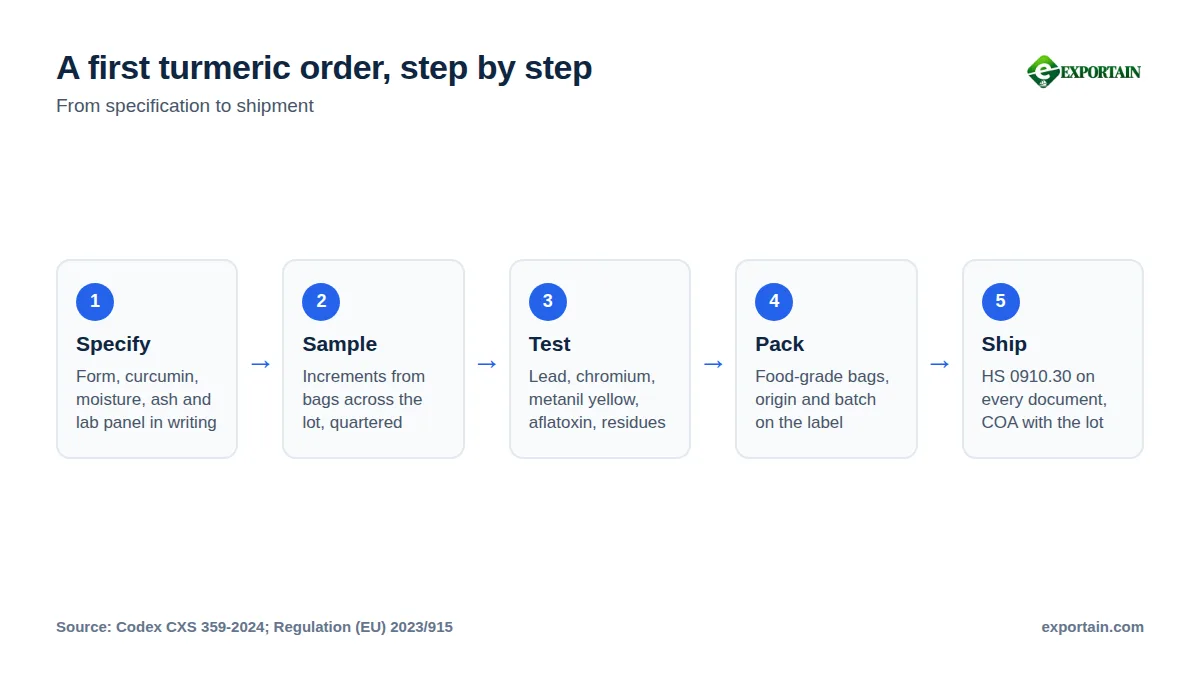
Example figures: a German spice blender orders 1,000 kilograms of turmeric powder from a processor near Dhaka for repacking. The order states powder, curcuminoids minimum 3 percent on a dry basis, moisture maximum 10 percent, total ash maximum 9 percent, acid-insoluble ash maximum 1.5 percent, lead maximum 2.5 parts per million, and aflatoxin B1 maximum 5 micrograms per kilogram with total aflatoxins maximum 10 micrograms per kilogram, matching the EU limits.3 7 6
The seller draws increments from bags across the lot, and the laboratory reports curcuminoids 3.4 percent, moisture 9.1 percent, lead 0.8 parts per million, aflatoxin B1 below the limit of quantification, and metanil yellow not detected. The COA names the lot and the bag numbers, and the buyer releases the shipment. The invoice describes the goods as turmeric powder under HS code 0910.30, and the buyer files the COA in the supplier record for the lot.
Which mistakes catch first-time turmeric buyers?
Buying powder on colour alone, then finding lead chromate or metanil yellow in the lab result at destination.5
Accepting a COA from an earlier batch instead of the lot being shipped.
Sampling one bag and treating the result as the lot result.5
Ordering without a moisture limit, then receiving a lot that moulds in transit.5
Leaving the destination's aflatoxin limit out of the order, then failing the EU border check.7
Writing the HS code on the invoice but not the form, so customs cannot tell fingers from powder.4
Next steps on Exportain
Draft a request for quotation: state powder or fingers, your curcuminoid floor, moisture ceiling, lab panel and destination port.
Weigh spice processors in the Exportain supplier directory side by side, then invite matching processors to quote.
When the lot loads, follow the quality control checklist for turmeric point by point. New to the platform? Read how to buy on Exportain first, then place the order.
Sources
- Turmeric (curcuma) in Bangladesh Trade. The Observatory of Economic Complexity (accessed )
- Earnings from spice exports rise 25%. The Daily Star, (accessed )
- Standard for dried or dehydrated roots, rhizomes and bulbs – Turmeric (CXS 359-2024). Codex Alimentarius (accessed )
- Chapter 9: Coffee, tea, maté and spices. World Customs Organization (accessed )
- Turmeric Testing for Export: Curcumin & Adulteration. Greenlink Laboratory, (accessed )
- Brighter riskier. The Daily Star, (accessed )
- Commission Regulation (EU) 2023/915 on maximum levels for certain contaminants in food. EUR-Lex, (accessed )
- Final Rule on Foreign Supplier Verification Programs (FSVP): Key Requirements. U.S. Food and Drug Administration (accessed )
About the author
Sourcing from Bangladesh?
Post a request for quotation and suppliers on Exportain can send you their quotes directly.
Post an RFQ