

Quality Control Checklist for Turmeric From Bangladesh
A numbered QC checklist for turmeric from Bangladesh: form and colour, rhizome defects, moisture, ash and curcuminoids, adulteration screens, contaminant tests, labels and packing, with fixes for common failures.
Short answer
Use this turmeric quality control checklist to check form and identity, colour and odour, rhizome defects, extraneous matter, moisture, ash and curcuminoids, adulteration screens, contaminant results, and packing and labels for turmeric from Bangladesh before shipment. Agree form, limits, test methods and acceptance numbers in the purchase order.

On this page
Key takeaways
Put turmeric-specific chemistry first: curcuminoids, moisture, and adulteration screens, because colour alone cannot prove quality.
Whole turmeric means bulbs and fingers, and powder hides rhizome defects, so confirm the form before applying any other test.
Treat unusual brightness as a test trigger: require lead and chromium together, and screen for metanil yellow and the other named adulterants.
Agree form, limits, test methods, sampling plan, and destination contaminant limits in the purchase order, and draw the sample randomly across bags.
If you buy turmeric from Bangladesh, check colour and chemistry together, not colour alone. A bright powder can hide a weak curcumin result, a damp lot, or an added pigment. Use this checklist at final inspection, with the approved sample beside you, and record each point as pass or fail. Turmeric here means dried turmeric from Curcuma longa L.1
Why this checklist matters
Turmeric is bought for colour, flavour, and curcuminoid content, and each can be faked or lost in ways a warehouse glance cannot catch. Grinding hides rhizome defects, and polishing can change surface colour. Separating form, chemistry, adulteration, and packing stops one strong result from covering a failure elsewhere.
The risk is specific to this spice. In Bangladesh, polishers have added lead chromate, a yellow industrial pigment, to dried turmeric root during polishing to improve brightness, a practice traced back more than 30 years and driven by preference for bright yellow roots.2 That history is why an unusually bright lot is a reason to test, not proof of quality.
Before you start
Assemble the references before any bag is opened: the approved sample for the exact form ordered, the purchase order naming form, variety or cultivar if agreed, moisture and curcuminoid limits, contaminant limits per destination, and the packing specification. Agree the sampling plan and acceptance numbers in the order, and draw randomly across bags and cartons, not from bags the supplier selects. ISO 2859-1 specifies an acceptance sampling system for inspection by attributes, indexed by the acceptance quality limit (AQL), for lot-by-lot inspection.3 See the AQL acceptance quality limit explainer before you set those numbers.
Confirm which form you are inspecting, because the checks differ. Dried turmeric may be whole or fingers, pieces in cut, diced, or sliced styles, or powdered product.1 Whole turmeric consists of cured primary or secondary rhizomes, called commercially bulbs or fingers, of Curcuma longa Linnaeus.4 Record the form first.
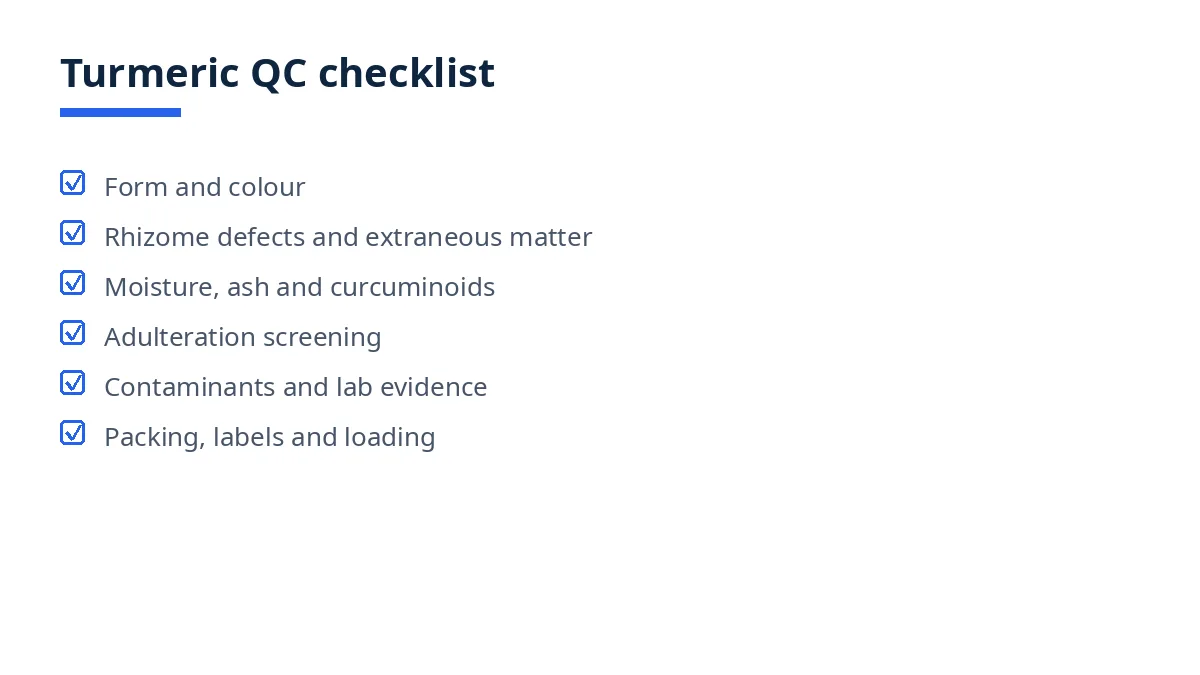
The full checklist (numbered, printable)
Form, identity, colour, and odour
Confirm lot identity: form, variety or cultivar where named, lot number, and order number match the sample and documents, with no bag from another lot mixed in.
For whole turmeric, separate bulbs from fingers and check each against the sample: rhizomes should be dry, well developed, and of the form and colour of the variety.4
For pieces, check cut size and uniformity against the sample, and confirm the label names the style supplied, such as sliced or diced.
For powder, check uniform colour and freedom from lumps, coarse grit, and visible foreign particles, and record the agreed fineness method.
Check colour against the sample under the same light: even, characteristic yellow-orange colour, with no grey, dull, or patchy areas suggesting mixed lots.
Check odour and flavour against the sample: turmeric shall have the characteristic odour and flavour of the spice, and shall be free from mustiness or other foreign flavours.4
Rhizome defects and extraneous matter
Separate defective rhizomes (shrivelled, immature, hollow, damaged, scorched, mouldy) and record their share against the order limit. CXS 359-2024 sets defective rhizomes at 5 percent by mass for whole turmeric; the order limit governs.1
Check whole and piece product for mould, insects, and webbing. Whole turmeric shall be free from living insects and moulds, and practically free from dead insects, insect fragments, and rodent contamination visible to the naked eye.4
Separate extraneous matter from whole turmeric: chaff, leaves, stones, soil, dust, mud, and other vegetable matter.4 ISO 5562 caps it at 2 percent by mass by the ISO 927 method; the order limit applies.4
For ground turmeric, require microscopic examination in the lab evidence: ground turmeric shall be examined by microscope and shall not contain any morphologically extraneous matter.4
Moisture, ash, and curcuminoids
Measure moisture at more than one point, per form, and record every value. CXS 359-2024 sets moisture at 12 percent by mass maximum for whole and sliced turmeric and 10 percent for powder; the order limit governs.1 Hold any lot over the order limit rather than averaging a wet result away with dry bags.
Review powder ash against the order limits. CXS 359-2024 sets total ash at 9 percent on a dry basis and acid-insoluble ash at 1.5 percent for powder.1 High acid-insoluble ash points to sand or soil.
Review the curcuminoid result for the lot, by the method named in the order, against the sample and the order minimum. CXS 359-2024 sets total curcuminoids at 2 percent on a dry basis minimum for whole, sliced, and powder turmeric.1 A wide spread across sub-samples points to blending, so segregate and re-test before acceptance.
Adulteration screening
Treat unusual brightness as a test trigger, not a pass. In the Bangladesh study, polishing pigments contained 2 to 10 percent lead by weight, and lead was highest in polished bulbs, then polished fingers.2
Require lead and chromium results together on the lab report, and investigate any lot where both are elevated. A lead result alone does not prove pigment addition.
Screen for Sudan 1, metanil yellow, acid orange II, and lead chromate, plus yellow chalk, other Curcuma species, and cassava, per the AOAC targeted-testing requirements.5 Metanil yellow is described there as the most frequently used non-permitted food colour in this context.5
Check for starch, filler, or spent material in powder where the order requires it: an ash or microscopy result unlike the sample, powder unlike the sample in water, or weak colour with a low curcuminoid result is a reason to hold the lot for lab confirmation.
Record every adulteration screen as a named test with a named method and a lot number.
Contaminants and laboratory evidence
Review the lab evidence pack before loading: moisture, ash, curcuminoids, adulteration screens, and every contaminant test the order names, with the lot number on each report. For other destinations, check results against the limits the order names, and record which limits were applied.
For the EU, check aflatoxins: Regulation (EU) 2023/915 sets aflatoxin B1 at 5 micrograms per kilogram and total aflatoxins at 10 micrograms per kilogram for dried turmeric, and food above a maximum level shall not be placed on the market.6
For the EU, check ochratoxin A against the dried-spice limit of 15 micrograms per kilogram.6
For the EU, check lead against the root and rhizome spice limit of 1.50 milligrams per kilogram for dried spices, and note the separate fresh-turmeric limit of 0.80 milligrams per kilogram where fresh product is involved.6
Use AOAC lead figures only as attributed references, never as acceptance rules: 2.5 parts per million in Bangladesh, 10 parts per million by the Food and Agriculture Organization of the United Nations, and 2.5 parts per million in India; the order and destination limits govern.5
Packing, labels, and loading
Weigh sampled packs against declared net weight and order tolerance; check seals, liners, and interiors for tears, moisture damage, stones, string, metal, and earlier labels.
Check labels against the order and destination rules: product name, form, net weight, lot or batch number, and country of origin. CXS 359-2024 requires country of origin to be declared for dried turmeric.1 Any anti-caking agent on a powder label must be the agent the order allows.
Check the container or vehicle before loading: clean, dry, free of odour and previous-cargo residue, with moisture protection where required. Retain a sealed sample, labelled with form, lot number, and inspection date.
Common failures and how to fix them
The most frequent failure is a bright powder with a weak curcuminoid result. Stop and compare the lot with the sample on chemistry, not colour: re-test curcuminoids and run the adulteration screens before more powder is packed. If lead and chromium are both elevated, treat pigment addition as the working explanation, and segregate the lot.
High moisture is the next failure, and it usually traces to uneven drying or damp storage. Re-dry and re-test at several points; do not blend wet and dry bags to reach an average. Mouldy or insect-damaged fingers should be segregated and re-inspected as their own group.
Mixed forms or grades show as a wide curcuminoid spread, uneven colour, or a label naming one form while the bag holds another. Re-sort by form and lot before packing, and correct the label to the form supplied. Above the order acceptance level, the options are re-inspection after sorting or rework, documented partial acceptance, or rejection.
Downloadable template / summary table
Copy the checklist into your inspection sheet, add the form and order limits, and record a result per bag or sample.
Section | Checks | Evidence |
|---|---|---|
Form and colour | Bulbs, fingers, pieces, powder, odour | Sample comparison |
Defects | Defective rhizomes, insects, mould, extraneous matter | Separation weights |
Chemistry | Moisture, ash, curcuminoids, colouring power | Lab reports per lot |
Adulteration | Lead and chromium, dyes, chalk, fillers, other species | Named screens, methods |
Contaminants | Aflatoxins, ochratoxin A, lead, residues | Reports, limits applied |
Packing and labels | Weight, seals, form, origin, lot marks, loading | Packing list, photos |
How Exportain helps
Exportain is a B2B marketplace connecting buyers with Bangladeshi suppliers of turmeric and other spices, so form, moisture and curcuminoid limits, adulteration screens, and the sampling plan can be agreed at enquiry. See the inspection services category when you plan the check. Supplier profiles show which document and photo checks have been recorded, not factory inspections. Exportain is not a party to the goods contract and does not inspect goods.
FAQs
When should this checklist be used?
Use it at final inspection, when the turmeric is dried and largely packed. For first orders and large lots, also use the form, colour, and moisture sections during processing.
Who should complete it?
The buyer, a local agent, or an independent inspector can complete it, using the approved sample, the order limits, and samples from different bags.
What are the most common failures?
Bright powder with weak curcuminoids, high moisture, mould or insect damage in fingers, mixed forms, and added pigment or filler are the failures found most often.
Can a third party do it?
Yes, if you share the approved sample, the form ordered, the moisture and curcuminoid limits, the adulteration screens, and the sampling plan first, and require lot numbers on lab reports.
Next steps on Exportain
Agree form, moisture and curcuminoid limits, adulteration screens, sampling plan, and destination contaminant limits in the order before production starts, then read the AQL acceptance quality limit explainer and the pre-shipment inspection guide, and plan the check with inspection services.
Sources
- CXS 359-2024 - Standard for dried or dehydrated roots, rhizomes and bulbs - Turmeric. Codex Alimentarius Commission (accessed )
- Turmeric means "yellow" in Bengali: Lead chromate pigments added to turmeric threaten public health across Bangladesh. Environmental Research, (accessed )
- SIST ISO 2859-1:2003 - Sampling procedures for inspection by attributes, Part 1: Sampling schemes indexed by acceptance quality limit (AQL). International Organization for Standardization, (accessed )
- ISO 5562:1983 - Turmeric, whole or ground (powdered) - Specification. International Organization for Standardization (accessed )
- Draft AOAC Standard Method Performance Requirements (SMPRs) for Targeted Testing of Turmeric Adulterants, Version 2. AOAC International (accessed )
- Commission Regulation (EU) 2023/915 on maximum levels for certain contaminants in food. European Union, (accessed )
About the author
Sourcing from Bangladesh?
Post a request for quotation and suppliers on Exportain can send you their quotes directly.
Post an RFQ


