HS Code for Turmeric: Classification Guide for Importers
Turmeric points indicatively to heading 0910 (subheading 0910.30, to be verified): grinding alone does not split the turmeric line, but blends, extracts, and high-curcumin isolates are boundary questions, and the full national code must be confirmed on the entry date.
Short answer
The indicative heading for turmeric is 0910, with the indicative subheading 0910.30, to be verified for your product and destination. Grinding alone does not split the turmeric line, but blends, extracts, oleoresins, and high-curcumin isolates are boundary questions under the Chapter 9 essential-character test, and the full national code must be confirmed in the destination tariff on the entry date.
On this page
Turmeric looks simple to classify and is easy to get wrong. The six-digit line is short, but the shipment may be a dried root, a ground powder, a spice blend, or a concentrated extract.
Quick answer: indicative HS heading
The indicative heading for turmeric is 0910, to be verified for your product and destination. Heading 0910 covers ginger, saffron, turmeric (curcuma), thyme, bay leaves, curry and other spices.1 The indicative subheading is 0910.30, to be verified for your product and destination; the United States tariff lists it as 0910.30.00 00.1 Every line below is indicative only.
Turmeric product | Indicative line | Verify note |
|---|---|---|
Turmeric (curcuma), in general | 0910.30, to be verified | Verify the goods are turmeric spice, not a blend, extract, or isolate |
Dried turmeric root, whole | 0910.30, to be verified | Verify whole dried root, still the spice |
Ground turmeric powder | 0910.30, to be verified | Verify ground spice only; grinding alone does not split the line |
Blend with spices of other headings | 0910.91, to be verified | Verify a mixture of different headings under note 1(b) |
Blend sold as a mixed condiment or seasoning | 2103, to be verified | Verify whether the blend has become a mixed condiment or seasoning |
Extract, oleoresin, or high-curcumin isolate | To be confirmed, to be verified | Verify whether the product is still the spice; no curcumin threshold appears in the opened notes |
No single 8-digit or 10-digit code covers all turmeric: the first six digits are international, the rest national.2
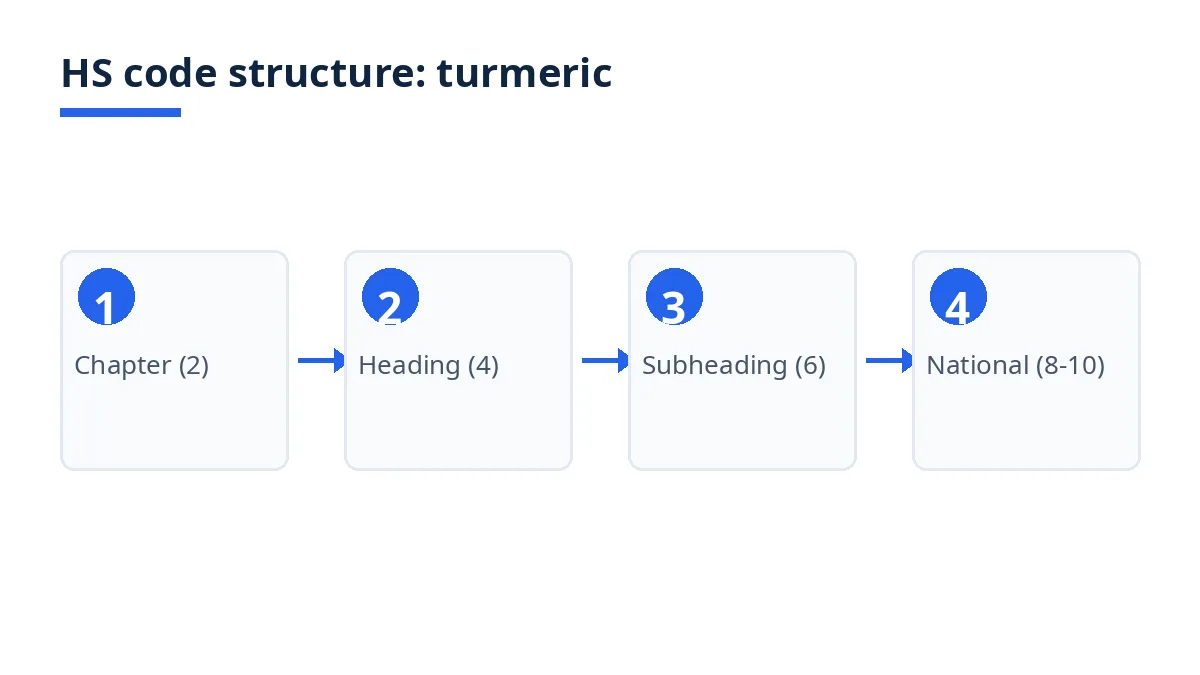
How HS codes are structured (2-4-6 digits)
The Harmonized System is a multipurpose international product nomenclature developed by the World Customs Organization (WCO). It comprises more than 5,000 commodity groups, each identified by a six-digit code, and is used by more than 200 countries and economies for customs tariffs and trade statistics.3
Level | Digits | Meaning for turmeric |
|---|---|---|
Chapter | 2 digits (09) | Coffee, tea, mate and spices |
Heading | 4 digits (0910) | Ginger, saffron, turmeric (curcuma) and other spices |
Subheading | 6 digits (0910.30) | Turmeric (curcuma) |
National extension | 8 to 10 digits | Set by the importing country |
Classification follows the heading texts and chapter notes first. Chapter titles are signposts only, and only subheadings at the same level are compared.
Factors that decide the code for turmeric
Answer these questions from the specification and the goods on arrival.
Whole, crushed, or powdered form. For turmeric this question does not split the six-digit code. The United States chapter notes state that, except as otherwise indicated, Chapter 9 covers the named products whether whole or in crushed or powdered form.1 The United States turmeric line is a single line, 0910.30.00 00, with no crushed-or-ground split.1 Dried root and ground powder therefore point to the same indicative subheading, 0910.30, to be verified.
Still the spice, or something made from it. The decisive test in the chapter notes is essential character. Mixtures of products of the same heading are classified in that heading, while mixtures of products of different headings are classified in heading 0910.1 Added substances do not affect classification if the mixture retains the essential character of those goods; otherwise it is not classified in this chapter, and mixed condiments or mixed seasonings are classified in heading 2103.1 Ask the supplier to state every ingredient and process in writing.
Extracts and oleoresins. An extract or oleoresin is a boundary question, not a settled line in this guide. The opened chapter notes do not list extracts under heading 0910, and they do not give a destination heading for them. Ask the destination tariff and a broker whether the goods, as presented, are still turmeric spice or have become an extract product. State the extraction method and physical form: the answer turns on the goods as presented.
Curcumin content. A high curcumin figure is also a boundary question, not a code by itself. The opened chapter notes contain no curcumin-percentage threshold, and none should be invented or copied from a supplier listing. The test they do state is essential character: does the product remain turmeric spice, or has concentration changed it into something else? A standardized high-curcumin powder needs the same treatment as an extract.
Fresh, dried, or otherwise presented. The United States turmeric line makes no fresh-versus-dried split, and the opened notes give no separate line for fresh root.1 Record the state on arrival anyway. Chapter 9 note 2 excludes cubeb pepper and other products of heading 1211 from the chapter.1
Worked examples as classification questions
Each example names its deciding factor; none is a settled code for an unchecked shipment.
Dried turmeric root, whole, in bulk bags: 0910.30, to be verified. Deciding factor: still the spice.
Ground turmeric powder, single ingredient: 0910.30, to be verified. Deciding factor: form, since the chapter notes cover products whole or in crushed or powdered form.1
Turmeric blended with coriander and cumin: 0910.91, to be verified. Deciding factor: mixture of different headings under note 1(b).1
Turmeric seasoning mix sold as a curry powder: 2103 as a boundary question, to be verified. Deciding factor: essential character, since a mixed condiment or seasoning leaves Chapter 9.1
Turmeric extract, 95% curcuminoids: boundary question, to be verified. Deciding factor: essential character after concentration; the opened notes give no curcumin threshold and no extract line under 0910.
Turmeric oleoresin, liquid: boundary question, to be verified. Deciding factor: goods as presented, since an oleoresin is no longer dried root or ground spice.
National codes: US HTS, EU CN/TARIC, UK commodity code
The first six digits should be the same internationally for the same product. The full code is not the same everywhere, because each country adds its own digits after the sixth.2 Confirm every line here in the destination tariff on the entry date.
System | How the national line is built | Turmeric line to confirm |
|---|---|---|
US HTS | 10 digits; the Harmonized Tariff Schedule of the United States | 0910.30.00 00, Turmeric (curcuma), to be confirmed on the entry date1 |
EU CN/TARIC | 8-digit Combined Nomenclature code, extended in TARIC | 09103000, Turmeric (curcuma), to be confirmed in the current TARIC on the entry date4 |
UK commodity code | 10 digits in the UK Trade Tariff | 0910300000, Turmeric (curcuma), to be confirmed on the entry date5 |
The European line needs a special note: the Combined Nomenclature text opened for this guide is the 2010 regulation, which lists 09103000 for turmeric (curcuma).4 The Combined Nomenclature is updated regularly, so re-check the EU line in the current TARIC before declaring; no EU 10-digit code is asserted here.
How to confirm the code officially
Start with the destination tariff, not with a supplier listing or a commercial lookup site. United Kingdom guidance puts it plainly: only the first six digits are used worldwide, and product-specific decisions are particular to each country.2
Work through these steps in order:
Write the full product description: plant part, state on arrival, every ingredient and proportion, process used, and intended use.
Read the heading 0910 text and the Chapter 9 notes, including the mixture rule and the essential-character test.1
Test the candidate subheading, 0910.30, against every boundary question in the previous section.
Extend the six digits in the destination tariff for the entry date.
For a decision customs must honor, apply for a ruling before you ship. In the United Kingdom, apply for an Advance Tariff Ruling before customs procedures have been completed, since decisions cannot be made retrospectively, and file a separate application for each type of goods.6 HMRC replies in 30 to 120 days with the ruling decision and the correct commodity code.6 In the United States, a ruling may be requested under Part 177 of the CBP Regulations by any person with a direct and demonstrable interest, by letter or through the eRulings Template.7 For the European Union or Northern Ireland, the United Kingdom guidance points to a Binding Tariff Information decision.6 A ruling covers one product on one set of facts.
Common classification mistakes
Copying the supplier's full code. A supplier code is a starting point for six digits only.2
Assuming powder needs a different code. For turmeric, the opened United States line has no crushed-or-ground split, and the chapter notes cover products whole or in crushed or powdered form.1 Grinding is a description detail for turmeric, not a code change.
Classifying from the trade name. "Turmeric latte mix," "turmeric capsules," and "turmeric powder" can point to different headings. Customs classifies the goods as presented, so the ingredient list and intended use matter more than the product name.
Skipping the blend test. A multi-spice blend and a mixed seasoning are different questions under the chapter notes and can land in different headings.1 Read the full recipe before choosing.
Declaring an extract under the spice line. Declaring an extract under 0910.30 without testing the extract question risks reclassification.
Related duties and documents
The code you declare works out more than the line on the form. United Kingdom guidance states that the commodity code works out customs duty and import VAT, taxes, and any preferential rates that may apply, and shows whether a license is needed.2 This guide states no duty rate: rates are national, change over time, and depend on origin and on the entry date.
Prepare these documents so the code can be checked without delay: a commercial invoice showing the full product description, not only the trade name; a packing list with the state on arrival and the form; a supplier specification sheet listing every ingredient and proportion and the process used; a certificate of origin, where a preferential rate is claimed, since origin is decided separately from classification; and any ruling reference, where a ruling has been obtained.
If the code is wrong, expect reclassification, a reassessed duty and tax bill, and a delayed shipment. Tell your broker promptly if you find an error.
FAQs
What is the HS code for turmeric?
The indicative heading is 0910, and the indicative subheading is 0910.30, both to be verified for your product and destination. Heading 0910 covers ginger, saffron, turmeric (curcuma), thyme, bay leaves, curry and other spices.1 Confirm the full national code in the destination tariff on the entry date.
Is the HS code the same in every country?
Only the first six digits are used worldwide, and product-specific decisions are particular to each country.2 The United States, the European Union, and the United Kingdom all build on 0910.30, but each adds its own trailing digits and notes.
How do I confirm the correct code?
Read the heading 0910 text and the Chapter 9 notes, test the boundary questions for your exact product, then extend the six digits in the destination tariff for the entry date. For a binding answer, apply for a ruling before you ship: an Advance Tariff Ruling in the United Kingdom, a Binding Tariff Information decision for the European Union, or a CBP ruling in the United States.6 7
What happens if I use the wrong code?
Customs can reclassify the goods, reassess duty and taxes, and delay clearance while the classification is corrected. The code also decides whether a license or control applies, so a wrong code can mean a missed requirement.2
Next steps on Exportain
For the shared structure behind every HS code, read the Exportain guide to HS Code (Harmonized System Code). For the step-by-step method behind this decision tree, read HS codes: how to classify your product. To compare suppliers, browse Bangladeshi manufacturers and exporters.
Sources
- Harmonized Tariff Schedule of the United States Revision 18 (2026), Chapter 9. U.S. International Trade Commission (accessed )
- Finding commodity codes for imports or exports. GOV.UK (HM Revenue & Customs), (accessed )
- What is the Harmonized System (HS)?. World Customs Organization (accessed )
- Commission Regulation (EU) No 861/2010, Annex I, Chapter 9 (Combined Nomenclature). European Union (accessed )
- Commodity code 0910300000: Turmeric (curcuma) - UK Integrated Online Tariff. GOV.UK, HM Revenue and Customs (accessed )
- Apply for an Advance Tariff Ruling. HM Revenue & Customs (GOV.UK), (accessed )
- What are Ruling Letters?. U.S. Customs and Border Protection (accessed )
About the author
Sourcing from Bangladesh?
Post a request for quotation and suppliers on Exportain can send you their quotes directly.
Post an RFQ