Potatoes Exporters in Bangladesh: Verified Supplier Checklist
A checklist for vetting potatoes exporters in Bangladesh: the ERC, trade licence and agro-products licence, the phytosanitary certificate, cold-storage proof, pre-shipment inspection, trial shipment, red flags, and what to do when a check fails.
Short answer
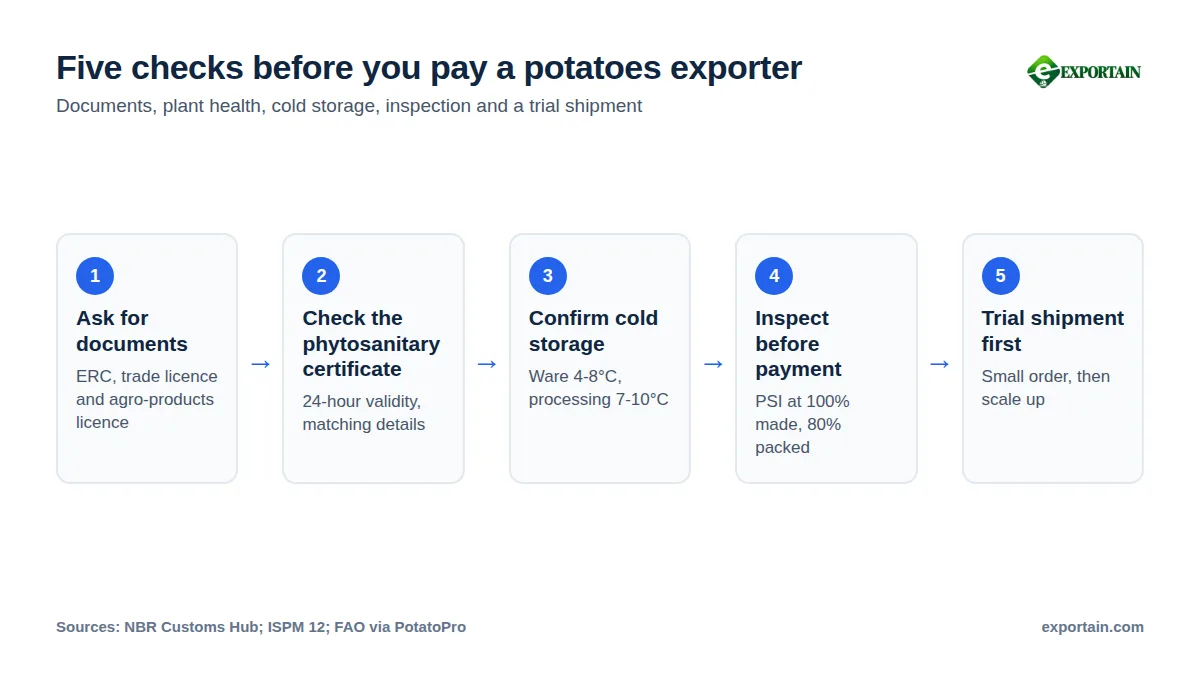
Ask a potatoes exporter in Bangladesh for a current ERC, trade licence, Department of Agricultural Marketing agro-products licence, and a phytosanitary certificate for the shipment, then check each document against the others and against the destination rules. Confirm cold-storage proof, book a pre-shipment inspection, and run a small trial shipment before a full order. Stop the order when a document is missing, expired, or mismatched.
On this page
Key takeaways
Match the business name exactly across the ERC, trade licence, bank certificate and chamber membership, and check the ERC is current.
A phytosanitary certificate for perishable potatoes is valid for 24 hours, so book the inspection close to loading and match every detail across the documents.
Check cold-storage proof against the end use: about 4-8°C for ware potatoes and at least 7-10°C for processing potatoes.
Book a pre-shipment inspection once 100% of the order is made and 80% is packed, and pay the balance only after the report arrives.
Run a small trial shipment first, and stop the order when a document is missing, expired, altered or mismatched.
A buyer ordering potatoes from Bangladesh is buying a perishable load from a supplier never met in person. The exporter can describe the stock, the cold store and the paperwork in any terms it likes, so the buyer's protection is a checklist worked through before paying. This article is that checklist, for a first order with a potatoes exporter in Bangladesh.
What does this checklist cover, and what does it not prove?
This checklist covers the exporter's documents, the phytosanitary certificate, cold-storage proof, the pre-shipment inspection and a trial shipment. Price negotiation and freight booking are outside it; the how to import potatoes guide covers those steps.
A passed checklist is evidence, not a guarantee: each document proves one fact at one date, and a clean inspection covers the sampled cartons on the day of the visit. Exportain's badges work the same way, recording a review of documents and photos, not a factory inspection or a guarantee.
Which documents should you ask for before you pay anything?
Ask for the full document set before you send a deposit: quick production shows ordinary paperwork, and stalling shows where the risk sits. The commercial invoice must include the exporter's ERC number and the HS code, and must agree with the other documents.1
Document | What it proves | What to check |
|---|---|---|
ERC (Export Registration Certificate) | The business is registered as an exporter | Current, in the exporter's exact name2 |
Trade licence | Current local business licence | Current, same name and address as the ERC2 |
Agro-products exporter licence | Licensed to export agro-products | Valid for one year from issue3 |
e-TIN and BIN certificates | Tax and VAT registration | Numbers match the name on the ERC2 |
Bank certificate | Account with a named Authorised Dealer | Account in the exporter's name2 |
Phytosanitary certificate | Consignment passed plant-health inspection | Issued for this consignment, inside its validity3 |
Certificate of origin | Goods come from Bangladesh | Exporter, consignee and origin match the invoice1 |
Commercial invoice and packing list | Sale and packing as agreed | Variety, quantity, value and marks agree with the contract1 |
EXP form | Export declared to the exporter's bank | Authorised Dealer bank named, details match the invoice4 |
Keep a dated copy of every document, and still ask for any missing item.
How do you check the ERC and trade licence?
The ERC is the principal registration through which a business is recognised as an exporter in Bangladesh, administered by the Office of the Chief Controller of Imports and Exports (CCI&E) under the Ministry of Commerce, under the Importers, Exporters and Indentors (Registration) Order, 2023.2 Ask for the ERC and the trade licence together, and read them against each other first.
Match the business name, exactly, across the ERC, the trade licence, the bank certificate and the chamber membership certificate, keeping name, address and ownership details consistent across all of them.2
Check the ERC is current: the initial registration is valid for one year from issue, a renewal can run for up to five years, and the exporter should apply for renewal at least 60 days before expiry.2
Read the prescribed attachments as a cross-check: updated trade licence, e-TIN or tax-return receipt, NID or passport, nominated bank certificate, updated chamber membership certificate, and the fee and VAT challan.2
Remember what the ERC does not do: the Export Policy 2024-2027 names it as the first step in the export process, and a valid ERC does not override product restrictions, so potatoes still need their own product papers.2
How do you check the phytosanitary certificate?
No plant or plant product leaves Bangladesh without this paper: the Department of Agricultural Extension's Plant Quarantine Wing examines every consignment through a plant quarantine officer and signs off the certificate for that load alone.3 Under IPPC standard ISPM 12, it records that officials inspected or tested the lot against the destination country's plant-health rules.5
Line up every field across the shipping papers: consignee, quantity, goods description and botanical name on the certificate should read exactly as on the invoice, packing list and bill of lading — and a pen correction added after issue voids it.5
Work backwards from loading day. For a perishable load the exporter should apply a full day ahead of sailing, and the paper then stays live only 24 hours; a non-perishable load gets 15 days.3 Compare inspection date with loading date: a certificate raised days earlier will already have run out.
Wooden pallets sit outside this document: timber packaging answers to its own ISPM 15 treatment mark, so ask for pallets carrying that mark, or switch to plastic.5
Look for the extra statements your destination demands: freedom from a named pest, or growth in a pest-free area; where a treatment was required, the certificate should record it.5
Ask whether an ePhyto can replace the paper original: plant protection bodies swap electronic certificates through the IPPC ePhyto Hub, so no courier is needed.5
How do you check cold-storage proof?
Potatoes are perishable, and the cold chain is the part of the order you cannot see from a quotation, so ask for storage proof before you agree the shipment date.
FAO guidance gives about 3-5°C for seed potatoes, 4-8°C for ware or fresh-market potatoes, and at least 7-10°C for processing potatoes, because cold-induced sweetening raises reducing sugars and darkens fried products.6 Freshly harvested potatoes are cured first at about 13-20°C with high relative humidity for about one to two weeks.6 Long-term storage commonly uses about 90-96% relative humidity, and light must be kept out because it turns tubers green and raises glycoalkaloid levels.6
Ask the exporter for the cold store's name and address and how long the lot has been stored there, temperature logs covering the storage period, the reefer set temperature and the pulp temperature at loading, and dated photos of the store and the lot.
Compare the logged temperature with the end use: a processing lot held at 4°C may look well kept and still fry dark, because the sugars built up during storage.6 A warm table lot will sprout sooner, and a lot stored in light will show greening.6 Write the size, defect and temperature checks into the contract — our potato quality control checklist spells out what to measure.
How should the trial shipment and inspection run?
Do not place a full order with a new exporter: run a trial shipment first, and tie payment to an inspection report.
Agree the specification in writing first: variety, end use, size band, pack, quantity, price and Incoterm, with a named inspection point. A supplier who quotes "potatoes" without a variety has given you nothing you can inspect against.
Order a small trial quantity: it tests the exporter's documents, packing, cold chain and timing at low cost.
Book a pre-shipment inspection (PSI), a quality control check performed right before the goods leave, once 100% of the order is manufactured and at least 80% is packed for export.7 The inspector opens selected cartons and checks quantity, workmanship, function, measurements, labelling and packaging against your checklist.7
Give the inspector your specification, reference samples and acceptance limits before the visit, because a PSI checks a random sample under an acceptance sampling standard.7
Ask for loading supervision on the trial: it records the container condition, carton count and seal number, your proof of what was loaded.7
Pay the balance only after the inspection report arrives: the PSI result is your go or no-go decision before you pay the final balance and ship.7
Our pre-shipment inspection guide explains the timing and the report, and our letter of credit guide explains the document check when you pay by LC.
Which red flags should stop the order?
Stop and reassess when any of these appear: one flag is a question to resolve, and two or more together are a reason to walk away.
No ERC, an expired ERC, or an ERC in a different business name from the trade licence and bank account.
No agro-products exporter licence from the Department of Agricultural Marketing, which is valid for one year from issue.3
A phytosanitary certificate with hand-written corrections, mismatched quantities, or an issue date that leaves it expired before loading.5
No cold store to name, no temperature logs, or a storage temperature that does not match the end use.6
Refusal to allow a third-party inspection, or an inspection offered only by the exporter's own staff.
Payment asked to a personal account, a foreign account, or an account in a different name from the ERC. Export proceeds go through the Authorised Dealer bank named on the EXP form, which must receive the shipping documents and EXP form within 14 days of shipment.4
A commercial invoice that omits the ERC number or the HS code, or that disagrees with the packing list on quantity or value.1
Pressure to pay the full balance before inspection, or a refusal to put the specification, inspection point and payment terms in writing.
What do you do when a check fails?
A failed check is a pause, not always an end.
Stop the payment clock: tell the exporter in writing which check failed and what you need, and hold the deposit or balance until it arrives.
Ask for a corrected document, never an altered one: a phytosanitary certificate with unauthorised alterations is invalid, and the remedy is a replacement from the issuing authority, not a correction written onto the original.5
Re-inspect after a fix. If the first PSI failed, ask the exporter to rework or sort the goods, then re-inspect before you release the balance. A failed inspection also leaves you the option of accepting the goods with a discount.7
Check the payment papers again: the EXP form is the export declaration linking the shipment to the Authorised Dealer bank that must receive its proceeds, submitted electronically through the Bangladesh Bank online reporting portal before customs formalities.4 Pay only the bank named on that form.
Walk away when the pattern repeats: a supplier who fails the same check twice, or answers with a new document in a different name, has told you what the next order will look like. Keep your notes and copies for any dispute.
A worked example: one trial shipment
Example figures: a buyer in Malaysia orders a trial shipment of 2 tonnes of table potatoes from a new exporter in Bangladesh, packed in 25 kg mesh bags, on FOB Chattogram terms.
Before paying a deposit, the buyer asks for the ERC, trade licence, agro-products exporter licence and bank certificate, and checks the business name matches on all four.2 The exporter applies for the phytosanitary inspection one day before loading, inside the 24-hour validity for perishable goods.3 The buyer books a PSI once the order is fully produced and 80% packed, pays the balance only after the report arrives, and the EXP form names the exporter's Authorised Dealer bank.7 4
If the PSI had found sprouting above the agreed limit, the buyer would have held the balance, asked for the lot to be sorted, and re-inspected before shipment.7 The trial costs one small order and one inspection.
Next steps on Exportain
Send a request for quotation stating variety, end use, size band, pack, quantity and destination — and that the balance follows the inspection report.
Check the replies in the Exportain supplier directory, keeping only potato exporters whose papers match this checklist.
Before committing, read the how to import potatoes guide and the export documents guide for the full sequence and paper set.
Sources
- Essential export documents for shipping from Bangladesh. DHL (accessed )
- Export Registration Certificate (ERC) in Bangladesh | 2026 Guide. Roy Law Nexus, (accessed )
- Other Potatoes Chilled, Nes - Export Requirements (HS Code: 07019029). National Board of Revenue, Bangladesh, (accessed )
- FE Circular No. 17: Introduction of electronic option of EXP Form submission for export of goods from Bangladesh. Bangladesh Bank, (accessed )
- Phytosanitary Certificate for Export: What It Is, When You Need One, ePhyto and Common Mistakes. Triplicate, (accessed )
- Potato Storage Systems: Preserving Quality Beyond Harvest Through Science and Sustainability. PotatoPro, (accessed )
- Pre-Shipment Inspection (PSI) in Bangladesh | Final Random Inspection. BPO Bangladesh (accessed )
- ERC
- pre-shipment inspection
- phytosanitary certificate
- potato exporters
- cold storage
- Bangladesh potatoes
- trial shipment
About the author
Sourcing from Bangladesh?
Post a request for quotation and suppliers on Exportain can send you their quotes directly.
Post an RFQ