HS Code for Basmati-Style Rice: Classification Guide for Importers
Basmati-style rice points indicatively to heading 1006, to be verified: the name does not decide the code — grain state, grain length, blend share, and working beyond heading 1006 do, and the full national code must be confirmed on the entry date.
Short answer
The indicative heading for basmati-style rice is 1006, to be verified for your lot and destination. The word basmati-style does not decide the code: the deciding factors are the grain state on arrival, grain length, blend share, and whether the rice has been worked beyond the forms heading 1006 keeps. Confirm the full national code in the destination tariff for the entry date before filing.
On this page
A supplier offers "basmati-style" rice, and the buyer asks for the HS code. The first thing to settle is what the word "style" is doing in that offer: it signals grain grown or milled to resemble basmati, not a named basmati variety, and customs classifies the grain as presented, not the marketing word on the offer. This guide answers the variety-name question: how the basmati and basmati-style wording, grain length, aging, blending, and further working affect classification, and which national lines to confirm in the United States, the European Union, and the United Kingdom.
A companion guide covers aromatic rice by grain state; this guide is built around the name question, the long-grain measurements, the blend share, and the flour boundary.
Quick answer: indicative HS heading (with verify note)
The indicative heading for basmati-style rice is 1006, to be verified. The subheading turns on the grain as presented, not on the word "basmati-style".
Basmati-style rice form | Indicative subheading | What to check before filing |
|---|---|---|
Basmati-style rice in the husk | 1006.10, to be verified | Husk still retained after threshing, to be verified |
Brown basmati-style rice, husk removed only | 1006.20, to be verified | Only the husk removed, bran layers still in place, to be verified |
Milled basmati-style rice, semi-milled or wholly milled | 1006.30, to be verified | Milling degree confirmed by the mill, to be verified |
Broken basmati-style rice | 1006.40, to be verified | Fragment length against the whole-grain average, to be verified |
No single 8-digit or 10-digit code covers all basmati-style rice: each national line is a line to confirm on the entry date.1
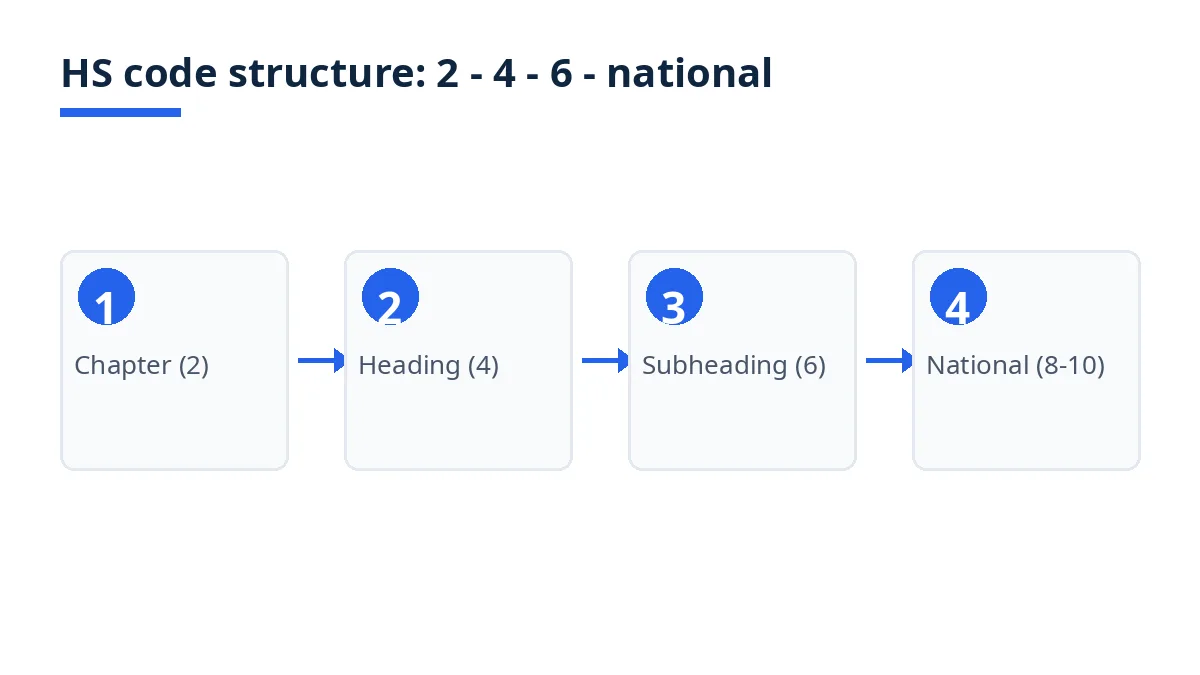
How HS codes are structured (2-4-6 digits)
The Harmonized System is a multipurpose international product nomenclature developed by the World Customs Organization (WCO). It comprises more than 5,000 commodity groups, each identified by a six-digit code, and is used by more than 200 countries and economies for customs tariffs and trade statistics.2
Level | Digits | Meaning for basmati-style rice |
|---|---|---|
Chapter | 2 digits (10) | Cereals |
Heading | 4 digits (1006) | Rice |
Subheading | 6 digits (1006.10, 1006.20, 1006.30, 1006.40) | Rice by husk state, milling degree, or broken character |
National extension | 8 to 10 digits | Set by the importing country, to be confirmed on the entry date |
Only the first six digits are used worldwide.1 Do not copy a full national code from one country into another country's entry.
Factors that decide the code for basmati-style rice
Answer these questions from the specification, the mill certificate, and the grain on arrival.
Basmati, or basmati-style: the wording is a flag, not a subheading. No variety name appears in the six-digit subheadings of heading 1006. In the United States schedule, basmati appears as a named line inside husked rice and as a statistical breakdown inside milled rice.3 That is a national detail. The word "style" should prompt three questions: variety grown, measured grain dimensions, and milling degree applied. If the supplier cannot name the variety, file from the measured grain.
Long-grain character, length, and ratio. Basmati-style rice is sold on length and aroma. Aroma does not appear in the heading text and decides nothing on its own. Grain length matters at the national level, because tariffs that split rice by grain class use measured length and the length-to-width ratio. The European notes define long grain rice as rice with grains exceeding 6.0 mm in length, and split it further by ratio: one group for a ratio greater than 2 but less than 3, and another for a ratio equal to or greater than 3.4 Record both figures.
Aging: aged versus new-crop. Aged and new-crop basmati-style rice differ in aroma and cooking behaviour. Storage time is not a classification factor. The chapter note keeps rice that is husked, milled, polished, glazed, parboiled, or broken in heading 1006, and it creates no separate subheading for aged rice.3 Lots with the same husk state and milling degree sit on the same subheading question, to be verified.
Blends: basmati-style mixed with non-basmati rice. A blend is the one case where proportion decides the answer. The chapter notes set a mixture rule: in mixtures where one component represents at least 90 percent by weight, that component governs; in other mixtures, the component with the higher treatment governs.4 A blend needs its share by weight on the specification, not a vague "basmati blend" label. Below the 90 percent line, confirm the line in the destination tariff, to be verified.
Broken basmati-style rice for processing. Intended use does not change the test. Broken rice means grain fragments the length of which does not exceed three-quarters of the average length of the whole grain.4 A lot described as "basmati-style brokens" is a 1006.40 question, to be verified, only if the fragments meet that measurement.
Brown basmati-style rice. "Brown" describes milling degree, not variety. Brown basmati-style rice is a 1006.20 question, to be verified, only if the mill confirms only the husk has been removed and the bran layers are still in place.4
The flour boundary. The chapter note keeps rice in heading 1006 only in the forms it lists: husked, milled, polished, glazed, parboiled, or broken.3 Once ground into flour, rice has been worked beyond those forms, and the question leaves heading 1006.
Worked examples as classification questions
Each example is a question, not a settled code for an unchecked shipment.
Aged versus new-crop basmati-style rice: 1006.30, to be verified. Deciding factor: milling degree, not storage time. Both lots are wholly milled and whole grain, so both point to semi-milled or wholly milled rice, to be verified.
Basmati-style blend proportion question: confirm the mixture line, to be verified. Deciding factor: share by weight. A milled blend of 70 percent basmati-style and 30 percent non-basmati rice sits below the 90 percent line, so apply the mixture rule and confirm the line in the destination tariff, to be verified.
Brown basmati-style rice, husk removed only: 1006.20, to be verified. Deciding factor: husk state plus mill confirmation. Only the husk removed, bran layers still present, points to husked rice, to be verified.
Basmati-style broken rice for processing: 1006.40, to be verified. Deciding factor: fragment length against the whole-grain average. Fragments not exceeding three-quarters of the average whole-grain length point to broken rice, to be verified.
Basmati-style rice flour boundary question: outside heading 1006, to be verified. Deciding factor: worked beyond the forms the chapter note keeps in heading 1006. Ground flour is no longer rice in the chapter-note sense, so confirm the flour heading in the destination tariff, to be verified.
National codes: US HTS, EU CN/TARIC, UK commodity code
The first six digits are shared; the rest is a national line to confirm.
System | Where to check | Confirm on the entry date |
|---|---|---|
US HTS | Harmonized Tariff Schedule of the United States, Chapter 10 | The full HTS line for your husk state and milling degree, including the basmati line inside husked rice and the basmati breakdown inside milled rice, as a national line to confirm, to be verified |
EU CN/TARIC | Combined Nomenclature and TARIC tools for the member state of entry | The full EU line for your husk state, milling degree, grain length, and ratio, as a national line to confirm, to be verified |
UK commodity code | UK Integrated Online Tariff, heading 1006 | The full 10-digit commodity code for your husk state, milling degree, and grain form, as a national line to confirm, to be verified |
Only the first six digits are used worldwide.1 If you rely on a supplier code, check how much of it applies in the destination country.1
How to confirm the code officially
Write the full description: variety wording, husk state, milling degree, grain length and ratio, blend share where applicable, broken share with measurements, and intended use.
Read the heading text for 1006 and the Chapter 10 notes, including the rice exception, the milling definitions, and the mixture rule.3 4
Compare subheadings only at the same level, starting with the four one-dash subheadings in 1006.
Extend the six digits in the destination tariff for the entry date, and record the date checked.
Where a boundary point remains, ask a destination-country broker, or apply for a binding ruling before shipping.
In the United Kingdom, an Advance Tariff Ruling must be applied for before all customs procedures have been completed, since decisions cannot be made retrospectively, and a separate application is needed for each type of goods.5 HMRC replies in 30 to 120 days with the ruling decision, the correct code, and a reference number.5 For Northern Ireland or the European Union, a Binding Tariff Information decision is the corresponding route.5
Common classification mistakes
Filing from the word "basmati-style": the marketing word is not a subheading.
Treating a named variety as a subheading: variety names appear only as national lines or breakdowns.
Treating aging as a classification factor: storage time changes no digit.
Filing a blend without the share: below the 90 percent line, apply the mixture rule and confirm the line.
Treating broken-for-processing rice as whole grain: measure fragments first.
Filing flour under 1006: once ground beyond the chapter-note forms, the question leaves heading 1006.
Copying a United States basmati line into an EU or UK entry: national lines do not transfer.
Recording "long grain" without the ratio: a tariff that splits by ratio needs both figures.
Skipping the chapter notes: the rice exception, milling definitions, and mixture rule decide cases "rice" alone does not.
Using an old quotation: re-check the line for the entry date even for a repeat shipment.
Related duties and documents
This guide states no duty rate. A commodity code works out customs duty and import VAT, taxes, and preferential rates, and the tariff tool also shows whether a licence, quota, or other measure applies.1 Those treatments are national.
The invoice, packing list, and import declaration should read the same way on variety wording, husk state, milling degree, grain length and ratio, blend share, broken share, and intended use.
FAQs
What is the HS code for basmati-style rice?
The indicative heading is 1006, to be verified for your product and destination. The subheading turns on grain state: 1006.10 for rice in the husk, 1006.20 for husked rice, 1006.30 for semi-milled or wholly milled rice, and 1006.40 for broken rice, each to be verified.3 4 The word "basmati-style" decides no subheading.
Is the HS code the same in every country?
The first six digits should be the same internationally, because they come from the shared WCO system.2 1 The full code is not the same everywhere, because countries add their own digits after the first six.1 Always confirm the full code in the destination tariff.
How do I confirm the correct code?
Describe the grain fully, read the 1006 heading text and Chapter 10 notes, compare subheadings at the same level, and extend the six digits in the destination tariff for the entry date.3 4 Where a boundary point remains, ask a broker or apply for a binding ruling before shipping.5
What happens if I use the wrong code?
Customs can reclassify the goods, reassess the duty and taxes on the corrected line, and delay clearance while the classification is corrected.1 Tell your broker promptly if you find an error.
Next steps on Exportain
For the shared structure behind every code in this guide, read HS Code (Harmonized System Code). For the method, read How to classify your product and find its HS code. When you are ready to compare suppliers, start from the supplier list at Exportain suppliers and share the full grain specification with each supplier and your broker before filing.
Sources
- Finding commodity codes for imports or exports. GOV.UK (HM Revenue & Customs), (accessed )
- What is the Harmonized System (HS)?. World Customs Organization (accessed )
- Harmonized Tariff Schedule of the United States Revision 18 (2026), Chapter 10. U.S. International Trade Commission (accessed )
- Commission Regulation (EU) No 861/2010, Annex I, Chapter 10 (Combined Nomenclature chapter notes). European Union (accessed )
- Apply for an Advance Tariff Ruling. HM Revenue & Customs (GOV.UK), (accessed )
About the author
Sourcing from Bangladesh?
Post a request for quotation and suppliers on Exportain can send you their quotes directly.
Post an RFQ