

The Light Engineering & Bicycles Industry in Bangladesh: Capacity, Clusters and Key Players
Engineering products earned USD 535.56 million in FY2024-25 and bicycle exports reached USD 151.40 million in FY2025-26. This pillar guide covers products, clusters, supplier checks, MOQ, pricing, compliance and duties.
Short answer
The light engineering industry in Bangladesh makes machinery, spare parts, tools, dies and moulds in tens of thousands of workshops, and exports bicycles and electrical goods. Engineering products earned USD 535.56 million in FY2024-25 on EPB data, and bicycle exports recovered to USD 151.40 million in FY2025-26. Buyers source it by specification, component map and test evidence.
On this page
Key takeaways
Engineering products earned USD 535.56 million in FY2024-25 on the EPB fiscal-year series, up 10.03 percent, after light engineering earnings fell from USD 795.63 million in FY2022 to USD 486.75 million in FY2024.
Bicycle exports fell to USD 82.50 million in FY2023-24, then recovered to USD 116.44 million in FY2024-25 and USD 151.40 million in FY2025-26 on the EPB bicycle series.
Association figures stated by BEIOA in February 2026 put the sector at about 50,000 enterprises, more than 300,000 skilled workers and more than 3,800 product types; those figures are association statements, not EPB trade data.
There is no industry-wide MOQ, price or lead time for light engineering goods or bicycles; all three are quoted per factory and per product against a written specification and component map.
For bicycles, ISO 4210-2 specifies safety and performance requirements for design, assembly and testing; buyers should name the current edition in the specification because the 2015 edition is withdrawn.
The light engineering industry in Bangladesh covers two linked offers. The first is a large base of small and medium workshops that make machinery, spare parts, tools, dies, moulds and metal components for agriculture, textiles, construction and transport. The second is a smaller set of export factories, led by bicycles, that sell finished goods to Europe and other markets on repeat orders. This pillar guide is for importers, brands, distributors and sourcing agents in the United States, the United Kingdom, the European Union and the United Arab Emirates. It covers export data, products and clusters, supplier checks, MOQ, pricing, compliance, Incoterms, duties and a buying process.
Market overview with latest data
Start with the Export Promotion Bureau (EPB) fiscal-year series, the official record behind most reporting on this sector. Bangladesh fiscal years run from July to June. Total merchandise exports were USD 48.28 billion in FY2024-25, and engineering products recorded 10.03 percent growth to earn USD 535.56 million.1 That puts engineering at a small share of national exports, well behind garments: read the sector as a diversification story, not a scale story.
The recent trend in the same EPB series is a fall and a partial recovery. A Financial Express analysis of EPB data recorded light engineering earnings of USD 795.63 million in FY2022, then USD 494.4 million in FY2023, USD 486.75 million in FY2024 and USD 535.56 million in FY2025.2 Keep this series together. Do not mix it with partial-year figures, association estimates or single-product figures, because each covers a different scope or period.
Bicycles are the clearest single product line, and their EPB series shows the same fall and recovery in sharper form. Earnings were USD 167.95 million in FY2021-22 and USD 142.22 million in FY2022-23, then fell to USD 82.50 million in FY2023-24, before climbing to USD 116.44 million in FY2024-25 and USD 151.40 million in FY2025-26.3 In the first two months of FY2026-27 the sector earned USD 29.39 million, compared with USD 24.19 million a year earlier.3 Reporting attributed the turnaround to easing freight rates, domestic backward linkage investment and renewed demand, after inflation and oversupply in European channels.3
A partial-year view confirms the direction without replacing the full-year series. EPB data reported for July to May of FY2025-26 put engineering products at USD 598.12 million in that eleven-month period, up 20.05 percent, accounting for about 1.37 percent of total exports of USD 43.8 billion in the same period.4 Electrical and electronic equipment led that period at USD 189.29 million, up 22.23 percent, while bicycle exports in the same period were USD 138.75 million.4 The July to May and full-year bicycle figures cover different periods, so this guide states them separately and never adds them.3 4
The structure behind the export figures is mostly domestic. At a February 2026 press conference, the president of the Bangladesh Engineering Industry Owners Association (BEIOA) said approximately 50,000 small and medium light engineering enterprises operate across the country, employing more than 300,000 skilled workers, and that the sector contributes nearly 3 percent to national GDP.5 Those are association figures, flagged as such. The same statement put domestic demand at USD 8.2 billion, with nearly half met locally through more than 3,800 types of machinery, spare parts, tools, dies, moulds and accessories.5 The BEIOA president also stated that exports stand at approximately USD 795 million and could reach USD 12.56 billion by 2030 with support and investment.5 That USD 795 million statement does not match the EPB record of USD 535.56 million for FY2024-25, and the 2030 figure is a projection, not a result.1 5 Use the EPB series for recorded trade and the association figures for how the industry describes its own size.
Capacity is wide but shallow: tens of thousands of workshops can make parts and small machines, while export-ready capacity in finished goods is concentrated in fewer factories, above all in bicycles and electrical goods.4 5 Locally assembled bicycles are exported to more than 40 countries, with the European Union the principal destination, led by Germany, the United Kingdom, the Netherlands, Austria, Denmark and Poland.3 A supplier that already ships to your market has already solved part of your compliance and packing problem, which is why export history is a core check below.
Main products and production clusters
The product range follows the two offers in the opening. Workshop products include automobile spare parts, agricultural machinery and spare parts, textile and jute machinery parts, machine tools, dies and moulds, and metal components. The BEIOA statement described the sector as a backward linkage supplier to agriculture, textiles, construction, power, automobiles and household appliances, producing more than 3,800 types of products.5 Finished export products are narrower: bicycles and e-bikes, electrical and electronic goods, copper products at USD 60.69 million, iron and steel products at USD 56.32 million, and machinery and engineering equipment at USD 42.11 million were the named lines in the EPB July to May FY2025-26 reporting, alongside the electrical and bicycle figures above.4
Bicycles need their own product map, because buyers order models, not tonnage. Exporters ship city commuter bicycles, mountain bikes, road cruisers and children cycles, plus a growing selection of electric-assist bicycles.3 A second report lists mountain, freestyle, trekking, folding, chopper, road racing and tandem models.6 Component depth is improving: local companies are widening capacity for alloy frames, forks, rims, spokes, inner tubes, tires and saddles, and manufacturers now produce most major parts domestically, including wheels, tubes, pedals, handlebars, bearings and saddles, while some components are still imported.3 6 Ask each factory which parts it makes, which it buys locally and which it imports, because that split decides lead time and origin evidence.
Classification follows the product, not the sector name. Under the Harmonized System, heading 8712 covers bicycles and other cycles, including delivery tricycles, not motorised, and the six-digit subheading is 871200.7
HS heading | What it covers | Typical Bangladesh products |
|---|---|---|
8712 | Bicycles and other cycles, including delivery tricycles, not motorised | City, trekking, mountain, racing and children bicycles without a motor |
871200 | The six-digit form of heading 8712 | Complete non-motorised bicycles as shipped for export |
For machined parts, machinery and electrical goods, there is no single light engineering heading. Each product is classified by function, material and degree of working, so agree the six-digit subheading with the supplier and your broker before ordering. An e-bike is not a non-motorised bicycle for classification, so do not put an electric-assist model on an order written for heading 8712 without a broker ruling for the exact model.
Clusters are uneven, and the cluster decides what a supplier can do well. Bogura, in the north, is the foundry and agricultural machinery cluster. A cluster inside a Bangladesh Small and Cottage Industries Corporation (BSCIC) estate in Bogura was reported as comprising ten foundries, 800 manufacturing facilities and 745 workshops, with 60 other foundries and 1,000 units elsewhere in the district.8 The same report said district units meet 70 percent of country demand for agricultural machinery and spare parts, produce more than 3,000 types of products worth BDT 500 crore each year and employ 15,000 people, in an industry that began there in the 1960s.8 Those Bogura figures are press-reported figures cited in that analysis, not EPB trade data. Dhaka and its surrounding districts hold the other main workshop concentration. Bicycle export factories sit in a different layer: commercial bicycle exports began in the mid-1990s when a Taiwanese company, Alita, established a factory at the Chattogram Export Processing Zone.6 Match the enquiry to the layer: Bogura for castings and agricultural machinery, Dhaka-area workshops for machined parts, and export factories with a shipment record for complete bicycles.
In September 2020 an inter-ministerial meeting decided to set up dedicated light engineering industrial parks in Dhaka, Narayanganj, Jashore, Bogura and Narsingdi, with a Light Engineering Training Institute to supply skilled workers.9 That is a 2020 decision, not evidence that every park is complete today, so ask a supplier for its actual production site rather than relying on a park name.
Key players differ by product. In bicycles, Meghna Group dominates exports, and other named top players include Rangpur Metal Industries, Panam Group and Alita (BD) Limited.3 National Board of Revenue (NBR) data reported for FY2024-25 put Meghna exports at USD 78.1 million, around 67 percent of total bicycle exports that year, through M&U Cycle and Hana System, while Panam Group exported USD 12.2 million.6 Those are NBR figures reported in the press for one fiscal year. In electrical goods, the July to May reporting named Walton Hi-Tech Industries as the largest contributor in that segment, with Energypac Engineering, Rahimafrooz and export-zone exporters also expanding.4 In workshop light engineering there is no comparable dominant exporter: the BEIOA count of approximately 50,000 enterprises is the structure.5
How to find and verify suppliers
Find suppliers through more than one channel so you can cross-check what a factory tells you. Start with the association channel for workshop products, add Bangladesh export data and Exportain trade intelligence for context, then work Bangladeshi suppliers listings by product. For bicycles, start from export history: around 80 percent of exports are shipped to EU countries, the remainder going to markets including India, the United States, the United Arab Emirates and Australia, and the United Kingdom and Germany are the two largest individual destinations.6
Verification is a document exercise first and a visit exercise second. Ask for, and read, the following before you discuss price in detail:
Trade licence and export registration in the company own name, plus the factory address where your goods will be made.
Shipment evidence for your product and market: anonymised bills of lading or shipment summaries showing product, volume and recency. In bicycles, concentration is high, with one group at around 67 percent of FY2024-25 exports on NBR data, so a small exporter claim needs evidence behind it.6
A parts and materials map: which components are made in-house, bought locally or imported, including frames, forks, rims and electrical parts for e-bikes.3 6
Machine list and capacity per day for your process, and whether any stage is subcontracted.
Test reports for the exact model or part you plan to buy, not a different model in the same catalogue.
The cluster and association the supplier claims, checked against the cluster picture above, for example a Bogura foundry address for a casting supplier.8
On Exportain, read badges for what they are. Verification is free, the seller completes checks in the verification centre, and Exportain staff review every submission; approved checks earn badges shown on the company page, listings and quotations, and the review is a document and photo review, not a factory inspection.10 Membership plans are a separate product and never grant a trust badge.10 Exportain is not a party to the contract for goods; it does not inspect goods, book freight or clear customs. Use the badge as a first filter, then run the checks above yourself or through an inspection firm you appoint.
Two red flags end a conversation early. A workshop that quotes a firm export price before it has seen your drawing, tolerance and material grade is not pricing your part. A bicycle factory that cannot show a recent shipment record for your destination, in a sector where the EU takes around 80 percent of exports, has not answered the first capacity question.6
MOQ, pricing and lead times
There is no industry-wide MOQ, standard price or standard lead time for light engineering products or bicycles from Bangladesh, and no official body publishes one. All three are quoted per factory, per product and per order, against a written specification. What follows is how each is built, so you can compare quotes on equal terms.
MOQ. The minimum order quantity is set by the production stage, not by the buyer carton count. A bicycle order carries the factory minimum per model, frame size and colour, because frames, painting and assembly are set up per model run. A machined part order carries the casting, machining and finishing minimum per drawing and material grade. A die, mould or machine order is normally a one-off or small-batch project build. State your target quantity per model, size and design, or per part number, and ask the factory to quote its MOQ on the same basis.
Pricing. Your unit price is built from material cost, casting or frame production, machining, welding, surface treatment and painting, bought-in components, assembly, testing, packing and export costs to the agreed Incoterm point. Import content matters: manufacturers still import a substantial share of raw materials and components for engineering and electrical goods, including steel sheets and copper in the electrical segment reporting, so a quote moves with bought-in parts as well as labour and machine time.4 Compare quotes only at the same Incoterm, specification and component map, and ask each supplier to state the material grade, the bought-in parts and the price validity period in writing.
Example figures. For illustration only: a specification for 1,000 city bicycles to one frame design is quoted by two suppliers at FOB Chattogram. Supplier A quotes USD 118 per bicycle itemised as frame and parts USD 82, painting and assembly USD 21, and packing and export costs USD 15. Supplier B quotes USD 109 with no itemisation. The example totals are USD 118,000 and USD 109,000. The example shows the method, not a market price: the buyer asks Supplier B for the same itemisation and component list before treating the USD 9,000 gap as a saving, because an unitemised gap is usually a lighter frame, a lower component grade or a different packing standard.
Lead times. A lead time is a chain: material and component purchase, casting or frame building, machining or painting, assembly, testing, inspection and booking, then transit. The component stage is the variable one, because some components are still imported while most major bicycle parts are now produced domestically.6 4 Ask for the stages separately, with the imported-component stage stated on its own, and agree what starts the clock, normally written order confirmation plus approved sample or drawing, not the first enquiry.
Quality, certifications and compliance
Quality is decided by three layers: destination product law, the product standard your goods are sold against, and your own specification and testing. The layers differ for a bicycle, an electrical good and a machined part, so write the applicable layer into the specification for each product rather than using one generic clause.
Bicycle safety. ISO 4210-2 specifies safety and performance requirements for the design, assembly and testing of bicycles and sub-assemblies, and lays down guidelines for manufacturer instructions on use and care.11 The 2015 edition page records that it applies to young adult bicycles with a maximum saddle height of 635 mm or more and less than 750 mm, and to city and trekking, mountain and racing bicycles with a maximum saddle height of 635 mm or more, including folding bicycles, and that it does not apply to delivery bicycles, recumbent bicycles, tandems and BMX bicycles.11 The same page records that the 2015 edition is withdrawn.11 The practical point is edition control: name the current edition your market requires, and ask which edition the factory test reports follow. For e-bikes, add the electrical layer: motor, battery, charger and control system need their own test evidence, separate from the mechanical tests, because an electric-assist bicycle is a different product from the non-motorised bicycle in heading 8712.7
Machined parts and machinery. For parts, quality is dimensional and material evidence. Write the drawing revision, material grade, tolerance, surface finish, heat treatment or coating, and the measurement method into the order. Approve a first article from production tooling before the batch runs. For a complete machine, add functional testing before packing: run the machine on the material it will process, record the output, and keep the signed test sheet with the shipment documents. Where your destination or customer requires a management system certificate, material test certificate or third-party inspection, name it in the order and require the certificate for the actual supplier and site.
Testing capacity as a buying question. Reporting on the bicycle rebound named specialised testing limits as a constraint, and stakeholders called for internationally certified testing laboratories.3 Ask where each test will be done, which standard and edition the laboratory follows, and whether you will receive the report for your production batch.
Your own quality system. Approve a pre-production sample or first article and a counter-sample, set the inspection point before cartons or crates are closed, and test production goods, not showroom samples. For bicycles, check frame and fork alignment, braking, gear function, wheel trueness, fastener torque and packing protection. For parts, check dimensions on a sample drawn across the batch. Keep the specification, test reports and inspection report together: that file is what your broker, insurer and customer will ask for if a claim arises.
Shipping, Incoterms and duties
Goods normally leave by sea from Chattogram, the port for the export processing zone where commercial bicycle exports began.6 Packing drives freight economics in opposite directions. Complete bicycles are bulky relative to weight, so carton dimensions and container loading per model decide freight cost per unit. Machined parts and castings are dense, so weight and crate protection against rust and moisture decide the cost and damage rate. Confirm dimensions, gross weight and packing method in the specification.
Incoterms 2020 is the current edition of the ICC rules, in force since 1 January 2020. The rules are eleven three-letter trade terms that clarify the tasks, costs and risks involved in the delivery of goods from sellers to buyers, and they are recognised as the global standard for interpreting the most common terms in foreign trade.12 In your own words, the four rules you will meet most often on these orders work as follows:
Rule | Who arranges and pays main freight | Where risk passes to the buyer | Practical note for this sector |
|---|---|---|---|
EXW (Ex Works) | Buyer | At the seller premises | Buyer carries export clearance workload; rarely suitable for a first order |
FOB (Free On Board) | Buyer | When goods are on board the vessel at the named loading port | A common Bangladesh export term; name the port, for example FOB Chattogram, Incoterms 2020 |
CIF (Cost, Insurance and Freight) | Seller, plus minimum insurance | When goods are on board at the loading port | Seller freight is convenient, but risk still passes at loading, not at arrival |
DAP (Delivered at Place) | Seller | At the named destination place, ready for unloading | Buyer still clears import and pays duty unless the contract says otherwise |
Always write the rule with its named place and edition, for example "FOB Chattogram, Incoterms 2020". Exportain does not book freight or clear customs, so the freight forwarder and customs broker are separate appointments to name in the order paperwork.
Duties are decided by the heading, the origin and the destination preference scheme, in that order. As a least developed country, Bangladesh benefits from the Everything But Arms (EBA) arrangement, which grants duty-free, quota-free access to the EU for all products except arms and ammunition.13 The European Commission records that Bangladesh is the largest beneficiary under EBA, with EUR 19 billion in exports benefitting in 2024 at a 96 percent utilisation rate, and that 91 percent of Bangladesh exports to the EU enter duty- and quota-free.13 Goods that meet the EBA rules of origin and ship with the required proof of origin therefore enter the EU without customs duty while Bangladesh holds that status. Preference is a property of the consignment, not the country: if the origin evidence fails, especially where imported components form a large share, the standard third-country duty applies, so the component map is a duty document as well as a production document.4 For the United States, the United Kingdom and the UAE, read the duty beside your confirmed six-digit code in the destination tariff for the entry date; this guide states no rate for them, because rates vary by heading.
The buying process below pulls these threads together.
Step-by-step buying process
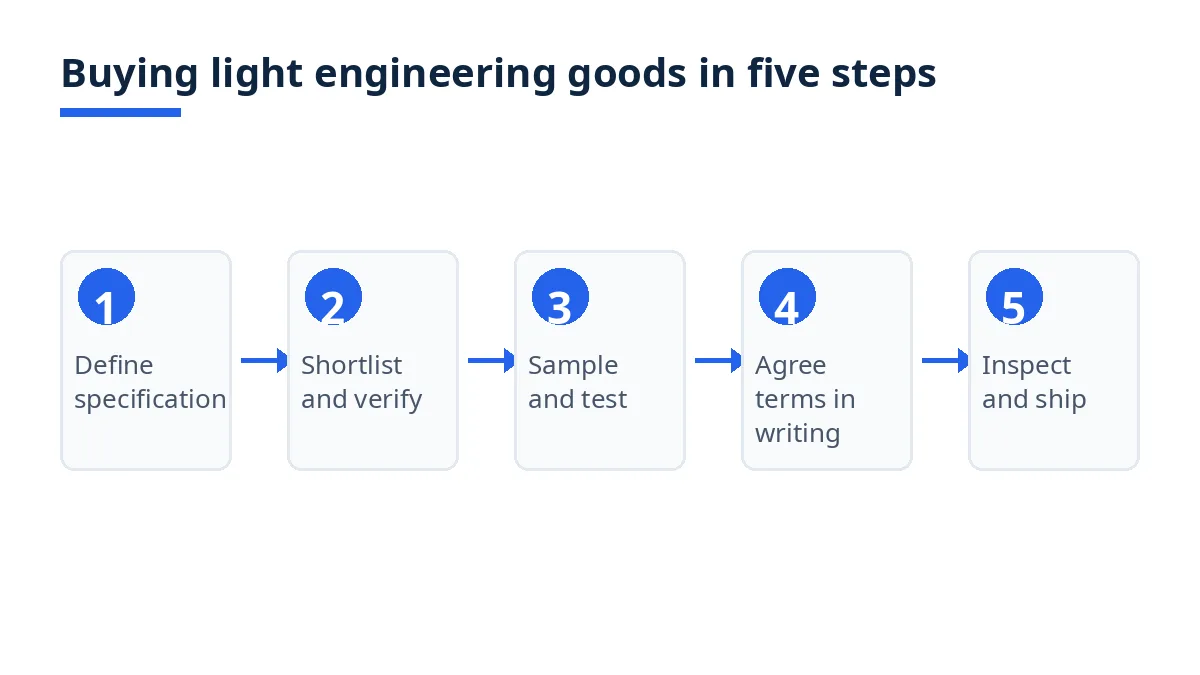
Define the specification. Write the product first: for a bicycle, model, frame material and size, component list, colour and packing; for a part, drawing revision, material grade, tolerance and finish; plus quantity, destination and test standard and edition.
Shortlist and verify suppliers. Build a shortlist from association, cluster and supplier listings, confirm the production site, then run the verification checks, including shipment evidence and the component map.6 10
Sample and test. Order samples or a first article, test production-representative goods, and approve a counter-sample or signed first article in writing.11
Agree commercial terms in writing. Fix MOQ, itemised price with validity, Incoterm with named place, staged lead time and start point, payment terms and inspection point in the purchase order.12
Produce, inspect and ship. Monitor component and frame or casting stages first, inspect finished goods against the approved sample, then ship with the origin evidence your duty position depends on.13
Related guides (links to cluster articles)
Read how to import from Bangladesh for the general import sequence, the electrical products industry in Bangladesh pillar for the neighbouring category, and the industrial equipment industry in Bangladesh pillar for heavier equipment. Incoterms for shipments from Bangladesh covers delivery terms in detail, and Bangladesh export data gives the wider picture behind the EPB figures.
FAQs
Is Bangladesh a good place to source light engineering & bicycles?
Bangladesh is a credible option for bicycles and for workshop-made parts and small machinery where specification, component map and testing are managed actively. It exported USD 535.56 million of engineering products in FY2024-25 on the EPB series, and bicycle exports recovered to USD 151.40 million in FY2025-26 after falling to USD 82.50 million in FY2023-24.1 3 According to Eurostat figures reported in the press, Bangladesh is the third-largest bicycle exporter to the European Union and the eighth-largest globally.6 Price in concentration in bicycles, imported components and testing capacity, and source factory by factory.
What is the typical MOQ?
There is no published typical MOQ for light engineering products or bicycles from Bangladesh, and no official body sets one. Each factory quotes its MOQ from its production stage: a model, frame and colour minimum for bicycles, a casting and machining minimum per drawing for parts, or a project build for a die, mould or machine. State your target quantity on the same basis in your enquiry, so quotes can be compared directly.
How long is the lead time?
There is no standard lead time: yours is the sum of its stages, material and component purchase, casting or frame building, machining or painting, assembly, testing, inspection and booking, and transit. The component stage is the variable one, because some components are imported while most major bicycle parts are now produced domestically.6 4 Ask for the stages separately and agree in writing what starts the clock.
Which certifications matter?
The requirements that matter are the ones your destination and your buyers require for the exact product. For bicycles, the operative safety family is ISO 4210: ISO 4210-2 specifies safety and performance requirements for design, assembly and testing, with guidelines for manufacturer instructions.11 Name the current edition in your specification, because the 2015 edition recorded by ISO is withdrawn.11 For e-bikes, add destination test evidence for motor, battery and charger as a separate file. For machined parts, the controlling documents are your drawing, material certificate and inspection report. Buyer-named management or social audits sit on top of the legal file and do not replace it.
Next steps on Exportain
Browse Bangladeshi suppliers by light engineering product or bicycle model, use Exportain trade intelligence to check the market picture behind this guide, and post a free RFQ at Exportain RFQs with your specification, target quantity and destination market so suppliers can quote against the same written brief.
Sources
- Exports fetch $48.28b in FY25. The Financial Express (accessed )
- Dilatory diversification keeps exports undersized. The Financial Express (accessed )
- Bicycle exports rebound, $151.4m earned in FY26. The Financial Express, (accessed )
- Bicycles to circuit boards: Bangladesh's electrical exports spark new manufacturing era. The Business Standard, (accessed )
- Three-day Light Engineering Expo to begin in Dhaka on February 2. The Financial Express, (accessed )
- E-bikes help cycle exports shift into higher gear. bdnews24.com, (accessed )
- HS, 2012 - Code 8712: Bicycles and other cycles, including delivery tricycles, not motorised. United Nations Statistics Division (accessed )
- Leveraging light engineering: searching for sustainable edge. The Financial Express (accessed )
- 5 districts to get light engineering industrial parks. The Business Standard, (accessed )
- Supplier verification: Earn trust badges buyers can see. Exportain (accessed )
- ISO 4210-2:2015 - Cycles - Safety requirements for bicycles - Part 2: Requirements for city and trekking, young adult, mountain and racing bicycles. International Organization for Standardization (accessed )
- Incoterms® rules. International Chamber of Commerce (ICC) (accessed )
- EU trade relations with Bangladesh. European Commission, (accessed )
- Incoterms
- quality control
- Bangladesh Export Data
- Category Pillars
- Supplier Sourcing
- Light engineering Bangladesh
- Bicycles Bangladesh
About the author
Sourcing from Bangladesh?
Post a request for quotation and suppliers on Exportain can send you their quotes directly.
Post an RFQ


