Leather Bags Exporters in Bangladesh: Supplier Verification Checklist
A supplier verification checklist for leather bag exporters in Bangladesh: identity, producing sites, leather evidence, samples and inspection terms, commercial record, classification and the export document set, with a recorded pass, fix or fail decision.
Short answer
Use this checklist to check a leather bag exporter in Bangladesh before you order: confirm identity and export documents, name both producing sites, test the leather and hardware evidence against your bag, agree samples and inspection terms in writing, and record a pass, fix or fail decision for every check.
On this page
Key takeaways
A badge records a document and photo review by Exportain staff, not a factory inspection or a guarantee of capacity, quality or delivery; check the documents, sites, samples and inspection terms yourself.
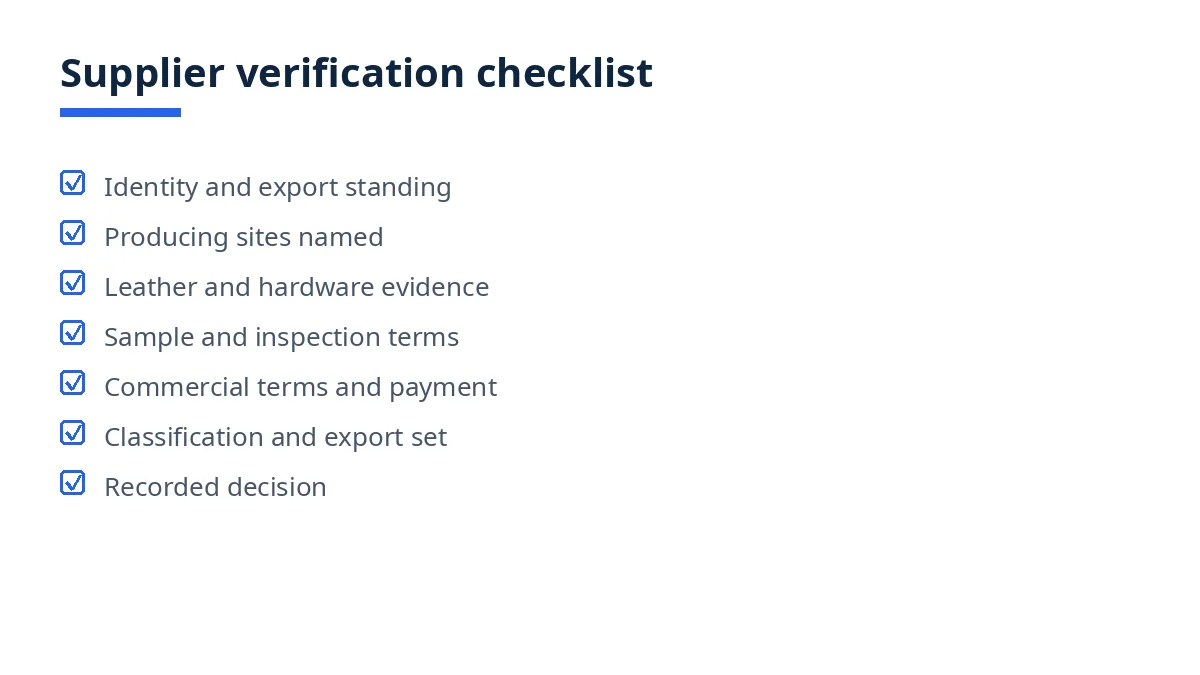
Work one file per supplier through seven blocks: identity, producing sites, leather and hardware evidence, samples and inspection, commercial terms, labels and the export set, and a recorded decision.
Name both producing sites and the leather evidence for your bag before discussing price; evidence for a different leather or site is background only.
Agree the sampling standard, defect classes and values in the order terms, and keep a sealed counter-sample in production materials as the shipment reference.
A leather bag order fails most often before production starts, when the buyer has not checked who will make the bag, where the leather came from, and what evidence covers that leather. This checklist checks the supplier against documents, sites, samples and written terms, in decision order, before money is committed.
Use it for a first order with a new exporter, and again when a supplier changes site, leather source or range. It does not replace the quality control checklist for leather bags, which judges the finished bag itself.
Check the supplier, not only the bag
A supplier can show a good sample and still be wrong for your order. The sample may use leather from one tannery while bulk production uses leather from another, or the company that quoted may plan to place your styles with a partner factory it has not named. Each gap is found by asking for a named site, a named leather and a document tying the two together, before price is discussed.
Exportain badges narrow the first pass and do not finish the job. Verification on Exportain is a document review by Exportain staff, not a factory inspection and not a check against any government database, and a badge is not a guarantee of production capacity, product quality or delivery.1 Read each badge for the check it records: Exportain Verified records identity, phone, email and business registration checks, Export Verified records an Export Registration Certificate (ERC) check, Factory Verified records reviewed photos of the factory, and Trading Company Verified records reviewed photos of the trading company office or warehouse.1 The verification guide sets out the checks behind each badge and their limits.2 A company without a badge shows nothing, which means a check has not been approved, not that the company failed one. A claim is open until a document, a named site or a confirmed check closes it, and no order is placed while a gap affecting identity, the producing site or payment remains open.
Set up one evidence file before you contact suppliers
Open one file per supplier: the specification, the quotation versions, the documents received, the sample record, the inspection terms and the decision. Use the same specification for every supplier you compare, so a price difference reflects a difference in offer, not in what was asked. Name one person on your side to own the file and the decision.
The diagram below shows the seven blocks of the checklist, from identity to the recorded decision.
Send the specification before you ask for a price. For each style, state the bag type, dimensions, leather type, thickness, color and finish, lining, handle and strap construction, hardware, edge finish, interior layout, label set and packing, with the quantity per style, per color and per leather. Add the destination market, delivery term and inspection terms. The leather goods sourcing guide sets out the wider sequence, from specification to shipment.
The supplier verification checklist, in decision order
Mark each check pass, fix or fail, with the evidence behind the mark. A fix must be closed before the order proceeds.
A. Identity and export standing
Legal name and address match everywhere. Check that the legal name and address match on the trade licence, quotation, invoice and every later document, and resolve any difference in writing before discussing price.
Trade licence and tax documents seen. Ask for the trade licence and, where provided, the Taxpayer Identification Number (TIN) documents, and check the name and address against the quotation. Exportain records such business registration checks as part of its identity checks.1
Export Registration Certificate checked. Ask for the ERC document and check that it names the same company. On Exportain, Export Verified records that Exportain has checked the ERC.1 Where no such badge shows, ask for the document yourself.
Association membership confirmed with the association. If a supplier claims membership of the Leathergoods and Footwear Manufacturers and Exporters Association of Bangladesh (LFMEAB), confirm it with the association. LFMEAB describes itself as a trade body representing manufacturers and exporters of leather products, footwear, synthetic and allied factories in Bangladesh.3 Membership is one identity check, not evidence that a factory can make your bag.
B. Which sites make your bag
Tannery or leather supply site named. Record which site tanned or supplied the leather, for each style. A workshop may buy finished leather from a Bangladeshi tannery or import it, and each route carries different evidence.
Bag-making site named. Record which site cuts, stitches and finishes your bag. For a trading company, record the producing factory for each style before any deposit, and name it in the order terms.
Bought-in stages named. Record which stages are bought in, such as hardware setting, lining, zips or edge paint. A bought-in stage is workable when it is named, with its own lot minimum and lead time.
C. Leather and hardware evidence for your bag
Leather stated per style. For each style, record leather type, origin, thickness, color and finish, and whether the leather is stocked or finished to order. A quote omitting leather type, origin or thickness cannot be compared.
Evidence names your leather and your tannery. Ask for evidence covering the leather in your order, naming the leather, the tannery or supply site, and the product. Evidence for a different leather or site is background only.
Hardware specification agreed in writing. State hardware per style: type, metal and finish, size, and attachment at handles, straps and corners. Agree any tooling or finish minimum in writing.
Change rule agreed. Agree in writing that no leather, color, finish or hardware change takes effect until the quotation, purchase order and sample change with it.
D. Samples, inspection and acceptance terms
Pre-production sample in production materials. Order a pre-production sample in your leather, color, lining and hardware, and check dimensions, stitching, edges, shade under the agreed light, and every zip, clasp and snap. Approve it in writing and keep one sealed counter-sample per style.
Inspection standard agreed before production. Agree the sampling standard, inspection level, defect classes and values, and the action on a failed lot, in the order terms. Set the values yourself. No universal sampling or defect figure is stated here.
Defect list with classes agreed. Agree which faults count as critical, major or minor, with photographs for borderline cases, and a rule for natural marks by position and size.
Inspector named and report format agreed. Name the inspector and agree the report format before production: lot, sample size, defects with photographs, measurements and packing. A supplier checking its own work is factory quality control, not an independent inspection.
E. Commercial terms, MOQ and payment
MOQ counting basis stated in writing. Ask each supplier to state its minimum order quantity against your specification, including the counting basis: per order, per style, per color or per leather. For the general meaning, see the MOQ guide.
Quotations compared on identical terms. Compare quotations only on the same specification, delivery term, currency and validity. A cheaper quote in thinner leather or a different finish is a different offer, not a saving.
Capacity stated with dates. Ask what is in production now, when your run would start, where leather and hardware will come from, and what happens if approvals slip. Confirm the slot and leather position in the purchase order.
Payment terms and bank details checked twice. Agree payment terms, including any funds hold, in writing before paying. Exportain holds money for a goods order only when both parties agree to a funds hold.1 Confirm bank details through a second channel, and treat any late change as a reason to pause and re-check.
F. Labels, classification and the export document set
Label proofs approved word for word. Approve every label proof word for word, for each destination market, before the label run, checking content, spelling and position.
Classification treated as indicative. The Harmonized System is a multipurpose international product nomenclature developed by the World Customs Organization (WCO), comprising more than 5,000 commodity groups, each identified by a six-digit code, and used by more than 200 countries and economies as a basis for their customs tariffs.4 Heading 4202 covers leather bags, split by container kind and outer surface: handbags at 4202.21, cases at 4202.11, pocket articles at 4202.31 and other bags at 4202.91.5 The HS code guide for leather bags covers the boundary cases. Treat every heading as indicative until your broker confirms the full national code.
Duties and preference confirmed with the broker. Confirm the duty rate and any preference position beside the confirmed code, for your exact product, origin and entry date, with your broker. No duty rate is stated here.
Export document set agreed. Check the shipment set against the Bangladesh Customs requirements before loading: goods must not be loaded for export unless an export declaration, known as a Bill of Export or Shipping Bill, has been submitted to Customs and approved.6 The enclosed documents are the export letter of credit or, where there is none, the export contract or purchase order, the signed commercial invoice, the packing list, the EXP form certified by an Authorized Dealer, the certificate of origin issued by the Export Promotion Bureau (EPB) or a chamber of commerce and industry, the VAT registration certificate, and the Taxpayer Identification Number.6 Confirm with your broker whether any product-specific document applies, and check names, codes, quantities and weights across every document as soon as drafts arrive.
G. Record the decision
One decision, recorded and dated. Record pass, fix or fail for each check, the evidence, the owner and the date. Order only when every check affecting identity, site, leather, sample, inspection or payment is marked pass. No deposit is paid while a fix affecting the goods or payment remains open.
Where checks fail most often, and the fix for each
A badge read as a factory check. A badge records a document and photo review, not a factory visit.1 Run the document, site and sample checks yourself.
A producing factory never named. Require it in writing, in the order terms, before any deposit.
Leather evidence for a different leather. Ask for evidence naming your leather and site, and re-check whenever either changes.
A sample approved from a photograph. Approve a sample in production materials, in hand, and seal a counter-sample first.
Inspection terms agreed after production. Write them into the order terms before production.
A certificate read beyond its scope. Check holder, site, coverage and expiry with the issuer.
Bank details changed late. Pause, confirm through a second channel, and re-check the account name before paying.
Summary table: evidence, source and decision
No file download is offered with this article. Copy the table below into your supplier file, add one row per supplier, and record the decision for each block.
Block | Evidence to hold | Check it with | Decision |
|---|---|---|---|
Identity and export standing | Trade licence, TIN documents, ERC, association confirmation | Documents, association | Pass, fix or fail |
Producing sites | Named tannery or supply site, named bag factory, bought-in stages | Supplier, order terms | Pass, fix or fail |
Leather and hardware | Leather per style, evidence naming your leather, hardware specification | Evidence, sample | Pass, fix or fail |
Samples and inspection | Sealed counter-sample, agreed standard and defect list, inspector report | Sample, order terms | Pass, fix or fail |
Commercial terms | MOQ counting basis, comparable quotation, dated capacity, payment terms | Quotation, broker | Pass, fix or fail |
Labels and export set | Label proofs, confirmed code, Bill of Export enclosure set | Broker, Customs set | Pass, fix or fail |
Decision | Completed checklist, owner, date | Your file | Order, hold or decline |
How Exportain fits into the checks
Exportain is a B2B marketplace where buyers find Bangladeshi suppliers and post requests for quotation. It is not a party to the goods contract and does not inspect goods, book freight or clear customs. Use it to build the shortlist and compare quotations on one specification, then run the checks yourself. Read the profile checklist on each supplier profile, which lists each check as approved or not approved and, where it applies, its validity dates.2 A certification marked as checked by Exportain means staff reviewed the uploaded document, and only approved certifications appear while in date.2 Where a certificate matters, confirm it with the issuer as well.
Verification is free, and membership plans never grant a badge.1 A high search position may come partly from a paid plan and says nothing about verification. Read how supplier verification works on Exportain for the checks behind each badge. If you suspect fraud or misrepresentation, report it through the Trust Center.2
When should this checklist be used?
Use it before a first order, when a supplier changes site or leather source, and when the range changes. Repeat it at quotation, at sample approval, and before any deposit. A check for one style does not close the same check for another style, leather or site.
Who should complete it?
The buyer owns the checklist and the decision. The supplier supplies documents, names sites and produces the sample; a forwarder, broker or inspector can complete the parts in their field. The final decision stays with the buyer.
What are the most common failures?
A badge read as a factory check, an unnamed producing factory, leather evidence for a different leather, a sample approved from a photograph, late inspection terms, a certificate read beyond its scope, and bank details changed late. Each is fixed by closing the gap in writing before the order proceeds.
Can a third party do it?
Yes. A third party can check documents, confirm association claims, inspect the sample and finished goods, and confirm classification and duty position with the broker. It needs the specification, quotations, documents and written authority. The buyer remains responsible for the decision.
Next steps on Exportain
Build one evidence file per supplier and keep the specification identical across quotations. Read the quality control checklist for leather bags for the product checks that follow, and the leather bags manufacturers guide for the six supplier types. Then browse suppliers and post an RFQ on the RFQ board with your specification, counting basis and delivery term.
Sources
- Trust & Safety Center. Exportain (accessed )
- How Supplier Verification Works on Exportain. Exportain, (accessed )
- President's Message - LFMEAB. Leathergoods and Footwear Manufacturers and Exporters Association of Bangladesh (LFMEAB) (accessed )
- What is the Harmonized System (HS)?. World Customs Organization (accessed )
- HS Code for Leather Bags: Classification Guide for Importers. Exportain (accessed )
- Customs Clearance Procedures for Export. Bangladesh Customs, National Board of Revenue (accessed )
About the author
Sourcing from Bangladesh?
Post a request for quotation and suppliers on Exportain can send you their quotes directly.
Post an RFQ