

Top Leather Bags Manufacturers in Bangladesh: How to Find and Verify Them
Six supplier types for leather bags from Bangladesh, and how to judge each one on its tannery evidence, bag construction, chemical tests and commercial terms before ordering.
Short answer
Leather bag suppliers in Bangladesh fall into six types: tannery-linked integrated makers, cut-and-stitch specialists, structured and hardware-led makers, private-label OEM and ODM makers, exporters and trading companies, and small-batch workshops. Match the type to your bag and leather, then verify the tannery evidence, a sample in your leather, chemical test reports and commercial terms before paying.
On this page
Key takeaways
Leather bag suppliers in Bangladesh sort into six types by what each controls: tannery-linked makers, cut-and-stitch specialists, structured makers, private-label makers, trading companies and small-batch workshops.
Record both sites for every order: the tannery that made the leather and the factory that cut, stitched and finished the bag.
An LWG audit covers 17 sections with medal thresholds of 85, 75 and 65 percent, is valid for 24 months, and does not guarantee no restricted substance failures in a final product.
Skin-contact leather in the UK must not be placed on the market at or above 3 mg/kg chromium VI, with limits also applying to azo dyes and dimethyl fumarate.
Price and MOQ are set per style, per colour and per leather, and Exportain badges are document and photo reviews, not factory inspections.
A leather bag is judged in the hand, not in a photograph. For buyers searching for leather bags manufacturers in Bangladesh, the test is the leather, stitching, handle anchors, edge finish and hardware. Each bag kind stresses a different part of the process, so this guide sorts suppliers by what each type controls.
Leather and leather products grew 14.74 percent in the first quarter of fiscal 2026-27, within merchandise exports of US$13.094 billion, up 6.34 percent, on Export Promotion Bureau (EPB) data reported by the Dhaka Tribune.1
What to settle before you shortlist
A bag order has two supply chains: the tannery that made the leather, and the factory that finished the bag. Record both sites.
Leather claims need documents naming your leather and product. A tannery audit covers the named tannery for the stated period. It does not replace testing your own bags.
Price and minimum order quantity (MOQ) are set per style, per colour and per leather. Compare quotations only on the same specification and terms.
Exportain badges record document and photo checks by Exportain staff. They are a starting filter, not a factory inspection.
Leather bags manufacturers in Bangladesh: six supplier types
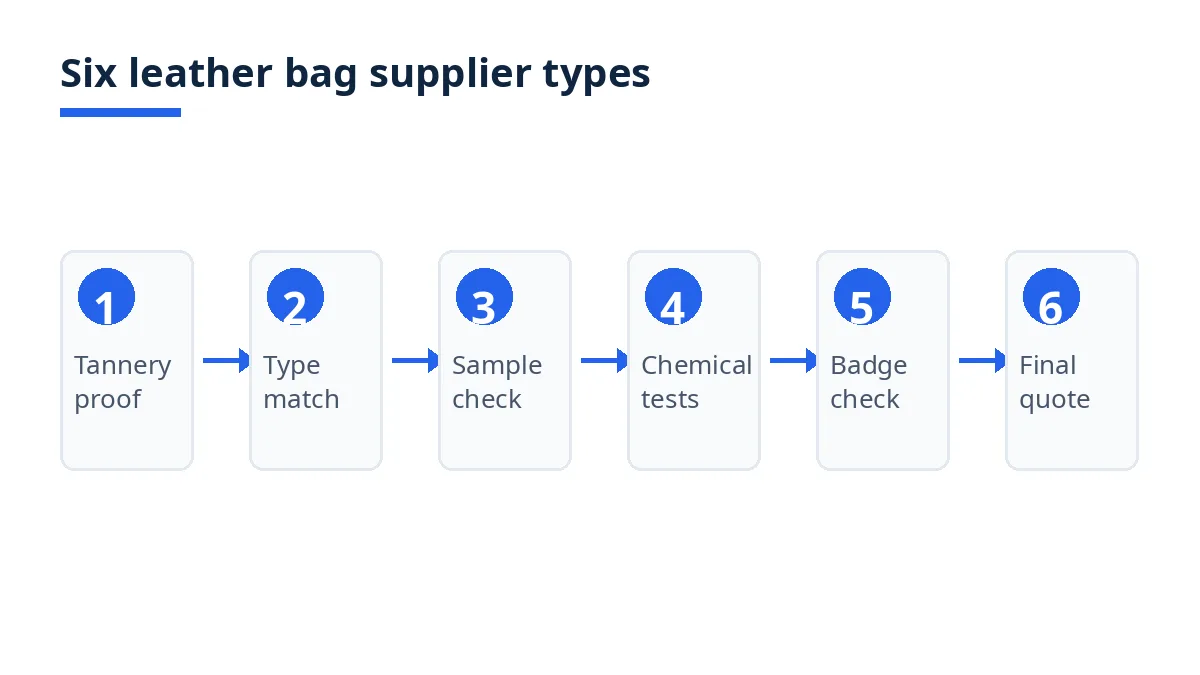
The six types below cover how leather bags are made and sold from Bangladesh. One company can sit in more than one type. Shortlist on Exportain by searching published products, filtering by badge, sample availability and OEM or ODM capability, and sorting by MOQ or lead time.2 Send every shortlisted supplier the same specification.
1. Tannery-linked integrated makers
What they are. Groups that tan or finish leather and make bags within the same group, so the leather route is shorter and the group can usually name the tannery behind a sample.
Who they suit. Buyers ordering a defined leather in volume, or needing the same colour across repeat orders.
How to verify. Ask which tannery made your sample leather, its finish and thickness, and what evidence names that tannery and leather.
2. Cut-and-stitch bag specialists
What they are. Factories that buy finished leather and concentrate on bag making: cutting and clicking, skiving, stitching, edge finishing, lining and hardware fitting.
Who they suit. Most handbag, tote and backpack orders, where shape, stitching and edge finish decide quality.
How to verify. Ask which leather suppliers the factory buys from, whether your leather is in stock or must be bought or finished to order, and which stages are done in the named facility. Inspect a sample in your leather for shade consistency, stitch density, anchor reinforcement, edge finish, and zip and closure function.
3. Structured and hardware-led makers
What they are. Makers set up for bags that must hold a rigid shape: briefcases, structured handbags, document cases and bags with frames, clasps, locks and fitted hardware.
Who they suit. Briefcases, structured work bags and any bag where a frame, clasp or lock is part of the design. A soft-bag maker can stitch the same leather and still fail, through shape loss and hardware pull-out.
How to verify. Handle a sample carrying its intended weight, checking anchors, frame seating, clasp operation and base. Agree the hardware specification in writing.
4. Private-label OEM and ODM bag makers
What they are. Suppliers set up to make bags under the buyer's label. Original equipment manufacturers (OEM) produce to your tech pack. Original design manufacturers (ODM) offer their own patterns and styles for you to label.
Who they suit. Brands needing their own labels and packing, and importers wanting a ready style range.
How to verify. For OEM work, judge the counter-sample against a complete tech pack. For ODM work, check the styles are the supplier's own. Agree pattern ownership, and approve every label proof word for word.
5. Exporters and trading companies
What they are. Export-licensed companies that sell bags made in partner factories rather than on their own stitching lines. They combine styles into one order and handle export documentation.
Who they suit. Buyers ordering several styles at once, or wanting one contract across a mixed range.
How to verify. Ask which factory will make each style, and get it named before you pay a deposit. Make the order terms name the producing factory and the tannery route for each style. A badge on the trading company's profile records checks for that company; it does not inspect the partner factory.3
6. Small-batch and sample-room workshops
What they are. Smaller workshops and sample rooms set up for short runs, trial orders and style development.
Who they suit. Trial orders, test colours and small retail ranges.
How to verify. Check capacity with dates attached: what is in production now, when your run would start, and what happens if inputs arrive late. Keep the same sample, inspection and payment discipline as for any supplier. A small order that ships wrong still costs the full freight and clearance.
Summary table
Type | Best for | Main check before ordering |
|---|---|---|
Tannery-linked maker | Defined leather, repeat colours | Tannery named, certificate scope |
Cut-and-stitch specialist | Handbags, totes, backpacks | Sample in your leather, anchors, edges |
Structured maker | Briefcases, framed bags | Loaded sample, anchors, hardware spec |
Private-label OEM / ODM | Own-label brands | Tech pack match, label proofs |
Exporter / trading company | Mixed ranges, one contract | Producing factory named per style |
Small-batch workshop | Trials, test colours | Dated capacity, same discipline |
Reading the leather: tannery evidence, tanning claims and chemical limits
Name leather type, thickness, finish, colour standard, lining, hardware and edge treatment, then ask for evidence tying that leather to your bag.
The Leather Working Group (LWG) audit is the tannery evidence buyers ask about most often. First launched in 2005, the LWG Audit Standard assesses how a tannery measures, controls and reports the impact of its operations.4 It includes 17 sections, including water and energy, chemical management, waste and effluent treatment, and health and safety.4 Section thresholds are 85 percent for Gold, 75 percent for Silver, 65 percent for Bronze and 50 percent for Audited, and the final medal is the lowest category achieved.4 Certification is valid for 24 months, and LWG states it does not guarantee no restricted substance failures in a final product.4
The current LWG Leather Manufacturer Audit Standard, version P7, launched in 2021, covers 17 sections and certification is valid for two years.5 LWG also notes it will not permit auditing any facility connected to the Savar Central Effluent Treatment Plant (CETP), owing to ongoing problems with that plant.4
Tanning claims need the same discipline. LWG states that leather is chrome-free if it contains less than 1,000 mg/kg of total chromium on a dry weight basis under BS EN 15987, and that Gold and Silver certifications require chromium VI below 3 mg/kg, with any level above that an automatic failure.4 A chrome-free or vegetable-tanned claim is a measured result for a named leather, not a general property of a factory. Ask for the test report naming your leather, tannery and method, and retest when any of them changes.
United Kingdom guidance under assimilated REACH rules states that skin-contact leather articles must not be placed on the market where they contain chromium VI at or above 3 mg/kg of the total dry weight of the leather.6 The same guidance states that azo dyes releasing listed aromatic amines above 30 mg/kg must not be used in articles in direct and prolonged skin contact, a list naming handbags, purses, wallets and briefcases, and that leather products with dimethyl fumarate above 0.1 mg/kg must not be placed on the market.6 Give the factory your restricted substances list at enquiry stage, require test reports naming your product and leather, and confirm which rules apply in each destination market before approving bulk leather.
Classification is separate from price or quality. Heading 4202 covers handbags, briefcases, wallets and similar containers, split by product type and outer surface: 4202.21 covers handbags with an outer surface of leather or composition leather, 4202.31 covers pocket articles with that outer surface, and 4202.91 covers other articles under the heading with that outer surface.7 Treat every heading as indicative until your broker confirms the full code.
The sector trade body is the Leathergoods and Footwear Manufacturers and Exporters Association of Bangladesh (LFMEAB), which describes itself as the official trade body registered under the Ministry of Commerce for the export-oriented leather footwear and goods industry, with over 300 members.8 Use membership as a starting point and one identity check, not as evidence a factory can make your bag. Confirm any membership claim with the association.
What moves price and MOQ for leather bags
No single price or MOQ applies to leather bags. Leather is usually the largest cost element, followed by lining, hardware, making, edge finishing, testing, packing and transport on the agreed delivery term. A quote that omits leather type, origin and thickness cannot be compared with another, because a thinner leather or different finish is a different bag. Leather is bought and finished in lots, so a dyed-to-order colour carries a separate commitment from a running colour, and fitted hardware carries its own tooling and minimum.
Minimums are counted per style and per colour, and often per leather. The guide to MOQ and minimum order quantity shows how the same number changes when counted per order, per style or per colour. Ask each supplier to state its minimum against your specification, including the counting basis. All figures here are Example figures. Example figures: two quotes for the same structured handbag, USD 18.40 EXW and USD 19.10 FOB; adding USD 0.55 of inland transport and handling to the EXW quote gives USD 18.95 FOB, so the real gap is USD 0.15, not USD 0.70. Example figures: a second colour at half quantity each can fail a per-colour minimum even when the order total passes it.
Lead time covers leather and hardware purchase, production, testing, packing and transport to port, after sample approval. Confirm the slot and leather position in the purchase order.
How to verify a supplier before you pay
Run this sequence on each shortlisted supplier, keeping the evidence in one file per supplier.
Name both producing sites. Record which site supplied the leather and which site cuts, stitches and finishes your bag, and which stages are bought in. A bought-in stage is workable when named.
Check registration on the documents. Ask for the trade licence and Export Registration Certificate (ERC), and check the legal name and address match on quotation, invoice and every document. Confirm any LFMEAB claim with the association.8
Read the badges for what they record. On Exportain, verification is a document and photo review by staff, not a factory inspection, and membership never grants a badge.9 Exportain Verified records identity, phone, email and registration checks, Export Verified records an ERC check, and Factory Verified and Trading Company Verified record reviewed photos.3 Treat a badge as a starting filter, then check the documents and bank account name yourself.
Approve a sample in your leather. Order a pre-production sample in your leather, colour, lining and hardware, check dimensions, stitching, edges, panel shade and closure function, and seal a counter-sample. State that bulk production starts only after your written approval.
Agree the inspection standard in the order. Set the acceptance quality limit (AQL) and inspection level before production. ISO 2859-1:2026 provides sampling procedures for inspection by attributes using AQL, the maximum percentage of defective items considered acceptable in a lot.10 Name the AQL values, inspection level and defect classes in the order terms.
Put payment protection in writing. Exportain is a marketplace, not a party to your goods contract; where a supplier asks for a funds hold, the buyer can pay it or decline it, and Exportain keeps a paid hold until the supplier files an export clearance document and the buyer confirms the trade is complete.2 Confirm bank details through a second channel, and treat any late change as a reason to pause and re-verify.
Warning signs include a quote far below comparable offers, refusal to sample in your leather, pressure to pay a personal account quickly, reluctance to name the tannery or factory, and certificates naming a different company or site. Do not order while any step is open.
What is the biggest mistake buyers make when sourcing leather bags from Bangladesh?
Choosing by price before checking which type of supplier quoted and which leather sits behind the price. A trading company quoting another factory's capacity, a specialist quoting bought-in leather, and a tannery-linked maker quoting its own group's leather are three different offers. The price only means something once supplier type, leather, hardware and inspection terms are the same.
How can I avoid it?
Send one specification to every supplier, run the same six-step sequence on each, approve a sample in your leather, check the tannery evidence and chemical reports for that leather, and agree inspection and commercial terms in one versioned quotation before paying. Keep specification, sample record, certificate checks and quotation versions in one file per supplier.
Who is responsible for verifying a leather bag supplier?
The buyer owns the verification decision; the supplier must supply the documents, samples and answers that make it possible. A badge records only the checks Exportain staff reviewed and approved.3 An inspector or certificate issuer can confirm one part, but none can create the specification or approve the sample.
Where can I get help verifying a supplier?
Start with the records that exist: LFMEAB for membership, the certificate issuer for any audit or product claim, and an inspection provider for the pre-shipment check.8 On Exportain, read what each badge covers, and message the supplier through its profile so questions and answers stay in one thread.3 The quality control checklist for leather bags covers grain, shape, stitching, edges, hardware, lining, lab evidence and packing, and the leather goods sourcing guide covers the wider category.
Next steps on Exportain
Browse Bangladeshi suppliers and filter leather goods listings by badge, sample availability and OEM or ODM capability. Read how supplier verification works on Exportain before you order. Then post a free RFQ with your specification, leather, quantity, destination and Incoterm, and compare the versioned quotations on the same fields.
Sources
- Exports up over 6% to $13.1bn in Q1 of FY27. Dhaka Tribune, (accessed )
- How to source and buy from Bangladesh. Exportain (accessed )
- How Supplier Verification Works on Exportain. Exportain, (accessed )
- Certification - Leather Working Group. Leather Working Group (accessed )
- Leather Manufacturer Standard - Leather Working Group. Leather Working Group (accessed )
- Leather goods | Business Companion. Business Companion (accessed )
- HS, 2017 - Code 4202 Classification Detail. United Nations Statistics Division (accessed )
- Terms of Reference (TOR) for Factory Assessment on BSCI, SEDEX and OHSMS ISO 45001:2018. Leathergoods and Footwear Manufacturers and Exporters Association of Bangladesh (LFMEAB) (accessed )
- Supplier verification: Earn trust badges buyers can see. Exportain (accessed )
- ISO 2859-1:2026 — Sampling for Inspection by AQL. American National Standards Institute (ANSI) (accessed )
About the author
Sourcing from Bangladesh?
Post a request for quotation and suppliers on Exportain can send you their quotes directly.
Post an RFQ


