LC Payment Meaning: Complete Guide
LC payment means the buyer's bank undertakes to pay the seller against documents that comply with the credit. This guide covers the parties, the eight steps, documents, Bangladesh rules, and the mistakes that delay payment.
Short answer
LC payment means payment under a letter of credit (LC). The buyer's bank, the issuing bank, gives an irrevocable undertaking to pay the seller, the beneficiary, when the seller presents documents that comply with the credit's terms before its expiry date. Banks examine documents, not goods, so names, dates, quantities and descriptions must match the credit exactly.
On this page
Key takeaways
LC payment means the buyer's bank undertakes to pay the seller against documents that comply with the credit, replacing the buyer's own promise to pay.
Banks deal with documents, not goods: names, dates, quantities and descriptions must match the credit and each other.
Most credits follow UCP 600, and an examining bank has a maximum of five banking days following presentation to decide on compliance.
The credit cannot be amended or cancelled without the agreement of the issuing bank, the confirming bank if any, and the beneficiary, so errors are fixed at advising.
In Bangladesh, import LCs run through Authorized Dealer banks under Bangladesh Bank rules and must specify signed invoices and certificates of origin.
If you are importing from Bangladesh for the first time, lc payment meaning is one of the first payment terms to understand before you sign a contract. LC payment means payment under a letter of credit (LC): the buyer's bank undertakes to pay the seller when the seller presents documents that comply with the credit's terms, on time. The bank's undertaking replaces the buyer's personal promise to pay, and the documents, not the goods, trigger the payment.
This guide explains who the parties are, how the cycle runs, which documents and timelines apply, how the rules work in Bangladesh, and the mistakes that delay payment. For a shorter definition, see the letter of credit (LC) guide.
What does LC payment mean in plain terms?
A letter of credit is an arrangement under which a bank, acting at the request of its customer, undertakes to pay a named seller against a complying presentation of documents. A complying presentation is one that accords with the credit's terms, the applicable provisions of UCP 600, and international standard banking practice 1.
Most documentary credits are issued subject to UCP 600, the Uniform Customs and Practice for Documentary Credits, 2007 Revision, published by the International Chamber of Commerce 1. UCP 600 took effect on 1 July 2007 and contains 39 articles 2.
Five parties appear in a standard LC transaction, as defined in UCP 600 Article 2 1:
Party | Who it is | What it does |
|---|---|---|
Applicant | The buyer or importer | Asks its bank to issue the credit |
Issuing bank | The buyer's bank | Issues the credit and undertakes to honour a complying presentation |
Beneficiary | The seller or exporter | Ships the goods and presents documents to claim payment |
Advising bank | A bank in the seller's country | Advises the credit to the beneficiary |
Confirming bank | Optional; usually in the seller's country | Adds its own undertaking to honour or negotiate a complying presentation |
Two principles govern every LC. First, the credit is separate from the sales contract: a documentary credit has its own terms and conditions, which do not rely on the terms or performance of the underlying contract 1. Second, banks deal with documents and not with goods, services or performance to which the documents may relate, a rule UCP 600 states in Article 5 2. A bank does not inspect your shipment. It reads the papers.
Why this matters for buyers and sellers
International trade starts with a trust gap. The buyer does not want to pay before the goods ship, and the seller does not want to ship before payment is secure. With no trading history, neither side can easily judge the other.
An LC narrows that gap by putting a bank in the middle. The seller ships against a bank's undertaking instead of a foreign buyer's promise. The buyer knows the bank pays only against documents showing the goods shipped as agreed: the right description, the right quantity, and a transport document dated on or before the credit's latest shipment date. A seller who does not ship has no transport document to present.
That balance is why LC terms are common in first transactions and larger orders. The main alternative is TT (telegraphic transfer), where money moves bank to bank without a document-based undertaking. TT is simpler to run, but the seller has no bank undertaking to ship against, so the risk allocation is different and should be a deliberate choice.
An LC also has limits. It does not certify the quality of the goods, because the bank pays against documents and never sees the products, and a presentation with errors can be refused even when the goods are exactly as ordered.
Step-by-step: how does an LC payment work?
The full cycle has eight stages, following standard UCP 600 practice 1.
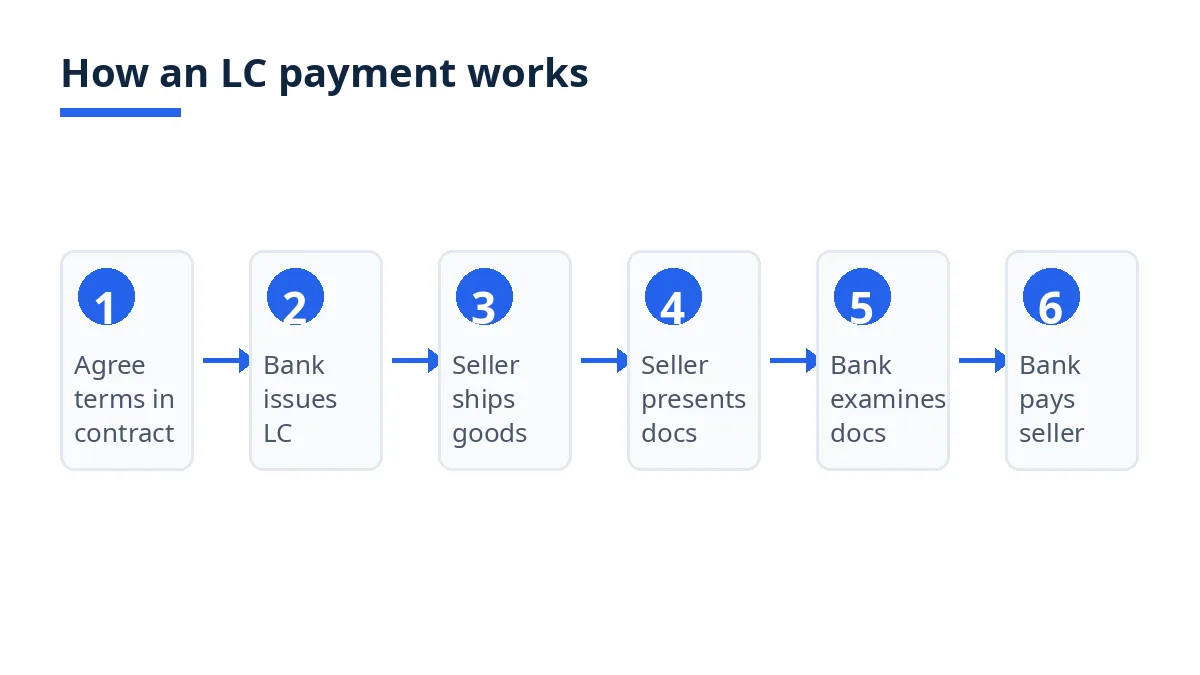
Agree the terms in the sales contract. Buyer and seller agree the price, quantity, delivery term, shipment deadline, and payment by letter of credit. A credit must state whether it is available by sight payment, deferred payment, acceptance, or negotiation 1. Settle everything here, because an issued credit cannot be amended or cancelled without the agreement of the issuing bank, the confirming bank if any, and the beneficiary 1.
The buyer applies for the credit. The buyer completes its bank's application, naming the beneficiary, amount, expiry date, latest shipment date, and required documents. The bank checks the buyer's credit line or security first.
The issuing bank issues the LC. The buyer's bank issues the credit and sends it to a bank in the seller's country, bound from this point to honour a complying presentation.
The advising bank advises the credit. The seller's bank advises the credit to the seller. The seller should read every line now and request an amendment at once for anything unworkable: a document it cannot obtain, a date it cannot meet, or a misspelled name.
The seller ships the goods. The seller produces, packs, and ships within the credit's conditions and collects the transport document, a bill of lading for sea freight or an air waybill for air freight, with the other required documents.
The seller presents the documents. The seller presents the full set to its bank within the presentation period in the credit and before the expiry date.
The issuing bank examines the documents. UCP 600 sub-article 14(b) limits examination to a maximum of five banking days following the day of presentation 1. If the documents comply, the bank must honour them. If they do not, the bank may refuse, state the discrepancies, and ask the applicant whether it will waive them.
The bank pays and releases the documents. The seller is paid at sight or at the maturity date set in a usance credit, and the issuing bank releases the documents to the buyer, who uses the transport document to take delivery.
Two variations matter. A sight LC pays on a complying presentation; a usance or deferred payment LC pays at a fixed future date. A confirmed LC adds a second bank's undertaking, in addition to the issuing bank's, to honour or negotiate a complying presentation 1.
Costs, timelines and documents
What does an LC cost?
Banks charge for issuing the credit, advising it, confirmation where requested, examining documents, and amendments. The amount depends on the bank's tariff, the value and duration of the credit, and whether confirmation is included. Which side pays which charge is a contract point, written into the sales contract and reflected in the credit. The fixed element in bank charges weighs more on a small order, which is one reason very small first orders are often paid by advance TT instead.
How long does an LC payment take?
Issuance follows a complete application and an agreed credit facility. Production and shipment time sits with the seller and must fit inside the credit's latest shipment date and expiry date. Examination time is the one fixed figure: a maximum of five banking days following the day of presentation 1. UCP 600 replaced the older open-ended standard of a reasonable time with this fixed limit 2. Most delay comes from a discrepant presentation, while documents are corrected or held for the buyer's waiver. Presenting several banking days early protects the schedule.
Which documents does an LC require?
The credit itself lists the documents, and that list governs. Compare it with the standard set in the guide to export documents from Bangladesh. A typical set includes:
Document | What it proves | Point to check |
|---|---|---|
Commercial invoice | The goods supplied and the amount claimed | Description must correspond with the credit |
Packing list | Weights, dimensions, and packing detail | Figures must agree with invoice and transport document |
Transport document | Shipment took place, and when | Date must be on or before the credit's latest shipment date |
Certificate of origin | Where the goods were made | Required where the credit or destination rules call for it |
Insurance document | Cover is in place for the shipment | Called for where the delivery term puts insurance on the seller, such as CIF |
Inspection certificate | A named inspection took place | Only where the credit names one, from the issuer it specifies |
Consistency across the set decides payment. Banks examine documents on their face, and ISBP 821, the ICC's International Standard Banking Practice published in July 2023, explains how UCP 600 examination practice is applied; ISBP does not amend UCP 600 1. ICC Academy guidance advises requiring only necessary documents, and, where feasible, limiting requirements to an invoice and a transport document 1.
Bangladesh-specific rules and tips
Letters of credit connected to Bangladesh run through the Authorized Dealer (AD) branches of banks, under Bangladesh Bank's foreign exchange regulations. Its consolidated import circular, FE Circular No. 33 of 14 August 2025, is the current reference 3.
ADs must follow the prevailing UCP for import LCs, and local regulations prevail on any conflict 3. All LCs covering imports into Bangladesh must be documentary LCs, providing for payment against full sets of on-board bills of lading, air waybills, or the transport receipt that fits the mode of carriage, and every LC must specify signed invoices and certificates of origin 3. An LC opens only against a firm contract: the AD should first see evidence that a firm order has been placed and accepted, and the credit must carry a full description of the goods with the unit price 3. For imports of USD 3 million and above, the AD must report the transaction to Bangladesh Bank's Online Import Monitoring System (OIMS) at least 24 hours before the LC is opened, government imports excluded 3.
The pattern many buyers meet in the garment sector is the back-to-back LC. ADs may open back-to-back import LCs against export LCs received by export-oriented industrial units operating under the bonded warehouse system 3. The master export LC must have validity long enough to cover importing the inputs, manufacturing the goods, and shipping them, and a back-to-back LC is opened on a usance basis not exceeding 180 days 3. For a buyer, the point is timing: your supplier's input purchase sits inside your LC's dates, so a late amendment compresses the supplier's production window too.
Three tips apply on both sides. Keep one consistent spelling of each company name, exactly as registered, across the contract, LC, and every document. Leave a buffer around public holidays when setting dates, because the examination clock runs in banking days.
Mistakes and red flags
Most LC problems are paperwork errors and unrealistic terms, not fraud:
Late presentation. Documents presented after the expiry date, or after the presentation period following shipment, can be refused. Record both dates when the credit arrives.
Late shipment. A transport document dated after the credit's latest shipment date is one of the most common discrepancies.
Inconsistent descriptions. The invoice description must correspond with the credit, and other documents must not conflict with it.
Documents you cannot obtain. A credit calling for a document the seller cannot collect cannot be complied with. Fix it at advising, by amendment.
Soft clauses. A clause making payment depend on an act outside the documents, such as the buyer's own inspection note, weakens the undertaking. Have it amended out.
Amount and shipment breaches. Drawing more than the credit amount, or splitting a shipment the credit does not allow, both create discrepancies.
Four red flags should stop a shipment until resolved: an LC advised from an unexpected country or unrelated bank, an amount or description that does not match the contract, pressure to ship before the credit is advised through your own bank, and a request to present documents outside the banking channel. A screenshot or emailed copy is not an advised credit.
Checklist: before you ship or pay under an LC
Work through this list when the credit arrives and before presentation:
The credit has been received through your own bank and read line by line against the contract.
Company names, amount, currency, and goods description match the contract exactly.
Shipment and expiry dates leave a realistic buffer after production and transport time.
Every required document is one the seller can obtain, from the issuer the credit names.
Partial shipment and transshipment settings match the logistics plan and the agreed Incoterms rule.
The tenor, sight or usance, matches the cash-flow plan, and agreed confirmation is in place.
The charges clause states which side pays which bank's charges.
Any unworkable clause has been amended, with the amendment advised through the bank, before shipment.
The presentation set is prepared from one master data sheet, so names, quantities, and weights agree everywhere.
Presentation is planned several banking days before the deadline, not on it.
Frequently asked questions
What should I know first about LC Payment Meaning?
An LC is a bank's undertaking to pay against documents, separate from the sales contract 1. Payment depends on presenting the documents the credit lists, in the form the credit describes, before its deadlines. The credit cannot be amended or cancelled without the agreement of the issuing bank, the confirming bank if any, and the beneficiary 1, so correct a bad term when the credit arrives, not after shipment.
What are the typical costs and timelines?
Costs come from bank tariffs for issuance, advising, confirmation where requested, examination, and amendments; the split between buyer and seller is set in the contract and the credit. Issuance follows a complete application and an agreed facility, production and shipment sit between issuance and presentation, and the examining bank has a maximum of five banking days following the day of presentation to decide on compliance 1.
Which documents are needed?
The credit lists them, and that list counts. A typical set is a commercial invoice, a packing list, and a transport document, with a certificate of origin, an insurance document, and an inspection certificate added where the credit or delivery term calls for them. For imports into Bangladesh, every import LC must specify signed invoices and certificates of origin 3.
What are the most common mistakes?
Late shipment and late presentation come first, followed by descriptions that do not correspond with the credit, misspelled names, and missing documents. Two habits prevent most of them: checking the credit against the contract when it is advised, and checking the presentation set before it goes to the bank.
Next steps on Exportain
On Exportain, a buyer can state the payment terms they work on when posting a requirement, and suppliers respond with the terms they can accept. Read how to write an RFQ before your first order, then post an RFQ or browse suppliers. Exportain is a marketplace and is not a party to the payment itself: the LC is issued by the buyer's bank.
Sources
- Documentary credits: Rules, guidelines & terminology. ICC Academy, International Chamber of Commerce (accessed )
- Evolution of UCP 600 & impact on documentary credits. ICC Academy, International Chamber of Commerce (accessed )
- FE Circular No. 33: Foreign Exchange Regulations regarding import transactions. Bangladesh Bank, (accessed )
About the author
Sourcing from Bangladesh?
Post a request for quotation and suppliers on Exportain can send you their quotes directly.
Post an RFQ