Canada Workwear and Uniforms From Bangladesh: Buyer Import Checklist
How to import workwear and uniforms from Bangladesh to Canada: classify each garment, confirm LDCT duty treatment, agree bilingual labels, approve samples, and build the landed cost before bulk production.
Short answer
To import workwear and uniforms from Bangladesh to Canada, specify each garment by type, cut, fabric, colour, size curve, trims and label, then classify it in Chapter 62 and confirm the LDCT treatment with your broker for the entry date. Approve a pre-production sample in production fabric and trims, agree bilingual labels or the employer-use route, inspect to an agreed AQL plan, and build the landed cost with duty, GST and clearance before bulk production.
On this page
Key takeaways
Woven workwear sits in Chapter 62: 6203 for men's trousers and overalls, 6204 for women's equivalents, and 6211 for other garments including coveralls, with the fibre selecting the line.
In the 2025 schedule opened for this guide, cotton lines 6203.42.00 and 6211.32.00 carry an MFN rate of 17 percent, synthetic-fibre line 6203.43.00 carries 18 percent, and the LDCT column shows Free for each of those lines.
Bangladesh is listed among the LDCT beneficiaries, but the programme page notes prospective United Nations graduation in 2026 with an intended three-year transition, so the treatment must be rechecked for the entry date.
Canadian fibre-content information must be shown in both English and French with dealer identity, while articles made up for a commercial or industrial enterprise for its own use, or for its employees, are exempt from the labelling requirements.
There is no single typical MOQ, price or transit time for workwear from Bangladesh, so confirm each one in writing for your exact garment, colour, size curve, route and shipment date.
This guide is for Canadian buyers of workwear and uniforms from Bangladesh: employers buying for their own staff, distributors and retailers, and sourcing agents acting for Canadian customers. It covers woven workwear: coveralls, bib and brace overalls, work trousers, work jackets and work shirts.
Canada is the reason this guide differs from a general import guide. The duty treatment, the labelling route and the customs system are all Canadian: the Least Developed Country Tariff (LDCT) column in the tariff schedule, bilingual fibre-content labelling, and assessment and payment through the CBSA Assessment and Revenue Management (CARM) system. Work through those three items before bulk production, because each one can change the landed cost or the label sewn into the garment.
Why source workwear and uniforms from Bangladesh
A workwear order is a specification order: the buyer sets the garment, fabric, colour, size range, trims and label. For woven workwear, the decisions that matter most are fabric composition and weight, colour fastness, seam construction, pockets and closures, reflective tape where needed, and the size curve. Set those decisions before you ask for prices.
The garments in this guide are woven garments, classified in Chapter 62, with the tariff lines set out in the duty section below. The commercial point for a Canadian buyer is the LDCT treatment: in the 2025 schedule opened for this guide, the LDCT column shows Free for the cotton and synthetic-fibre workwear lines in the table, against Most-Favoured-Nation (MFN) rates of 17 percent or 18 percent.1 That treatment depends on origin rules and on the treatment in force on the entry date, so confirm it with your broker rather than treating it as a permanent price input. The Finance Department page notes that Bangladesh has been identified for prospective United Nations graduation in 2026, with an intended three-year transition period retaining full tariff benefits after a formal change in status.2
Find and verify suppliers
Where should you start the search?
Start with the garment list, not with supplier names. Write down every garment first: coverall, bib overall, trouser, jacket or shirt; men's or women's cut; fabric composition and weight as your choices; colour; size range; pockets and closures; reflective tape or other trims; and label and packing requirements. Then shortlist suppliers whose current range already includes woven workwear in those garment types. A supplier making only fashion shirts or only knitwear is not a close substitute.
Send every candidate the identical specification and ask for the same reply format: fabric assumed, trims assumed, price inclusions, validity, and minimum per garment and per colour. Browse suppliers on Exportain, read finding suppliers in Bangladesh, and compare your approach with the HS code guide for workwear and uniforms.
How do you verify a supplier before you pay?
Verification has three layers. The first is company documents: trade licence, export registration and association membership where applicable, checked so that name, address and bank account name agree across every document. The second is capability: woven workwear capacity, fabric source, dyeing route, trim and tape route, and recent workwear styles. A finished garment from current production shows more than a catalogue photograph: seam finish, bar tacks, tape alignment, closure function and shade consistency.
The third layer is payment discipline. Keep payments to the company account named in the documents, never to a personal account, and verify any change of bank details separately. On Exportain, supplier profiles carry document and photo review badges; read how supplier verification works on Exportain for what those checks cover. A badge is a review of documents and photos, not a factory inspection, and Exportain is not a party to the goods contract.
MOQ, pricing and samples
What is the typical MOQ for workwear and uniforms from Bangladesh?
There is no single typical minimum order quantity for workwear and uniforms from Bangladesh. The minimum is set per garment and usually per colour, because fabric is woven or dyed in batches and a cutting plan is set up per size range. Ask each supplier how its minimum splits by garment, colour, fabric and size curve.
How is the price built, and how should you compare quotes?
Fabric is usually the main cost element in a workwear garment, followed by cutting and sewing, dyeing, trims such as zippers, buttons and reflective tape, testing, packing and the factory margin. Fabric use per garment depends on the size curve and on pocket, reinforcement and tape layout. Detail adds operations: taped seams, reinforced knees, multi-pocket layouts and reflective tape each cost more to process, so two quotes can differ because one assumes a lighter fabric, fewer pockets, no tape or a simpler size range. Ask what each price is based on, in writing, so a lower quote is judged as a different specification rather than accepted as a saving.
Compare quotes on the same basis, and ask what is excluded, for example tape, special packing, testing or labelling.
Which samples do you need, and how do you approve them?
Work in stages. A development sample shows whether the factory can construct the garment, apply tape evenly, set pockets and closures correctly and grade across sizes. A pre-production sample, made in the actual production fabric, colour, trims and label, is the sample you approve for bulk. Shade, tape performance and fit cannot be approved from a sample in substitute fabric.
Test the samples as they will be worn: try the size set, measure against your size chart, work every closure, check tape after washing where the garment will be laundered, and confirm that the label wording matches the fabric you bought. Approve in writing and keep one sealed counter-sample of each garment.
Quality control and certifications needed
Which quality checks are specific to workwear and uniforms?
Against the approved sample and chart, check fabric composition and finished weight, measurements across the size curve within your agreed tolerances, and consistency across colours and sizes. Then check construction garment by garment: seam type and stitch density, bar tacks, pocket attachment, closure function, tape placement and adhesion, shade, and label position and wording. A shipment can still fail as a programme if one size runs small or one colour comes from a different dye batch.
Agree the inspection method and defect limits before production. ISO 2859-1:2026 defines a system of acceptance sampling plans for inspection by attributes, indexed by acceptance quality limit (AQL) for lot-by-lot inspection.3 Inspect in stages: an inline check during sewing catches a drift while correction is still possible, and a final random inspection on packed goods checks quantity, workmanship, measurements, labels and packing. See the acceptance quality limit, pre-shipment inspection and workwear and uniforms quality control checklist.
Which label rules apply in Canada?
Canadian labelling is the section most often missed on a first workwear order, because the route depends on who will wear the garment. The Competition Bureau guide states that the disclosure label must bear fibre content information expressed as percentages by mass, and dealer identity information, with the generic name of each fibre present in an amount of 5 percent or more stated as a percentage of the total fibre mass, generally in order of predominance.4 The Textile Labelling and Advertising Regulations require the fibre content information to be shown in both English and French, and require the dealer name and postal address, or a CA identification number, on the label.5
The same guide sets out an exemption that matters for workwear: consumer textile articles made up for commercial or industrial enterprises for their own use, or for use by or resale to their employees, students or members, are exempt from the labelling requirements.4 A uniform bought by an employer for its own staff may therefore sit on a different labelling route from a workwear garment sold at retail to consumers. Confirm with your broker which route your shipment takes before label printing begins, and agree the exact bilingual wording at sampling stage.
Which certifications do you actually need?
No single certificate covers every workwear order. What you need follows your customer and your use: a distributor, retailer or employer may name a specific test or standard in its own supplier manual, including a protective-performance requirement where the garment is sold as protective equipment. Name any such requirement in the specification, ask for the matching test report for the exact garment, fabric and trim combination, and check its scope, product covered, issuing body and date. A report for a different fabric, an untaped version or a different colour does not cover your garment.
Incoterms, shipping and transit time
Which delivery term should a first order use?
The Incoterms 2020 rules set out, for each rule, where delivery takes place, and risk passes from seller to buyer at the same point and time as delivery.6 Under FOB, CFR and CIF the seller must place the goods on board the vessel.6 On customs, in all rules but EXW the seller must carry out export formalities, and in all rules but DDP the buyer must carry out import formalities.6 The same ICC Academy summary notes that the four sea rules, FAS, FOB, CFR and CIF, are only intended for port-to-port bulk or break-bulk shipments and are not suitable for container shipments, because a container is handed to the carrier before it is on board.6
For a first order shipped in containers, weigh FOB at the Bangladeshi port against FCA at the named terminal. Under FOB, the factory delivers the goods on board and your forwarder handles the sea leg. Under FCA, delivery happens when the goods are handed to your carrier, which matches how containerised cargo moves.
How long does shipping take?
There is no single typical transit time for workwear from Bangladesh. Sea freight is the standard route for bulk orders and it takes weeks rather than days, varying by port, routing, transshipment and season. Plan from your forwarder's current sailing schedule, and add clearance and delivery. Keep production time separate: an order is ready only when every garment has finished sewing, taping, inspection and packing. Confirm pieces per carton, carton dimensions and weight in the specification.
Import duty, taxes and documents
How are workwear and uniforms classified for duty?
Duty follows the classification of each garment in the Canadian tariff, not the supplier's product name. Woven workwear sits in Chapter 62, which applies to made up articles of textile fabric other than knitted or crocheted articles.1 The garment and the fibre select the line: men's trousers and overalls sit in 6203, women's equivalents in 6204, and other garments, including coveralls, sit in 6211.1 One order can therefore span three different lines. Confirm the full 10-digit Canadian code for each garment before you price or ship. The CBSA guide explains that the classification number, together with the country of origin, is used to find the tariff treatment, and that the last two columns of each chapter show the MFN rate and the applicable preferential tariffs.7
What import duty applies?
Your rate depends on each garment's line, the origin and the preference in force on the entry date, so there is no single rate for a whole workwear order. In the 2025 schedule opened for this guide, the lines below show an MFN rate of 17 percent or 18 percent, with LDCT shown as Free.1 Confirm the current rate and treatment before you commit to a selling price.
Tariff line | Garment and fibre | MFN rate | LDCT |
|---|---|---|---|
6203.42.00 | Men's trousers, bib and brace overalls, of cotton | 17% | Free |
6203.43.00 | Men's trousers, bib and brace overalls, of synthetic fibres | 18% | Free |
6204.62.00 | Women's trousers, bib and brace overalls, of cotton | 17% | Free |
6204.63.00 | Women's trousers, bib and brace overalls, of synthetic fibres | 18% | Free |
6211.32.00 | Men's other garments, including coveralls, of cotton | 17% | Free |
6211.42.00 | Women's other garments, of cotton | 17% | Free |
The LDCT programme provides duty-free treatment for virtually all goods from least developed countries, and Bangladesh is listed among its beneficiaries.2 The same page notes that the programme has been renewed in legislation to December 31, 2034, that Bangladesh has been identified for prospective United Nations graduation in 2026, and that it is Canada's intent to apply a three-year transition period retaining full tariff benefits after a formal change in status.2 A preference claim still needs proof of origin on hand, and must meet the shipping requirements for that treatment.7 Agree the proof of origin at order stage, and have your broker recheck the treatment for the entry date.
What taxes apply on top of duty?
Goods and Services Tax (GST) is a federal tax on most products imported into Canada, and the CBSA guide states that GST is calculated on the total value of the goods and applicable duties.7 The CBSA worked example on the same page applies 5 percent GST to the value for tax, which is the value for duty plus the customs duty.7 Even when no duty is owed under LDCT, the value for duty still matters, because it is used to calculate the tax.7 Your broker will confirm whether GST or harmonised sales tax applies for your province of entry.
Which documents do you need for clearance?
The standard import set is the commercial invoice, packing list, bill of lading or air waybill, and proof of origin where a preference is claimed. The invoice should name each garment plainly, for example men's cotton coverall with reflective tape, with composition, size curve, quantities, unit prices and the delivery term, on its own line. Keep garments on separate lines matching their classifications, and keep quantities, weights and carton counts agreeing across every document.
Duties and taxes on commercial goods are assessed and paid through CARM, and the CBSA guide points importers to the Duties and Taxes Calculator in the CARM Client Portal to estimate amounts before importing.7 CARM is the CBSA system for assessing and paying duties and taxes on imported commercial goods.8 Settle your CARM registration and your broker's authority before the goods ship.
Landed cost example
A landed cost is the full cost of one garment, ready to sell or issue. Every number below is an example figure only, not a quote.
Example figures: 1,200 men's cotton coveralls, FOB Chattogram, sea freight to Canada, duty at the LDCT rate in the table above, GST at 5 percent on the product value for illustration.
Cost element | Example figures (per coverall, CAD) | How to obtain your figure |
|---|---|---|
Product price, FOB | 24.00 | Confirmed pro forma invoice |
International freight | 2.10 | Forwarder quote divided by coveralls shipped |
Insurance | 0.20 | Policy or forwarder quote |
Duty, LDCT | 0.00 | Broker calculation from confirmed codes and treatment |
GST, 5 percent | 1.20 | Broker calculation on the actual value for tax |
Port, clearance and broker fees | 0.45 | Broker invoices divided by coveralls shipped |
Local delivery to warehouse | 0.60 | Local carrier quote divided by coveralls shipped |
Total landed cost | 28.55 | Sum of all lines above |
Work the calculation twice: at quote stage, garment by garment, and again after shipment with the actual invoices. As a sensitivity check, the same coverall at the 17 percent MFN rate would carry duty of 4.08 CAD, GST of 1.40 CAD on the higher value for tax, and a total of 32.83 CAD on the same example freight and fees. See landed cost for imports from Bangladesh for the full method.
Step-by-step import checklist
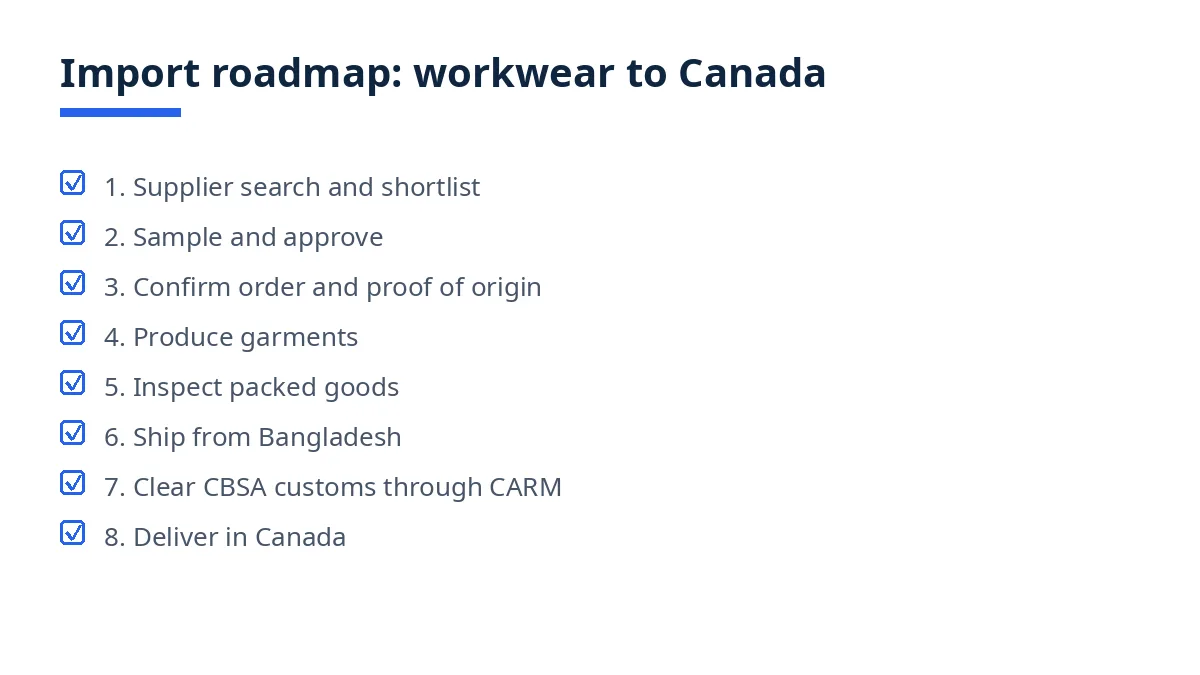
Write the specification garment by garment: type, cut, fabric composition and weight as your choices, colour, size curve, pockets, closures, reflective tape where needed, labels and packing.
Classify every garment from Chapter 62: 6203 and 6204 for trousers and overalls, 6211 for other garments including coveralls. Confirm each full 10-digit code, MFN rate and LDCT treatment with your broker for the entry date.
Settle the labelling route before sampling: retail sale with bilingual fibre content and dealer identity, or employer-use supply under the exemption, as your broker advises.
Shortlist suppliers whose range includes woven workwear, and request comparable quotes on the identical specification and delivery term.
Verify the chosen supplier: company documents, workwear capacity, fabric and tape route, and a video or in-person factory check.
Order samples in stages, test fit, closures, tape and wash performance, then approve a pre-production sample of each garment in production fabric, trims and label.
Confirm the order in writing: purchase order, pro forma invoice, delivery and payment terms, inspection plan with AQL and defect limits, labelling, packing and proof of origin.
Inspect during production and again on packed goods against the approved samples, checking measurements, tape, shade and labels.
Ship, clear customs through CARM with the confirmed code and treatment for each garment, and reconcile the actual landed cost against the quote-stage calculation.
How Exportain helps
Browse suppliers for Bangladeshi woven-garment exporters, then post your specification and target quantity as an RFQ and compare replies on the same terms before you choose a factory for sampling. Exportain is a B2B marketplace where buyers post RFQs, receive quotations and message suppliers. It does not inspect goods, book freight or clear customs.
FAQs
What is the typical MOQ for workwear and uniforms from Bangladesh?
There is no single typical minimum. It is set per garment and usually per colour, because fabric is woven or dyed in batches and a cutting plan is set up per size range.
How long does shipping take?
Production time and transit time are separate, and neither has a single typical figure. Sea transit takes weeks rather than days and varies by port, routing and season. Plan from your forwarder's current sailing schedule.
What import duty applies?
Duty follows the confirmed classification of each garment, the origin and the preference in force on the entry date. In the 2025 schedule opened for this guide, cotton lines 6203.42.00 and 6211.32.00 carry an MFN rate of 17 percent, synthetic-fibre line 6203.43.00 carries 18 percent, and the LDCT column shows Free for each of those lines.1 Bangladesh is listed among the LDCT beneficiaries, subject to origin rules and to the treatment in force on the entry date.2
How do I verify a supplier?
Check company documents first, so that name, address and bank account agree across the trade licence, export registration and invoices. Then check capability: woven workwear capacity, fabric source, dyeing, trim and tape route, and recent workwear production. Keep payments to the company account named in the documents.
Next steps on Exportain
Read how to import from Bangladesh for the full process and landed cost for imports from Bangladesh to build your own calculation. When ready, post a free RFQ on Exportain and compare quotes on the same terms.
Sources
- Chapter 62: T2025 - Articles of apparel and clothing accessories, not knitted or crocheted. Canada Border Services Agency (accessed )
- Canada's unilateral tariff preference programs for imports from developing countries. Department of Finance Canada (accessed )
- ISO 2859-1:2026 - Sampling procedures for inspection by attributes — Part 1: Sampling schemes indexed by acceptance quality limit (AQL) for lot-by-lot inspection. International Organization for Standardization (accessed )
- Guide to the Textile Labelling and Advertising Regulations. Competition Bureau Canada (accessed )
- Textile Labelling and Advertising Regulations. Justice Laws Website (accessed )
- Insider thoughts: Bob Ronai on Incoterms 2020 Rules; What are they about?. International Chamber of Commerce (accessed )
- Select the duties and taxes that apply. Canada Border Services Agency (accessed )
- CARM: Assess and pay duties and taxes on imported commercial goods. Canada Border Services Agency (accessed )
About the author
Sourcing from Bangladesh?
Post a request for quotation and suppliers on Exportain can send you their quotes directly.
Post an RFQ