

Australia Workwear Imports From Bangladesh: ABF Entry Guide
How to import workwear and uniforms from Bangladesh to Australia: ABF entry, duty-free preference, GST, labelling and landed cost for Australian buyers.
Short answer
To import workwear and uniforms from Bangladesh to Australia, specify each garment by group, fabric and size, verify the supplier and approve a pre-production sample, then clear the shipment through the Australian Border Force with the correct classification, duty-free preference evidence where it applies, and GST paid on the customs value plus freight and insurance.
On this page
Key takeaways
Qualifying Bangladesh-made workwear enters Australia duty-free under the LDC access granted in July 2003, provided the last process of manufacture took place in Bangladesh and at least 50 percent of total factory costs are allowable factory costs.
Consignments over AUD 1,000 need an ABF Import Declaration (N10), with all duties, taxes and charges paid before release; consignments at or under AUD 1,000 use a Self-Assessed Clearance Declaration.
GST on import is 10 percent of the value of the taxable importation: customs value plus any duty payable, international freight and insurance.
Clothing and uniforms that are not for personal protection are not PPE under Safe Work Australia guidance, while high-visibility clothing is PPE; name AS 4602.1:2024 for hi-vis garments in the specification.
Care labelling is mandatory for clothing in Australia under the Consumer Goods (Care Labelling) Information Standard 2023, using AS/NZS 1957:1998, ISO 3758:2012, or both.
To import workwear and uniforms from Bangladesh to Australia, start with the Australian entry rules and work backwards to the factory. The factory work is familiar: specification, samples, inspection and shipment. The Australia-specific work decides the landed cost and the clearance timetable: the tariff classification of each garment, the duty-free preference for qualifying Bangladesh-made goods, the 10 percent goods and services tax (GST) on imports, the Australian Border Force (ABF) import declaration, and the labelling and safety requirements that apply once the garments are sold or worn in Australia.
This guide is for Australian buyers: workwear brands, uniform suppliers, hire companies, councils, hospitals, schools and retailers buying corporate uniforms, hi-vis garments and industrial workwear. It states no typical minimum order, price or transit time, because none has a single figure across garment types, fabrics, sizes and volumes. Corporate uniforms and protective clothing are treated as two different buying problems, because Australian work health and safety (WHS) law treats them differently.
Why source workwear and uniforms from Bangladesh
Australia granted duty-free access to 49 least developed countries (LDCs), including Bangladesh, in July 2003.1 That access is the commercial reason to look at Bangladesh first for workwear, not the only reason: the country has a large woven-garment sector that already makes the drill, twill and poly-cotton fabrics workwear is usually cut from, and a supplier base used to size runs, repeat orders and buyer labelling.
Export Promotion Bureau (EPB) data reported in October 2025 put Bangladesh apparel exports to Australia at $816 million in FY23, $800 million in FY24 and $813 million in FY25, roughly flat for three years.2 The same report quoted a former BGMEA president saying buyers in Australia typically place small orders, which do not suit a volume-based apparel industry.2 If your order is small, say so in the first message, ask which suppliers take smaller runs, and expect the minimum to be set per style and colour rather than per order. The report also noted that, as a Southern Hemisphere market, Australia's off-peak seasons can let specialised factories use capacity year-round.2
Find and verify suppliers
Where should you start the search?
Start with a specification, not with factory names. Write down every style first: garment type, wearer (men, women or unisex), fabric and fibre composition, fabric weight, colour, size range in Australian sizing, trims, reflective tape where specified, labels and packing. Then shortlist suppliers whose current range already includes workwear or uniforms of the same construction. A supplier making only fashion shirts is not a close substitute for a hi-vis jacket programme, because tape application, seam strength and wash testing use different operations. Send every candidate the identical specification and ask for the same reply format: fabric assumed, sizes offered, price inclusions, validity and minimum per style and per colour. Browse suppliers on Exportain and read finding suppliers in Bangladesh before you shortlist.
How do you verify a supplier before you pay?
Verification has three layers. The first is company documents: trade licence, export registration and association membership where applicable, checked so that name, address and bank account name agree across every document. The second is capability: monthly workwear capacity, whether fabric is woven in-house or bought in, cutting and sewing lines, tape application for hi-vis styles, and which recent workwear styles the factory can show. The third layer is payment discipline: keep payments to the company account named in the documents, never to a personal account, and verify any change of bank details separately. Read how supplier verification works on Exportain for what document and photo checks cover. On Exportain, supplier profiles carry document and photo review badges. A badge is a review of documents and photos, not a factory inspection or a guarantee, and Exportain is not a party to the goods contract.
MOQ, pricing and samples
What is the typical MOQ for workwear and uniforms from Bangladesh?
There is no single typical minimum order quantity for workwear and uniforms from Bangladesh. The minimum is set per style and usually per colour, because fabric is woven or dyed in batches and a cutting plan is set up per size range. A plain navy drill shirt and a hi-vis jacket with taped seams and several sizes will not carry the same minimum. Ask each supplier how its minimum splits by style, colour and size run, and whether a smaller first order is possible at a higher unit price.
How is the price built, and how should you compare quotes?
Fabric usually accounts for more of the cost than any other element in workwear, followed by cutting and sewing, dyeing, trims, reflective tape where specified, testing, packing and the factory margin. Tape, bar tacks, reinforced knees and elbows, and flame-resistant finishes each add operations. Two quotes can differ because one assumes a lighter fabric, a shorter size range, no tape, no testing or a simpler trim set. Ask what each price is based on, in writing, so a lower quote is judged as a different specification rather than accepted as a saving. Compare quotes on the same basis: same garment, sizes, fabric, trims, delivery term and packing, with exclusions stated, for example testing, tape, special packing or freight to the Australian port.
Which samples do you need, and how do you approve them?
Work in stages. A development sample shows whether the factory can construct the garment, apply tape evenly and grade the size range. A pre-production sample, made in the actual production fabric, colour, trims and tape, is the sample you approve for bulk. Fit cannot be approved from a sample in substitute fabric, because washing and finishing change dimensions, and tape performance cannot be approved from a sample without tape. Test the samples as your customers will use them: fit the garment on the intended body size, wash it to the care label and check tape reflectivity and adhesion after washing, and confirm shade match across sizes.
Quality control and certifications needed
Which quality checks are specific to workwear?
Against the approved sample and size chart, check fabric composition and finished weight, measurements within your agreed tolerances, and consistency across the size range. Then check construction garment by garment: seam type and stitch density, bar tacks at pockets and stress points, tape width, placement and adhesion on hi-vis styles, zip and button function, and shade match across panels and sizes.
Agree the inspection method and defect limits before production. ISO 2859-1:2026 defines a system of acceptance sampling plans for inspection by attributes, and AQL stands for acceptance quality limit, the maximum average percentage of defective items considered acceptable during random sampling.3 Inspect in stages: an inline check during sewing catches drift while correction is still possible, and a final random inspection on packed goods checks quantity, workmanship, measurements, labels and packing. See the acceptance quality limit and pre-shipment inspection guides.
Is your garment PPE, or is it a uniform?
Safe Work Australia states that clothing and uniforms that are not for personal protection are not PPE, while high-visibility clothing is an example of PPE.4 The distinction decides who carries the obligation: as the person conducting a business or undertaking (PCBU), the employer must give workers PPE if they need it, select PPE that is reasonably comfortable and suitable for the worker and the task, provide information, training and instructions on use and maintenance, and periodically assess whether the PPE is and continues to be effective.4
For hi-vis garments, name the applicable standard in the specification and ask for the matching test evidence. The current high-visibility standard listed for Australia is AS 4602.1:2024, High visibility safety garments, Part 1: Garments for high risk applications, alongside AS/NZS 4501.1:2008 on occupational protective clothing selection, use, care and maintenance.5 A report for a different fabric, a daytime-only garment or an unwashed sample does not cover your day/night garment after washing.
Which labels does Australia require?
Care labelling is mandatory for clothing and other textile products in Australia. The Australian Government introduced the Consumer Goods (Care Labelling) Information Standard 2023, which became effective on 5 September 2023, and it allows labelling under AS/NZS 1957:1998, ISO 3758:2012, or both.6 The standard applies to clothing, household textiles, furnishings, piece goods and several other textile categories.6 Agree the care wording at sampling stage and check it against the fabric you bought, because a wash instruction that the fabric cannot survive will produce returns, not compliance. Fibre content is not mandated by that care labelling standard, although it is expected by most consumers.5 State the fibre composition on your specification and invoice anyway, since your tariff classification is built on it.
Incoterms, shipping and transit time
Which delivery term should a first order use?
The Incoterms 2020 rules set out, for each rule, where delivery takes place, and risk passes from seller to buyer at the same point and time as delivery.7 Under FOB, CFR and CIF the seller must place the goods on board the vessel.7 On customs, in all rules but EXW the seller must carry out export formalities, and in all rules but DDP the buyer must carry out import formalities.7 The same ICC Academy summary notes that the four sea rules, FAS, FOB, CFR and CIF, are only intended for port-to-port bulk or break-bulk shipments and are not suitable for container shipments, because a container is handed to the carrier before it is on board.7
For a first order shipped in containers, weigh FOB at the Bangladeshi port against FCA at the named terminal. Under FOB, the factory delivers the goods on board and your forwarder handles the sea leg. Under FCA, delivery happens when the goods are handed to your carrier, which matches how containerised cargo moves. Either way, keep the Australian import entry in your own hands or your broker's hands: you, not the seller, are responsible for the accuracy of the import declaration, even if a broker prepares it.8 See Incoterms for shipments from Bangladesh for the comparison for this route.
How long does shipping take?
There is no single typical transit time for workwear from Bangladesh to Australia. Sea freight is the standard route for bulk orders and takes weeks rather than days, varying by port, routing, transshipment and season. Plan from your forwarder's current sailing schedule, and add clearance and delivery. Keep production time separate: an order is ready only when every garment has finished sewing, taping, inspection and packing. Confirm garments per carton, carton dimensions and weight in the specification, because workwear cartons are bulky and carton volume can limit a shipment before weight does.
Import duty, taxes and documents
How are workwear and uniforms classified for duty?
Duty follows the classification of each garment in the Australian tariff, not the supplier's product name. The main headings are:
Garment group | Heading | What sits there |
|---|---|---|
Men's or boys' suits, ensembles, jackets, trousers, overalls, shorts (not knitted or crocheted) | 6203 | Woven men's work trousers, jackets and overalls |
Women's or girls' suits, ensembles, jackets, dresses, skirts, trousers (not knitted or crocheted) | 6204 | Woven women's work trousers, jackets and uniforms |
Men's or boys' suits, ensembles, jackets, trousers (knitted or crocheted) | 6103 | Knitted men's workwear |
Women's or girls' suits, ensembles, jackets, trousers (knitted or crocheted) | 6104 | Knitted women's workwear |
Garments of fabrics of heading 5602, 5603, 5903, 5906 or 5907 | 6210 | Coated and protective-type garments, including lines 6210.20 and 6210.30 |
Tracksuits, ski suits and other garments, not elsewhere specified | 6211 | Other workwear garments that fit no heading above |
Classify each style separately: a woven cotton drill trouser, a knitted polo used as a uniform shirt and a coated wet-weather jacket in one order can sit on three different lines. Confirm the full national code and rate for each style with your broker before you price or ship.
What import duty applies to goods from Bangladesh?
For qualifying Bangladesh-made goods, the answer is no duty. Australia granted duty-free access to 49 least developed countries, including Bangladesh, in July 2003.1 For a manufactured product to qualify, the last process of manufacture must have taken place in Bangladesh, and at least 50 percent of the total factory costs must be allowable factory costs, covering materials, labour and overheads.1 Materials from non-LDC countries that can be counted as local content are limited to 25 percent of the total factory cost.1 Agree the origin evidence at order stage: which materials come from where, and what factory-cost calculation the supplier will support.
Two cautions apply. The tariff schedule itself states that, unless otherwise indicated, NZ, PG, FI, DC and LDC rates are Free, so check the preference line by line rather than assuming it for every garment.9 From 1 July 2024 the rates for 457 tariff subheadings and headings were reduced to Free, including certain clothing lines, so some workwear lines may now carry a Free general rate even without a preference.9 In the Schedule 3 chapter 62 pages in the ABF notice opened for this guide, the other-garment lines 6210.20.00 and 6210.30.00 carry a general rate of 5 percent, and the protective-garment lines 6210.40.10 and 6210.40.20 also carry 5 percent.9 Confirm the current rate for each of your lines at entry date. Reports in 2025 also said the duty-free facility is expected to continue for five more years after Bangladesh graduates from LDC status in 2026.2 Treat that as a reported expectation, not a guarantee, and have your broker confirm the preference in force on your entry date.
What GST applies on import?
GST is payable on most goods imported into Australia, at 10 percent of the value of the taxable importation.10 That value is the sum of the customs value of the goods, any customs duty payable, the amount paid or payable to transport the goods to their place of consignment in Australia, the insurance cost for that transport, and any wine tax payable.10 GST is generally payable before the goods are released, unless you are registered under the deferred GST scheme, which lets an importer defer payment until the first activity statement lodged after the goods are imported.10 If you are GST-registered and you import goods for a creditable purpose, you may be able to claim a GST credit for the GST paid, but you must hold documentation showing the goods were imported and GST was paid or deferred.10
Which documents do you need for clearance?
A consignment with a combined value over AUD 1,000 that is being cleared into home consumption needs an Import Declaration (N10), and you must pay all applicable duties, taxes and charges before the goods can be released.8 The declaration states the goods, the importer, how the goods are transported, and the tariff classification and customs value.8 For goods worth AUD 1,000 or less arriving by air or sea cargo, a Self-Assessed Clearance (SAC) Declaration applies instead, and the ABF encourages first-time or infrequent importers to use a licensed customs broker.8 Keep all relevant documents for five years after the declaration.8
The standard import set is the commercial invoice, packing list, bill of lading or air waybill, and proof of origin where a preference is claimed. The invoice should name each style plainly, for example woven cotton men's work trouser, with composition, sizes, quantities, unit prices and the delivery term, on its own line. Keep woven, knitted and coated styles on separate lines matching their classifications. Quantities, weights and carton counts must agree across every document.
Biosecurity is a separate check that runs alongside customs. Under the Department of Agriculture, Fisheries and Forestry (DAFF) non-commodity cargo clearance conditions, the consignment must be free from unacceptable packing materials, timber or bamboo packaging and dunnage must be declared, and all solid wood components of timber packaging and dunnage must be treated offshore in compliance with ISPM 15 and marked accordingly.11 The container must also be clean before loading and free from contamination with materials of animal and plant origin.11 Ask your supplier for a packing declaration covering these statements before the container is loaded, and check the current BICON case for your consignment, since conditions vary by packing type and destination.
Landed cost example
A landed cost is the full cost of one garment, ready to sell. Every number below is an example figure only, not a quote.
Example figures: 2,400 cotton drill work shirts, FOB Chattogram, sea freight to Sydney, duty at nil under the LDC preference where the origin test is met, GST at 10 percent of the value of the taxable importation.
Cost element | Example figures (per shirt) | How to obtain your figure |
|---|---|---|
Product price, FOB | A$15.00 | Confirmed pro forma invoice |
International freight | A$1.80 | Forwarder quote divided by shirts shipped |
Insurance | A$0.15 | Policy or forwarder quote |
Duty | A$0.00 | LDC preference, only where the origin test is met |
GST on import | A$1.70 | 10 percent of A$16.95 (customs value plus freight plus insurance, with duty at nil) |
Clearance, broker and import processing charge | A$0.60 | Broker invoices divided by shirts shipped |
Local delivery to warehouse | A$0.45 | Local carrier quote divided by shirts shipped |
Total landed cost | A$19.70 | Sum of all lines above |
GST paid at import is not necessarily a final cost: a GST-registered business importing for a creditable purpose may be able to claim a GST credit, with the import declaration as evidence.10 Work the calculation twice: at quote stage, style by style, and again after shipment with the actual invoices. If the preference does not apply to a style, duty at the general rate for that line enters the GST calculation as well, so have your broker price both cases. See landed cost for imports from Bangladesh for the full method.
Step-by-step import checklist
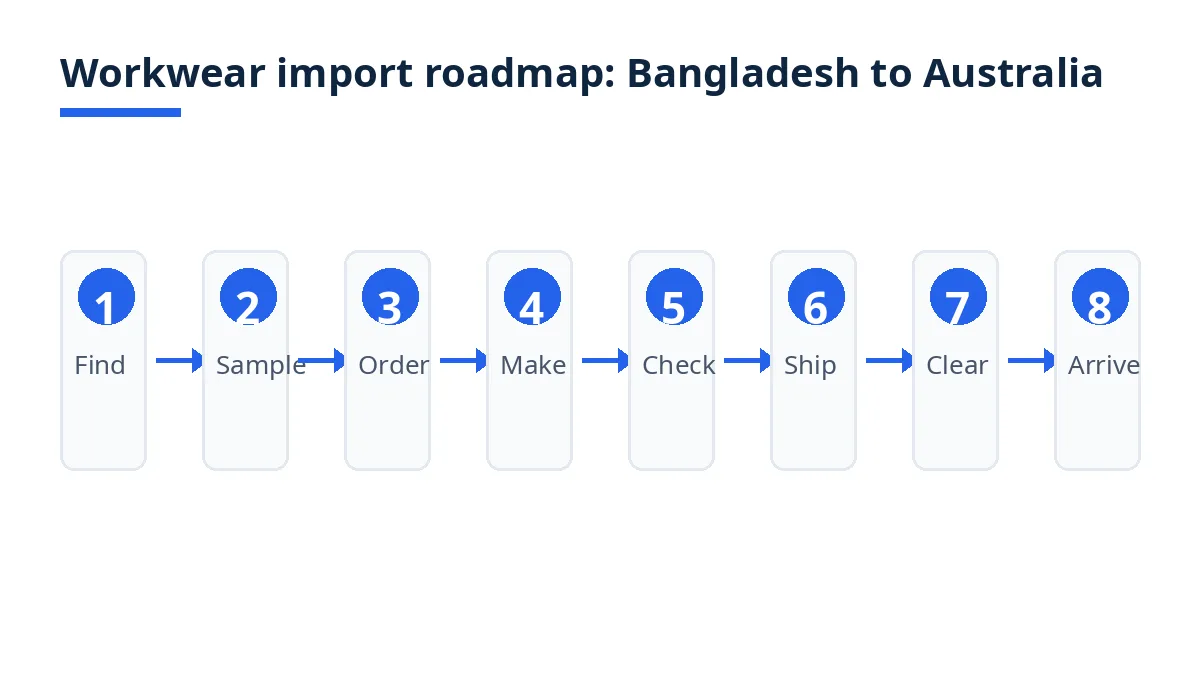
Write the specification style by style: garment group, wearer, fabric and composition, weight, colours, Australian size range, trims, tape where specified, labels and packing.
Split the range into PPE and non-PPE styles, and name any applicable Australian standard, such as AS 4602.1:2024 for hi-vis garments.5
Classify every style from headings 6203, 6204, 6103, 6104, 6210 and 6211, and confirm each code, duty preference and GST treatment with your broker.
Shortlist suppliers whose range already includes workwear or uniforms of the same construction, and request comparable quotes on the identical specification and delivery term.
Verify the chosen supplier: company documents, workwear capacity, fabric source, tape route, and a video or in-person factory check for a first order.
Order samples in stages, wash-test tape and fabric to the care label, then approve a pre-production sample of each style in production fabric and trims.
Confirm the order in writing: purchase order, pro forma invoice, delivery and payment terms, inspection plan with AQL and defect limits, labelling, packing and shipment date.
Inspect during production and again on packed goods against the approved samples, checking measurements, tape, shade and size consistency.
Ship with a packing declaration covering the DAFF timber, bamboo and container-cleanliness statements, and lodge the ABF declaration for consignments over AUD 1,000 before release.8 11
Clear customs with the confirmed code and origin evidence for each style, claim any GST credit you are entitled to, and reconcile the actual landed cost.
How Exportain helps
Browse suppliers for Bangladeshi workwear and uniform exporters and compare their ranges against your style list. Then post your specification and target quantity as an RFQ and compare replies on the same terms before you choose a factory for sampling. Exportain is a B2B marketplace where buyers post RFQs, receive quotations and message suppliers. It does not inspect goods, book freight or clear customs.
FAQs
What is the typical MOQ for workwear and uniforms from Bangladesh?
There is no single typical minimum. It is set per style and usually per colour, because fabric is woven or dyed in batches and a cutting plan is set up per size range. Australian buyers should state small-order needs early, since Australian buyers typically place small orders, which do not suit a volume-based apparel industry.2
How long does shipping take?
Production time and transit time are separate, and neither has a single typical figure. Sea transit takes weeks rather than days and varies by port, routing, transshipment and season. Plan from your forwarder's current sailing schedule, and add ABF clearance and local delivery.
What import duty applies?
For qualifying Bangladesh-made goods, no duty applies under the duty-free access granted to least developed countries in July 2003, provided the last process of manufacture took place in Bangladesh and at least 50 percent of total factory costs are allowable factory costs.1 The tariff schedule itself notes that, unless otherwise indicated, LDC rates are Free, and some lines may now carry a Free general rate following the 1 July 2024 reduction.9 GST still applies: 10 percent of the value of the taxable importation, which includes customs value, duty payable, freight and insurance.10 Confirm each line with your broker at entry date.
How do I verify a supplier?
Check company documents first, so that name, address and bank account agree across the trade licence, export registration and invoices. Then check capability: workwear capacity, fabric source, tape application route and recent workwear production. Keep payments to the company account named in the documents, and approve a pre-production sample of each style before bulk production.
Next steps on Exportain
Read how to import from Bangladesh for the full process, then use landed cost for imports from Bangladesh to build your own per-garment calculation. When ready, post a free RFQ on Exportain and compare quotes on the same terms.
Sources
- Expanding Your Export Horizons: Exporting to Australia. Australian High Commission, Dhaka (accessed )
- Growth of garment exports to Australia stagnate. tob.news, (accessed )
- ISO 2859-1:2026 - Sampling procedures for inspection by attributes — Part 1: Sampling schemes indexed by acceptance quality limit (AQL) for lot-by-lot inspection. International Organization for Standardization (accessed )
- Personal Protective Equipment (PPE). Safe Work Australia (accessed )
- Clothing and Textiles Regulations in Australia: A Quick Guide. ComplianceGate, (accessed )
- Australia - Update Care Labelling Regulation for Clothing and Textiles. Intertek (accessed )
- Insider thoughts: Bob Ronai on Incoterms 2020 Rules; What are they about?. International Chamber of Commerce (accessed )
- Import declarations. Australian Border Force (accessed )
- Australian Customs Notice No. 2024/17: Removal of nuisance tariffs and extension of duty reduction for Ukrainian goods. Australian Border Force, (accessed )
- GST and imported goods. Australian Taxation Office (accessed )
- BICON: Non-Commodity Cargo Clearance import conditions. Department of Agriculture, Fisheries and Forestry (accessed )
About the author
Sourcing from Bangladesh?
Post a request for quotation and suppliers on Exportain can send you their quotes directly.
Post an RFQ


