

Importing Knitted Underwear From Bangladesh to UAE: Costs, Duties and Suppliers
Import knitted underwear from Bangladesh to UAE: GCC duty, 5% VAT, Jebel Ali routing, HS 6107 and 6108, supplier checks, MOQ, samples, quality control and a landed-cost example for UAE buyers.
Short answer
To import knitted underwear from Bangladesh to UAE, confirm your customs code and VAT position, classify each style under heading 6107 for men and boys or 6108 for women and girls, and confirm the duty line with your broker before pricing. Agree the English and Arabic label and a pre-production sample in production fabric and elastic, set the inspection plan in writing, and build the landed cost style by style before bulk production.
On this page
Key takeaways
Knitted underwear for men and boys sits in heading 6107 and for women and girls in heading 6108. Subheadings split by fibre, including cotton, man-made fibres and other textile materials.
Duties levied on imports into the UAE are mostly a unified 5 percent, and the GCC Common External Tariff sets a default rate of 5 percent, with certain goods at other rates. Confirm the line for your styles with your broker before pricing.
The UAE applies VAT at 5 percent, and VAT on imports is calculated on the customs value plus duty. Confirm how the reverse charge applies to your business with your broker or tax adviser.
There is no single typical MOQ, price or transit time for knitted underwear. Confirm each one in writing for your exact fabric, elastic, size curve, colour range, route and shipment date.
Agree the fibre label, the care label and any conformity evidence before bulk production. A label sewn in Bangladesh is far cheaper to correct than one changed after the goods reach the UAE.
To import knitted underwear from Bangladesh to UAE, start with the UAE side of the order: the customs code, the classification of each style, the duty and VAT treatment, and the label you will put on the garment. Fit and fabric decide a knitted underwear order before price does. Waistband elastic, rise, leg opening, size curve and fabric recovery decide whether a style is reordered, and those points cannot be fixed after bulk production starts.
This guide is for UAE-based buyers buying for sale in the Emirates, from a mainland company or a free zone. Confirm every rate with your broker before you price. Treat the first order as a controlled test: one supplier, one fabric family and a narrow size range.
UAE import at a glance
Knitted underwear for men and boys sits in heading 6107 and for women and girls in heading 6108, with subheadings by fibre. Confirm the full UAE code for each style with your broker.
Duties levied on imports into the UAE are mostly a unified 5 percent, and the GCC Common External Tariff sets a default rate of 5 percent, with certain goods at other rates. Confirm the line for your styles before you price.
The UAE applies VAT at 5 percent, and VAT on imports is calculated on the customs value plus duty. Confirm how the reverse charge applies to your business with your broker or tax adviser.
There is no single typical MOQ, price or transit time. Confirm each one in writing for your exact fabric, elastic, size curve, colour range, route and shipment date.
Agree the fibre label, the care label and any conformity evidence before bulk production.
Why source knitted underwear from Bangladesh
Knitted underwear suits factories that already run circular knitting, cutting, sewing and elastic application for close-fitting garments.
A factory that makes T-shirts is not automatically a good underwear factory: narrow elastic insertion, waistband folding that must hold its width after washing, and leg elastic that must sit flat need daily practice. Look for current production of briefs, boxers, trunks or panties in the fabric family you want.
Fabric choice shapes the order. Cotton-rich single jersey is a common base for everyday underwear, cotton and elastane blends add stretch and recovery for fitted styles, and man-made fibre blends are used where quick drying or lower fabric weight is wanted. Name the fabric construction, weight, fibre composition and elastane content in your specification.
Find and verify suppliers
Where should you start the search?
Start with a written specification, not with factory names: garment type, wearer, fibre composition, fabric construction and weight, elastane content, waistband type and width, elastic type, rise, leg opening finish, stitching, size curve, colours, labelling and packing. Then shortlist suppliers whose current range already includes knitted underwear in that fabric family. Browse suppliers on Exportain, read finding suppliers in Bangladesh, and check the HS code guide for knitted underwear so classification is settled early.
Send every candidate the identical specification and ask for the same reply format. A supplier that replies with a different fabric or waistband has quoted a different product.
How do you verify a supplier before you pay?
Check company documents first: trade licence, export registration and association membership where applicable, so name, address and bank account name agree. Then check capability: knitting or fabric sourcing route, cutting capacity, sewing lines, elastic and waistband operations, and dyeing and finishing route.
Read how supplier verification works on Exportain. Supplier profiles may carry document and photo review badges. A badge is a review of documents and photos, not a factory inspection or a guarantee, and Exportain is not a party to the goods contract.
MOQ, pricing and samples
What is the typical MOQ for knitted underwear from Bangladesh?
There is no single typical minimum order quantity. The minimum is set per style and usually per colour, because fabric is knitted, dyed and finished in batches, elastic and waistband materials are bought in rolls, and a cutting plan is set up per size curve. A plain cotton brief in three core colours will not carry the same minimum as a printed trunk in eight fashion colours with a branded waistband.
Ask how the minimum splits by style, colour, size curve and fabric, and record the answer in writing.
How is the price built, and how should you compare quotes?
Fabric is usually the largest cost element, followed by cutting and sewing, elastic and waistband materials, dyeing and finishing, labelling and packing, testing and the factory margin. Fabric use per garment depends on size, rise, leg opening and fabric width, and elastane content and waistband type add cost a plain fabric price does not show.
Two quotes can differ because one assumes a lighter fabric, a lower elastane content, a simpler waistband, a narrower size curve or different packing. Ask what each price is based on, in writing, and compare quotes on the same basis: same styles, sizes, fabric, elastic, waistband, delivery term, labelling and packing.
Which samples do you need, and how do you approve them?
A development sample shows whether the factory can construct the garment and form the waistband evenly. A pre-production sample, made in the actual production fabric, colour, elastic and waistband, is the sample you approve for bulk. Fit and shrinkage cannot be approved from a sample in substitute fabric.
Wear each style, wash it following your care label, and measure it again after washing. Check the waistband and leg opening in every size, because grading errors show at the ends of the curve.
Quality control and certifications needed
Which quality checks are specific to knitted underwear?
Against the approved sample, check fabric composition, finished weight, measurements within agreed tolerances, and consistency across the size curve. Then check waistband width and join, elastic stitching and tension, leg opening finish, seam strength, stitch density and holes at the elastic line.
Agree the inspection method before production. ISO 2859-1 defines acceptance quality limit (AQL) as the quality level that is the worst tolerable process average when a continuing series of lots is submitted for acceptance sampling.1 Agree the inspection level, sample size rule, defect classes and acceptance numbers, and apply that rule to a random sample. See the acceptance quality limit and pre-shipment inspection guides, and the knitted underwear quality control checklist.
Which label and conformity rules apply in the UAE?
Agree label wording, fibre composition, care, size and origin at sampling stage, and check the finished label before bulk sewing. For the UAE, agree labels in English and Arabic, and confirm current labelling rules with your broker or conformity body before approving artwork.
Textiles appear in the regulated product scope described by SGS for the UAE conformity system, and a certificate of conformity is mandatory before a regulated product can be traded on the UAE market.2 Whether your line needs an Emirates Conformity Assessment Scheme (ECAS) certificate depends on the product, its claims and the current regulated list. Confirm the position with the Ministry of Industry and Advanced Technology (MoIAT) route or a conformity body before ordering testing.
Which certifications do you actually need?
No single certificate covers every order. What you need follows your market, your customer and the claims you make, and any customer requirement should be written into the specification.
Many buyers ask for OEKO-TEX STANDARD 100 evidence. Product Class II covers textiles whose surface comes into direct contact with the skin, including underwear, bed linen, towels, shirts, blouses and socks.3 The certificate is awarded only if all components meet the criteria, including fabric, threads, dyes, finishes, prints and accessories.3
Incoterms, shipping and transit time
Which delivery term should a first order use?
Under FOB, risk passes when the goods are on board the vessel, and under CFR and CIF risk also passes on loading at origin even though the seller pays freight to the destination port.4 For container shipments, FCA is often the closer fit, because risk transfers when the goods are handed to the carrier nominated by the buyer.4
Weigh FOB against FCA, and read the Incoterms guide for shipments from Bangladesh. CIF and CIP add seller-arranged insurance but do not move the risk point to arrival.4
How long does shipping take, and which route should you use?
There is no single typical transit time. Sea freight is the standard route for bulk orders, and it takes weeks rather than days.
The usual sea route runs from Chattogram to Jebel Ali. A regional service described by DP World rotates between Port Klang, Jebel Ali, Karachi, Chattogram, Belawan and Mundra.5
Import duty, taxes and documents: import knitted underwear from Bangladesh to UAE
How are knitted underwear styles classified for duty?
Duty follows the classification of each style in the UAE tariff, not the supplier's product name. Heading 6107 covers men's or boys' underpants, briefs, nightshirts, pyjamas, bathrobes, dressing gowns and similar articles, knitted or crocheted, and heading 6108 covers women's or girls' slips, petticoats, briefs, panties, nightdresses, pyjamas, negligees, bathrobes, dressing gowns and similar articles, knitted or crocheted.6 Subheadings split by fibre, including cotton, man-made fibres and other textile materials. Confirm the full UAE code for each style before you price or ship, and treat every heading here as indicative. Verify the full code on the current UAE tariff or with your broker.
What import duty applies?
Your rate depends on the confirmed code, customs value, origin and any preference or exemption in force on the entry date, so no single rate for a whole order can be stated without that check. Duties levied on imports are mostly of a unified percentage of 5 percent, except for tobacco products at 100 percent and alcoholic beverages at 50 percent, with exemptions detailed in the list of goods exempted under the unified customs tariff for GCC states.7 The GCC Common External Tariff sets standard customs duty rates at a default rate of 5 percent, with certain goods subject to zero, 10 percent or higher rates under specific conditions.8 Read those statements as the general framework, indicative for your entry date, and confirm the current line rate for each style with your broker.
The UAE uses the transaction value method as the primary basis for customs valuation, valuing goods at the price actually paid or payable when sold for export to the UAE.8
What VAT applies, and how is it accounted for?
The UAE imposes VAT on tax-registered businesses at 5 percent on a taxable supply at each step of the supply chain, and VAT-registered businesses collect the amount on behalf of the government while consumers bear the VAT in the cost of taxable goods and services they purchase.9 For imports, VAT is calculated at 5 percent on the sum of the CIF customs value, any applicable customs duty and excise tax where relevant, with that aggregate treated as the taxable value at entry.10 Knitted underwear is not an excise product, so the excise element should not arise for these styles, but confirm that position with your broker if any style carries a different treatment.
How import VAT is paid depends on registration. VAT-registered importers may account for import VAT through the reverse charge mechanism on the VAT return instead of paying it at the border, declaring the taxable import value and claiming the equivalent input tax, with the customs declaration referencing the importer's Tax Registration Number.10 That treatment is not automatic. Confirm whether reverse charge applies to your entry, which return period it falls in, and which records you must keep. An unregistered buyer should budget for VAT as a cash cost at clearance.
Which documents do you need for clearance?
The importer must hold a valid UAE trade licence and apply for a customs code through the relevant emirate portal, with the code linked to the trade licence.10 The mandatory documents include the commercial invoice, packing list, bill of lading or airway bill, and certificate of origin, with the invoice stating seller and buyer details, description, price, value, currency, Incoterms and origin, and the packing list detailing weight, dimensions and package count matching the invoice.10 A certificate of origin is required to claim preferential duty rates.10
Quantities, weights, carton counts, values and codes must agree across every document: missing or mismatched documents trigger inspection holds and storage charges.10
Landed cost example (table)
A landed cost is the full cost of one garment, ready to sell from your UAE warehouse, excluding any VAT you can recover. Every number below is an example figure only, not a quote, and every figure must be replaced with your confirmed invoice, forwarder quote and broker calculation.
Example figures: 20,000 cotton briefs, FCA Chattogram, sea freight to Jebel Ali, duty and VAT at the example rates only, in US dollars per garment. Example figures are used throughout this table and the notes that follow it.
Cost element | Example figures (per garment) | How to obtain your figure |
|---|---|---|
Product price, FCA | $0.62 | Confirmed pro forma invoice |
International freight | $0.09 | Forwarder quote divided by garments shipped |
Insurance | $0.01 | Policy or forwarder quote |
CIF value | $0.72 | Sum of product price, freight and insurance |
Duty at 5 percent of CIF value | $0.04 | Broker calculation from confirmed codes and rates |
Port, clearance and broker fees | $0.05 | Broker and port invoices divided by garments |
Local delivery to warehouse | $0.03 | Local carrier quote divided by garments |
Total landed cost, excluding recoverable VAT | $0.84 | Sum of all lines above |
VAT at 5 percent of CIF value plus duty | $0.04 | Broker or tax adviser calculation for your entry |
Total landed cost, including VAT paid at entry | $0.88 | Sum of landed cost and VAT |
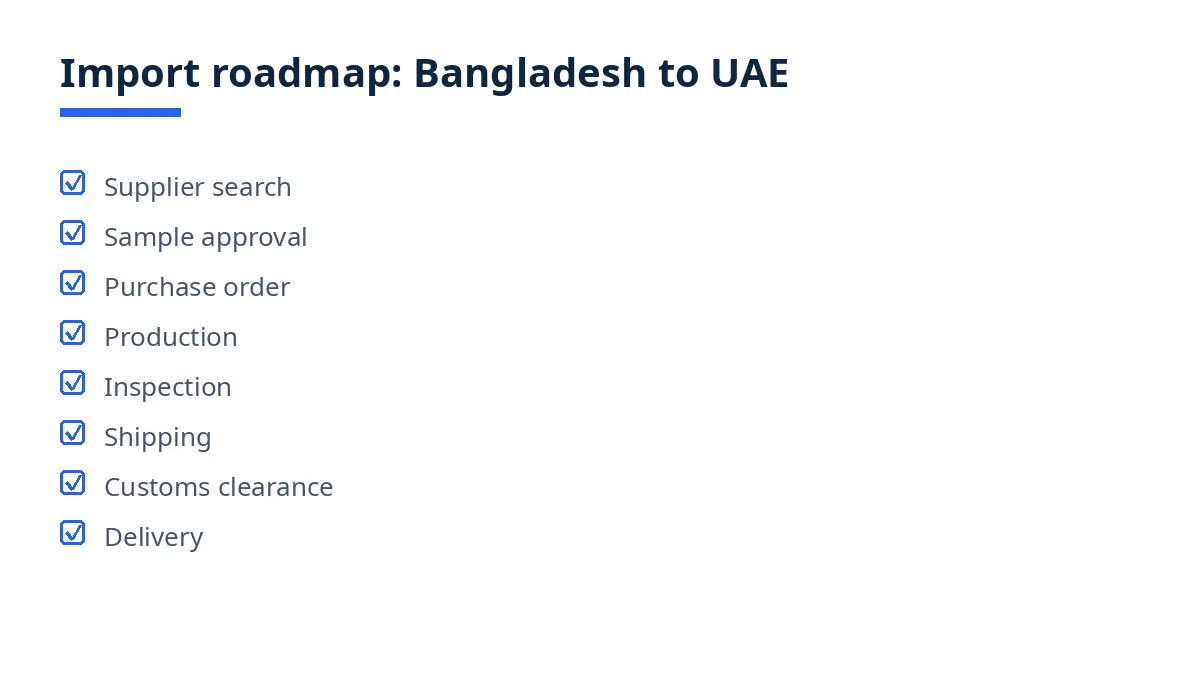
Work the calculation twice: at quote stage and again after shipment with actual invoices. See landed cost for imports from Bangladesh for the full method, and read how to import from Bangladesh for the full process from specification to delivery.
Step-by-step import checklist
Write the specification style by style: garment type, wearer, fibre, fabric, elastane, waistband, elastic, rise, leg opening, size curve, colours, labels and packing.
Classify every style from heading 6107 or 6108 and the fibre subheading, and confirm each full UAE code, duty line and origin position with your broker.
Confirm your UAE entry position: trade licence, customs code, free zone or mainland warehouse, VAT registration and reverse charge treatment.
Shortlist suppliers whose current range includes knitted underwear, and request comparable quotes on the identical specification and delivery term.
Verify the chosen supplier: documents, underwear capacity, fabric and elastic route, dyeing and finishing route, and a video or in-person check for a first order.
Agree labels and conformity evidence: English and Arabic artwork, fibre, care, size and origin marking, and any ECAS or test evidence, before bulk label production.
Order samples in stages, wear and wash them, measure them again, then approve a pre-production sample of each style and colour in production fabric, elastic and waistband.
Confirm the order in writing: purchase order, pro forma invoice, delivery and payment terms, inspection plan, labelling, packing and shipment date.
Inspect during production and again on packed goods against approved samples, checking waistband, elastic, measurements, shade and packing.
Ship, clear customs with the confirmed code for each style and the full document set, and reconcile the actual landed cost style by style.
How Exportain helps
Browse suppliers for Bangladeshi suppliers and compare their ranges against your style list, then read how to buy for the buying steps on Exportain. When your specification is ready, post it as a request for quotation and compare replies on the same fabric, elastic, waistband, size curve, delivery term and packing before you choose a factory for sampling. Exportain is a B2B marketplace where buyers post RFQs, receive quotations and message suppliers. It does not inspect goods, book freight or clear customs, and it is not a party to the goods contract. Supplier badges reflect document and photo reviews, not factory inspections or guarantees, so keep your own verification checks for a first order.
FAQs
What is the typical MOQ for knitted underwear from Bangladesh?
There is no single typical minimum. It is set per style and usually per colour, because fabric is knitted, dyed and finished in batches, elastic and waistband materials are bought in rolls, and a cutting plan is set up per size curve. Ask how the minimum splits by style, colour, size curve and fabric, and record the answer in writing.
How long does shipping take?
Production time and transit time are separate, and neither has a single typical figure. Sea transit from Chattogram to Jebel Ali takes weeks rather than days and varies by sailing schedule, routing, transshipment, port congestion and season. Plan from your forwarder's current sailing schedule, and add clearance and delivery.
What import duty applies?
Duty follows the confirmed classification, customs value, origin and any preference or exemption in force on the entry date. Knitted underwear sits in heading 6107 for men and boys and heading 6108 for women and girls, with subheadings by fibre.6 Duties levied on imports are mostly a unified 5 percent, and the GCC Common External Tariff sets a default rate of 5 percent, with certain goods at other rates.7 8 Confirm the current line rate with your broker. VAT at 5 percent applies separately, calculated on the CIF value plus duty.9 10
How do I verify a supplier?
Check company documents first, so name, address and bank account agree across the trade licence, export registration and invoices. Then check capability: underwear production, fabric and elastic route, dyeing and finishing route and recent styles from current production. Keep payments to the company account named in the documents, and approve a pre-production sample of each style and colour before bulk production. On Exportain, treat document and photo review badges as document and photo reviews, not as factory inspections or guarantees.
Next steps on Exportain
Read how to import from Bangladesh for the full import process, then work your numbers with the landed cost guide for imports from Bangladesh. When your specification is ready, post a request for quotation on Exportain and compare replies on the same terms before you choose a supplier for sampling.
Sources
- SIST ISO 2859-1:2003 - Sampling procedures for inspection by attributes, Part 1: Sampling schemes indexed by acceptance quality limit (AQL). International Organization for Standardization, (accessed )
- Navigating UAE Product Conformity: Understanding ECAS and EQM Certification. SGS (accessed )
- OEKO-TEX STANDARD 100 for textiles tested for harmful substances. Hohenstein (accessed )
- Incoterms 2020 Explained: All 11 Rules. Blue Ocean Academy (accessed )
- New Bangladesh-Pakistan direct shipping route starts delivering results: DP World. The Business Standard (accessed )
- Harmonized Tariff Schedule of the United States, Chapter 61. U.S. International Trade Commission (accessed )
- Customs duties. Fujairah Customs (accessed )
- Customs Duties in UAE: GCC Common External Tariff. Nour Attorneys (accessed )
- Value Added Tax (VAT). UAE Government (accessed )
- UAE Customs Duty on Imports: Requirements and Calculation Guide. GlobalTradePlaza (accessed )
About the author
Sourcing from Bangladesh?
Post a request for quotation and suppliers on Exportain can send you their quotes directly.
Post an RFQ


