

Saudi Arabia Frozen Shrimp Imports From Bangladesh: SFDA Checklist
Saudi Arabia frozen shrimp imports from Bangladesh, registration-first: Ghad and Faseh clearance, Saber and halal scope checks, the 12-digit GCC line with broker-confirmed duty, Arabic labelling, and a riyal landed-cost example before duty and VAT.
Short answer
To import frozen shrimp from Bangladesh to Saudi Arabia, register the exact product on the SFDA Ghad platform under the Saudi importer, build the Faseh clearance request from the registered product, certified invoice, and bill of lading, settle the Saber and halal scope for this consignment, classify on the 12-digit GCC line, confirm duty and VAT bases with your broker, agree the Arabic label before packing, and complete the Bangladesh export file before loading.
On this page
Key takeaways
Register the exact shrimp product on the SFDA Ghad platform under the Saudi importer before import, and build the Faseh clearance request from the registered product, the certified invoice, and the bill of lading.
Settle the Saber and halal scope for this exact product, pack, and label in writing: neither a PCoC and SCoC nor a halal certificate should be assumed for plain frozen shrimp.
Classify on the 12-digit GCC tariff line from heading 0306.17, and price on a duty rate confirmed by the broker on the ZATCA schedule, never on a rate from another market.
Complete the Bangladesh export file before loading: export licence, no objection certificate, and salubrity certificate for the lot, plus the marine-catch certificate where it applies.
Price VAT at the 15 percent standard rate on the broker-confirmed base, and rework the SAR 37.95 per kilogram example subtotal before duty and VAT at quote stage and after shipment with actual invoices.
A Saudi shrimp order is decided in the Saudi registration and clearance file before it is decided on price. The product must be registered, the clearance request must match it, and the conformity and halal questions must be answered for this consignment.
This guide is for Saudi Arabia-based buyers bringing frozen shrimp from Bangladesh. Every cost figure is an example figure, every duty figure is a broker confirmation, and no minimum quantity is stated.
Register first: Ghad, Faseh and the Saudi clearance file
The Ghad Platform, from the Saudi Food and Drug Authority (SFDA), regulates the import, distribution, and marketing of food products in Saudi Arabia, and food products must be listed and registered before import.1 Registration is mandatory for companies importing food products, and no food product can enter the market unless registered under the Saudi importer's account.1
Registration needs the product name in Arabic, customs tariff code, shelf life, storage temperature, country of production, and manufacturer name, plus a complete label image in Arabic.1 Clearance is separate, through Faseh, an SFDA system integrated with Ghad, and a Faseh request needs a certified commercial invoice with batch numbers or expiry dates, the bill of lading, the port of entry, the products on the invoice, and an approved conformity assessment body.1 SGS describes registration through GHAD and shipments through FASEH, where complete documentation enables customs clearance.2
Settle the Saber question before you assume a certificate is needed
Do not assume a SABER certificate is required for frozen shrimp, and do not assume it is not required. Answer the question for this product, this HS line, and this consignment, through the conformity assessment body and the broker, before ordering.
The Saudi Standards, Metrology and Quality Organization (SASO) is the national standards body for the quality and safety of products entering the Kingdom, and businesses obtain a SASO certificate of conformity through the SABER electronic platform.3 SABER issues the Product Certificate of Conformity (PCoC), valid for one year, and the Shipment Certificate of Conformity (SCoC), issued per shipment, and all regulated products must be registered on SABER before they can clear Saudi customs.3 Classification comes first, because SASO maintains a list of regulated products, and goods outside the regulated scope may only need a self-declaration.3 The list read for this guide names electrical equipment, toys, textiles, building materials, automotive parts, food contact materials, cosmetics, appliances, lighting, and machinery, not frozen shrimp.3 SGS states that a certificate of conformity is mandatory for shipments from specific countries, naming Egypt and Jordan, Sri Lanka, Somalia and Sudan, and India, while noting it is not required for all countries, and that its certificates must be obtained before shipment.2 Bangladesh is not on that list, and that list is not a ruling for Bangladesh shrimp.
Check the halal scope: what the mandatory categories do and do not cover
Halal certification is a scope question, not a blanket requirement for food shipments. The SFDA has extended mandatory halal certification and halal shipment certification for several commonly consumed foods from November 2023, and importers must ensure halal certificates are issued only from bodies recognized by SFDA's Saudi Halal Center.4
The mandatory categories are halal slaughtering, meat processing, animal extractions such as gelatin, collagen, and enzymes, compound products containing meat, and all products bearing the word "Halal" or a logo.4 Plain frozen shrimp, with no meat, no animal-derived ingredient, and no halal word or logo, does not appear in those categories, while a product bearing a halal word or logo, or containing meat, gelatin, collagen, enzymes, or fat, falls in the "Others", compound, or extraction categories.4 Ask the broker and Saudi importer to confirm the halal position for the exact product before the label is printed. If a certificate is required, the documents include a valid halal certificate, shipment details, invoice and packing list, a GCC food export health certificate, and a country of origin certificate.4 If none is required, record that confirmation, and do not print a halal word or logo.
Classify on the 12-digit GCC line and get the duty from ZATCA, not from another market
Classification comes before price, because the duty, the Ghad tariff code, and the label all follow the code. Starting from January 1, 2025, the integrated tariff for the Gulf Cooperation Council (GCC) countries will begin at the 12-digit level, according to the Zakat, Tax and Customs Authority (ZATCA).5
The shared six-digit starting point is heading 0306.17, other shrimps and prawns, frozen. The line wording read on a tariff schedule here is shrimps and prawns of the species Penaeus vannamei and Penaeus monodon, whether in shell or not, not cooked, for processing, shown as commodity 0306 17 92 20.6 Treat that wording as indicative only: it comes from the United Kingdom tariff schedule, and the United Kingdom duty rate there does not apply to a Saudi import. No duty rate is stated here, because the ZATCA page opened for this guide shows the 12-digit structure and no shrimp rate.5 ZATCA provides a customs and tax calculator service for the duties and taxes on imported goods.7 Use it with the broker, on the confirmed line and entry date, and price on the broker-confirmed rate only.
Get the Bangladesh export file in order before loading
The Bangladesh side of the order has its own file, and it must be complete before loading. The Bangladesh Customs hub page for other shrimps and prawns, HS code 03063610, lists export documents issued by the Deputy Director of Fish Inspection and Quality Control in the Department of Fisheries.8 The documents are a licence for export, valid for one year, a no objection certificate, valid for the lot, and a salubrity certificate, valid for the consignment, each under the Fish and Fish Products (Inspection and Quality Control) Act, 2020.8 Where the product is extracted from marine sources, a certificate for illegal, unreported, and unregulated fisheries is required, under the Marine Fisheries Rules, 2023.8
Read that list as a starting point, not a complete file: the hub page warns that the list may not always be exhaustive.8 The hub page is for HS code 03063610, while the Saudi classification here is worked from heading 0306.17, so confirm which hub entry applies. Ask the supplier to send the export licence, no objection certificate, and salubrity certificate before loading, and to confirm whether the illegal, unreported, and unregulated fisheries certificate applies to a farmed lot, a wild-caught lot, or both. The hub page also lists farm registration, and a rule that fish from an unregistered farm shall not be used for export.8
Agree the Arabic label and the carton marks before packing
The label is agreed before packing, not corrected after printing. Ghad registration needs the product name in Arabic and a complete label image showing the required information in Arabic.1 The label registered, the label printed, and the label shipped must be the same label.
Agree the full label text with the Saudi importer and broker before the first carton is printed, and approve the finished artwork. Fix the species name and commercial designation in Arabic, the scientific name where required, production method and origin wording, and storage temperature in the registration words, and fix the net weight basis on the label, invoice, packing list, and Faseh request. On every carton, fix species, size or count, presentation, net weight, lot mark, and purchase order number. Do not print a halal word or logo unless the halal check confirms a certificate from a recognized body covers this product.4
Why Bangladesh fits a Saudi shrimp order
Bangladesh fits a Saudi order when the buyer needs farmed shrimp in defined sizes and presentations, from plants that already work to an export file Saudi clearance can check. The fit is between what the order requires, a species and size specification, a glaze and presentation specification, a Ghad registration, a Faseh file, a Saber and halal answer, and an Arabic label, and what a plant can show before the order: current production of the same species, size range, and pack format, with the export documents and label artwork required.
Specify the shrimp so the registration, label and invoice agree
One specification document carries the whole order. Write it before requesting prices, send the identical document to every supplier, and require replies in the same format, so quotes, registration, label, and invoice can be checked against one document.
Specification part | Fix in writing before quoting |
|---|---|
Species and origin | Species, scientific name, farmed or wild-caught, and origin wording as the broker confirms it |
Size and count | Size range or count per unit weight, uniformity rule, and out-of-range treatment |
Presentation | In shell or peeled, deveined or not, tail on or off, cooked or uncooked, and the exact name for the label and tariff line |
Glaze and weight | Glaze basis, net weight basis, drained weight where required, and weighing method |
Pack and carton | Pack weight, packs per carton, carton weight, carton marks, and label artwork approval |
Registration and file | Ghad fields, Faseh data, Saber and halal answers, and export documents |
Shipment | Reefer requirement, temperature range, temperature record, and sailing plan |
Find and check suppliers against the Saudi file
Shortlist suppliers whose current range already includes frozen shrimp in the species, size range, and presentation the order needs, packed for export, and whose plants already hold the Bangladesh export file. Browse suppliers on Exportain and read each profile against the Saudi specification, not a headline price. Shortlist three or four suppliers and send each the identical specification.
Verification has three layers, all before any payment. First, company documents: trade licence, export registration, and association membership where applicable, checked so name, address, and bank account agree across every document. Second, capability: current production of the specified species and presentation, and recent orders in the same presentation. Third, payment discipline: pay only the company account named in the documents, never a personal account, and verify any bank detail change separately, through a different channel. On Exportain, supplier profiles carry document and photo review badges, not a factory inspection or a guarantee, and Exportain is not a party to the contract, does not inspect goods, book freight, or clear customs.
MOQ, pricing and samples without a stated typical minimum
There is no single typical minimum for frozen shrimp from Bangladesh, and this guide states none. The minimum is set per species, size range, presentation, and pack format, because raw material is bought and processed in lots, and a packing run is set up per size and presentation. Ask how it splits by size, presentation, and pack format, and get the split in writing.
Ask for the price on the identical specification, with inclusions stated line by line. Read the frozen shrimp MOQ guide and the frozen shrimp price guide before comparing minimums and FOB figures. Samples work in stages: a product sample tests the specified species, size, and presentation, and a pre-shipment sample tests whether the production lot matches the approved sample. Approve each sample in writing, and keep one sealed counter-sample per presentation.
Quality control, cold chain and the reefer leg to the Saudi gateway
Quality control is agreed before production, not discovered at the Saudi port of entry. Agree the inspection method, defect classes, and acceptance limits in writing, and state who inspects, when, and on what sample. Agree what happens when inspection fails, who bears the cost, and the lot identity system, so every carton can be traced to its production lot, health certificate, and Ghad registration. Agree the frozen temperature range, pre-cooling of the reefer, and a temperature record travelling with the consignment.
Plan the reefer leg in three blocks: production time, sea transit, and Saudi clearance and delivery. No transit figure is stated, because no opened source states one for this reefer route. Plan from the forwarder's current sailing schedule, ask the forwarder, in writing, for the port of entry, the cold-store arrangement, and the clearance lead time, and send the full document set before arrival. Read the frozen shrimp quality control checklist before fixing the plan.
Delivery terms: FCA, CIF and DAP and the container trap
The delivery term must be stated in full in every document: rule, named place, and version, with cost and risk confirmed by the forwarder and broker. Incoterms are eleven three-letter trade terms, published by the International Chamber of Commerce (ICC), that define who arranges and pays for transport, at what point risk passes, and who handles export and import clearance.9 They say nothing about price, payment method, or when title transfers.9
The ICC sorts the rules into two families: seven for any mode of transport, EXW, FCA, CPT, CIP, DAP, DPU, and DDP, and four for sea and inland waterway transport, FAS, FOB, CFR, and CIF.9 For containerised reefer shrimp, the family matters: any-mode rules fit containerized cargo, handed over at an inland depot, and a common mistake is using a sea-only term like FOB for a container that changes hands at an inland yard.9 Under FCA, the seller delivers the goods, cleared for export, to a carrier or place named by the buyer, and risk passes on handover.9 Under FOB, the seller delivers when the goods are loaded on board, and risk passes once the goods are on board.9 Under CIF, the seller pays cost, freight, and a marine insurance policy to the destination port, while risk passes to the buyer once the goods are on board at origin, and the insurance is the minimum level, Institute Cargo Clauses (C), for at least 110 percent of the contract value.9 Under DAP, the seller delivers when the goods are placed at the buyer's disposal at the named destination, ready to be unloaded, while the buyer handles unloading and import clearance.9 The ICC page confirms the 2020 changes: FCA was revised for an on-board bill of lading, CIF and CIP now provide for different insurance levels, and Delivered at Terminal became Delivered at Place Unloaded (DPU).10
Landed cost example in Saudi riyals
A landed cost is the full cost of one unit of shrimp, ready at the Saudi cold store or plant, before duty and VAT are added on their broker-confirmed bases. Every number below is an example figure only, not a quote, for frozen shrimp in shell, uncooked, for processing, shipped by sea in a reefer container from Chattogram to a Saudi port of entry and delivered to a cold store. Confirm the duty rate, customs value base, VAT base, and every fee line with your broker and tax adviser before fixing a price.
Example figures: per kilogram, net weight basis as agreed in the specification.
Cost element | Example figures (per kilogram) | How to obtain your figure |
|---|---|---|
Product price, FOB Chattogram | SAR 31.50 | Pro forma invoice |
Freight and insurance, per kilogram | SAR 3.90 | Forwarder quote |
Customs value, per kilogram | SAR 35.40 | Broker calculation |
Duty, per kilogram | Broker rate applied to the customs value | Broker calculation on the confirmed 12-digit line |
Port, broker, and cold-store fees, per kilogram | SAR 1.45 | Broker and port invoices |
Delivery to cold store or plant, per kilogram | SAR 1.10 | Local carrier quote |
Subtotal before duty and VAT, per kilogram | SAR 37.95 | Sum of the lines above, excluding duty and VAT |
VAT | 15 percent on the broker-confirmed VAT base | Broker and tax adviser calculation |
The standard VAT rate is 15 percent, effective from 1 July 2020, as announced by ZATCA, and most goods and services are taxed at 15 percent, with food and beverages listed among the standard-rated examples.11 Goods imported on or after 1 July 2020 are subject to the 15 percent rate.11 Ask the broker and tax adviser to show the VAT base in writing, and work the calculation twice: at quote stage and again after shipment, with actual invoices. The arithmetic is 31.50 plus 3.90 equals 35.40, and 35.40 plus 1.45 plus 1.10 equals 37.95.
Saudi import sequence, step by step
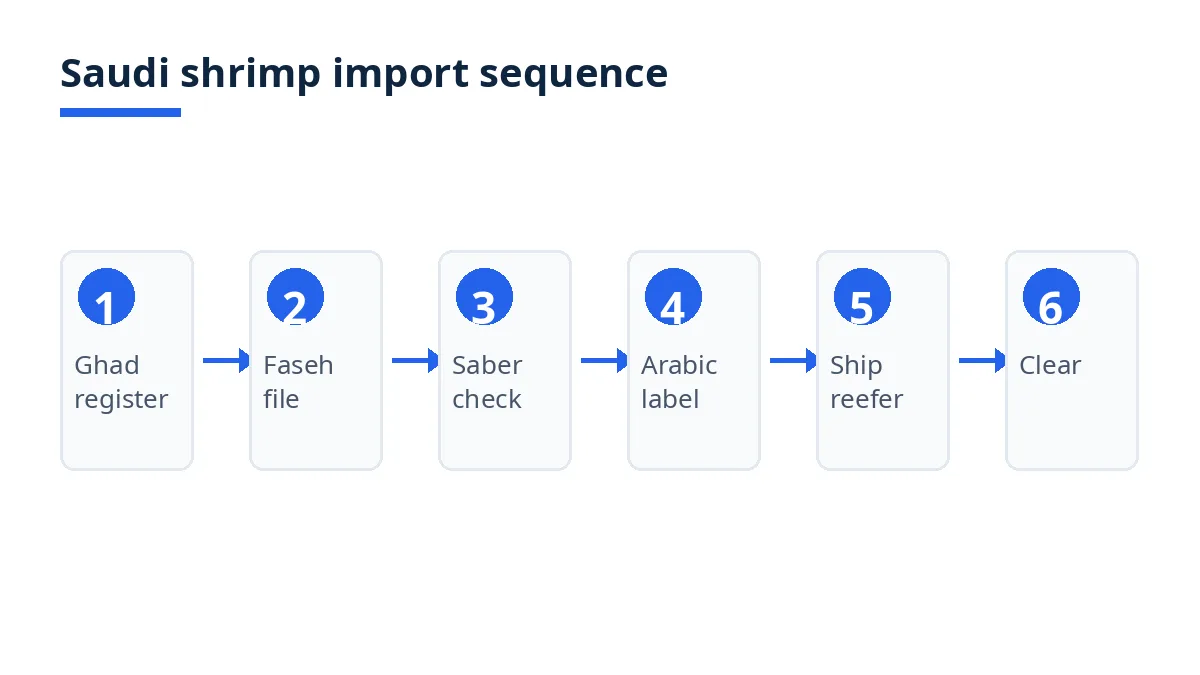
Name the Saudi importer, confirm the Ghad account, and confirm the product is registered.
Confirm the Saber classification and halal scope for this product and pack.
Confirm the 12-digit GCC tariff line, and ask the broker for the duty rate and VAT base.
Confirm the Bangladesh export documents, and ask the supplier to send them before loading.
Agree the Arabic label, approve the artwork, and check it against the registration.
Send one specification to every supplier, and compare quotes on the same terms.
Check the supplier on documents, capability, and payment discipline, before any payment.
Agree inspection, cold-chain range, and temperature recording, and approve samples in stages.
Build the Faseh request from the registered product, certified invoice, and bill of lading.
Ship on the agreed term, clear the Saudi entry, and reconcile the landed cost, duty, and VAT.
What is the typical MOQ for frozen shrimp from Bangladesh?
There is no single typical minimum, and no figure is stated here. The minimum is set per species, size range, presentation, and pack format, so ask how it splits, and get the split in writing.
How long does shipping take?
Production time, sea transit, and Saudi clearance and delivery are separate blocks. Sea transit varies by port pair, routing, transshipment, and season, and clearance varies by the Faseh request and the file. No transit figure is stated. Plan from the forwarder's sailing schedule, and ask for the clearance lead time.
What import duty applies?
Duty follows the classification, species, presentation, end use, and the broker-confirmed rate on the 12-digit GCC line. Starting from January 1, 2025, the GCC integrated tariff applies at the 12-digit level.5 No duty rate is stated, because the ZATCA tariff page opened for this guide shows the structure and no shrimp rate. Use the ZATCA calculator with the broker, on the confirmed line and entry date, and price on the broker-confirmed rate only.7 The 12 percent rate on the United Kingdom tariff page is a United Kingdom third country duty, not a Saudi duty.6
How do I verify a supplier?
Check company documents first, so name, address, and bank account agree across the trade licence, export registration, and invoices. Then check capability: current production of the specified species, size range, and presentation, and the Bangladesh export documents for the lot. Then verify any bank detail change separately, through a different channel, before paying.
Next steps on Exportain
Read the general guide to importing from Bangladesh and the classification guide for frozen shrimp before you price, and the landed cost guide for imports from Bangladesh for the full cost picture. When the Ghad registration, the Saber and halal answers, and the specification are fixed, post a free RFQ on Exportain with the delivery date and the exact specification, and compare replies on the same terms.
Sources
- Ghad Platform Registration Service for Food Products. Tabseer (accessed )
- Streamlining Food Export Compliance Procedures for Saudi Arabia. SGS, (accessed )
- What Is a SASO Certificate? SABER Certification Guide. Tetra Inspection (accessed )
- New Categories Added for Halal Certification of Food in Saudi Arabia. SGS, (accessed )
- Integrated Tariffs. Zakat, Tax and Customs Authority (ZATCA) (accessed )
- Commodity code 0306179220: Shrimps and prawns of the species Penaeus vannamei and Penaeus monodon, whether in shell or not, not cooked, for processing. GOV.UK (accessed )
- Customs and Tax Calculator Fee Service. Zakat, Tax and Customs Authority (ZATCA) (accessed )
- Other shrimps and prawns: export requirements, HS Code 03063610. Bangladesh Customs, National Board of Revenue, (accessed )
- Incoterms 2020 Explained: Complete Guide (2026 Update). Inecta (accessed )
- Incoterms® 2020. International Chamber of Commerce (ICC) (accessed )
- Saudi Arabia VAT Rate 2026: Zero Rated, Exempted Supplies and Transitional Period. ClearTax, (accessed )
About the author
Sourcing from Bangladesh?
Post a request for quotation and suppliers on Exportain can send you their quotes directly.
Post an RFQ


