

How to Import Frozen Shrimp From Bangladesh to Netherlands: Step-by-Step Guide
Frozen shrimp from Bangladesh to the Netherlands: the Rotterdam border control post and CHED, the 09.2802 processing quota, 9% import VAT, supplier checks, and a per-kilogram landed cost example.
Short answer
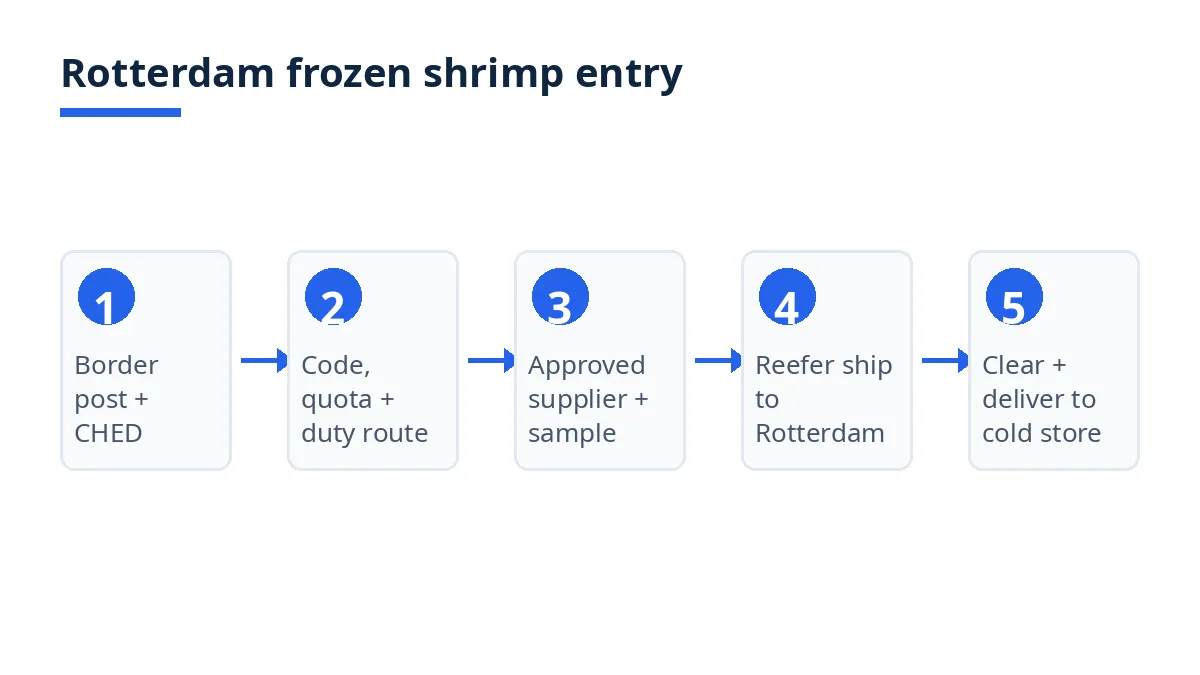
To import frozen shrimp from Bangladesh to the Netherlands, settle the Rotterdam border entry first: an approved border control post, a CHED-P pre-notification in TRACES, a health certificate from the approved establishment and the catch certificate route for the exact lot. Then confirm the 10-digit code, the 09.2802 processing quota and the duty route with your broker, verify the supplier on the approved-establishment list, and compare quotes only on the identical specification and document set.
On this page
Key takeaways
Settle the Rotterdam entry first: an approved border control post, a CHED-P in TRACES, a health certificate and the catch certificate route for the exact lot.
The 09.2802 quota covers Penaeus vannamei and Penaeus monodon for processing at 0 percent for 48,000 tonnes to 31 December 2026, under end-use supervision; confirm the balance and the successor arrangement after that date.
Check the supplier on the EU approved-establishment list, and confirm the health certificate authority and the catch certificate route before payment.
Compare quotes only on the identical specification, delivery term and document set, on net drained weight, with glaze, count and pack format stated in the same format.
The example landed cost is EUR 9.58 per kilogram excluding VAT, with duty at the 0 percent quota duty and VAT at 9 percent shown separately; rework it at quote stage and after shipment.
A Dutch frozen shrimp order is settled at the border control post before it is settled in the cold store. The post of entry, the Common Health Entry Document, the health certificate and the catch certificate decide whether a reefer container moves onward or waits for a document agreed before shipment.
This guide is for Netherlands buyers importing frozen shrimp from Bangladesh for processing and onward sale: processors, wholesalers, retailers and food service buyers. It works in Dutch order: border post first, then code and duty position, then suppliers, specification, quality and shipping. It states no typical price, minimum order or transit time. Confirm every duty line, quota balance and document requirement with your broker before you price or ship.
Start at the border control post, not at the price
Fishery products from outside the European Union may only enter through an approved border control post, where veterinary border checks take place.1 In the Netherlands, veterinary controls are performed by the NVWA and Dutch Customs, and consist of checking all documents present and, optionally, a physical product inspection.1 The NVWA charges a fee, and the amount is not stated here.1 Confirm the post is approved for fishery products, and the fee and booking route, before the goods sail.
Register the shipment by submitting a Common Health Entry Document (CHED).1 For products of animal origin, the document is the CHED-P, used together with the EU import certificate or other transport documents.2 Consignments requiring border controls must be pre-notified with a CHED in TRACES, the European Union digital platform for traceability and monitoring.2 Notification may be provided by a company, a freight forwarder or a customs representative, but to create and submit a CHED a user account must be linked to an operator with the activity Responsible for the Load.2 Ask the supplier, the forwarder and the border control post, in writing, which form each certificate will take.
Settle the code, the processing quota and the duty position before you order
Classification comes before pricing. To find the import duty rate for a fishery product, you first need a 10-digit commodity code, and most fishery products have 10-digit codes beginning with 03.1 Import duties are based on the customs value: the purchase price plus shipping and any insurance costs up to the border or port of entry into the European Union.1 Ask your broker to confirm the code for the exact species, state and presentation. The code lines in this guide are indicative and must be verified against the tariff for the entry date.
The quota annex names the line directly. Order number 09.2802 covers shrimps and prawns of the species Penaeus vannamei and Penaeus monodon, whether in shell or not, fresh, chilled or frozen, not cooked, for processing, under CN code ex 0306 17 92, TARIC subdivision 20, at a quota duty of 0 percent for 48,000 tonnes, from 1 January 2024 to 31 December 2026.3
The quota is a processing quota. Import duties are suspended or reduced within the tariff quotas at the rates, periods and amounts indicated, under end-use customs supervision.3 The reduction applies only to products intended for human consumption, not to products processed at retail or catering level, and not to products intended solely for cleaning, gutting, cutting, repacking, labeling, packing, chilling, freezing, glazing, thawing or separation.3 A consignment that arrives after the balance is used up does not get the quota rate. Ask your broker to check the balance, the end-use authorization and the successor arrangement after 31 December 2026.3
Do not assume a duty outcome from the quota alone, or from a preference scheme. Under Everything But Arms, 46 countries benefit from duty-free and quota-free access for all products except arms and ammunition, and graduating countries retain the preferences for three years.4 Whether a consignment qualifies depends on origin and proof: you demonstrate preferential origin with a preferential certificate or declaration of origin, such as a EUR.1 certificate, an invoice declaration or a certificate of origin.1 Ask your broker which route applies: quota, preference or the standard rate. Preferences are never automatic.
Two Dutch formalities sit beside duty. When you import fishery products from a non-EU country, you have to file an import declaration with Dutch Customs, and you will need an EORI number, the mandatory identification number for anyone dealing with Customs.1 When you import fishery products into the Netherlands, you pay 9 percent Dutch import VAT, which you may deduct in your VAT return as input tax if you are entitled to a VAT deduction.1 If you regularly import from outside the European Union, you can apply for an Article 23 permit from the Dutch Tax Administration to avoid paying VAT at the time of import, and instead file the VAT with your VAT return.1 Confirm the EORI number, the VAT treatment and the Article 23 position before the first order, and keep the VAT line separate from duty.
Why Bangladesh fits a Dutch processing order
A Dutch processing order needs a processor that can hold one written specification and prove, lot by lot, that the shrimp came from an approved establishment and can be traced to its source. Fishery products may only be imported from non-EU countries approved by the European Union, whose authorities check that vessels and businesses meet European Union food safety requirements and that products can be traced back to their source.1
Check the establishment before you check the price. The European Commission has published a list of approved factory vessels, cold stores and processing plants in approved countries outside the European Union.1 If no business is listed, there is an import ban on those products.1 Ask the supplier for its listing entry, check it yourself, and confirm that the species, product form and establishment match the specification and the health certificate.
Two shipments can both be Penaeus vannamei and still differ in count, glaze, net weight, pack format and freezing method, changing the price per kilogram, the customs value and the fit with the quota description. Keep the first order to one specification, one processor and one border control post.
Find and verify suppliers against the Rotterdam file
Send the identical specification pack to every candidate: species and Latin name, count, shell and processing state, glaze, net weight, pack format, label content, delivery term, border control post, and the document list.
Shortlist processors whose current range already includes frozen shrimp for export in the species and pack formats you need, and whose establishment appears on the approved list.1 Browse suppliers on Exportain and ask the Netherlands questions first: shipments to the European Union in the last two years, the border control post used, the health certificate and catch certificate routes, the quota or preference route claimed, and any border check faced. Then ask about freezing method, cold store capacity, count range, glaze and net weight control.
Check in three layers before payment: company documents, so name, address and bank account agree across every document; capability, including current production, the freezing and packing line and cold store capacity; and document discipline, meaning the approved-establishment listing, the certifying authority, the catch certificate route, and a sample document set from a comparable shipment. On Exportain, a profile badge is a document and photo review, not a factory inspection or a guarantee. Keep payments to the company bank account named in the documents, never to a personal account, and verify any bank detail change through a separate channel.
MOQ, pricing and samples
What is the typical MOQ for frozen shrimp from Bangladesh?
There is no single typical minimum order quantity, and this guide states none. The minimum is set by the processor, per species, count and pack format, because freezing runs, glazing lines and carton printing are set up per specification. Ask how the minimum splits by species, count, glaze and pack format, and whether it is counted in cartons, kilograms or containers. See the frozen shrimp MOQ guide for the working.
How is the price built, and how should you compare quotes?
The price per kilogram follows the specification. Glaze is the point buyers most often misread: more ice means less shrimp per kilogram, so compare quotes on net drained weight, not the headline carton price. Ask every supplier to state glaze, net weight, count and price basis in the same format, and compare quotes only on the same specification, delivery term and document set. See the frozen shrimp price guide for the FOB reading.
Quote element | What to check before you compare |
|---|---|
Species and Latin name | Matches the quota line, the code and the specification |
Count | Stated in the same units by every supplier |
Glaze percentage | Stated, with net weight per carton |
Processing state | Shell-on, headless, peeled or deveined, as specified |
Delivery term | The same term, with the same named place |
Document set | Health certificate, catch certificate route and origin file included |
Which samples do you need, and how do you approve them?
Work in stages, and approve in writing at each stage. A development sample shows whether the processor can meet the count, glaze and pack format. A pre-production sample, made on the production line in the production pack format, is the sample you approve for bulk. Check it line by line, record the count and net weight you measured, and keep one sealed counter-sample. Write the approval into the contract so the bulk is judged against the approved sample.
Quality control, health certificate and labeling
Write the quality specification before production: species, count, glaze and net weight each with a tolerance, processing state, freezing method, pack formats, label content, carton marks, and temperature in transit and on arrival.
Check the shipment in this order: documents, temperature, count and weight, then appearance. Species, count, net weight and carton count must match the specification and each other across documents. Check cartons drawn across the consignment, not from the top layer only. Use the frozen shrimp quality control checklist as the starting point, and agree the inspection method and defect limits before production.
Inspection bodies in approved non-EU countries issue health certificates for export shipments of fishery products to the European Union, declaring that the products are healthy and free of harmful organisms, and the foreign exporter should apply for the health certificate from a local inspection authority.1 Ask the supplier to name the inspection authority, confirm it can certify the exact establishment and product, and check the certificate against the CHED, the invoice and the packing list before the goods sail.
If you produce, process, transport or store fishery products, you need a food safety plan under European food hygiene law, following HACCP principles.1 Name the tests required, who pays, and that results are available before shipment. Certifications are evidence about a scope, not a guarantee: check scope, products, sites and expiry with the issuing body.
Labeling is agreed at sampling stage. Prepackaged food is subject to legal labeling requirements, and fishery products carry additional requirements, including the correct commercial designation of the fish.1 Agree the wording in full and check the finished label before bulk packing.
Catch certificate, IUU control and CATCH in TRACES
Imports of most fishery products from non-EU countries have to be accompanied by additional documents such as health certificates and catch certificates.1 A catch certificate demonstrates that the products did not come from illegal, unreported and unregulated fishing, and is issued by the country where the vessel involved in the catch is registered.1 Fishery products are accompanied by catch certificates throughout the supply chain, so ask your supplier for the catch certificate.1 Keep it with the health certificate and the CHED, and check that species, weight, vessel or farm details and carton counts agree across all three.
The catch certificate question needs care for farmed shrimp. The KVK guidance states that you do not need a catch certificate for ornamental fish, freshwater fish, aquaculture products obtained from fry or larvae, and some molluscs.1 Do not read that line as a blanket exemption for every farmed lot. Ask your broker and the border control post, for your exact lot, whether a catch certificate is required and how the farmed origin must be evidenced.
Where a catch certificate is required, the digital route matters. The Swedish Agency for Marine and Water Management is the competent authority for catch certificates (CATCH) in TRACES, and as of 10 January 2026 it is mandatory to use TRACES to register imports that require catch certificates.2 Ask the supplier and the forwarder whether the certificate for your lot will be created, validated and transferred in TRACES, and who holds the operator access to do so.
Incoterms, reefer shipping and the Chattogram to Rotterdam leg
Agree the delivery term in writing before the price is fixed, because the term decides who books freight, who insures, who lodges the CHED and where risk passes. For a reefer container, buyers most often weigh a term at the load port against a term to Rotterdam or the Dutch cold store. Agree separately who books the reefer, records temperature, lodges the CHED, supplies the certificates, files the entry, and pays the border charges and the NVWA fee.
Ship in a reefer with the set point, temperature recording and pre-cooling agreed in writing, and keep the temperature record in the document set. No fixed transit time is stated here. Work from the forwarder's sailing schedule, add clearance time and a buffer for border checks, and give customers a delivery window until the goods have cleared. Re-check the CHED booking whenever the sailing changes, and plan the inland cold store slot at the same time.
Landed cost example
Example figures only, not a quote: one kilogram of frozen shrimp, Penaeus vannamei, shell-on, in a stated count band, delivered to a Dutch processing cold store, under the quota route above, with end-use authorized and quota balance available. Duty is shown at the 0 percent quota duty in Regulation (EU) 2023/2720 for order 09.2802.3 VAT is shown separately at 9 percent.1 Confirm the code, quota balance, end-use authorization, customs value and VAT treatment before you price.
Cost element | Example figures (per kilogram) | How to obtain your figure |
|---|---|---|
Product price, FOB Chattogram | EUR 8.20 | Confirmed pro forma invoice |
International reefer freight | EUR 0.55 | Forwarder quote |
Insurance | EUR 0.05 | Forwarder quote |
Customs value | EUR 8.80 | Product price plus freight and insurance |
Duty at the 0 percent quota duty shown | EUR 0.00 | Broker calculation; confirm quota and balance |
Border, clearance and broker fees | EUR 0.38 | Broker and port invoices |
Inland delivery to cold store | EUR 0.22 | Carrier quote |
Inspection and testing share | EUR 0.10 | Inspection quote |
Cold store buffer | EUR 0.08 | Cold store quote |
Total landed cost, excluding VAT | EUR 9.58 | Sum of all lines above |
VAT at 9 percent on customs value plus duty | EUR 0.79 | Tax adviser; Article 23 may defer |
On these example figures, duty is EUR 0.00 and the total landed cost is EUR 9.58 per kilogram excluding VAT. VAT at 9 percent is EUR 0.79 per kilogram, payable at import unless an Article 23 permit defers it.1 Work the calculation twice, at quote stage and after shipment: see the landed cost method. If the broker confirms a different duty route, the duty line and the VAT base change.
Step-by-step import checklist
Name the border control post, confirm it is approved for fishery products, and agree who creates the CHED and pays the NVWA fee.1 2
Confirm the code, quota description, quota balance, end-use authorization and duty route with your broker, including the position after 31 December 2026.1 3
Confirm the EORI number, the 9 percent VAT treatment and the Article 23 permit position.1
Check the supplier on the approved-establishment list, and confirm the health certificate authority and catch certificate route for the exact lot.1
Write the specification pack: species, count, glaze, net weight, pack format and processing use.
Shortlist processors, send the identical pack to each, and check documents and capability.
Approve the pre-production sample in writing; keep a sealed counter-sample.
Agree delivery term, payment triggers, inspection plan and document timetable in the contract.
Book the reefer, the sailing, the border control post and the inland cold store, and confirm the CHED matches the sailing.
Collect the health and catch certificate documents, and pre-notify the consignment in TRACES.1 2
Clear the border control post and check the arrival against the specification.
Reconcile the landed cost, file the document set, and judge the processor.
How Exportain helps
Exportain is a marketplace where Netherlands buyers find Bangladeshi suppliers, post requests for quotation, receive quotations, message suppliers and place orders. Post your specification pack as a request for quotation so quotes are comparable on the identical specification, delivery term and document set. A profile badge is a document and photo review, not a factory inspection or a guarantee. Exportain is not a party to the contract for the goods, and it does not inspect goods, book freight or clear customs.
What is the typical MOQ for frozen shrimp from Bangladesh?
There is no single typical minimum. It is set per species, count and pack format by the processor. Ask how it splits across your specification, and start with a trial order.
How long does shipping take?
Transit varies by port pair, routing and season. Work from the forwarder's sailing schedule, add clearance time and a buffer for checks, and re-check the CHED booking whenever the sailing changes.1 2
What import duty applies?
Duty depends on the confirmed code, quota description and balance, end-use authorization and origin proof for any preference route. The quota annex shows a 0 percent quota duty for order 09.2802, covering Penaeus vannamei and Penaeus monodon for processing, for 48,000 tonnes from 1 January 2024 to 31 December 2026.3 Under Everything But Arms, least developed countries benefit from duty-free and quota-free access for all products except arms and ammunition, with a three-year retention after graduation.4 Which route applies must be confirmed by your broker. No single duty rate is stated here.
How do I verify a supplier?
Check three layers: company documents, capability, and document discipline on the Netherlands entry file. First, check the establishment on the approved list.1 Then ask for European shipment experience, the certifying authority, the catch certificate route and a sample document set, and inspect the first order before shipment.
Next steps on Exportain
Read the general guide to importing from Bangladesh for the full process, and check each code against the HS code guide for frozen shrimp before you price. When the post, code and duty route are fixed, post a free RFQ with the specification and processing use, and compare quotes on the same specification, delivery term and document set.
Sources
- Importing fishery products. KVK (Netherlands Chamber of Commerce), (accessed )
- TRACES (Trade Control and Expert System) in imports. Swedish Food Agency (accessed )
- Council Regulation (EU) 2023/2720 opening and providing for the management of the Union autonomous tariff quotas for certain fishery products for the 2024-2026 period. Council of the European Union, (accessed )
- How the EU's GSP supports long-term stability for developing countries. European External Action Service (accessed )
About the author
Sourcing from Bangladesh?
Post a request for quotation and suppliers on Exportain can send you their quotes directly.
Post an RFQ


