

USA: How to Import Baby Clothes From Bangladesh
USA buyers importing baby clothes from Bangladesh must clear the CPSC gate first: third-party testing, a Children's Product Certificate and tracking labels, then US classification, duty and CBP entry. This guide covers each step, with an example landed cost.
Short answer
To import baby clothes from Bangladesh to the USA, first confirm the CPSC rules for each style, arrange third-party testing by a CPSC-accepted laboratory and issue a Children's Product Certificate as importer. Then classify each style under HTS heading 6111 or 6209, confirm the current duty with a customs broker, agree the delivery term and inspection plan, and build the landed cost before bulk production.
On this page
Key takeaways
Baby clothes for the United States must pass CPSC third-party testing by a CPSC-accepted laboratory, with a Children's Product Certificate issued by the importer and a permanent tracking label on product and packaging.
Heading 6111 covers knitted or crocheted babies' garments for children up to 86 cm in body height; woven babies' garments fall in heading 6209, and each style is classified and priced separately.
In the schedule opened for this guide, cotton babies' T-shirts in heading 6111.20.20 carry a general rate of 14.9 percent and synthetic-fibre babies' T-shirts carry 32 percent; confirm the current rate with a broker before pricing.
Children's sleepwear in sizes 0 to 14 falls under 16 CFR parts 1615 and 1616, and children's loungewear is treated as sleepwear, so the sleepwear check comes before marketing claims.
There is no single typical MOQ, price or transit time for baby clothes from Bangladesh; confirm each one in writing for your exact styles, colours, size range, route and shipment date.
Importing baby clothes from Bangladesh to the United States is a compliance-first purchase. The garments are small, the buyers are exacting about softness and fit, and the destination rules treat anything designed for children 12 years of age or younger as a children's product with its own testing and certification duties. A buyer who settles fabric, size range and testing before bulk production avoids the most expensive failure in this trade: a finished shipment that cannot be sold in the United States because its paperwork, labels or test results do not match the goods in the cartons.
This guide is for United States buyers, brands, retailers and sourcing teams buying baby clothes from Bangladesh. It follows the United States route only: CPSC children's product rules, the United States tariff schedule, United States entry and United States labelling. Treat every duty rate and test requirement below as a starting point to confirm with your customs broker and testing laboratory for your exact styles and entry date.
Why source baby clothes from Bangladesh
Bangladesh supplies knitted and woven baby garments across cotton, cotton blends and synthetic fibres, in the small sizes and soft hand-feel infant ranges require. The practical reason to source there is range depth: rompers, bodysuits, sleepers, dresses, trousers and sets from factories that already cut and sew small garments. That depth only helps when the specification is precise, because infant garments are graded across a narrow size range and a small measurement error shows at once on a short garment.
Size is a classification question as well as a fit question. In the United States tariff schedule, heading 6111 covers babies' garments and clothing accessories, knitted or crocheted, and the chapter note defines babies' garments as articles for young children of a body height not exceeding 86 centimetres. Articles classifiable both in heading 6111 and in other headings of the chapter are classified in heading 6111.1 Keep the size chart and tariff heading together in your specification, so classification, duty and labelling describe the same garment.
Find and verify suppliers
Where should you start the search?
Start with a style list, not with a supplier list. Write down each style, its construction (knitted or woven), fibre composition, size range, colour range, closure type, trim list, label set and packing unit. Then shortlist Bangladeshi suppliers whose current range already includes baby clothes in those constructions. A supplier that sews adult knitwear may not hold infant patterns, small-size grading or snap-setting equipment. Browse suppliers on Exportain, read finding suppliers in Bangladesh, and compare your shortlist with the baby clothes manufacturers guide.
Send every candidate the identical specification and ask for the same reply format: fabric assumed, price inclusions, minimum per style and colour, sample and production lead times, and delivery term quoted.
How do you verify a supplier before you pay?
Verification has three layers. The first is company documents: trade licence, export registration and association membership where applicable, checked so that name, address and bank account name agree across every document and invoice. The second is capability: infant pattern and grading capacity, fabric source, dyeing and printing route, snap and trim setting, and washing and shrinkage control.
The third layer is payment discipline. Keep payments to the company account named in the documents, never to a personal account, and verify any change of bank details separately through a channel you already trust. For a first order, ask for a factory visit or a live video walkthrough, and ask which baby styles are in production on the day of the visit.
MOQ, pricing and samples
What is the typical MOQ for baby clothes from Bangladesh?
There is no single typical minimum order quantity for baby clothes from Bangladesh. The minimum is set per style and usually per colour, because fabric is dyed or printed in batches, cutting is planned per size range, and trims are ordered per style. A plain cotton bodysuit in three colours and a printed romper set in six colours will not carry the same minimum, and a style with several sizes does not carry the same minimum as a one-size item. Ask each supplier how its minimum splits by style, colour, size range and set composition, and get the answer in writing before you approve samples.
How is the price built, and how should you compare quotes?
Fabric is usually the largest cost element in a baby garment, followed by cutting and sewing, dyeing or printing, trims, washing, testing, labelling and packing, and the factory margin. Small garments use less fabric than adult garments but carry more operations per piece, and detail adds operations directly: a snap closure, printed panel, applique or lined hood each adds a step a plain bodysuit does not have.
Compare quotes on the same basis: same style list, sizes, fibre composition, construction, trims, labels, packing and delivery term. Ask each supplier to state what is excluded, for example testing fees, special packing, hangtags, or a separate charge for a size-set sample.
Which samples do you need, and how do you approve them?
Work in stages. A development sample shows whether the factory can construct the garment, set snaps evenly, grade the size range and hold the hand-feel you specified. A pre-production sample, made in the actual production fabric, colour, trims and labels, is the sample you approve for bulk. Size, colour and softness cannot be approved from a sample in substitute fabric, because washing, dyeing and finishing change dimensions, shade and hand-feel.
Quality control and certifications needed
What does the CPSC require for children's products?
Children's products sold in the United States must meet the applicable children's product safety rules, and the CPSC guidance states the core duties plainly: third-party testing by a CPSC-accepted laboratory, a Children's Product Certificate (CPC) issued by the domestic manufacturer or importer, and a permanent tracking label on the product and its packaging.2 The same guidance sets the chemical limits that apply across children's products: paint and similar surface coatings must not contain more than 90 parts per million of lead, total lead content in any accessible component part must not exceed 100 parts per million, and toys and child care articles must not contain more than 0.1 percent of any regulated phthalate in any accessible plasticized component part.2 Products intended for children under 3 years of age must also not contain small parts or liberate small parts after use and abuse testing.2
Treat the CPC as a legal declaration, not as a factory certificate. The importer issues it on the basis of testing by a CPSC-accepted laboratory, and it must accompany distribution of the product.2 Testing is arranged before shipment, the laboratory scope must cover each applicable rule, and a material change, new trim supplier or new coating colour can require fresh testing. Ask the laboratory which rules apply to each style, and keep test reports, the CPC and tracking label data tied to the same production lot.
What about sleepwear, and what about labels?
Sleepwear needs a separate check before you describe any garment as sleepwear or loungewear. The CPSC sleepwear standards sit in 16 CFR parts 1615 and 1616, and the agency's position letter states that children's sleepwear covers products of wearing apparel in sizes 0 to 14 intended to be worn primarily for sleeping or activities related to sleeping, with stated exceptions for diapers and underwear, infant garments sized for a child nine months of age or younger, and tight-fitting garments that meet specific maximum dimensions.3 The same letter states that children's loungewear and similar comfort wear are viewed as garments worn primarily for sleep-related activities and must comply with the children's sleepwear standards.3 The agency states that it considers the nature of the garment, fabric and print, promotion and distribution, and likelihood of purchase for sleep-related use, not only the manufacturer's marketing term.3
Labels carry two different duties. The CPSC tracking label is a permanent distinguishing mark on the product and its packaging.2 Separately, federal law requires most textile and wool products to carry a label listing fibre content, country of origin and the identity of the manufacturer or another business responsible for marketing or handling the product, and the Care Labeling Rule requires care instructions for consumers.4 Agree the full label set at sampling stage and check it against the production garment before bulk label sewing begins.
Which certifications do you actually need?
No single certificate covers every baby clothes order. The mandatory core for the United States is the CPSC route above: applicable rules identified per style, third-party testing by a CPSC-accepted laboratory, a CPC issued by the importer, and tracking labels. Beyond that core, what you need follows your customer: a retailer may name a specific test, restricted substance list or labelling format in its supplier manual. Name any such requirement in the specification, ask for the matching report, and check its scope, product covered, issuing body and date.
Which quality checks are specific to baby clothes?
Against the approved sample and size chart, check fabric composition and finished weight, measurements after washing, seam strength and finish, snap and zip function, print durability on stretch, colour match across sizes and sets, and packing completeness per set. Inspect in stages where the order size justifies it: an inline check during sewing catches a drift while correction is still possible, and a final random inspection on packed goods checks quantity, workmanship, measurements, labels and packing. See the baby clothes quality control checklist and the pre-shipment inspection guide, and agree the inspection method and defect limits before production starts.
Incoterms, shipping and transit time
Which delivery term should a first order use?
The Incoterms 2020 rules set out, for each rule, where delivery takes place, and risk passes from seller to buyer at the same point and time as delivery.5 Under FOB, CFR and CIF the seller must place the goods on board the vessel, and in all rules but EXW the seller must carry out export formalities, while in all rules but DDP the buyer must carry out import formalities.5 The four sea rules, FAS, FOB, CFR and CIF, are only intended for port-to-port bulk or break-bulk shipments and are not suitable for container shipments.5
For a first containerised order, weigh FOB at the Bangladeshi port against FCA at the named terminal. Under FCA, delivery happens when the goods are handed to your carrier, which matches how containerised cargo moves. Write the named place or port into the purchase order.
How long does shipping take?
There is no single typical transit time for baby clothes from Bangladesh to the United States. Sea freight is the standard bulk route and air freight is the faster, higher-cost route for urgent replenishment, but neither has a single figure across ports, routings and season. Plan from your forwarder's current sailing schedule, and keep production, testing, inspection and clearance time separate from transit time.
Import duty, taxes and documents
How are baby clothes classified for United States duty?
Duty follows the classification of each style in the United States tariff schedule, not the supplier's product name. Knitted or crocheted babies' garments sit in heading 6111, defined for young children of a body height not exceeding 86 centimetres, with the rule that articles classifiable both in heading 6111 and in other headings of the chapter are classified in heading 6111.1 Woven babies' garments sit outside Chapter 61, which applies only to made up knitted or crocheted articles, and the woven heading is 6209, covering babies' garments and clothing accessories, not knitted or crocheted, split into cotton, synthetic fibres and other textile materials.6 Classify knitted and woven styles on separate lines.
What import duty applies?
Your rate depends on each style's full tariff line, the origin and any preference or additional duty in force on the entry date, so there is no single rate for a whole baby clothes order. In the United States schedule opened for this guide, Revision 2 (2022), the general rates for knitted cotton babies' garments in heading 6111 include 19.7 percent for blouses and shirts, 14.9 percent for T-shirts, singlets and similar garments, 14.9 percent for sweaters, pullovers and similar articles, 11.5 percent for dresses, 14.9 percent for trousers, breeches and shorts, and 8.1 percent for other cotton babies' garments.1 For knitted synthetic-fibre babies' garments in the same heading, the general rates include 28.2 percent for trousers, breeches and shorts, 32 percent for blouses and shirts, 32 percent for T-shirts, singlets and similar garments, 30 percent for sweaters, pullovers and similar articles, and 16 percent for other synthetic-fibre babies' garments.1
Read those figures as schedule lines in that revision, and confirm the current rate for each style with your customs broker before you commit to a selling price. Rates change and additional duties and fees can apply on top of the general rate. The broker's written calculation, style by style, is the number to price from.
Which documents do you need for clearance?
The standard import set is the commercial invoice, packing list, bill of lading or air waybill, test reports and CPC data, and proof of origin where a preference is claimed. The invoice should name each style plainly, with construction, fibre composition, sizes, quantities, unit prices and delivery term, on its own line. Keep knitted, woven, cotton and synthetic styles on separate lines matching their classifications, and keep quantities, weights and carton counts in agreement across every document.
For the United States entry itself, arrange the customs bond and the broker relationship before the goods sail. A bond for basic importation and entry may be either a single transaction bond or a continuous bond, and its conditions include paying duties, taxes and charges, completing entry and producing documents and evidence as required.7 Give your broker the classification, CPC and test report references, tracking label data and invoice set before arrival.
Landed cost example (table)
A landed cost is the full cost of one garment. Every number below is an example figure only, not a quote, and the duty line uses one schedule rate from the section above for illustration.
Example figures: 2,000 knitted cotton baby T-shirts, heading 6111.20.20, FOB Chattogram, sea freight to a United States port, duty at the schedule general rate for that line, with customs value taken as the FOB value for this illustration only.
Cost element | Example figures (per garment) | How to obtain your figure |
|---|---|---|
Product price, FOB | $3.20 | Confirmed pro forma invoice |
International freight | $0.85 | Forwarder quote divided by garments shipped |
Insurance | $0.05 | Policy or forwarder quote |
Duty at 14.9 percent of $3.20 | $0.48 | Broker calculation from confirmed codes and current rates |
Port, clearance and broker fees | $0.22 | Broker invoices divided by garments |
Local delivery to warehouse | $0.18 | Local carrier quote divided by garments |
Total landed cost | $4.98 | Sum of all lines above |
Work the calculation twice: at quote stage, style by style, and again after shipment with the actual invoices. See landed cost for imports from Bangladesh for the full method, and read the HS code guide for baby clothes before you finalise any classification.
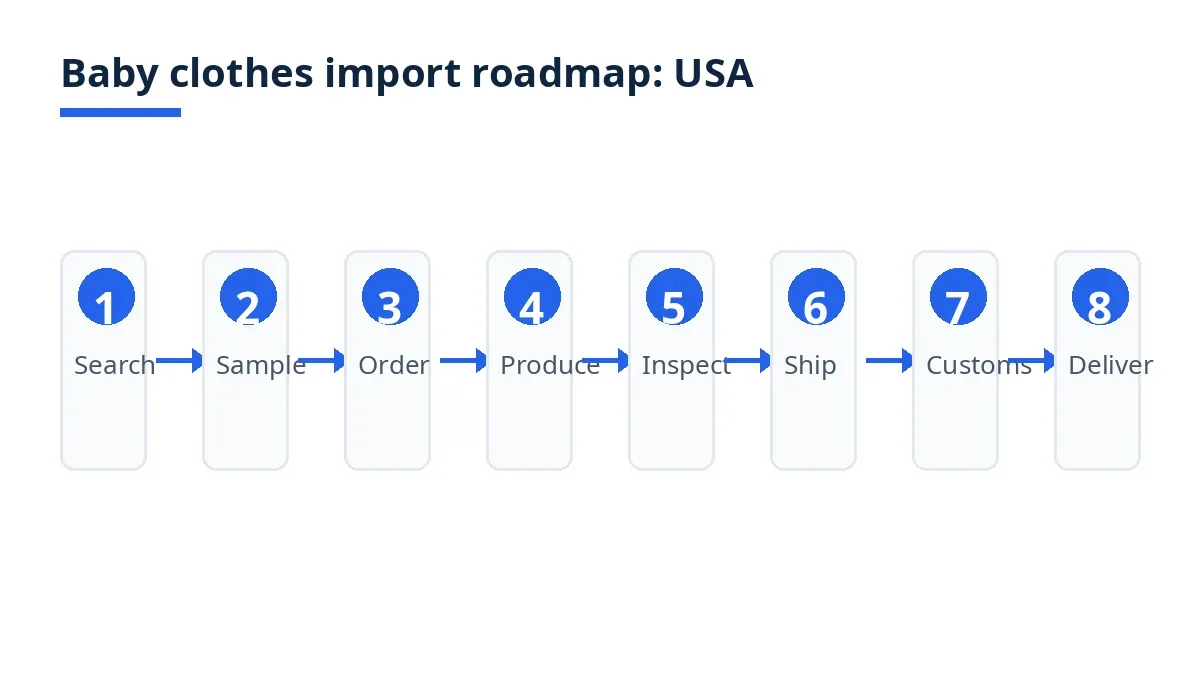
Step-by-step import checklist
Write the style list: construction, fibre composition, size range, colours, closures, trims, labels and packing unit for each style.
Confirm the United States classification of each style from heading 6111 (knitted) or 6209 (woven), and confirm each full code and current duty with your customs broker.
Identify the CPSC rules for each style, including sleepwear rules where relevant, and confirm the testing plan and laboratory scope before sampling.
Shortlist Bangladeshi suppliers whose current range includes baby clothes in your constructions, and request comparable quotes on the identical specification and delivery term.
Verify the chosen supplier: company documents, infant pattern and grading capacity, fabric and trim sources, washing control, and current baby clothes production.
Order samples in stages, wash and measure them, test closures and prints, then approve a pre-production sample of each style in production fabric, colour, trims and labels.
Confirm the order in writing: purchase order, pro forma invoice, delivery and payment terms, testing and inspection plan, labelling, packing and shipment date.
Complete third-party testing through a CPSC-accepted laboratory, issue the CPC as importer, and check tracking labels against the production lot before shipment.
Inspect during production and again on packed goods against the approved samples, checking size, colour, closures and set completeness.
Ship, clear United States customs with the confirmed code for each style, and reconcile the actual landed cost style by style.
How Exportain helps
Browse suppliers for Bangladeshi baby clothes exporters and compare their ranges against your style list, then post your specification and target quantity as an RFQ and compare replies on the same terms before you choose a factory for sampling. Exportain is a B2B marketplace where buyers post RFQs, receive quotations and message suppliers. It does not inspect goods, book freight or clear customs, so testing, inspection, freight and customs remain your arrangements with your laboratory, inspector, forwarder and broker.
FAQs
What is the typical MOQ for baby clothes from Bangladesh?
There is no single typical minimum. It is set per style and usually per colour, because fabric is dyed or printed in batches, cutting is planned per size range, and trims are ordered per style. Ask each supplier how its minimum splits by style, colour and size range, and record the agreed split in the purchase order.
How long does shipping take?
Production, testing and transit times are separate, and none has a single typical figure. Sea freight is the standard bulk route and takes longer than air freight, with the exact time varying by port, routing and season. Plan from your forwarder's current sailing schedule.
What import duty applies?
Duty follows the confirmed classification of each style, the origin and the rules in force on the entry date. Knitted babies' garments sit in heading 6111 and woven babies' garments in heading 6209.1 6 In the schedule opened for this guide, cotton babies' T-shirts in heading 6111 carry a general rate of 14.9 percent and synthetic-fibre babies' T-shirts carry 32 percent, but confirm the current rate for each style with your customs broker before pricing.1
How do I verify a supplier?
Check company documents first, so that name, address and bank account agree across the trade licence, export registration and invoices. Then check capability: infant patterns and grading, fabric and trim sources, washing and shrinkage control, and current baby clothes production. Keep payments to the company account named in the documents, and approve a pre-production sample of each style before bulk production.
Next steps on Exportain
Read how to import from Bangladesh for the full buying process, then use how to write an RFQ to set out your style list. When ready, post a free RFQ on Exportain and compare quotes on the same specification and delivery term.
Sources
- Harmonized Tariff Schedule of the United States, Chapter 61 (2022, Revision 2). U.S. International Trade Commission (accessed )
- Business Guidance FAQ. U.S. Consumer Product Safety Commission (accessed )
- Sleepwear Policy and Loungewear Position. U.S. Consumer Product Safety Commission, (accessed )
- Textile, Wool, Fur, Apparel and Leather Matters. Federal Trade Commission (accessed )
- Insider thoughts: Bob Ronai on Incoterms 2020 Rules; What are they about?. International Chamber of Commerce (accessed )
- HS 2012 Classification Detail: Code 6209, babies' garments and clothing accessories, not knitted or crocheted. United Nations Statistics Division (accessed )
- 19 CFR 113.62 - Basic importation and entry bond conditions. eCFR (accessed )
About the author
Sourcing from Bangladesh?
Post a request for quotation and suppliers on Exportain can send you their quotes directly.
Post an RFQ


