Top Baby Clothes Manufacturers in Bangladesh: How to Find and Verify Them
Bangladeshi baby clothes supply is organised by factory type, not by ranking: seven types, the safety rules that shape each order, what drives price and MOQ, and how to verify each supplier.
Short answer
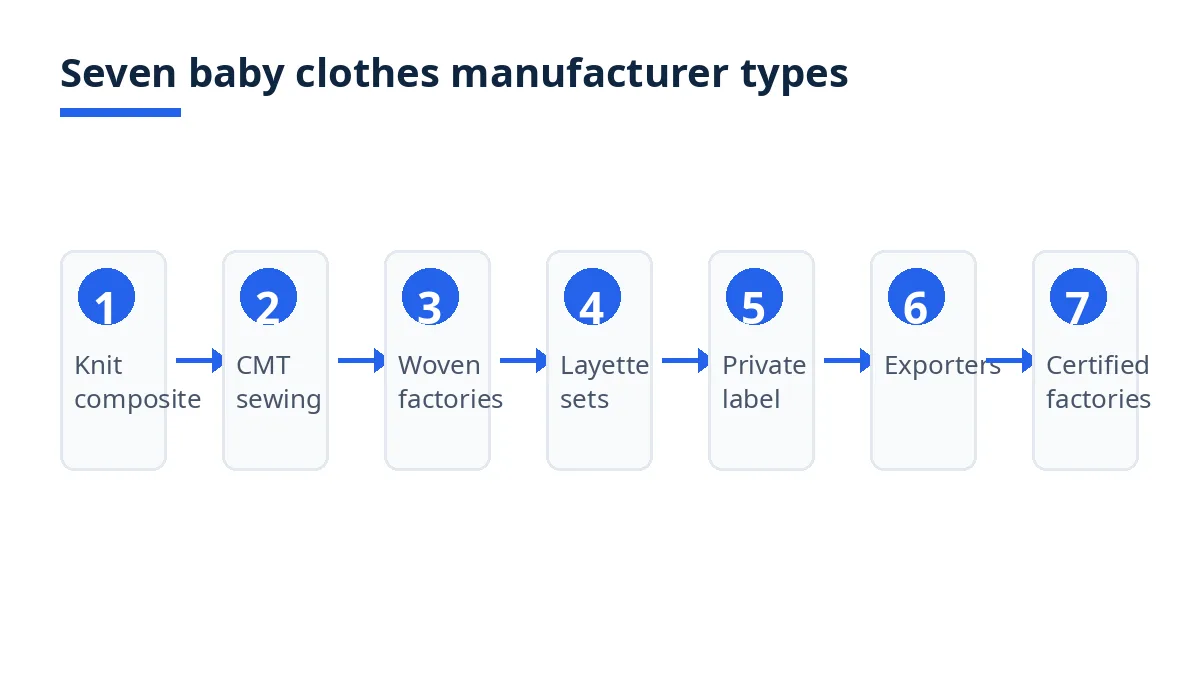
Baby clothes manufacturers in Bangladesh fall into seven types: integrated knit composites, sewing-only factories, woven baby garment factories, layette and newborn-set specialists, private-label OEM and ODM suppliers, exporters and trading companies, and compliance-audited factories. Match the type to knit or woven construction, size range and destination-market safety rules, then verify membership, certificates, samples and inspection terms before paying.
On this page
Key takeaways
Baby clothes in trade terms means garments for children of body height up to 86 cm: knitted lines fall under HS heading 6111 and woven lines under HS heading 6209, so the first sourcing split is knit versus woven.
Bangladesh sells both halves at scale: in the first quarter of fiscal 2026-27 knitwear earned US$5.963 billion and woven garments US$4.614 billion, according to EPB data.
Safety rules are set by the destination market: EN 14682:2014 bars drawstrings and functional cords in the head, neck and upper chest area of young children's garments, and US rules cover sleepwear flammability, third-party testing, certification and tracking labels.
Price and MOQ are set per style: fabric, the size ratio across the smallest sizes, fasteners and trims, retail packing and testing move the quote more than location does.
Verification is a sequence the buyer runs: association membership, document and certificate checks, a washed sample in production fabric, destination-market test evidence, and an agreed AQL inspection before payment.
Buyers searching for baby clothes manufacturers in Bangladesh are choosing from a garment sector that sells both knitted and woven clothing at scale, not from a shortlist of famous names. In the first quarter of fiscal 2026-27, ready-made garment exports earned US$10.578 billion, split between knitwear at US$5.963 billion, up 6.88 per cent year on year, and woven garments at US$4.614 billion, up 5.11 per cent, according to Export Promotion Bureau (EPB) data.1 The knitwear trade body, BKMEA, says it represents approximately 2,540 knitwear member factories.2 In trade terms, "babies' garments" means articles for young children of a body height not exceeding 86 cm, classified in heading 6111 when knitted or crocheted3 and in heading 6209 when not knitted or crocheted.4 The useful question is not who ranks first. It is which type of factory fits your product, and how you verify it before you pay.
Key points to take away
Baby clothes means garments for children of body height up to 86 cm: knitted lines fall under HS heading 6111 and woven lines under HS heading 6209, so the first sourcing split is knit versus woven.3 4
No single factory type fits every order. Fabric control, construction, size range and your destination market's safety rules each point to a different type.
Safety requirements are set by the market that will sell the garment, not by the factory. Cords, sleepwear flammability, chemical limits, testing and tracking labels must be specified before production.
Price and minimum order quantity (MOQ) are set per style, not per country. Fabric, size ratio, fasteners, packing and testing move the quote more than location does.
Verification is a sequence you run yourself: membership, documents and certificates, samples in production fabric, destination-market test evidence, an agreed inspection standard, and written terms before payment.
The list: baby clothes manufacturers in Bangladesh by type
The seven types below cover the ways baby clothes are made and sold from Bangladesh. One company can sit in more than one type, and the type matters more than the sales pitch: it tells you what the supplier controls and what you must check yourself.
1. Vertically integrated knit composite factories
What they are. Groups that knit fabric, dye and finish it, then cut, sew and pack garments within the same company. A knitted baby order under heading 6111, split by fibre into cotton, synthetic fibre and other textile materials,3 stays inside one organisation from yarn to carton.
Who they suit. Buyers with larger, repeat programs in knitted cotton: bodysuits, rompers and sleepsuits where fabric hand feel and shade must hold across seasons and the smallest sizes.
How to verify. Ask which stages are in-house and which are subcontracted, in writing. Check that its profile matches baby knitwear work.
2. Sewing-only knit factories (cut, make and trim)
What they are. Factories that cut and sew garments from fabric supplied by the buyer or bought from a local mill against the buyer's specification. Their skill is garment construction.
Who they suit. Buyers running smaller quantities, buyers who source their own fabric, and buyers testing a new style.
How to verify. Fabric quality becomes your responsibility, so inspect the fabric before cutting, agree shrinkage and shade tolerances in writing, and hold a pre-production sample made from the bulk fabric. Check its fasteners and bindings as closely as the fabric.
3. Woven baby garment factories
What they are. Factories set up for garments that are not knitted or crocheted, classified in heading 6209 and split by fibre into cotton, synthetic fibres and other textile materials.4 Dresses, shirts and woven sets are its typical products.
Who they suit. Buyers whose range is woven rather than knitted, and buyers running mixed knit and woven ranges who need a supplier whose regular work is woven construction.
How to verify. Do not judge a woven baby order on a knitwear track record. Ask which woven styles it sews every month, sample in the production fabric, and check seams, hems and fasteners after washing. Confirm it grades patterns across the full size range.
4. Layette and newborn-set specialists
What they are. Suppliers whose regular work is the layette category: multi-piece newborn sets, bodysuits, sleepsuits, bibs and hats, packed as sets for retail.
Who they suit. Retailers and importers selling gift sets and newborn essentials, where the product is the set itself.
How to verify. A set multiplies every check. Approve a sample of the complete set, not one piece, and confirm each piece is present, in the right size and colour, with fasteners working. Agree in writing what happens when one component fails inspection: a failed piece makes the whole set unsaleable.
5. Private-label OEM and ODM suppliers
What they are. Suppliers making baby clothes under the buyer's label. Original equipment manufacturers (OEM) produce to your tech pack; original design manufacturers (ODM) offer their own patterns and pack formats for you to label.
Who they suit. Brands needing their own labels, size sets and packaging, and importers who want a ready style range.
How to verify. For OEM work, send a complete tech pack covering fabric, measurements for every size, fasteners and pack format, and judge the counter-sample against it line by line. For ODM work, confirm your market's labelling and safety rules before adopting a ready pattern: it was not necessarily developed for your market. Agree who owns patterns and grading files.
6. Exporters and trading companies
What they are. Export-licensed companies that sell baby clothes made in partner factories rather than on their own sewing lines. They aggregate capacity across factories and handle export documentation.
Who they suit. Buyers ordering several product types at once, and buyers who want one contract and one contact.
How to verify. Ask which factory will sew each style, and get it named before you pay a deposit. The trading company's export record does not tell you which sewing line makes your baby clothes, and the producing site is the site behind any test report.
7. Compliance-audited and certified factories
What they are. Factories holding current audits or certifications under the schemes their buyers require. BGMEA lists the frameworks factories in Bangladesh are assessed against, including BSCI, WRAP, SMETA, ICS, the Higg Index, ZDHC, GOTS and OEKO-TEX.5 For baby clothes, the product-level check buyers ask for most often is OEKO-TEX Standard 100 Product Class I, the class for textiles for babies and young children up to three years of age.6
Who they suit. Retail chains and EU, UK or US programs with a code of conduct, chemical restrictions or certified-fibre claims.
How to verify. A certificate is only useful inside its scope. Under OEKO-TEX Standard 100, every component must meet the criteria, including fabric, threads and accessories such as buttons and zips, and a certificate is valid for 12 months.6 Check the number with the issuer, the address against the producing site, and the expiry and product class. A logo on a profile is a claim, not a check.
Summary table
Type | Best for | Main check before ordering |
|---|---|---|
Vertically integrated knit composite | Large repeat knit programs, shade consistency | Which stages are truly in-house |
Sewing-only (CMT) | Smaller runs, buyer-supplied fabric | Fabric inspection before cutting |
Woven baby garment factory | Woven dresses, shirts and sets (heading 6209) | Woven track record, full size grading |
Layette and newborn-set specialist | Gift sets and newborn essentials | Complete-set sample, component failure terms |
Private-label OEM / ODM | Own-label brands and retailers | Tech pack match, market labelling rules |
Exporter / trading company | Mixed orders, one contract | Producing factory named in writing |
Compliance-audited / certified | Retail chains, chemical and fibre claims | Certificate class, scope, address and expiry |
Baby clothes safety rules that shape your order
Baby clothes carry safety rules that adult garments do not, and the rules belong to the destination market.
Cords and drawstrings in the EU and UK. The GOV.UK product safety guidance states the rule in EN 14682:2014, covered under the General Product Safety Regulations 2005: garments intended for young children shall not be designed, manufactured or supplied with drawstrings or functional cords in the head, neck or upper chest area, and decorative cords shall not be permitted anywhere on the hood or at the back of the neck. Elsewhere in the neck and upper chest areas, decorative cords shall have free ends no longer than 7.5 cm, no knots, toggles or three-dimensional embellishments, and shall not be positioned so they can tie across the throat.7 Verification step: check the tech pack and the pre-production sample against the same rule.
Flammability in the US. CPSC clothing guidance states that 16 CFR part 1610 classifies clothing textiles into three classes, and that Class 3 textiles are prohibited in clothing. Children's sleepwear that does not meet the definitions of an "infant garment" or a "tight-fitting garment" is instead subject to 16 CFR part 1615 (sizes 0 through 6X) or 16 CFR part 1616 (sizes 7 through 14); those definitions rest on sizing and measurement guidelines in 16 CFR sections 1615.1 and 1616.2.8 Verification step: state in the order whether each style is sleepwear, which part applies, and whether an infant garment or tight-fitting claim is made.
Testing, certification and labels in the US. The same guidance states that children's wearing apparel must be tested at a third-party, CPSC-accepted laboratory, and that the manufacturer or importer must then issue a Children's Product Certificate (CPC). Accessible components are subject to a total lead limit of 100 parts per million; painted components and screen-printing inks to a lead in paint limit of 90 parts per million; and bibs and sleepwear for children ages 3 and younger, as child care articles, to the phthalates ban in 16 CFR part 1307. Products and packaging must also carry tracking labels identifying the manufacturer, importer or private labeler, production date and location, and batch information.8 Verification step: name the laboratory evidence, the CPC and the tracking label content in the order terms, and check the label on the production sample.
What drives price and MOQ for baby clothes
A Bangladeshi quote is built from the same parts wherever you buy, so compare quotes part by part rather than by the final number. Fabric is the largest part: small garments use little material per piece, but each size and colour combination carries pattern, cutting and line setup costs. That is why the size ratio matters: the smallest cut in the range, not the order total, drives the per-style MOQ. Fasteners, set packing, labelling and destination-market testing add further line items.
On Exportain, a quotation is versioned and states unit price, MOQ, lead time, Incoterm, payment terms and validity for each version, so you can compare two factories on the same fields instead of on email text.9 Ask every supplier to quote the same specification, Incoterm and packing, then question any line that differs. A cheap-looking quote usually leaves something out: a lighter fabric, fewer sizes, or testing never priced in. For how MOQ works across a range, read the guide to MOQ in the supply chain.
How to verify a supplier before you pay
Check association membership. A knitwear exporter should appear in the BKMEA member records, and a woven exporter in the BGMEA records; BGMEA runs a member search on its own site.2 5 Membership proves registration, nothing more: treat it as step one, not the result.
Review the documents. Trade licence, Export Registration Certificate (ERC) and factory or office photos are the standard set. On Exportain, profiles carry badges only for checks the Exportain team has reviewed and approved.10
Check the safety evidence for your market. For each style, hold the test reports behind any US CPC, the tracking label content, and any OEKO-TEX certificate at Product Class I scope, checked with the issuer.6 8
Sample in the production fabric. Approve a pre-production sample from bulk fabric and trims, in more than one size, wash it, and measure it against your size chart. Check cords, fasteners and labels against your market's rules, and keep one sealed sample as the reference.
Agree the inspection standard in the order. Set the acceptance quality limit (AQL) and inspection level before production. ISO 2859-1 specifies sampling schemes indexed by AQL for lot-by-lot inspection, so an inspector can accept or reject a shipment against a published rule.11
Put payment protection in writing. Agree inspection and shipment conditions before settling. Exportain is not a party to your goods contract; where a supplier asks for a funds hold, you can pay or decline it, and Exportain keeps a paid hold until the supplier files an export clearance document and you confirm the trade complete.9
The guide to how supplier verification works sets out what each badge covers, and the baby clothes quality control checklist turns steps 4 and 5 into garment-level checks.
How Exportain helps
Exportain is a B2B marketplace for sourcing from Bangladesh. Buyers search published products by keyword and category, filter to suppliers holding the Exportain Verified badge, sample availability and OEM or ODM capability, and sort by MOQ or lead time.9 Buyers then post a request for quotation (RFQ) stating quantity, target price, destination, Incoterm, required certifications and deadline, and suppliers in that category quote against it.9
Use the badges as a starting filter, not a conclusion. Verification on Exportain is a document and photo review, not a factory inspection, and membership never grants a badge.10 Run the verification sequence above on your shortlist.
FAQs
What is the biggest mistake buyers make when sourcing baby clothes from Bangladesh?
Choosing a supplier by quoted price before checking the factory type and the destination market's safety rules. A sewing-only factory quoted on buyer-supplied fabric, a trading company quoting another factory's capacity, and an integrated factory quoting its own fabric are three different offers at three different prices. Baby clothes add a fourth difference: a style developed without your market's cord, flammability and labelling rules may not be saleable on arrival.
How can I avoid it?
Write one specification covering construction (knit heading 6111 or woven heading 6209), fabric, size range and ratio, fasteners, your market's safety rules and test evidence, labels and packing, and send it to every supplier you quote. Name the producing factory in the order terms, approve washed samples in more than one size, and set the AQL level in writing before production.
Who is responsible for quality, the factory or the buyer?
Both, at different points. The factory is responsible for making garments to the agreed specification and approved sample, and for the test evidence its production generates. The buyer is responsible for making that specification complete and checkable, including the destination market's safety rules, and for inspecting against it before shipment. In a dispute, the side with the written specification, sealed sample and inspection report is the side whose version counts.
Where can I get help verifying a supplier?
Start with the records that exist: BKMEA and BGMEA member listings for registration, the certificate issuer for any audit or fibre claim, the CPSC-accepted laboratory evidence behind a US Children's Product Certificate, and an inspection provider for the pre-shipment check.2 8 On Exportain, read what each badge covers before relying on it, and message the supplier through its profile so questions and answers stay in one thread.10
Next steps on Exportain
Browse Bangladeshi suppliers and filter the baby clothes listings by badge, MOQ and OEM or ODM capability. Before you order, read how supplier verification works on Exportain so you know what each badge covers. Then post a free RFQ with your specification, size range, quantity, destination and Incoterm, and compare the quotations that come back. The guides to importing baby clothes from Bangladesh and the HS code for baby clothes cover the steps and classification that follow.
Sources
- Merchandise exports rise 6.34pc to $13.09b in Q1 FY27: EPB. The Financial Express, (accessed )
- BKMEA at a Glance. BKMEA (accessed )
- HS Nomenclature 2022, Chapter 61: Articles of Apparel and Clothing Accessories, Knitted or Crocheted. World Customs Organization (WCO) (accessed )
- HS Nomenclature 2017, Chapter 62: Articles of Apparel and Clothing Accessories, Not Knitted or Crocheted. World Customs Organization (WCO) (accessed )
- BGMEA | Home. Bangladesh Garment Manufacturers and Exporters Association (BGMEA) (accessed )
- OEKO-TEX STANDARD 100 for textiles tested for harmful substances. Hohenstein (accessed )
- PRISM: Narrative style risk assessment - non-compliant cords and drawstrings identified in clothing intended for children. GOV.UK (accessed )
- Clothing Business Guidance. U.S. Consumer Product Safety Commission (accessed )
- How to source and buy from Bangladesh. Exportain (accessed )
- Supplier verification: Earn trust badges buyers can see. Exportain (accessed )
- ISO 2859-1:2026 — Sampling for Inspection by AQL. American National Standards Institute (ANSI) (accessed )
- MOQ
- supplier verification
- knitwear
- importing from Bangladesh
- Baby clothes
- Children's product safety
- Private label apparel
About the author
Sourcing from Bangladesh?
Post a request for quotation and suppliers on Exportain can send you their quotes directly.
Post an RFQ