HS Code for Ceiling Fans: Classification Guide for Importers
Ceiling fans with a self-contained electric motor of 125 W or below sit in heading 8414 at subheading 8414.51, and national codes in the US, EU and UK extend the six digits to eight or ten.
Short answer
A ceiling fan with a self-contained electric motor of an output not exceeding 125 W is classified in heading 8414, at subheading 8414.51, which covers table, floor, wall, window, ceiling or roof fans. In the United States the line for ceiling fans for permanent installation is 8414.51.30. Only the first six digits are shared worldwide, so confirm the full national code before filing.
On this page
Key takeaways
Ceiling fans with a self-contained electric motor of an output not exceeding 125 W sit in heading 8414 at subheading 8414.51, which names table, floor, wall, window, ceiling or roof fans.
Motor output is the deciding measurement: a fan rated above 125 W leaves 8414.51 and is tested against 8414.59, other fans, so take the rating from the motor plate, not the catalogue.
In the United States, ceiling fans for permanent installation take the line 8414.51.30, and the United Kingdom splits 8414 5100 at ten digits by civil aircraft use.
Spare parts shipped on their own take the parts lines at 8414.90, not the complete-fan line, and complete fans and spares in one shipment are separate entry lines.
Only the first six digits are shared worldwide: the EU extends to eight digits and the United States and United Kingdom to ten, so confirm the full national code per market.
If you import ceiling fans, the hs code for ceiling fans is the line your customs entry, duty calculation and origin claim depend on. The Harmonized System is a multipurpose international product nomenclature developed by the World Customs Organization (WCO), comprising more than 5,000 commodity groups, each identified by a six-digit code, and used by more than 200 countries and economies as a basis for their customs tariffs.1 For ceiling fans, the code turns on one measurement above all others: the output of the fan's self-contained electric motor. This guide covers classification only; the ordering steps are in how to import ceiling fans from Bangladesh and the inspection points in the ceiling fans quality control checklist.
Quick answer: indicative HS heading (with verify note)
The HS organises its approximately 5,000 six-digit product categories by sections, chapters (2 digits), headings (4 digits) and sub-headings (6 digits).2 Ceiling fans sit in Chapter 84, machinery and mechanical appliances, in heading 8414, which covers air or vacuum pumps, air or other gas compressors and fans, ventilating or recycling hoods incorporating a fan, and parts thereof.3
Product | Indicative code territory | Why |
|---|---|---|
Ceiling fan with a self-contained electric motor of an output not exceeding 125 W | Subheading 8414.51 | The subheading covers table, floor, wall, window, ceiling or roof fans with a self-contained electric motor of an output not exceeding 125 W |
Fan outside that description, including a fan above 125 W | Subheading 8414.59, other fans | Heading 8414 places the remaining fans in the other-fans subheading |
Fan parts shipped on their own | Heading 8414, parts lines at 8414.90 | The heading covers parts, and the US schedule lists parts of fans on their own lines |
Verify the motor output, not the product name. Inside heading 8414, the fan split runs first on fan type and motor output: subheading 8414.51 covers table, floor, wall, window, ceiling or roof fans with a self-contained electric motor of an output not exceeding 125 W, and subheading 8414.59 covers other fans.3 Treat 8414.51 as indicative and confirm the full national code before filing.
How HS codes are structured (2-4-6 digits)
Each pair of digits narrows the category: chapter 84 for machinery, heading 8414 for pumps, compressors and fans, then the six-digit subheading 8414.51 for the listed fan types at 125 W or below, and a national extension of 8 to 10 digits.2
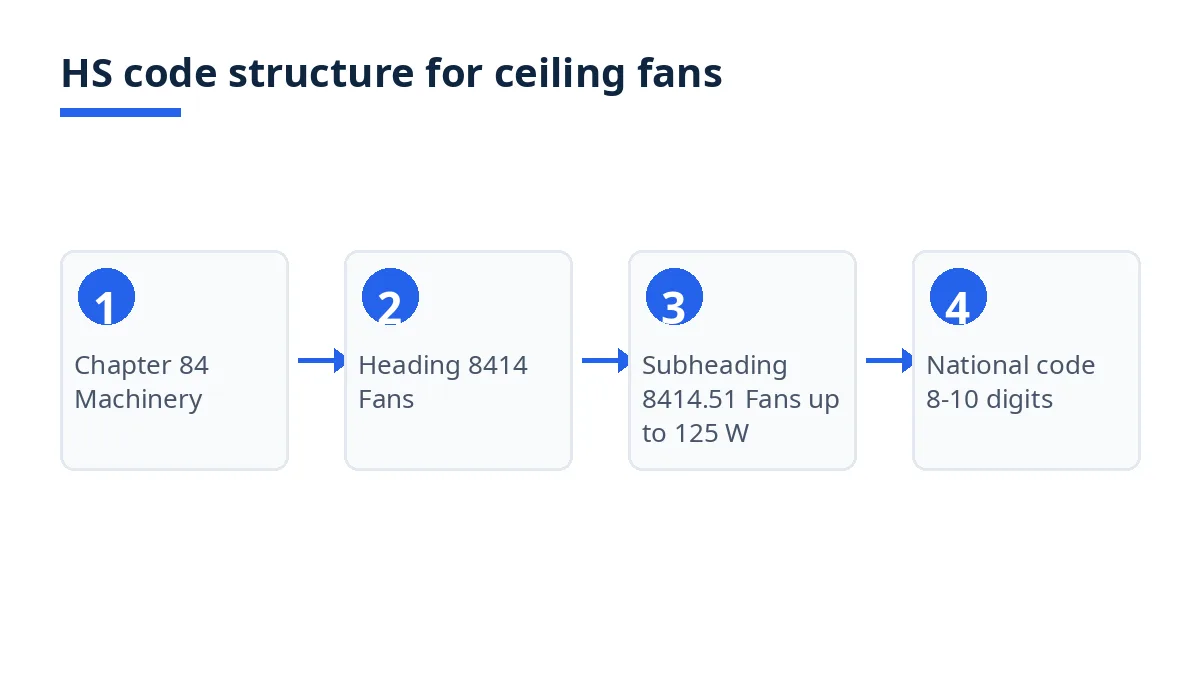
Countries subdivide the six-digit categories into national subheadings for their tariffs and statistics.2 The current version is HS 2022.2 Read the 6-digit HS code guide for more on the structure, and the HS code harmonized system explainer for the background.
Factors that decide the code for ceiling fans
Motor output is the deciding measurement. Subheading 8414.51 is limited to fans with a self-contained electric motor of an output not exceeding 125 W.3 The UK tariff states the same line in the same words: table, floor, wall, window, ceiling or roof fans, with a self-contained electric motor of an output not exceeding 125 W, at 8414 51.4 Take the rated output from the motor rating plate and the product specification, not from a catalogue headline, and keep the figure in the shipment file. A fan rated above 125 W does not meet the 8414.51 description and is tested against 8414.59, other fans.3
The motor must be self-contained. The subheading text requires a self-contained electric motor.3 A complete ceiling fan ships with its motor built in, which is the standard case for this line. A fan sold without its motor, or a motor sold on its own, is a different product for classification purposes and needs its own test.
Fan type is named in the subheading. The 8414.51 description names the fan types it covers: table, floor, wall, window, ceiling or roof fans.3 A ceiling fan is named directly, so it does not need a residual line. Fan forms not named in 8414.51, and fans above the output limit, fall to 8414.59, where the schedules split the lines further, for example by fans used for cooling microprocessors and by axial and centrifugal fans.3 4
A ceiling fan is not an air conditioner or a hood. Heading 8414 also covers ventilating or recycling hoods incorporating a fan, at 8414.60 for hoods having a maximum horizontal side not exceeding 120 cm.3 Air conditioning machines, which comprise a motor-driven fan and elements for changing temperature and humidity, sit in heading 8415, not 8414.3 If the product only moves air, it stays a fan; if it changes the temperature and humidity, test heading 8415 first.
Parts take the parts lines, not the fan line. Heading 8414 covers parts thereof, at 8414.90.3 The US schedule splits the parts lines by product, including a line for parts of fans and a statistical line for parts of fans of subheading 8414.51.3 Blades, downrods and housings shipped as spares are parts, not complete fans under 8414.51.
Complete fans and spare parts in one shipment are separate lines. Classify each product as presented: complete ceiling fans on the fan line, and loose spares on the parts line at 8414.90.3 One code for a mixed carton of fans and spares invites a correction at entry.
National codes: US HTS, EU CN/TARIC, UK commodity code
United States: HTS, ten digits. The US schedule splits subheading 8414.51 into two eight-digit lines: 8414.51.30 for ceiling fans for permanent installation, and 8414.51.90 for other fans in the subheading.3 Under 8414.51.90, the statistical suffixes separate fans for permanent installation from other fans.3 A standard ceiling fan for permanent installation therefore reads 8414.51.3000 in full. Read the complete ten-digit line for your fan rather than stopping at six digits.
European Union: CN at eight digits, TARIC for measures. The Combined Nomenclature integrates the HS and adds EU subdivisions, producing eight-digit codes.2 At eight digits, the 8414.51 line continues as 8414 5100 before the TARIC extension adds measure-specific digits. Read the confirmed line in TARIC for the entry date and for origin Bangladesh, and check the origin rules behind any preference claim.
United Kingdom: commodity code. The UK builds its commodity code on the same first six digits, with its own extension after them.2 The UK tariff page for heading 8414 lists the 8414 51 line with two ten-digit codes: 8414 5100 10 for fans for use in civil aircraft and 8414 5100 90 for other fans in the line, which is where an ordinary ceiling fan falls.4 Take the full code from the UK Trade Tariff for your fan and entry date.
How to confirm the code officially
Write a precise description: fan type, the rated output of the self-contained electric motor in watts, whether the fan is for permanent installation, and what is in the carton, complete fans or parts.
Start from the official tariff for the destination: the USITC HTS, TARIC or the UK Trade Tariff, and read the heading text for 8414 and the subheading text for 8414.51.
Check published rulings for similar products. For the United States, the USITC advises traders to use the Customs Rulings Online Search Service (CROSS), because the correct classification of many items can be found there.5
For a borderline product, such as a fan rated close to the 125 W limit or a fan combined with another function, apply for a binding decision before you ship. In the EU, a Binding Tariff Information (BTI) application needs a separate application for each type of product and a detailed description of the goods.6 In the United Kingdom, a legally binding decision is generally valid for 3 years, through an Advance Tariff Ruling.7 In the United States, if the merchandise is not described in any ruling on CROSS, you may request a binding ruling from U.S. Customs and Border Protection.5
Give your broker the description and the confirmed code, and use the same code throughout the entry. The guide to classifying your product sets out the method.
Common classification mistakes
Filing a fan above 125 W under 8414.51. The subheading is limited to an output not exceeding 125 W.3 A higher-output fan belongs in 8414.59, other fans.3
Filing spare parts as complete fans. Parts sit at 8414.90, and the US schedule lists parts of fans on their own lines inside it.3 A carton of blades or motors is not a carton of ceiling fans.
Filing an air conditioning unit as a fan. Heading 8415 covers air conditioning machines comprising a motor-driven fan and elements for changing the temperature and humidity.3 A product that cools or heats the air is not classified by its fan alone.
Filing a ventilating hood under the fan line. Hoods incorporating a fan take their own line at 8414.60, for hoods having a maximum horizontal side not exceeding 120 cm.3
Copying a code from another country. The EU extends the six digits to eight,2 the United States names ceiling fans for permanent installation at 8414.51.30,3 and the United Kingdom splits the same line by civil aircraft use at ten digits.4 The first six digits travel; the rest do not.
Relying on the supplier code without the motor rating. The 8414.51 test is a measured output, not a product name.3 If the rating plate and the paperwork disagree, settle the rating first and classify second.
Related duties and documents
This guide states no duty rates: the code decides which duty line customs applies, and a rate on the ceiling fan line does not carry to the other-fans line or to parts. Read the rate beside your confirmed code for your origin and entry date, and check the origin proof a preference claim requires.
Keep the classification evidence with the shipment documents: the product description, the motor rating, the confirmed national code, any binding decision, and the origin evidence. Show complete fans and spare parts as separate invoice lines with their own codes, so the entry, the packing list and the invoice agree. Electrical safety and product compliance rules for the destination market sit outside classification; confirm them before shipping and keep those certificates in the same file.
FAQs
What is the HS code for ceiling fans?
A ceiling fan with a self-contained electric motor of an output not exceeding 125 W is classified at subheading 8414.51, inside heading 8414.3 In the United States, ceiling fans for permanent installation take the line 8414.51.30.3 A fan above 125 W falls to 8414.59, other fans.3
Is the HS code the same in every country?
Only the first six digits are harmonised. Beyond six digits, each country adds its own lines: eight digits in the EU Combined Nomenclature,2 and ten in the United States, where ceiling fans for permanent installation are named at 8414.51.30,3 and in the United Kingdom, where the 8414 51 line splits by civil aircraft use.4
How do I confirm the correct code?
Describe the fan precisely, including the rated motor output, read the heading and subheading text in the destination tariff, and check published rulings, such as CROSS for the United States.5 For a borderline product, apply for a binding decision before shipping: a BTI in the EU,6 an Advance Tariff Ruling in the United Kingdom,7 or a CBP binding ruling in the United States.5
What happens if I use the wrong code?
Duty, licensing and quota treatment are worked out from the code on the declaration, so a wrong code brings the wrong treatment. Taking a binding decision in advance helps you calculate the duties and restrictions that will apply.7
Next steps on Exportain
Browse Bangladeshi suppliers on Exportain, a B2B marketplace where supplier profiles carry document and photo review badges, and post a free RFQ at Exportain RFQs with the confirmed code and the motor rating stated for each model. Exportain is not a party to the goods contract and does not inspect goods, book freight or clear customs, so keep your broker and your binding decision at the centre of the entry.
Sources
- What is the Harmonized System (HS)?. World Customs Organization (accessed )
- Harmonised System. European Commission (accessed )
- Harmonized Tariff Schedule of the United States, Chapter 84: Nuclear reactors, boilers, machinery and mechanical appliances; parts thereof (Revision 11, 2026). United States International Trade Commission (accessed )
- Air or vacuum pumps, air or other gas compressors and fans: UK Integrated Online Tariff, heading 8414. GOV.UK, HM Revenue and Customs (accessed )
- MTB 2019: Get Out Ahead of the Pack with a Binding Ruling from CBP. U.S. International Trade Commission (accessed )
- European Binding Tariff Information (EBTI). European Commission, Taxation and Customs Union, (accessed )
- Check what you'll need to get a legally binding decision on a commodity code. GOV.UK, HM Revenue and Customs (accessed )
About the author
Sourcing from Bangladesh?
Post a request for quotation and suppliers on Exportain can send you their quotes directly.
Post an RFQ