Quality Control Checklist for Ceiling Fans From Bangladesh
A numbered QC checklist for ceiling fans from Bangladesh: sweep and balance, motor and mounting, safety and regulator checks, air delivery and noise evidence, markings, manuals and packing, with fixes for common failures.
Short answer
Use this ceiling fans quality control checklist to check blade sweep and balance, motor and downrod assembly, electrical safety, regulator function, air delivery evidence, noise, markings, instructions and packing on ceiling fans from Bangladesh before shipment. Agree tolerances, test methods and acceptance numbers in the purchase order and draw the sample randomly across models and cartons.
On this page
Key takeaways
Agree the sample, specification, tolerances, test methods and acceptance numbers before inspection, and draw the sample randomly across models, finishes and cartons.
Assemble and run every sampled fan at every speed, because wobble, loose coupling and regulator faults show only when the fan turns.
Check the rating label, wiring and manual against the order on every sampled fan, and confirm safety and performance reports name this model and lot.
Treat air delivery and noise as evidence checks against the named standard method, and record a result per fan and carton, not from memory.
If you import ceiling fans, this ceiling fans quality control checklist gives you a practical way to check a shipment before it leaves Bangladesh. A ceiling fan is judged in use: wobble, motor noise or a regulator fault shows at once. Use an agreed sampling plan rather than pieces the factory selects. ISO 2859-1 specifies an acceptance sampling system for inspection by attributes, indexed in terms of the acceptance quality limit (AQL), applicable to end items.1
Why this checklist matters
Ceiling fans concentrate risk in a rotating electrical product fixed above head height: sweep and balance decide whether the fan runs true, the downrod and mounting parts decide whether it stays secure, and the motor, wiring and regulator decide whether it runs safely at every speed. A fault hidden in the carton, such as a bent blade iron, shows only after installation.
A written checklist removes interpretation. Each point is checked against the approved sample, the specification and the packing list, and recorded as pass, fail or not applicable. Set acceptance numbers per defect class in the purchase order.1 See the AQL acceptance quality limit explainer.
Before you start
Do not begin until the references are complete: an approved sample per model, sweep and finish, the purchase order and specification with rated voltage, frequency and power, blade sweep, downrod length and tolerances, the regulator type, and the packing specification. Agree the sampling plan in advance,1 and draw the sample randomly across models, finishes and cartons.
Confirm the safety references before bulk marking is printed. IEC 60335-2-80:2024 deals with the safety of electric fans for household and similar purposes, with a rated voltage of not more than 250 V for single-phase appliances and 480 V for other appliances, and ceiling fans are listed among the fan types it covers.2 IEC 60335-2-80:2024 is used in conjunction with IEC 60335-1:2020.2 IEC 60335-1:2020 deals with the safety of electrical appliances for household and similar purposes, with the same rated voltage limits.3
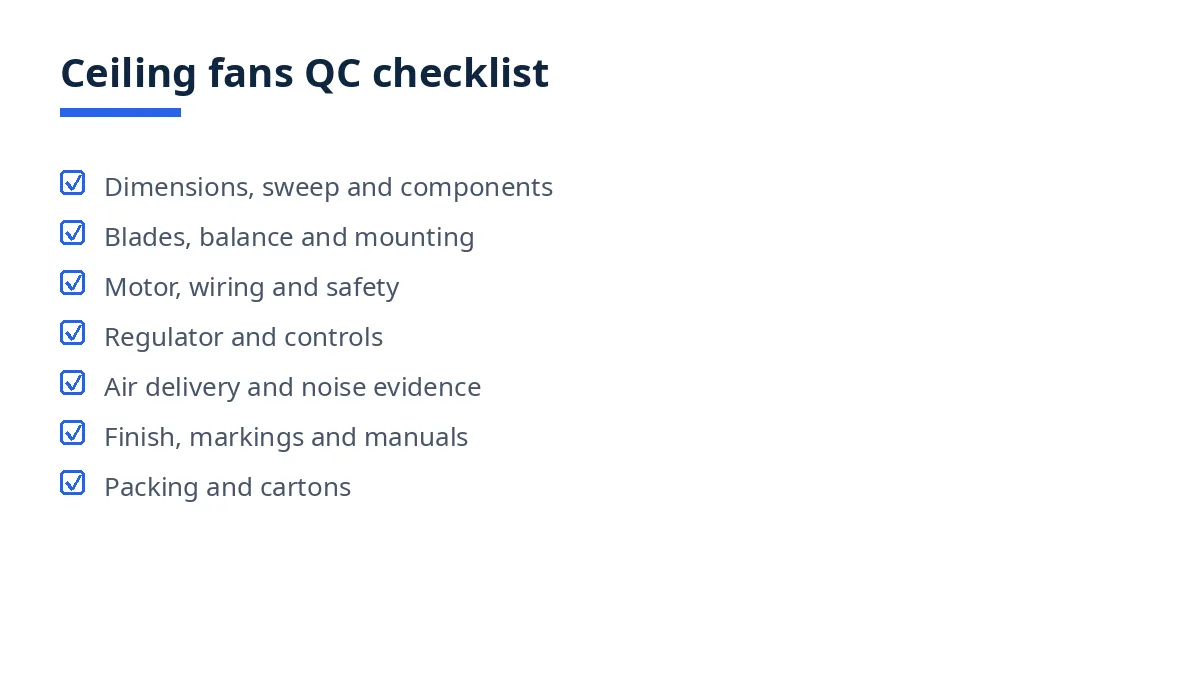
The full checklist (numbered, printable)
Dimensions, sweep and components
Confirm each sampled carton contains the motor unit, blades, blade irons, downrod, canopy, regulator or remote control and fixing kit named in the specification.
Measure blade sweep tip to tip on each sampled fan, assembled as directed, against the specification figure and tolerance.
Measure downrod length, canopy size and blade length and width, recording actual values, not pass marks alone.
Check blade count, shape and finish on every sampled fan against the approved sample, with no substitution in bulk.
Weigh sampled fans where the specification gives a weight, and check each blade for symmetry of shape and pitch.
Blades, balance and mounting
Check each blade for cracks, warping, dents, sharp edges and coating damage, on the face, back and edges.
Check blade irons for straightness and angle, and confirm every blade screw seats firmly without stripping.
Check the downrod, hanger ball and coupling: setscrew tight, safety pin named in the instructions present, and no play when the fan is moved by hand.
Check canopy and mounting bracket parts in the kit against the instruction drawing, including screws, washers and insulating parts.
Run each sampled fan at every speed and check for wobble at the blade tips, rocking at the canopy and contact between moving and fixed parts, recording the speed where wobble appears.
Motor, wiring and electrical safety
Check the rating label on each sampled motor against the purchase order: model, rated voltage, frequency and rated power input must match the order and the carton marking.
Check supply leads, terminals and connectors for damage, loose strands and secure fixing, with no copper showing outside a terminal.
Check earthing, where the design provides it, is connected as drawn, and that protection symbols on the sample appear the same way in bulk.
Run each sampled fan through start, every speed step and stop, checking for failure to start, stalling at low speed, heating smell and sparking.
Check motor noise while running: listen for grinding, scraping and bearing rumble separate from normal air movement, at each speed.
Confirm safety test evidence where the order requires it names this model and lot. IEC 60335-2-80:2024 also applies to separate controls supplied with fans.2
Regulator and controls
Check the regulator or remote supplied with each sampled fan matches the specification, with the correct number of speed steps.
Operate every speed step in order and confirm changes in the right sequence, with no dead step or sticking control.
Where a remote is supplied, check pairing, range, battery fit and that the fan responds only to its paired control.
Check any light kit, timer or reverse function named in the specification works as the manual describes.
Performance evidence: air delivery and noise
Review air delivery evidence where the order requires it and confirm the report names this model, sweep and lot. IEC 60879:2019 specifies the performance-measuring methods of comfort fans and regulators, with a rated voltage of not more than 250 V for single-phase fans and 480 V for other fans, and a rated power input of less than 125 W.4
Confirm the performance report uses the ceiling fan method. Under IEC 60879:2019, comfort fans are classified into two groups for testing, and ceiling fans form one group.4
Review regulator performance evidence where required, because IEC 60879:2019 covers regulators together with the fan where applicable.4
Review noise evidence where required. IEC 60704-2-7:2020 applies to electrical fans for household and similar use, including ceiling fans, and treats the motor, impeller and housing, if any, as a single unit.5
Check by ear that no run fan is clearly louder than the approved sample at the same speed, and hold louder units for review.
Finish, appearance and markings
Check coated parts for peeling, bubbles, rust spots and color difference between blades, motor cover and canopy, against the sample under the same light.
Check decorative trim and model badges named in the specification for straight placement, secure fixing and correct wording.
Check rating markings are legible, durable to a rub by hand and identical across the sample, including voltage, frequency, power and model identification.
Check warning and installation wording on the product and in the manual against the approved artwork, with no missing page.
Check the manual in each sampled carton: language, model name, wiring diagram, parts list and fixing steps must match this model and destination market.
Packing and cartons
Confirm each fan is packed as directed, with blades, irons and motor protected so metal parts cannot rub in transit, with spacers where specified.
Check that the fixing kit, regulator or remote, manual and warranty card named in the pack are present in each sampled carton.
Check that barcode, model and sweep stickers scan and match the purchase order, and that carton markings match the fans inside.
Handle sampled cartons as the carrier would: no crushed corner reaching the product, no split seam and no loose contents.
Weigh and measure sample cartons, and check markings and carton count against the packing list.
Record every failure by fan, carton and defect type, photograph it, and keep the unit aside until disposition is agreed.
Common failures and how to fix them
The most frequent failure is wobble at high speed, usually because one blade is warped, one blade iron is bent, or blade screws were tightened unevenly. Stop, measure blade height and sweep on the assembled fan, replace the affected blade or iron, and re-run the fan at every speed before more fans are packed. Next is a fan that hums or runs hot at low speed, which points to the regulator or capacitor match for that motor: hold those units, compare the regulator type against the specification, and test a corrected unit before the line restarts.
Loose movement at the canopy traces to a slack setscrew or a missing safety pin in the downrod coupling: refit the coupling as drawn and re-check the affected group. Finish differences between blades and motor cover point to mixed finish batches: re-sort complete fan sets by finish before packing. Crushed cartons point to weak packing for a heavy motor unit: repack as specified and re-check handling on a fresh sample.
Above the agreed acceptance level, options are re-inspection after sorting or rework, documented partial acceptance, or rejection. See the pre-shipment inspection guide.
Downloadable template / summary table
Copy the checklist into your inspection sheet, add the specification, tolerances and acceptance numbers, and record a result per fan.
Section | Checks | Evidence |
|---|---|---|
Dimensions and sweep | Sweep, downrod, components | Measurements, kit count |
Blades and mounting | Blade condition, irons, coupling | Run test, photos |
Motor and safety | Label, wiring, start and heat | Run log, test reports |
Regulator | Speed steps, remote, functions | Function log |
Performance | Air delivery, noise | Reports per model |
Finish and markings | Coating, label, manual | Sample comparison |
Packing | Protection, stickers, cartons | Packing list |
How Exportain helps
Exportain is a B2B marketplace connecting buyers with Bangladeshi suppliers of ceiling fans and other electrical products, so the specifications behind this checklist can be agreed at the enquiry stage. Read the companion guide to importing ceiling fans from Bangladesh, browse suppliers and use inspection services when you plan the check. Supplier profiles show document and photo checks recorded, not factory inspections. Exportain is not a party to the goods contract and does not inspect goods.
FAQs
When should this checklist be used?
Use it at final inspection, when fans are finished, tested and largely packed. For larger and first orders, also use it in production, while faults can still be corrected across the run.
Who should complete it?
The buyer, a local agent or an independent inspector can complete it, using the approved sample and specification.
What are the most common failures?
Wobble at high speed, humming or heat at low speed, loose downrod coupling, finish mismatch between parts and crushed cartons are the failures buyers find most often.
Can a third party do it?
Yes, if you share the approved sample, specification, tolerances and acceptance levels first.
Next steps on Exportain
Before production starts, agree your specification, tolerances, test methods and marking artwork, then read the guide to importing ceiling fans from Bangladesh and the pre-shipment inspection guide, and plan the check with inspection services. You can also post a free RFQ via RFQs.
Sources
- ISO 2859-1:1999 - Sampling procedures for inspection by attributes — Part 1: Sampling schemes indexed by acceptance quality limit (AQL) for lot-by-lot inspection. International Organization for Standardization (accessed )
- IEC 60335-2-80:2024 - Household and similar electrical appliances - Safety - Part 2-80: Particular requirements for fans. International Electrotechnical Commission, (accessed )
- IEC 60335-1:2020 - Household and similar electrical appliances - Safety - Part 1: General requirements. International Electrotechnical Commission, (accessed )
- IEC 60879:2019 - Comfort fans and regulators for household and similar purposes - Methods for measuring performance. International Electrotechnical Commission, (accessed )
- IEC 60704-2-7:2020 - Household and similar electrical appliances - Test code for the determination of airborne acoustical noise - Part 2-7: Particular requirements for fans. International Electrotechnical Commission, (accessed )
- pre-shipment inspection
- quality control
- aql inspection
- Electrical products
- Ceiling fans
- Bangladesh electrical products
About the author
Sourcing from Bangladesh?
Post a request for quotation and suppliers on Exportain can send you their quotes directly.
Post an RFQ