How to Import Ceiling Fans From Bangladesh in 2026: Complete Buyer Guide
How to import ceiling fans from Bangladesh: model specification, supplier checks, samples, HS 8414.51 duty, shipping and landed cost for buyers.
Short answer
To import ceiling fans from Bangladesh, write a model-by-model specification that fixes sweep, motor type and output, rated voltage and frequency, control and finish as your own choices, then shortlist factories that already make that class of fan. Verify the factory, approve a pre-production sample built with the production motor and control, classify each model in sub-heading 8414.51, agree the delivery term and inspection plan, and build the landed cost before bulk production.

On this page
Key takeaways
Ceiling fans with a self-contained motor not exceeding 125 W sit in sub-heading 8414.51; in the US schedule the general rate on 8414.51.30 and 8414.51.90 is 4.7 percent.
IEC 60335-2-80:2024 is the fan safety standard: it covers ceiling fans at not more than 250 V single-phase and also applies to separate controls supplied with fans.
There is no single typical MOQ, price or transit time for ceiling fans, so confirm each one in writing for your exact sweep, motor, voltage, control, route and shipment date.
Sweep, motor type, voltage and control are buyer specification choices: name each one per model, and compare quotes only on the same specification.
Bangladesh has duty-free access to the European Union under Everything But Arms and 0 percent tariffs on 99.8 percent of products in the United Kingdom under DCTS Comprehensive Preferences, subject to origin rules.
To learn how to import ceiling fans from Bangladesh, start with the electrical specification, not with a catalogue photograph. A ceiling fan is a motor, a set of blades, a downrod and suspension system, and a control, and each part has to match the voltage, frequency and safety rules of the destination market.
The Harmonised System is an international commodity classification of approximately 5,000 six-digit product categories, organised by sections, chapters, headings and sub-headings, and countries subdivide the six-digit categories further for their own tariffs.1 Ceiling fans with a self-contained electric motor sit in that system under the fan lines of heading 8414, and the motor output decides the sub-heading, so classification, safety testing and pricing all start from the same specification sheet.
This guide is for importers, retailers, wholesalers and project buyers in the United States, the United Kingdom, the European Union and the United Arab Emirates. It states no typical minimum, price or transit time, because none has a single figure across sweep sizes, motor types, voltages and destinations.
Why source ceiling fans from Bangladesh
Bangladesh has an established electrical products sector that makes fans for its own domestic market as well as for export, so a buyer can source from factories whose core product is the fan itself. That matters, because the operations are specific: motor winding and assembly, blade pressing and balancing, downrod and canopy work, suspension safety, speed control, finishing, and packing that protects blades and motor housings in transit.
IEC 60335-2-80:2024 deals with the safety of electric fans for household and similar purposes, with a rated voltage of not more than 250 V for single-phase appliances and 480 V for other appliances, and its listed examples include ceiling fans.2 The same standard also applies to separate controls supplied with fans.2 A factory that builds ceiling fans as a main line is more likely to hold test experience against that fan safety framework and to understand why a change of motor, capacitor or control is a new test sample, not a minor variation.
The range you can specify is wide: sweep sizes for standard and large rooms, three, four or five blades, AC induction motors and BLDC motors, pull-cord, wall regulator, remote and smart controls, light kits where destination rules allow them, and finishes for domestic, commercial and project use. Treat each combination as its own model. A 220 to 240 V fan is not interchangeable with a 110 to 120 V fan, and the rating plate, manual and carton marks must match the model shipped. Two fans that look alike can differ in motor output, blade material and pitch, bearing type, capacitor, control and suspension hardware, and each difference affects airflow, noise, power use, safety testing and the tariff line.
Find and verify suppliers
Where should you start the search?
Start with a specification sheet, not with factory names. Write down every model first: sweep, number of blades and blade material, motor type and rated output in watts, rated voltage and frequency for the destination, speeds and control type, downrod length, finish and colour, light kit if any, rating plate and manual language, and packing per carton. Then shortlist factories whose current range already includes ceiling fans of that class. A factory making only lighting or small appliances is not a close substitute, because motor winding, blade balancing and suspension testing are fan-specific operations.
Send every candidate the identical specification and ask for the same reply format: motor and blade construction assumed, rated voltage and frequency offered, test reports held for that exact model, price inclusions, validity and minimum per model and per colour. Browse suppliers on Exportain and read finding suppliers in Bangladesh.
How do you verify a supplier before you pay?
Verification has three layers. The first is company documents: trade licence, export registration and association membership where applicable, checked so that name, address and bank account name agree across every document. The second is capability: monthly ceiling fan capacity, whether motor winding and blade making are in-house or bought in, balancing and run-testing arrangements, which voltages the line can build, and which recent models the factory can show running, not only packed. A fan from current production, run at every speed, shows wobble, noise, control response and finish.
The third layer is payment discipline. Keep payments to the company account named in the documents, never to a personal account, and verify any change of bank details separately. Read how supplier verification works on Exportain for what document and photo checks cover. On Exportain, supplier profiles carry document and photo review badges. A badge is a review of documents and photos, not a factory inspection or a guarantee, and Exportain is not a party to the goods contract.
MOQ, pricing and samples
What is the typical MOQ for ceiling fans from Bangladesh?
There is no single typical minimum order quantity for ceiling fans from Bangladesh. The minimum is set per model and usually per colour or finish, because motors are wound, blades are pressed and finished, and cartons and manuals are printed in batches. A standard model in one colour and a BLDC model with remote control and light kit will not carry the same minimum. Ask each supplier how its minimum splits by model, colour, voltage and control type.
How is the price built, and how should you compare quotes?
The motor is usually the largest cost element in a ceiling fan, followed by blades, control, finishing, testing, hardware, packaging and the factory margin. A BLDC motor with an electronic controller, a remote handset and a light kit is a different cost structure from a basic AC fan with a wall regulator. Two quotes can differ because one assumes a smaller motor, thinner blades, a shorter downrod, no remote or simpler packing. Ask what each price is based on, in writing, so a lower quote is judged as a different specification rather than accepted as a saving.
Compare quotes on the same basis: same sweep, blade count and material, motor type and output, voltage and frequency, control, downrod, delivery term and packing. Ask each supplier to state what is excluded, for example remote handsets, light kits, testing fees or packing upgrades.
Which samples do you need, and how do you approve them?
Work in stages. A development sample shows whether the factory can build the model to the specification: correct sweep, motor, control and finish. A pre-production sample, built as the bulk units will be built, with the production motor, blades, capacitor or controller, rating plate and manual, is the sample you approve for bulk. Voltage, frequency, airflow and noise cannot be approved from a sample built for a different market.
Test the samples as your customers will use them: mount the fan with the specified downrod, run it at every speed in both directions where reverse is specified, and check for wobble, bearing noise, control response and hum. Measure the sweep, confirm the blade set is matched and balanced, check the rating plate against the specification, and read the manual. Approve in writing and keep one sealed counter-sample of each model.
Quality control and certifications needed
Which quality checks are specific to ceiling fans?
Against the approved sample and specification, check the electrical identity first: rated voltage and frequency, motor type and output, capacitor or controller, and the rating plate on every sampled unit. Then check construction and running: blade sweep and pitch consistency across the set, blade balance, downrod and canopy fit, suspension hardware completeness, tightness of blade irons, and finish. Run each sampled fan at every speed: wobble that grows with speed, clicking, bearing noise and control faults are reject findings, not cosmetic notes, because a ceiling fan hangs above people.
Agree the inspection method and defect limits before production. ISO 2859-1:2026 defines a system of acceptance sampling plans for inspection by attributes, and its summary states that AQL stands for acceptance quality limit, the maximum average percentage of defective items considered acceptable during random sampling, used to determine sample sizes and acceptance and rejection thresholds.3 Inspect in stages: an inline check during motor and blade production catches a drift while correction is still possible, and a final random inspection on packed goods checks quantity, workmanship, running performance, labels and packing. See the acceptance quality limit and pre-shipment inspection guides.
Which safety standard applies to ceiling fans?
The fan-specific safety reference is IEC 60335-2-80:2024, the fourth edition, published on 30 October 2024, which deals with the safety of electric fans for household and similar purposes and lists ceiling fans among its examples.2 The standard covers fans with a rated voltage of not more than 250 V for single-phase appliances and 480 V for other appliances, including direct current supplied and battery-operated appliances, and it also applies to separate controls supplied with fans.2 Your destination may adopt the IEC text as its own national standard or impose its own scheme, so name the destination standard and test route in the specification, and ask for a report for the exact model, motor and control you are buying. A report for a different motor or voltage does not cover your model.
Which certifications do you actually need?
No single certificate covers every ceiling fan order. What you need follows your market and your customer: the destination safety scheme for electrical appliances, any energy or airflow performance declaration your market or retail customer requires, and the test reports behind both. Name each requirement in the specification, ask for the matching report or certificate, and check that the model number, motor, voltage and control on the document match the units being shipped. Airflow, power input and noise figures belong to the tested model at the tested voltage, not to the whole range.
Incoterms, shipping and transit time
Which delivery term should a first order use?
The Incoterms 2020 rules set out, for each rule, where delivery takes place, and risk passes from seller to buyer at the same point and time as delivery.4 Under FOB, CFR and CIF the seller must place the goods on board the vessel.4 On customs, in all rules but EXW the seller must carry out export formalities, and in all rules but DDP the buyer must carry out import formalities.4 The same ICC Academy summary notes that the four sea rules, FAS, FOB, CFR and CIF, are only intended for port-to-port bulk or break-bulk shipments and are not suitable for container shipments, because a container is handed to the carrier before it is on board.4
For a first order shipped in containers, weigh FOB at the Bangladeshi port against FCA at the named terminal. Under FOB, the factory delivers the goods on board and your forwarder handles the sea leg. Under FCA, delivery happens when the goods are handed to your carrier, which matches how containerised cargo moves. See the best Incoterm for importing electrical products from Bangladesh for the comparison for this product group.
How long does shipping take?
There is no single typical transit time for ceiling fans from Bangladesh. Sea freight is the standard route for bulk orders and it takes weeks rather than days, varying by port, routing, transshipment and season. Plan from your forwarder's current sailing schedule, and add clearance and delivery. Keep production time separate: an order is ready only when every fan has passed run testing, inspection and packing. Confirm fans per carton, carton dimensions and weight in the specification, because ceiling fan cartons are long and light, and carton volume can limit a shipment before weight does.
Import duty, taxes and documents
How are ceiling fans classified for duty?
Duty follows the classification of each model in your destination tariff, not the supplier's product name. The central line is sub-heading 8414.51, which covers table, floor, wall, window, ceiling or roof fans with a self-contained electric motor of an output not exceeding 125 W.5 In the United States schedule, ceiling fans for permanent installation sit on their own line inside that sub-heading, and other fans of the sub-heading sit on the other line.5 A model with a motor output above 125 W leaves sub-heading 8414.51 and falls in the other fan lines of heading 8414, so the rated output is a classification fact, not a marketing detail. Confirm the full national code for each model before you price or ship, and classify spare motors, controllers and blade sets shipped separately on their own lines.
What import duty applies?
Your rate depends on your market, each model's sub-heading, the origin and any preference in force on the entry date, so there is no single rate for a whole fan order. In the United States schedule opened for this guide, Revision 11 (2026), the general rate for ceiling fans for permanent installation, 8414.51.30, is 4.7 percent, and the general rate for the other line, 8414.51.90, is also 4.7 percent.5 Read those figures as schedule lines in that revision, and confirm the current rate before you commit to a selling price.
In the European Union, the Everything But Arms scheme is a special arrangement for least developed countries, granting full duty-free and quota-free access to the EU Single Market for all products except arms and ammunition.6 In the United Kingdom, the Developing Countries Trading Scheme guidance lists Bangladesh in the Comprehensive Preferences tier, with 0 percent import tariffs on 99.8 percent of products, being all products except arms and ammunition.7 The Netherlands Chamber of Commerce (KVK) makes the closing point: customs classifies products using HS codes and commodity codes, each code is unique, and using the correct code matters because it determines which import duties apply and whether you need permits or certificates.8 A preference depends on the goods meeting the origin rules of the scheme, so agree the proof of origin at order stage. Import VAT is separate from duty: often recoverable, but a cash cost at clearance.
Which documents do you need for clearance?
The standard import set is the commercial invoice, packing list, bill of lading or air waybill, and proof of origin where a preference is claimed. The invoice should name each model plainly, for example ceiling fan, 1,320 mm sweep, BLDC motor, 220 to 240 V, remote control, with quantities, unit prices and the delivery term, on its own line. Keep models of different motor output, voltage or control type on separate lines matching their classifications and test reports. Quantities, weights and carton counts must agree across every document.
Landed cost example (table)
A landed cost is the full cost of one ceiling fan, ready to sell. Every number below is an example figure only, not a quote.
Example figures: 2,000 ceiling fans, FOB Chattogram, sea freight to a European port, duty at an example rate only.
Cost element | Example figures (per fan) | How to obtain your figure |
|---|---|---|
Product price, FOB | $18.60 | Confirmed pro forma invoice |
International freight | $2.35 | Forwarder quote divided by fans shipped |
Insurance | $0.14 | Policy or forwarder quote |
Duty | $0.93 | Broker calculation from confirmed codes and rates |
Port, clearance and broker fees | $0.55 | Broker invoices divided by fans |
Local delivery to warehouse | $0.40 | Local carrier quote divided by fans |
Total landed cost | $22.97 | Sum of all lines above |
Import VAT or sales tax is not included, because its treatment depends on your market and tax position. Work the calculation twice: at quote stage, model by model, and again after shipment with the actual invoices. See landed cost for imports from Bangladesh for the full method.
Step-by-step import checklist
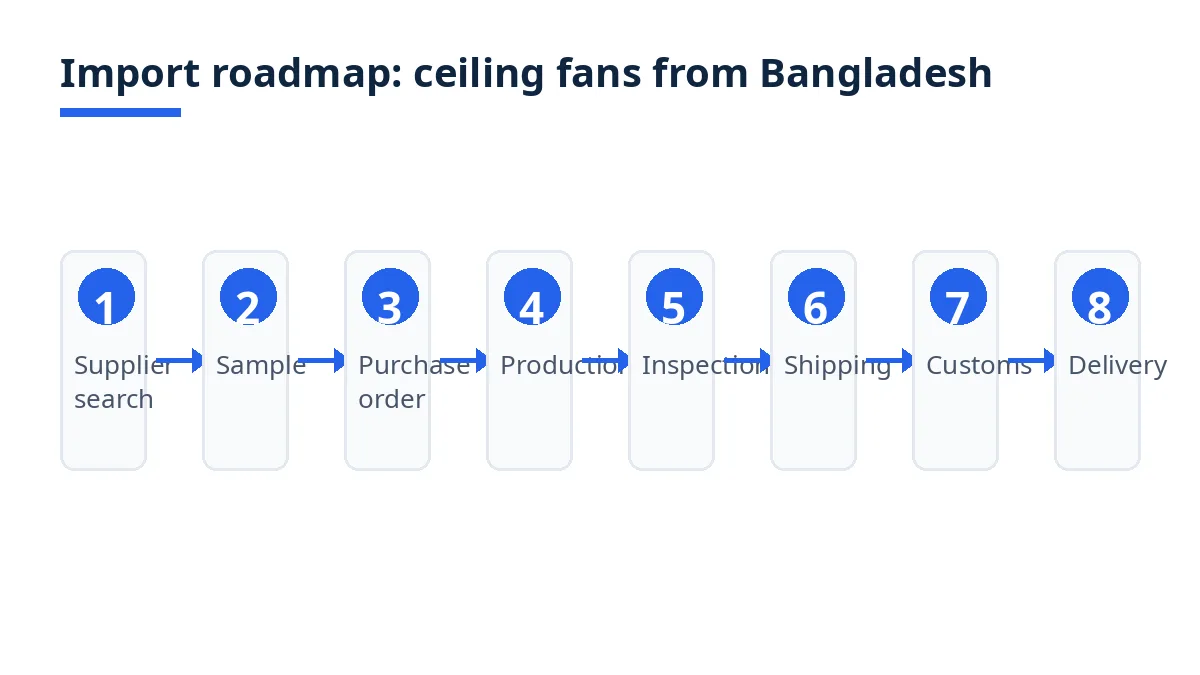
Write the specification model by model: sweep, blade count and material, motor type and rated output, rated voltage and frequency for the destination, speeds, control type, downrod length, finish, light kit if any, rating plate, manual and packing.
Classify every model, starting from sub-heading 8414.51 for fans with a self-contained electric motor of an output not exceeding 125 W, and confirm each full code and duty with your broker.
Shortlist factories and exporters whose range includes ceiling fans of that class, and request comparable quotes on the identical specification and delivery term.
Verify the chosen supplier: company documents, fan capacity, motor winding and blade route, balancing and run-testing arrangements, and a video or in-person factory check for a first order.
Order samples in stages, mount and run them at every speed, check wobble, noise and control response, then approve a pre-production sample of each model in the production motor, blades and control.
Confirm the order in writing: purchase order, pro forma invoice, delivery and payment terms, inspection plan with AQL and defect limits, labelling, packing and shipment date.
Inspect during production and again on packed goods against the approved samples, checking running performance, blade balance and rating plates.
Ship, clear customs with the confirmed code for each model, and reconcile the actual landed cost.
How Exportain helps
Browse suppliers for Bangladeshi electrical product exporters and compare their ranges against your model list. Then post your specification and target quantity as an RFQ and compare replies on the same terms. Exportain is a B2B marketplace where buyers post RFQs, receive quotations and message suppliers. It does not inspect goods, book freight or clear customs.
FAQs
What is the typical MOQ for ceiling fans from Bangladesh?
There is no single typical minimum. It is set per model and usually per colour or finish, because motors are wound, blades are pressed and finished, and cartons and manuals are printed in batches.
How long does shipping take?
Production time and transit time are separate, and neither has a single typical figure. Sea transit takes weeks rather than days and varies by port, routing and season.
What import duty applies?
Duty follows the confirmed classification of each model, the destination and the origin. Ceiling fans with a self-contained electric motor of an output not exceeding 125 W sit in sub-heading 8414.51, and in the United States schedule opened for this guide the general rate on 8414.51.30 and 8414.51.90 is 4.7 percent.5 In the European Union, Bangladesh benefits from Everything But Arms duty-free access, subject to origin rules.6 In the United Kingdom, Bangladesh is listed under Comprehensive Preferences, with 0 percent tariffs on 99.8 percent of products.7 Confirm the current rate beside each model's code for the entry date.
How do I verify a supplier?
Check company documents first, so that name, address and bank account agree across the trade licence, export registration and invoices. Then check capability: ceiling fan capacity, motor winding and blade route, balancing and run-testing arrangements and recent fan production. Keep payments to the company account named in the documents, and approve a pre-production sample of each model before bulk production.
Next steps on Exportain
Read how to import from Bangladesh, then use how to write an RFQ to set out your model list. When ready, post a free RFQ on Exportain and compare quotes on the same terms.
Sources
- Harmonised System. European Commission (accessed )
- IEC 60335-2-80:2024 - Household and similar electrical appliances - Safety - Part 2-80: Particular requirements for fans. International Electrotechnical Commission, (accessed )
- ISO 2859-1:2026 - Sampling procedures for inspection by attributes — Part 1: Sampling schemes indexed by acceptance quality limit (AQL) for lot-by-lot inspection. International Organization for Standardization (accessed )
- Insider thoughts: Bob Ronai on Incoterms 2020 Rules; What are they about?. International Chamber of Commerce (accessed )
- Harmonized Tariff Schedule of the United States, Chapter 84: Nuclear reactors, boilers, machinery and mechanical appliances; parts thereof (Revision 11, 2026). United States International Trade Commission (accessed )
- Trade arrangements. European Commission, Access2Markets (accessed )
- Preference tiers under the Developing Countries Trading Scheme. GOV.UK (Department for Business and Trade), (accessed )
- Why do you use a commodity code when importing?. Netherlands Chamber of Commerce (KVK), (accessed )
About the author
Sourcing from Bangladesh?
Post a request for quotation and suppliers on Exportain can send you their quotes directly.
Post an RFQ