How to Import Windbreakers From Bangladesh in 2026: Complete Buyer Guide
Step-by-step buyer guide to importing windbreakers from Bangladesh: shell ratings and seam sealing, the 6201.93 code, 5% UAE duty and VAT, sampling, the AQL plan and a worked 5,000-piece example to Dubai.
Short answer
To import windbreakers from Bangladesh, define the jacket in numbers: hydrostatic head of at least 10,000mm and MVTR of 10,000 to 15,000g/m2 for the shell, with fully taped seams. Classify men's styles under 6201.93 and women's under 6202.93; the UAE charges 5 per cent duty and 5 per cent VAT on the CIF value. Approve a pre-production sample, set the AQL inspection plan in the order, and clear UAE customs with the full 12-digit code.

On this page
Key takeaways
A men's man-made fibre windbreaker sits under 6201.93; the UAE charges 5% duty and 5% VAT on the CIF value, with no de minimis threshold.
Specify the shell by hydrostatic head of at least 10,000mm and MVTR of 10,000 to 15,000g/m2, and ask for fully taped seams.
A 5,000-piece lot inspected at General Inspection Level II takes a 200-piece sample: accept 10, reject 11 major defects at AQL 2.5.
Example figures put 5,000 windbreakers CIF Jebel Ali at £32,461.50 all in, or £6.19 per piece ex-VAT, with duty at 5%.
A windbreaker earns its keep in weather a heavier coat never meets: a sharp shower, wind on a ferry deck, a cold snap at a spring match. The faults show fast: a sticking zip, lifting tape, a hood that will not stay up. This guide runs the import in eight stages to a Dubai warehouse, with a worked example for 5,000 men's polyester windbreakers to Jebel Ali.
What a windbreaker has to do
A windbreaker has three jobs: block wind, shed rain, and pack small. Put each in the specification as a number, because a number can be tested and a word like "waterproof" cannot.
The first number is the hydrostatic head, in millimetres: the height of a water column the fabric holds back. A minimum of 10,000mm suits most uses, and 20,000mm suits proper all-weather use.1 The second is breathability: the moisture vapour transmission rate (MVTR), measured in grams per square metre over 24 hours: 8,000 suits low-intensity use, 10,000 to 15,000 suits most activities, and 20,000 or more suits high-intensity use.1 Ask for the test method beside each figure. The third is the shell weight and packed size.
Seams decide whether the numbers hold in rain. Stitching punches hundreds of tiny holes through the shell, and tape seals them.2 Critically taped seams seal only the areas most prone to leaks, fully taped seams seal every seam, and welded seams melt the fabric into a bond often stronger than the cloth itself.2 For a rain jacket, ask for fully taped seams. Then the closures: zip type, pocket layout, hood, cuffs, hem drawcord and vent zips. Our windbreakers quality control checklist turns these points into inspector checks.
Which code and duty apply in the UAE
Windbreakers are woven outerwear in Harmonized System chapter 62. A men's or boys' windbreaker of man-made fibres sits under the six-digit line 6201.93, described as anoraks, windcheaters and wind jackets of man-made fibres; the women's equivalent is 6202.93.3 The first six digits are the same everywhere; the UAE adds its own digits, using a 12-digit code from 1 January 2025.4
The UAE applies a standard customs duty of 5 per cent on the CIF value for apparel under headings 61 and 62, and 5 per cent VAT on the CIF value plus duty, CIF being cost, insurance and freight to the UAE port.4 There is no de minimis threshold: every commercial shipment needs a full declaration.4 A shipment entering a UAE free zone, such as Jebel Ali Free Zone, bypasses the standard duty until the goods enter the mainland.4
Line | Garment | UAE duty | UAE VAT |
|---|---|---|---|
6201.93 | Men's or boys' windbreaker, man-made fibres | 5% of CIF | 5% of CIF + duty |
6202.93 | Women's or girls' windbreaker, man-made fibres | 5% of CIF | 5% of CIF + duty |
The import in eight stages
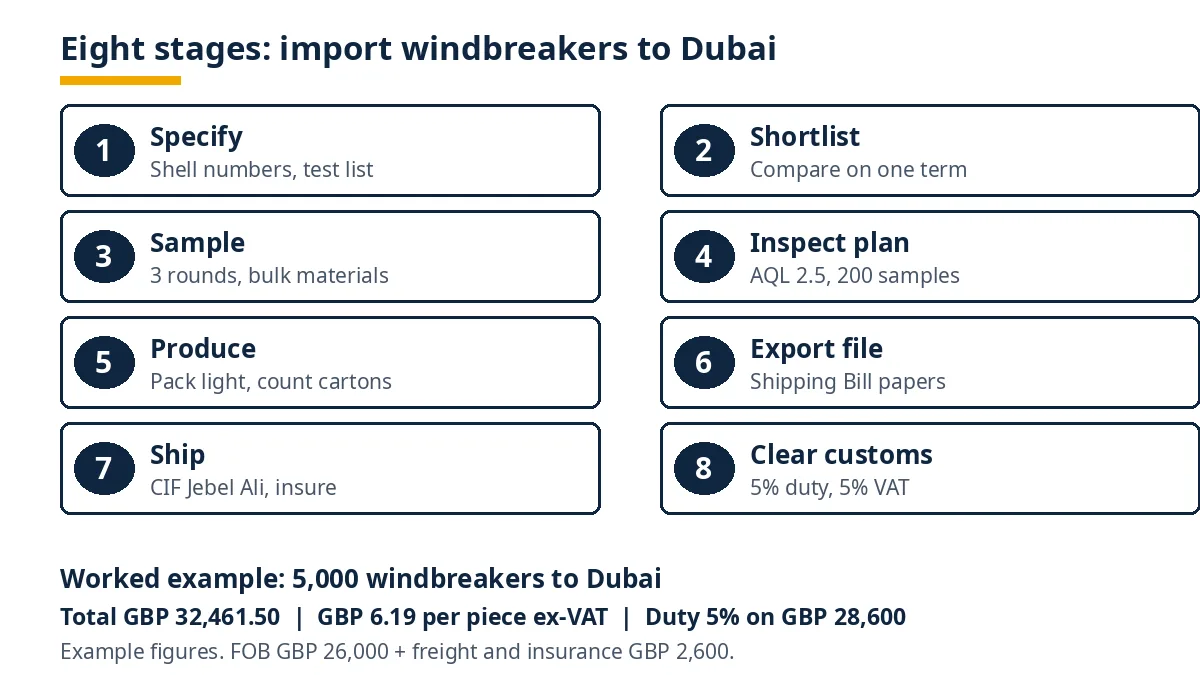
Write the windbreaker specification.
Shortlist makers and compare quotations.
Approve the sample in three rounds.
Set the inspection plan in the order.
Produce, pack light and check the cartons.
File the export papers.
Ship, insure and track to Jebel Ali.
Clear UAE customs and receive the goods.
Stage 1: Write the windbreaker specification
Draft the specification before any maker is contacted: style, shell cloth with its hydrostatic head, MVTR and weight, membrane or coating, DWR finish, seam sealing, hood, zips, size chart, colours, packing, tests and delivery term. Give every candidate the same document.
Add a test list: hydrostatic head and MVTR on the bulk shell, seam tape adhesion, zip cycles, colour fastness, DWR spray rating, and a pack-and-unpack check, each with a pass mark and the wash count beside the spray rating.
Stage 2: Shortlist makers and compare quotations on one term
Shortlist three to five makers of light woven outerwear, and check taped-seam work, zip setting and packable construction before price. Our windbreakers manufacturers guide sets out the checks. Ask each maker for an itemised quotation — shell, membrane or coating, zips, trims, testing, packing and freight — and the minimum per style.
Fix the delivery term before you compare prices. Incoterms 2020 sets out 11 rules on who pays, who carries the risk and who clears customs.5 Under FOB Chattogram, the sea leg and insurance sit with you; under CIF Jebel Ali, the seller arranges carriage and insurance; under DAP Dubai, the seller delivers to your warehouse.5 Under CIF, the default cover is Institute Cargo Clauses (C).5
Stage 3: Approve the sample in three rounds
Take the sample through three rounds, signing off each in writing: a fit sample in substitute cloth, to settle the pattern, hood and length; a size-set sample, to settle the grading; and a pre-production sample in the bulk shell, zips, trims and labels, washed, measured and tested for hydrostatic head, MVTR and seam tape adhesion before bulk is released.
Run the wet-weather checks on the pre-production sample: spray it, flex the taped seams, run every zip, and fold the jacket into its own pocket. Keep one sealed, washed pre-production sample as the bulk reference. Bulk starts only on the approved washed sample.
Stage 4: Set the inspection plan in the order
Name the inspector, the timing and the references in the order, before any cloth is cut. ISO 2859-1 sets the sampling tables, with General Inspection Level II as the usual choice.6 For a 5,000-piece lot, level II gives code letter L: the inspector draws 200 pieces, and at AQL 2.5 the lot passes with 10 major defects and fails at 11, while at AQL 4.0 it passes with 14 minor defects and fails at 15; one critical defect fails the lot.6 Put the edition, ISO 2859-1:2026, in the order.6
Fix the defect classes in writing, and have the inspector draw pieces at random from every size, colour and carton, adding weather checks: taped seams lifting, zips catching, DWR failing the spray test, hoods that will not adjust, and packed dimensions outside the agreed size.
Stage 5: Produce, pack light and check the cartons
Check the shell lots on arrival, the cut panels in production and the finished jackets before packing, and weigh a sample against the specification. Pack as the order states: fold each jacket to the agreed size, bag it, sort cartons by size and colour, and mark each carton with style, size, colour and quantity. Count the cartons against the packing list.
Stage 6: File the Bangladesh export papers
Nothing loads until Bangladesh Customs has approved a Shipping Bill, the mandatory document for customs clearance and loading.7 The exporter applies for it with the EXP form, certified by Authorized Dealers; the signed commercial invoice; the packing list; the certificate of origin; the export letter of credit, telegraphic transfer or purchase order; the VAT certificate; the taxpayer identification number, known as the TIN; and the Export Registration Certificate.7 Ask for the file as one set before production finishes. For the certificate of origin, go to the Export Promotion Bureau or a Chamber of Commerce and Industry.
Stage 7: Ship, insure and track to Jebel Ali
Under FOB, book the freight and insurance yourself and confirm the sailing date in writing. Under CIF, read the insurance certificate before the vessel sails.5 The bill of lading is the contract of carriage and receipt the carrier gives the shipper.7 Collect the bill of lading and container numbers as soon as the carrier issues them.
Stage 8: Clear UAE customs and receive the goods
Hand your broker the full 12-digit code, invoice, packing list, bill of lading and origin certificate before the vessel arrives.4 Importers need a customs code with the emirate customs department before filing. The duty line is 5 per cent of the CIF value, and the VAT line is 5 per cent of the CIF value plus duty.4
On receipt, count the cartons against the packing list, then open jackets from several sizes and colours: spray-test a few jackets, run the zips, flex the taped seams and fold one jacket into its pocket against the sealed sample.
Worked example: 5,000 windbreakers to Dubai
Example figures: 5,000 men's polyester windbreakers, CIF Jebel Ali, to a Dubai warehouse, duty 5 per cent and VAT 5 per cent.4
Cost element | GBP |
|---|---|
Product price, FOB Chattogram (5,000 x £5.20) | 26,000 |
Freight and insurance to Jebel Ali | 2,600 |
Customs value (CIF) | 28,600 |
Duty at 5% of 28,600 | 1,430 |
Value for VAT (28,600 + 1,430) | 30,030 |
VAT at 5% of 30,030 | 1,501.50 |
Customs broker fee | 250 |
Port handling | 300 |
Delivery to warehouse | 380 |
Total cash outlay | 32,461.50 |
Net cost ex-VAT | 30,960 |
Cost per piece ex-VAT | 6.19 |
Check it: 26,000 plus 2,600 is 28,600; 5 per cent of 28,600 is 1,430; 5 per cent of 30,030 is 1,501.50; the lines add to 32,461.50, or 30,960 without the VAT, which is 6.19 per piece. For the FOB lines, see our windbreakers price guide.
How to test a windbreaker before you pay
The lab report is the starting point, not the verdict. On the pre-production sample and again on the inspection sample: spray the shell — water should bead and run off, and fabric that soaks through has a failed DWR finish;1 bend each taped seam inside out, since lifting or gapping tape is a defect;2 work every zip on a form, since a catching or separating zip will come back as a return; and fold the jacket into its own pocket and check the tape stays flat.
Five mistakes that cost windbreaker importers money
Trusting a shell rating with no lab report behind it. A hydrostatic head figure is only a claim until the bulk shell has a test report behind it.1
Accepting critically taped seams on a rain jacket. Critically taped seams seal only the areas most prone to leaks, while fully taped seams seal every seam.2
Judging an FOB price against a CIF price. The CIF figure already holds the sea leg and insurance, so put every quotation on the same rule and named place.5
Filing the entry on the six-digit code. The six-digit line is only the start: the UAE uses a 12-digit code.4
Paying the balance before the inspection report is read. Put the plan, the sample size and the accept and reject numbers in writing before production starts.6
Import checklist
Windbreaker defined as numbers: hydrostatic head, MVTR, weight, seam sealing, zips, hood, packed size.
UAE line settled: heading 6201 or 6202, 12-digit code, 5% duty, 5% VAT.
Makers shortlisted, three to five; quotations compared on one rule.
Samples signed off in writing at each of three rounds, in bulk materials, washed and spray-tested.
Inspection plan in the order: level II, code L, 200 samples.
Order confirmed: specification version, quantities, price, payment terms, packing and sailing date.
Export papers complete: Shipping Bill file, EXP form, origin certificate, invoice, packing list.
Freight and insurance arranged, bill of lading numbers in hand.
Broker holds the code, origin certificate and entry papers.
Goods received, spray-tested and counted; order file closed.
FAQs
What duty do windbreakers from Bangladesh pay in the UAE?
Apparel under headings 61 and 62 pays 5 per cent duty on the CIF value, and 5 per cent VAT on the CIF value plus duty.4 A men's windbreaker sits under 6201.93, the women's under 6202.93.3 4
What hydrostatic head should I ask for?
Ask for at least 10,000mm for most uses, and 20,000mm for all-weather use, with an MVTR of 10,000 to 15,000g/m2.1
Is a certificate of origin needed?
Yes, for the UAE declaration and for the Bangladesh export file: the Bureau issues it, or a Chamber of Commerce and Industry.4 7
Next steps on Exportain
Start with our HS code guide for windbreakers, read our Bangladesh import guide, and post an RFQ with the shell numbers and the seam sealing.
Sources
- How Waterproof Jackets Work: Membranes, Ratings and Breathability. Alpkit, (accessed )
- What are taped seams, and why are they so vital?. Advnture (accessed )
- HTS Code 6201.93 - Men's or boys' anoraks, windcheaters, wind jackets and similar articles, of man-made fibres. Credlix (accessed )
- UAE Import Taxes & Customs Duties 2025: Complete Guide. FreightAmigo, (accessed )
- Incoterms® 2020. International Chamber of Commerce (ICC) (accessed )
- AQL Chart 2.5 and 4.0: Sample Size Tables Explained. ClearLoad (accessed )
- Bangladesh Trade Portal FAQ: Export Registration Certificate (ERC). Bangladesh Trade Portal (accessed )
About the author
Sourcing from Bangladesh?
Post a request for quotation and suppliers on Exportain can send you their quotes directly.
Post an RFQ