

HS Code for Windbreakers: Classification Guide for Importers
Woven windbreakers sit in heading 6201 or 6202, at the six-digit line for the shell fiber. This guide explains the windcheater, wind jacket and anorak tests, the water resistant line, and the US, EU and UK national codes to confirm.
Short answer
A woven windbreaker is tested under heading 6201 for men and boys or heading 6202 for women and girls, at the six-digit line for its shell fiber. The heading covers anoraks, windbreakers and similar articles, so a lightweight unpadded shell, a windcheater and a wind jacket all start here. Confirm the full national code before filing.
On this page
A windbreaker order arrives with a retail name, a shell fabric and a size range, but customs reads construction, padding, length, hood and shell fiber. The Harmonized System is a multipurpose international product nomenclature developed by the World Customs Organization (WCO), comprising more than 5,000 commodity groups, each identified by a six-digit code, and used by more than 200 countries and economies as a basis for their customs tariffs.1 This guide covers classification only, for woven windbreakers, and states no duty rates.
Quick answer: indicative HS heading (with verify note)
The indicative headings are 6201 for men's or boys' garments and 6202 for women's or girls' garments. The United States schedule covers overcoats, carcoats, capes, cloaks, anoraks (including ski jackets), windbreakers and similar articles (including padded, sleeveless jackets), other than those of heading 6203 and 6204.2 A windbreaker belongs in that text by name.
Wearer | Heading | Six-digit line by shell fiber |
|---|---|---|
Men's or boys' | 6201 | 6201.20 wool, 6201.30 cotton, 6201.40 man-made fibers, 6201.90 other |
Women's or girls' | 6202 | 6202.20 wool, 6202.30 cotton, 6202.40 man-made fibers, 6202.90 other |
Treat those lines as indicative and confirm the full code for each wearer group and fiber before filing.
How HS codes are structured (2-4-6 digits)
The Harmonised System runs in sections, chapters at two digits, headings at four digits and subheadings at six digits, with the EU Combined Nomenclature using eight-digit codes built on the same six digits.3 The current version is HS 2022, and countries subdivide the six-digit categories further.3
Level | Digits | For a men's man-made fiber windbreaker |
|---|---|---|
Chapter | 2 digits (62) | Apparel, not knitted or crocheted |
Heading | 4 digits (6201) | Men's overcoats, anoraks, windbreakers and similar articles |
Subheading | 6 digits (6201.40) | The same garments, of man-made fibers |
National extension | 8 to 10 digits | Set by the importing country |
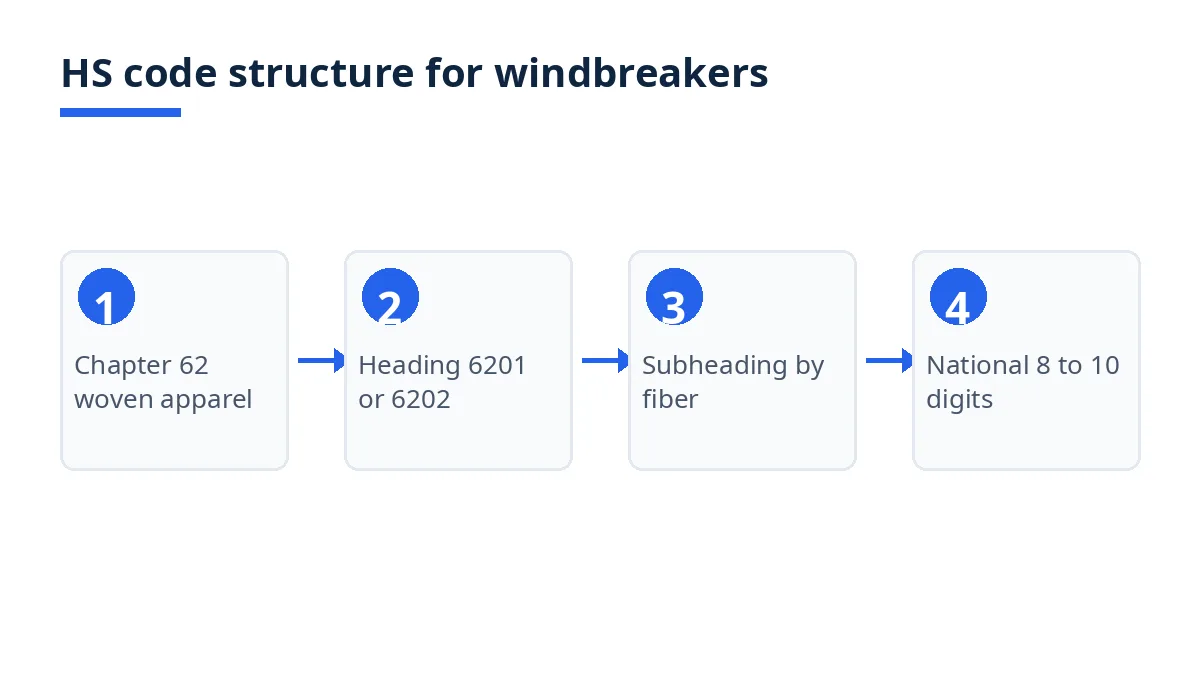
Two windbreakers can therefore share 6201.40 and still need different full codes.2 3
Factors that decide the code for windbreakers
Woven construction comes first. Chapter 62 excludes knitted or crocheted articles.2 Knitted garments sit under headings 6101 and 6102.4 A knitted windbreaker-look shell is tested there instead.
Padding does not decide this heading, and that is the point that separates windbreakers from puffers. The heading text itself covers windbreakers and similar articles including padded, sleeveless jackets.2 An unpadded shell and a lightly padded shell with the same character start in the same heading. Padding changes only the national line: padded sleeveless jackets and down content have their own United States lines.
Windcheater, wind jacket and anorak are three tests inside the same heading. European and United Kingdom guidance define them by length, hood and lining rather than by warmth.4 5
Test | Length | Hood | Lining and tightening |
|---|---|---|---|
Windcheater | Hips or just below | No hood | Unpadded lining; collar; full zip; bottom tightening |
Wind jacket (blouson) | Waist or just below | Hood optional | Lining optional; close neckline; front opening; elastic cuffs; bottom tightening |
Anorak | Well below waist to mid-thigh | Hood required | Padded lining optional; full opening; plus drawstring, tight cuffs, collar or pockets |
For anoraks, and similar articles includes garments with anorak features except for either a hood or a lining.4
The hood, elasticated hem and drawstring pull a shell into this family. A drawstring hood, elasticated cuffs and a drawstring hem are the classic windbreaker features, and they are why a light shell is not filed as a shirt: headings 6205 and 6206 do not cover garments with tightening at the bottom.2
Shell fiber decides the six-digit line; a blend follows weight. For a blend, the section notes classify a mixture as the material that predominates by weight.6 A nylon shell with a small cotton content stays on the man-made fiber line; a cotton-predominant shell moves to cotton.
Wearer group follows closure, then cut. Left over right closure marks a men's or boys' garment, and right over left closure marks a women's or girls' garment, unless the cut clearly indicates otherwise.2 Garments that cannot be identified as either go to the women's or girls' headings.2
The 6203 and 6204 exclusion is a character test, not a panel count alone. Headings 6201 and 6202 exclude garments of heading 6203 and 6204.2 A shell with three or more lengthwise panels, two at the front, can fall under 6203 or 6204, but garments with tightening at the base such as windcheaters are classified elsewhere.4 A tailored jacket with no windbreaker tightening belongs in 6203 or 6204; a light shell with a drawstring hem keeps its windbreaker character even if cut in panels.
Coatings, nonwovens, babies' sizes and ski sets move a shell out of 6201 and 6202. Garments classifiable both in heading 6210 and in other headings, excluding heading 6209, go to heading 6210.2 A woven fabric with a visible non-cellular coating on one surface, and garments made from felt or other nonwovens, are classified there too.4 5 Babies' garments for children up to 86 centimeters tall go to heading 6209 where they are classifiable both there and elsewhere.2 A windbreaker in a ski ensemble must be tested against heading 6211, and garments of different headings keep their own headings in retail sets.6
The water-resistant versus waterproof wording trap. In the United States schedule, water resistant is a defined test: at 600 millimeters head pressure, at most 1.0 gram of water penetrates after two minutes under AATCC Test Method 35, and the resistance must come from a rubber or plastics application.2 A hangtag saying waterproof or water-repellent does not place a windbreaker on the water resistant line. The same caution applies to recreational performance outerwear: windbreakers that are water resistant within the note or treated with plastics, with critically sealed seams and five or more listed features, excluding occupational outerwear.2 A plain windbreaker without sealed seams is not recreational performance outerwear.
National codes: US HTS, EU CN/TARIC, UK commodity code
United States: HTS, ten digits. For a plain men's or boys' man-made fiber windbreaker, neither performance, water resistant, down nor padded sleeveless, the other anorak line is 6201.40.75, giving 6201.40.7511 for men's and 6201.40.7521 for boys'.2 The women's line is 6202.40.75, giving 6202.40.7511 and 6202.40.7521.2 A water resistant version takes 6201.40.70 and 6202.40.70, and a performance version takes 6201.40.50 and 6202.40.50, subject to the feature and sealed-seam tests.2
European Union: CN at eight digits, TARIC for measures. The Combined Nomenclature adds EU subdivisions, producing eight-digit codes.3 Start from 6201.40 or the matching 6202 line, and read the CN and TARIC lines for the garment type and entry date. This guide publishes no EU eight-digit windbreaker line: the EU source opened here gives garment definitions, not a windbreaker-specific eight-digit line, so read the EU line in TARIC for the entry date.
United Kingdom: commodity code. The United Kingdom builds its commodity code on the same first six digits, read from the UK Trade Tariff for the garment and entry date.3 On the UK tariff page for heading 6201, man-made fiber lines split by weight: 6201 4010 up to 1 kilogram and 6201 4090 above it, with the Other line at 6201 4010 90 and 6201 4090 90 respectively.7 Weigh the garment, and read the heading 6202 page for a women's garment.
How to confirm the code officially
Write a precise description: construction, shell, lining and padding fibers by weight, windcheater, wind jacket or anorak type, flat length, hood, cuff and hem tightening, wearer group, coating, and any water resistance test result.
Start from the official tariff for the destination: the USITC HTS, TARIC or the UK Trade Tariff, and read the heading text and chapter notes.
Check published rulings for similar shells. For the United States, the USITC advises traders to use the Customs Rulings Online Search Service (CROSS), because the correct classification of many items can be found there.8
For a borderline shell, apply for a binding decision before you ship. In the EU, a Binding Tariff Information application needs a separate application for each type of product and a detailed description.9 In the United Kingdom, a legally binding decision is generally valid for 3 years, through an Advance Tariff Ruling.10 In the United States, if the merchandise is not described in any ruling on CROSS, you may request a binding ruling from U.S. Customs and Border Protection.8
Give your broker the description and the confirmed code for each style, wearer group and fiber.
Common classification mistakes
Filing every shell as a puffer because it has a lining. An unquilted, unpadded lining is part of the windcheater test; a padded lining alone does not make a puffer.4
Calling a shell waterproof and filing it on the water resistant line. Water resistant in the United States schedule is a defined test with a stated pressure, penetration limit and rubber or plastics condition.2 A marketing word is not a test result.
Filing a plain shell as recreational performance outerwear. That line needs water resistance or plastics treatment, critically sealed seams and five or more listed features.2
Filing a coated shell without the 6210 test. A woven fabric with a visible non-cellular coating on one surface is classified under heading 6210, which prevails over other Chapter 62 headings.2 4
Copying a full national code from another country. Only the first six digits are shared. The EU extends to eight digits, and the United States and the United Kingdom to ten digits.3
Related duties and documents
This guide states no duty rates: the code decides which duty line customs applies, and a rate on a water resistant line does not carry to a plain windbreaker line, or from a men's line to a women's line. Read the rate beside your confirmed code for your origin and entry date, and check what proof of origin a preference claim requires. Keep the description, fiber weights, flat length, hood and lining notes, tightening details, any test report, confirmed codes, any binding decision and origin evidence together in the shipment file, per style, wearer group and fiber.
FAQs
What is the HS code for windbreakers?
No single code is printed under the name windbreaker. A woven windbreaker is tested under heading 6201 or 6202, at the fiber line 6201.20, 6201.30, 6201.40 or 6201.90, or the matching 6202 line.2 A plain man-made fiber windbreaker in the United States takes the other anorak line above, not the water resistant or performance line, unless it passes those tests.2
Is the HS code the same in every country?
Only the first six digits are harmonised. Beyond six digits, each country adds its own lines: eight digits in the EU Combined Nomenclature, and ten in the United States and the United Kingdom.3 2
How do I confirm the correct code?
Describe each windbreaker precisely, read the heading text and notes in the destination tariff, and check rulings such as CROSS.8 For a borderline shell, apply for a binding decision: a BTI in the EU,9 an Advance Tariff Ruling in the United Kingdom,10 or a CBP ruling in the United States.8
What happens if I use the wrong code?
Duty, licensing and quota treatment follow the code on the declaration, so a wrong code brings the wrong treatment. A binding decision in advance helps you calculate the duties and restrictions that will apply.10
Next steps on Exportain
Start with the HS code explainer for the digit structure and how to classify your product for the method, then confirm the code with your broker. When the specification is set, Post a free RFQ on Exportain. Exportain is not a party to the goods contract and does not inspect goods, book freight or clear customs.
Sources
- What is the Harmonized System (HS)?. World Customs Organization (accessed )
- Harmonized Tariff Schedule of the United States, Chapter 62: Articles of apparel and clothing accessories, not knitted or crocheted (Revision 17, 2026). United States International Trade Commission (accessed )
- Harmonised System. European Commission (accessed )
- Classifying textiles. European Commission, Access2Markets (accessed )
- Classifying textile apparel. HM Revenue & Customs (GOV.UK), (accessed )
- Harmonized Tariff Schedule of the United States, Section XI Notes (2025 Revision 11). U.S. International Trade Commission (accessed )
- UK Integrated Online Tariff: heading 6201, men's or boys' overcoats, anoraks, wind-cheaters, wind-jackets and similar articles. GOV.UK (accessed )
- MTB 2019: Get Out Ahead of the Pack with a Binding Ruling from CBP. U.S. International Trade Commission (accessed )
- European Binding Tariff Information (EBTI). European Commission, Taxation and Customs Union, (accessed )
- Check what you'll need to get a legally binding decision on a commodity code. GOV.UK, HM Revenue and Customs (accessed )
About the author
Sourcing from Bangladesh?
Post a request for quotation and suppliers on Exportain can send you their quotes directly.
Post an RFQ


