

Windbreakers Price in Bangladesh: FOB Cost Breakdown for Buyers
Windbreaker FOB prices in Bangladesh have no single typical figure. This guide reads the price as itemized cost lines up to loading, shows how a specification change moves the total with example figures, and lists the terms to agree in writing.
Short answer
A windbreaker FOB price from Bangladesh has no single typical figure. It is the sum of cost lines up to loading on board at the named port of shipment: shell fabric, coating or laminate, DWR finish, seam taping, trims and labels, packing, testing and setup, and inland transport and port handling. Compare quotations only as itemized lines on one specification, one quantity basis and one delivery term, with validity dates stated.
On this page
Key takeaways
There is no single typical FOB price for windbreakers from Bangladesh: the price is the sum of cost lines up to loading on board at the named port of shipment.
Example figures show the structure: in a 100-unit example, shell is 38 units and coating and DWR is 14 units, and raising the coating line alone to 20 units raises the total to 106 units.
Under FOB the buyer carries freight, insurance and import costs beyond loading, and FCA may fit containerised multimodal movement better than FOB.
Agree the evidence in writing before payment: an itemized quotation, a sample in production materials, a wash retest and an inspection standard. A badge is a document and photo review only.
A windbreaker FOB price from Bangladesh has no single typical figure. It is the sum of cost lines up to loading on board at the named port of shipment: shell fabric, coating or laminate, DWR finish, seam taping, trims and labels, packing, testing and setup, and inland transport and port handling. Two quotations with the same headline price can describe different jackets, because one prices a coated, fully taped shell and the other prices an uncoated, untaped one. This guide reads a windbreaker price line by line, shows how a specification change moves the total with example figures, and lists the terms to agree in writing before payment.
Windbreakers are woven shells, and woven garments earned US$4,614.80 million in the first quarter of fiscal 2026-27, within ready-made garment exports of US$10,578.56 million, on Export Promotion Bureau (EPB) data reported by The Financial Express.1 That scale produces no shared price: each factory prices your shell, coating, taping, trim and pack runs for your quantity and your delivery term.
Read the FOB price as cost lines, not as a jacket price
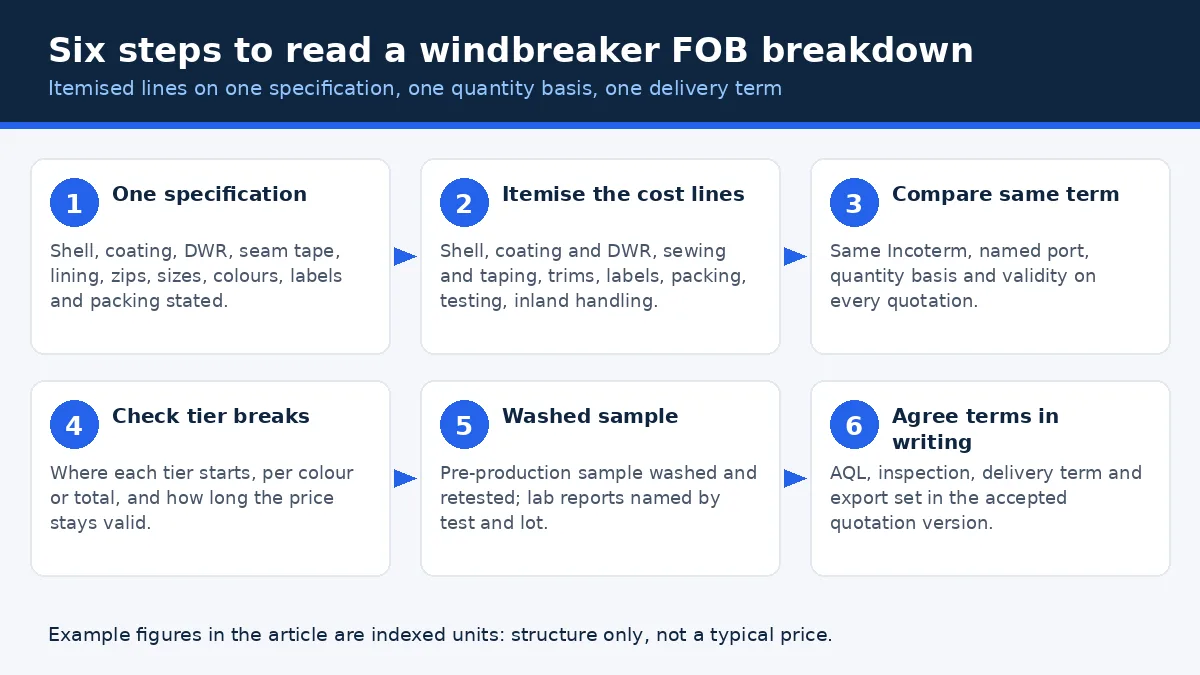
A usable FOB quotation states the unit price, the quantity basis, the specification, the Incoterm and named port of shipment, payment terms and validity, with the cost lines the price contains. A quotation that states only a unit price and a total has not yet told you what the price buys. Ask for the lines below, itemised, before comparing any two offers.
The lines that make up a windbreaker FOB price, in the order they enter production, are: shell fabric; coating or laminate; DWR finish; cutting and sewing; seam taping; lining, where specified; zips, trims and cord locks; labels, tags and packing; testing and setup; and inland transport, export clearance and port handling to loading on board. Freight beyond loading, insurance, import duty and onward delivery sit outside an FOB price.2
A price without a specification cannot be held to account. State the shell, coating, DWR, seam construction, lining, zip, size range, colours, labels and pack in the same document as the price. A change to any one line after the quotation is a new quotation.
The shell line: fabric, weight and coating
Fibre decides the fabric lot. Most windbreaker shells are woven nylon or polyester, produced and dyed in lots, and one colour is one dye lot. A stocked shell in a standard colour can cost less than a dyed-to-order colour, because the lot already exists. State the fibre, weave, weight and colour, and whether each colour is stocked or dyed to order.
Weight decides how much fabric each jacket consumes. A heavier shell uses more fabric per jacket and changes the cutting marker, sewing time and packed weight. A lighter shell can cost less on fabric and more on handling, because light fabric distorts more easily at the zip tape and seams.
Coating or laminate decides the run cost. A coating or laminate is applied in runs, and a change of coating restarts the run, its curing and its retest. A shell with a coating in one colour and a different coating in another is two coating runs. Ask which run your order joins, and what retest follows a lot change.
Shell decision | What moves the line | Ask for it as |
|---|---|---|
Fibre and weave | Fabric lot, dye lot, shade match | Fibre, weave, weight, stock or dyed to order |
Weight | Fabric per jacket, marker, packed weight | Weight on the production-lot lab report |
Coating or laminate | Coating run, curing, retest | Coating type, run, wash retest |
Colour count | One lot per colour | Quantity per colour, in writing |
The weatherproofing lines: DWR, tape and testing
DWR is the chemical treatment on the outer face fabric that makes water bead and roll off. It is not the waterproof membrane: it is the first line of defence, and when it degrades from dirt, sweat and washing, water wets out on the face fabric, reducing breathability and making the jacket feel heavy.3 Price the DWR finish as its own line, with the named test and the wash condition stated. A finish without a named test cannot be compared, and a finish priced without a wash retest will be retested only if you pay for it later.
Seam taping is the line that decides whether the finished jacket keeps water out at the joins. Seam taping applies a waterproof tape over stitching to prevent water ingress, and every seam is a potential leak point.3 Fully taped seams tape every seam; critically taped seams tape only the main stress points, typically shoulders, chest and back.3 Price the seam line as stated construction, not as an assumption, and check tape adhesion after washing on a washed sample.
Testing is the line buyers most often leave out and then pay for twice. Hydrostatic head figures describe fabric resistance to water penetration, measured as the height of a water column the fabric can withstand before water penetrates.3 A head figure is a fabric result on a stated test, not a garment result. Price the lab reports you require: shell and coating reports for the production lot, a DWR or spray retest after washing, and a tape-adhesion check after washing.
Trims, lining, labels and packing: where small lines add up
Zips are the trim buyers handle every day, and the trim most often changed between sample and bulk production. Name the zip type, size and grade in the specification, and ask for the same zip on the sample and in bulk, at the price quoted. Cord locks, elastic, drawcords and hook-and-loop cuffs follow the same rule.
Labels, hang tags and cartons are ordered in their own print runs, each with a minimum and a setup cost, and a private-label order can meet the garment quantity and still carry a label surcharge. Ask for the label, tag and carton lines apart from the unit price, and check the label proof word for word: in the European Union, a textile product must be labelled with the name and percentage by weight of all constituent fibres in descending order, under Regulation (EU) No 1007/2011.4
Packing is a cost line and a protection line. A packable style packed per piece in its own pouch, a retail pack with a hang tag, and a bulk pack in cartons are three different packing runs. State the pack type per colour and size, and ask for the carton assortment, dimensions and gross weight on the quotation.
How quantity, colour and size move the unit price
Quantity moves the unit price through setup costs, not through fabric alone. Print screens, embroidery digitising, label runs, coating runs and seam-tape setup are fixed costs, spread over the quantity that shares them. A smaller quantity per colour carries a larger share of each setup cost, so the unit price rises as the quantity per colour falls, even when the total quantity stays the same.
Example figures below use indexed units, not currency, to show the structure. All figures are example figures, illustrative only.
Example figures: a windbreaker FOB price of 100 indexed units is made up of shell 38 units, coating and DWR 14 units, cutting, sewing and taping 22 units, trims, lining and labels 12 units, packing, testing and setup 8 units, and inland transport and port handling 6 units. Raising the coating and DWR line to 20 units raises the total to 106 units. Adding fully taped seams raises the sewing line by 4 units, to 110 units. Cutting the colour count from three to one, at the same total quantity, spreads setup over more jackets per colour, and the example total falls back to 102 units. The example shows structure only, not a typical price.
Cost line | Example figures, base | After a heavier coating | After full taping |
|---|---|---|---|
Shell fabric | 38 units | 38 units | 38 units |
Coating and DWR | 14 units | 20 units | 20 units |
Cutting, sewing and taping | 22 units | 22 units | 26 units |
Trims, lining and labels | 12 units | 12 units | 12 units |
Packing, testing and setup | 8 units | 8 units | 8 units |
Inland transport and port handling | 6 units | 6 units | 6 units |
Total, example figures | 100 units | 106 units | 110 units |
Price tiers work the same way: a lower unit price at a higher quantity reflects fixed setup costs spread over more pieces. Check where each tier starts, whether it applies per colour or to the total, and how long it stays valid. An order just below a tier break can cost more in total than an order at the break. Check both sides of every break, and agree the tier basis in writing.5
FOB, and what sits beyond loading
FOB (Free On Board) fixes the finish line of the price: loading on board the vessel at the named port of shipment. The Incoterms 2020 rules allocate cost, risk and obligations between seller and buyer, and have been used globally since 1936, updated in 2020.6 Under FOB, the seller delivers on board, cleared for export, and the buyer arranges and pays the main carriage, insurance and import clearance, and bears risk from loading.
Beyond loading, the buyer pays ocean freight, cargo insurance, destination charges outside the freight contract, import clearance, duty and tax, and inland delivery. Duty follows classification: the Harmonized System comprises more than 5,000 commodity groups, each identified by a six-digit code.7 Heading 6201 covers men's or boys' anoraks of man-made fibres at 6201.93, and heading 6202 covers the women's or girls' equivalents at 6202.93.8 9 Confirm the full code with the destination tariff before filing.
Comparing two quotations line by line
Rewrite each quotation into the same fields before judging it: specification, quantity basis, cost lines, delivery term, payment terms and validity. A quotation is versioned on Exportain, stating unit price, MOQ, lead time, Incoterm, payment terms and validity for each version.10 Use that version as the record, and counter-offer in the same thread.
Check, in order: the shell and coating lines match the specification, with lab evidence named; the seam line states which seams are taped; the zip and trim lines name the grade; the label and packing lines are priced apart; the testing lines name the tests; and the delivery term and validity are the same on both offers. A lower headline price that omits testing, taping or labels is not a lower price: it is a price with lines still to be bought.
Ask each omitted line to be priced or explicitly excluded, in writing, before accepting. Ask what happens to the price if the shell lot changes, if a colour is dropped, or if the quantity moves across a tier break.
What to agree in writing before you accept a price
The specification. Shell fibre, weave and weight, coating or laminate type, DWR finish and named test, seam construction, lining, zip type and grade, size range, colours, labels and packing, each as a buyer-specification item.
The cost lines. Shell, coating and DWR, sewing and taping, trims, lining and labels, packing, testing and setup, and inland transport and port handling, itemised, with any line excluded stated as excluded.
The quantity basis. Per style, per colour and per size, with the size curve size by size, and the tier basis and tier breaks stated.
The sample and testing evidence. A pre-production sample in the production shell, coating, tape and trims, washed and retested, approved in writing; lab reports named by test and lot.3
The inspection standard. AQL, inspection level, defect classifications, who inspects, and what happens to a rejected lot. ISO 2859-1:2026 provides sampling schemes indexed by AQL for lot-by-lot inspection by attributes.11 Keep a sealed sample as the shipment reference.
The delivery term and validity. One Incoterm, one named port of shipment, payment terms, and price validity dates, each stated in the quotation version accepted.6
The export set. The Bill of Export with the invoice, packing list, EXP form, certificate of origin, VAT certificate and Taxpayer Identification Number, approved before loading.12
The windbreakers manufacturers guide sorts suppliers by shell, coating, seam tape and zip capability, rather than by ranking.13 Shortlist by capability, then check records, documents, a washed sample and inspection terms before payment. On Exportain, profile badges record document and photo checks; verification is a document and photo review, not a factory inspection.14
What should I know first about windbreakers?
Know the windbreaker price as cost lines, not as a jacket price. Shell, coating, DWR, taping, trims, labels, packing, testing and inland handling each carry their own line, and a specification change moves the line it touches. Stating the shell, coating, DWR, seam construction and quantity basis yields comparable quotations; a style photograph and a target price do not.
What are the typical costs and timelines?
There is no typical FOB price or lead time for windbreakers as a category: shell, coating, taping, trims, quantity, delivery term and destination each move the figure. Ask for an itemised cost breakdown, a lead time by approval gate, and a validity date, and compare suppliers on the same breakdown. One total price and one total lead time, without the lines and gates, cannot be compared or held to account when a line or gate moves.
Which documents are needed?
The documents fall into three sets: the order set (specification or tech pack, accepted quotation version, purchase order stating the cost lines and quantity basis, sample approval record); the product set (shell and coating lab reports, DWR test evidence, certification evidence, label approvals); and the shipment set (commercial invoice, packing list, transport document, any origin or customs document required), prepared under the agreed Incoterm.6 The export set is the Bill of Export with the invoice, packing list, EXP form, certificate of origin, VAT certificate and Taxpayer Identification Number.12 Keep all three sets in one order record.
What are the most common mistakes?
The most common mistake is comparing headline prices on different specifications, where one price includes full taping and testing and the other omits both. The second is treating a DWR finish as waterproofing, or a fabric head figure as a garment result, without a taped-seam and wash-retest check.3 The third is comparing an FOB price with a CIF or DAP price without adding the lines each term leaves to the buyer.
Next steps on Exportain
Search Bangladeshi suppliers and filter outerwear listings by badge, MOQ and OEM or ODM capability, then shortlist by shell, coating and seam-tape capability using the windbreakers manufacturers guide. Read the windbreakers quality control checklist before ordering, so the seam, hood and closure checks are agreed before production. Then post an RFQ stating shell, coating, DWR, seam construction, cost-line requirements, quantity basis and destination, and compare versioned quotations on the same fields.
Post a free RFQ on Exportain and get quotes from Bangladeshi suppliers →
Sources
- RMG exports rise 6.10pc to US$10.58b in July-Sept of FY27. The Financial Express, (accessed )
- CIF Meaning (Cost, Insurance & Freight). Exportain (accessed )
- Rain Jacket Buying Guide NZ — Waterproofing & Fit. Dwights Outdoors, (accessed )
- Regulation (EU) No 1007/2011 on textile fibre names and related labelling and marking of the fibre composition of textile products. European Union, (accessed )
- MOQ Meaning (Minimum Order Quantity). Exportain (accessed )
- Incoterms® 2020. International Chamber of Commerce (ICC) (accessed )
- What is the Harmonized System (HS)?. World Customs Organization (accessed )
- HS, 2012 - Code 6201. United Nations Statistics Division (accessed )
- HS, 2012 - Code 6202. United Nations Statistics Division (accessed )
- How to source and buy from Bangladesh. Exportain (accessed )
- ISO 2859-1:2026 — Sampling for Inspection by AQL. American National Standards Institute (ANSI) (accessed )
- Customs Clearance Procedures for Export. Bangladesh Customs, National Board of Revenue (accessed )
- Top Windbreakers Manufacturers in Bangladesh. Exportain (accessed )
- How Supplier Verification Works on Exportain. Exportain, (accessed )
About the author
Sourcing from Bangladesh?
Post a request for quotation and suppliers on Exportain can send you their quotes directly.
Post an RFQ


