

Top Windbreakers Manufacturers in Bangladesh: How to Find and Verify Them
Windbreaker factories in Bangladesh are judged on shell fabric, coatings, seam sealing and zips, not on company names. Seven checks, from lab reports to versioned quotations, show how to find and verify one.
Short answer
To find windbreaker manufacturers in Bangladesh, write one specification covering shell fabric, coating or laminate, hydrostatic head figure, seam construction, zips, sizes and packing, shortlist woven-garment suppliers, and run seven checks on each: fabric lab reports, seam sealing, zips and packability, graded fit, washed sampling, documents and certificates, and dated capacity with versioned quotations. Approve a washed pre-production sample before paying.
On this page
Key takeaways
Windbreakers are light woven shells, so judge suppliers on woven outerwear they are making now: shell fabric, coatings, seam tape and zips.
Production is concentrated in Dhaka, Gazipur, Narayanganj and Chattogram; the BGMEA woven pool is the starting point, not the knitwear sector.
Run seven checks on each supplier: fabric, seams, closures, fit, sampling, documents and commercial terms, and file the evidence per supplier.
Exportain badges record document and photo checks reviewed by the Exportain team; they are not factory inspections, so check the documents yourself.
Price and MOQ are set per style, colour and counting basis; every figure in this article is labelled Example figures.
A windbreaker is a light woven shell, not a padded coat and not a knit top, so finding windbreakers manufacturers in Bangladesh starts with shell-fabric capability: coatings, seam sealing and zips on current woven outerwear work. Woven garments earned US$4,614.80 million in the first quarter of fiscal 2026-27, within ready-made garment exports of US$10,578.56 million, according to Export Promotion Bureau (EPB) data reported by The Financial Express.1 The United States took US$2,220.86 million, the European Union US$4,904.02 million, and exports to the United Arab Emirates rose 18.67 per cent to US$74.34 million.1
Where windbreaker factories work in Bangladesh and what they make
A mapping of 3,485 export-oriented garment units counted 1,351 in Dhaka, 1,057 in Gazipur, 615 in Narayanganj and 386 in Chattogram, with the rest elsewhere.2 The same mapping reported that about 60 per cent of the Bangladesh Garment Manufacturers and Exporters Association (BGMEA) member factories it described were woven manufacturers.2 That is the pool to search first: woven-garment factories, not the knitwear sector. The Bangladesh Knitwear Manufacturers and Exporters Association (BKMEA) represents approximately 2,540 knitwear member factories, a different production base.3
Ask which shell types the factory is running now: an unlined single-layer shell, a mesh-lined shell, a packable shell that folds into its own pocket or pouch, a ripstop shell, a hooded shell, and a pullover anorak style as well as a full-zip style.
Seven checks for windbreakers manufacturers in Bangladesh
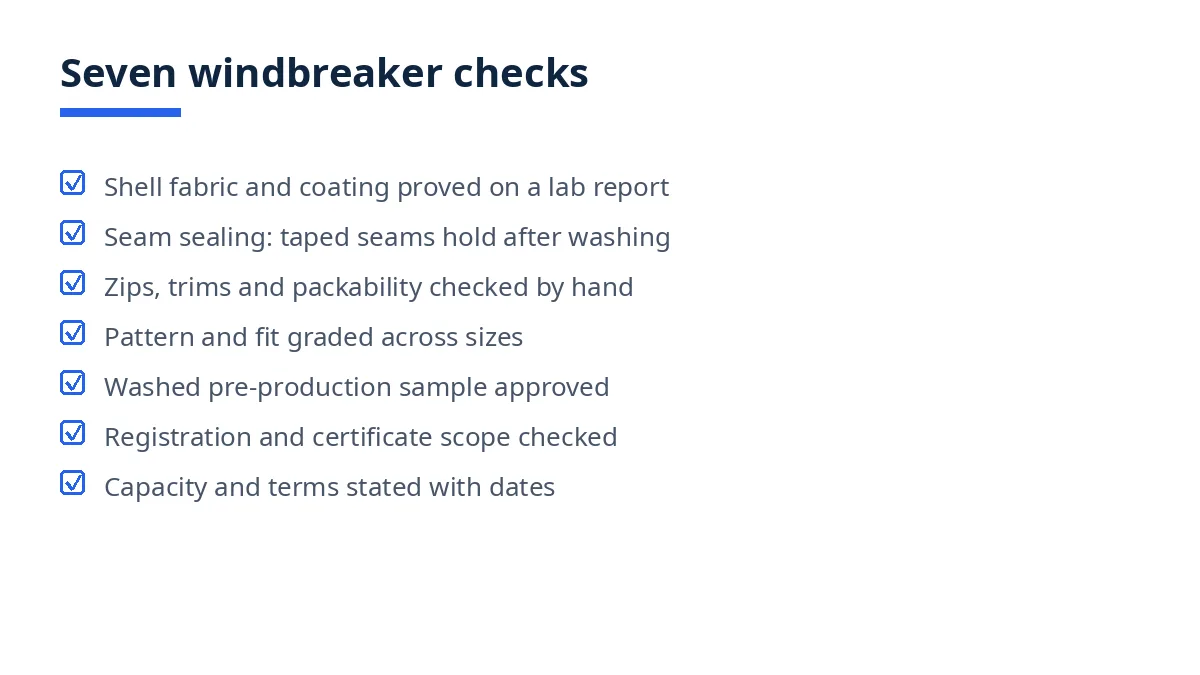
Run the seven checks below in order on each shortlisted supplier, and keep the evidence in one file per supplier.
1. Shell fabric and coating or laminate, proved on a lab report
What it is. Proof that the shell fabric, its coating or laminate, and its water-repellent finish meet the water resistance your market needs, on the production fabric. The hydrostatic pressure method in ISO 811 applies steadily increasing water pressure to one face of a fabric until penetration occurs in three places, and it applies to all fabrics intended to be water resistant.4
Why it matters. A coating that delaminates after washing or a finish that washes out leaves a shell that looks right and no longer sheds rain.
How to check it. Name the fabric, weight, coating or laminate type, and hydrostatic head figure you require, and ask for the lab report for the production lot. Require a retest after washing on the pre-production sample, and a new approval if the lot changes.
2. Seam sealing and water entry at the joins
What it is. Control of every joined edge: whether seams are stitched only, taped with seam-sealing tape, or welded, and whether tape adhesion holds after washing and flexing. Shoulder seams, yoke seams, hood joins and pocket openings are the places water enters first.
Why it matters. A shell fabric can pass a hydrostatic test while the finished jacket leaks at every seam.
How to check it. Ask which seams are taped, which tape is used, and how tape adhesion is checked after washing. Inspect the tape at the shoulders, hood and armholes on a finished sample, wash it, and inspect the same seams again. Record the seam construction in the specification.
3. Zips, trims, closures and packability
What it is. Proof that the zips, cord locks, elastic, hook-and-loop cuffs, drawcords and pack pouch work as a set: zips that run without catching on the storm placket, cuffs and hem that seal out wind, and a packable style that folds to the stated packed size.
Why it matters. Zips and trims are the parts a buyer handles every day, and the parts most often changed between sample and bulk production to cut cost.
How to check it. Name the zip type, size and grade in the specification, and ask for the same zip on the sample and in bulk. Operate every zip, cord lock and cuff adjustment on the sample by hand. For a packable style, fold the sample into its pouch and check the packed size.
4. Pattern, fit and layering, proved on a graded sample
What it is. Evidence that the supplier can grade the shell pattern across your full size range and hold fit at each size, with room for the layers worn underneath a windbreaker. A shell that fits over a T-shirt at a medium can bind over a fleece at the upper end of the range.
How to check it. Send a specification with a size chart, tolerances and the layer to be worn underneath, and ask for the fit sample in your base size plus graded measurements for the full range. Measure the sample against your chart, check hood, sleeve and hem, and require corrections in writing.
5. Sampling and wash and water testing before bulk production starts
What it is. A prototype or fit sample, then a pre-production sample made from the bulk shell fabric, lining, trims, tape and labels, approved in writing before cutting starts.
Why it matters. The pre-production sample is the only point where the windbreaker exists in its final form before the full order is cut. Washing and water checks on that sample catch coating loss, tape lifting, shade change, zip failure and shrinkage.
How to check it. Require the pre-production sample in the production shell fabric and trims, with the production tape and labels attached. Wash it, retest water resistance on the washed fabric, inspect taped seams after washing, and measure it against the size chart. Keep one sealed sample as the reference.
6. Registration, identity and certificate scope checked on the documents themselves
What it is. Confirmation that the company quoting is a registered exporter, that its legal name and address match on every document, and that any certificate relied on covers the right company, site, product and dates. BGMEA runs an online Membership Management System through which member factories can generate an e-certificate of membership.5
Why it matters. A quotation, an invoice and a certificate that name different companies cannot be relied on together. In the European Union, a textile product must be labelled or marked with the name and percentage by weight of all constituent fibres in descending order, under Regulation (EU) No 1007/2011.6
How to check it. Ask for the trade licence and the Export Registration Certificate (ERC), and check the name and address on each against the quotation. If the supplier claims BGMEA membership, confirm the record with the association.5 Check the certificate number with the issuing body, and confirm the company, site, product category, standard and expiry date. On Exportain, the Exportain Verified and Export Verified badges record staff checks of identity, registration and the ERC; both are document and photo reviews, not factory inspections.7 Treat a badge as a starting filter.8
7. Capacity, workload and commercial terms stated with dates
What it is. A dated statement of current production, your start date, the capacity your order would take, whether any stage is subcontracted, and a single quotation version stating unit price, minimum order quantity (MOQ) and how it is counted, lead time, Incoterm and named place, payment terms and validity date.
Why it matters. A factory that can make your windbreaker in principle may have no line free in the weeks you need, and a supplier that quietly subcontracts coating, taping or sewing has handed control of quality to a facility you have not checked. The Incoterms 2020 rules give a clear allocation of cost, risk and obligations across 11 rules, used globally since 1936 and updated in 2020.9
How to check it. Ask for the current production list, the start date, the expected production window, and a written statement of every stage done outside the named facility. On Exportain, every quotation is versioned and states unit price, MOQ, lead time, Incoterm, payment terms and validity for each version.10 Agree the inspection standard in the same document: ISO 2859-1:2026 provides sampling schemes indexed by acceptance quality limit (AQL), the maximum percentage of defective items considered acceptable in a lot.11
Summary table
Check | What good looks like | Evidence to file |
|---|---|---|
1. Shell fabric and coating | Lab report for the production lot | Lab report, wash retest |
2. Seam sealing | Taped seams stated, tape holds after washing | Seam record |
3. Zips, trims and packability | Named zip grade, packed size checked | Trim list, packed sample |
4. Pattern, fit and layering | Graded measurements against your chart | Measured sample |
5. Sampling and testing | Pre-production sample washed and retested | Sealed sample |
6. Registration and certificates | Licence, ERC, membership record, certificate checked | Document copies |
7. Capacity and commercial terms | Dated workload, subcontracting stated, one quotation | Dated statement, quotation version |
What moves price and MOQ for windbreakers
No single price or MOQ applies to windbreakers. Shell fabric and weight, coating or laminate type, seam taping, zip specification, colour count, lining, pack pouch, labels and packing each move the quote, and each supplier counts its minimum differently: per order, per style, per colour, per size, or per fabric lot. Ask for the counting basis in writing, and read the guide to MOQ meaning. All figures here are Example figures.
Example figures: a quotation shows a unit price for 1,000 windbreakers in one colour and a lower unit price from 2,000 windbreakers, and ordering 1,900 at the first tier costs more in total than ordering 2,000 at the second tier. Compare quotations only on the same specification, coating, seam construction, zip grade, counting basis, Incoterm and packing.
How to shortlist and verify a windbreaker supplier, step by step
Start with one written specification before contacting any supplier, naming shell fabric and weight, coating or laminate type, hydrostatic head figure, seam construction, lining, zip type and grade, size range, colours, trims, pack pouch, labels, packing, markets, quantity, destination and Incoterm.
Shortlist on Exportain by searching published products by keyword and category, filtering by badge, sample availability and OEM or ODM capability, and sorting by MOQ or lead time.10 Send the identical specification to each shortlisted supplier, and ask each one the seven checks above in writing. Compare the versioned quotations on the same fields, approve the pre-production sample after washing and water testing, and agree the AQL inspection terms before paying.
The Harmonized System comprises more than 5,000 commodity groups, each identified by a six-digit code, so confirm the full code for the destination tariff before filing.12 The guide to the HS code for windbreakers sets out the classification factors for this product.
How Exportain helps
Exportain is a B2B marketplace for sourcing from Bangladesh. Buyers search published products by keyword and category, and can filter to suppliers holding the Exportain Verified badge, sample availability and OEM or ODM capability, and sort by MOQ or lead time.10 Each supplier profile shows its verification level, location and the certifications the supplier has declared.10 Buyers then post a request for quotation (RFQ) stating quantity, target price, destination, Incoterm, required certifications and deadline.10
Use the badges as a starting filter, not a conclusion. Verification on Exportain is a document and photo review by the Exportain team, not a factory inspection, and membership never grants a badge.8 The verification guide sets out what each badge covers and what it does not cover.7 Run the seven checks above on your shortlist.
What MOQ do windbreaker factories ask for?
There is no standard MOQ for windbreakers, because the minimum is set by the fabric lot, the coating run, the colour count and the counting basis, not by the product name. The counting basis varies: per order, per style, per colour, per size or per fabric lot. Ask each supplier to state the minimum and its basis in writing. On Exportain, each versioned quotation states unit price, MOQ, lead time, Incoterm, payment terms and validity together.10
How do I prove a factory really makes windbreakers?
Ask for current production, not a catalogue. A factory that makes windbreakers now can name the shell styles in production this season, show the coating or laminate it uses, show taped seams on garments in work, and produce a sample in the production fabric with the production zip and tape. Check the lab report, wash the sample, and inspect the taped seams and zips by hand. A trading company can still be a sound route, but the producing factory must be named in the order terms and checked with the same seven checks.
Which documents should I ask for?
Ask for the trade licence and the Export Registration Certificate (ERC), and check the legal name and address match on every document and the quotation. If the supplier claims BGMEA membership, confirm the record through the association's Membership Management System, through which member factories can generate an e-certificate of membership.5 Ask for the shell fabric lab report and the certificate for any audit or fibre claim, then check the certificate number with the issuing body. For the European Union, approve the label proof word for word: a textile product must be labelled with the name and percentage by weight of all constituent fibres in descending order.6
How do I verify a supplier before ordering?
Run the same seven checks on every shortlisted supplier, in the same order, and file the evidence per supplier: lab report and lot note, seam and tape record, trim and zip list, graded sample measurements, washed pre-production sample approval, document and certificate checks, and a dated workload statement with a versioned quotation. Approve the pre-production sample after washing and water testing, check the documents yourself rather than relying on a badge or a profile claim, and agree the AQL inspection standard, Incoterm and payment terms in one versioned quotation before paying.10 11 If a supplier cannot produce a document, a lab report, a sample or a date for any check, do not order until it is closed.
Next steps on Exportain
Browse Bangladeshi suppliers, filter by badge and MOQ, then run the seven checks on your shortlist. Read the guide to how supplier verification works on Exportain. Then post an RFQ with your windbreaker specification, quantity, destination and Incoterm, and compare the versioned quotations that come back.
Sources
- RMG exports rise 6.10pc to US$10.58b in July-Sept of FY27. The Financial Express, (accessed )
- 2.7m apparel workers on database. The Financial Express, (accessed )
- BKMEA at a Glance. BKMEA (accessed )
- ISO 811:1981 - Textile fabrics — Determination of resistance to water penetration — Hydrostatic pressure test. International Organization for Standardization (ISO) (accessed )
- BGMEA launches Membership Management System to provide faster and simpler services. BGMEA (accessed )
- Regulation (EU) No 1007/2011 on textile fibre names and related labelling and marking of the fibre composition of textile products. European Union, (accessed )
- How Supplier Verification Works on Exportain. Exportain, (accessed )
- Supplier verification: Earn trust badges buyers can see. Exportain (accessed )
- Incoterms® 2020. International Chamber of Commerce (ICC) (accessed )
- How to source and buy from Bangladesh. Exportain (accessed )
- ISO 2859-1:2026 — Sampling for Inspection by AQL. American National Standards Institute (ANSI) (accessed )
- What is the Harmonized System (HS)?. World Customs Organization (accessed )
About the author
Sourcing from Bangladesh?
Post a request for quotation and suppliers on Exportain can send you their quotes directly.
Post an RFQ


