How to Import Knitted Beanies From Bangladesh in 2026: Complete Buyer Guide
Step-by-step buyer guide to importing knitted beanies from Bangladesh: define the gauge, rib and pom-pom in numbers, classify under HS heading 6505, check the UAE 5% duty and VAT, approve samples, set the AQL plan and land 12,000 acrylic beanies in Jebel Ali with a worked cost example.
Short answer
To import knitted beanies from Bangladesh, write the beanie in numbers: yarn weight category and gauge in stitches per 4 inches, rib type and cuff depth, pom-pom fixing and sizes by head circumference. Beanies sit under HS heading 6505; the UAE charges 5 per cent duty on the CIF value and 5 per cent VAT on the duty-inclusive value. Approve a pre-production sample, set the AQL plan in the order, and clear customs with the code and the export file.

On this page
Key takeaways
Knitted beanies sit under HS heading 6505, subheading 6505.00; the UAE charges 5% duty on the CIF value and 5% VAT on the CIF value plus the duty.
Specify the beanie by gauge: worsted yarn knits at 16 to 20 stitches over 4 inches and bulky at 12 to 15, proved with a washed swatch in the production yarn.
A 12,000-piece lot inspected at General Inspection Level II takes a 315-piece sample: accept 14, reject 15 major defects at AQL 2.5.
Example figures put 12,000 acrylic beanies CIF Jebel Ali at $27,781.75 all in, or $2.32 per piece, including the 5% duty and 5% VAT.
A beanie is judged on the head, not on the hanger. A cuff that will not stay up, a gauge that runs loose after one wash, or a pom-pom that pulls off in a small hand all show up after the goods have shipped. This guide works through the import in eight steps, with the yarn numbers, the UAE duty and VAT, the inspection plan and a worked example for 12,000 acrylic beanies to Jebel Ali.
Why a beanie is a gauge decision first
Gauge is the number that decides whether a beanie fits: stitches and rows over 4 inches, set by the yarn weight and the machine setting. The Craft Yarn Council numbers yarn weights from 0 (lace) to 7 (jumbo), and each weight carries a typical knit gauge: DK, category 3, knits at 21 to 24 stitches over 4 inches; worsted, category 4, at 16 to 20; bulky, category 5, at 12 to 15.1
Put the gauge in the specification as a number. Two yarns sold as worsted can knit a stitch apart: at 5 stitches per inch, 110 stitches make a 22-inch band, while at 4.5 the same 110 stitches make about 24.4 inches. Name the yarn weight category, the fibre and ply, the gauge and the tolerance, and prove it with a swatch: knit a square about 5 inches wide in the production yarn, block it the way the finished beanie will be washed, then count stitches and rows across the middle 4 inches.1
Treat the ribbed cuff the same way. A 2x2 rib grips harder and recovers better than a 1x1 rib, so it is the usual choice for a turn-back cuff. Specify the rib type, the cuff depth in centimetres, and a stretch-and-recover check. Settle the crown, the lining and the pom-pom in the same document: the crown decrease style, whether the beanie is lined, and the pom-pom material, size and fixing. Sizes go by head circumference in centimetres.
A beanie sits against the forehead for hours, so ask what the yarn and dyes were tested for. OEKO-TEX Standard 100 runs independent testing and certification of textiles for harmful substances, with limits that depend on the intended use: the more direct the skin contact, the stricter the requirements.2 Its four product classes put direct skin contact in Class II.2 Ask for the certificate number; it is valid for 12 months, so an old one is not proof for a new order.2
What the UAE charges at the border
A knitted beanie is headgear, not a garment. Heading 6505 covers knitted or crocheted hats and other headgear, and hair-nets, plus headgear made up from lace, felt or other textile fabric, lined or trimmed.3 The heading has a single six-digit subheading, 6505.00. Our classification guide for beanies sets out the fibre-by-fibre lines.
The UAE applies the GCC Common External Tariff, and the standard import duty is 5 per cent of the CIF value for most goods.4 VAT is charged at 5 per cent on the duty-inclusive value.4 The UAE uses an 8-digit GCC code, and commercial declarations pass through the eMirsal2 system, reached through the Dubai Trade portal.4
Duty is 5 per cent of the CIF value and VAT is 5 per cent on the CIF value plus the duty; no excise tax applies to beanies.4
One choice changes the timing of those charges: goods that land in a free zone sit in a customs-bonded warehouse with the duty suspended, and the 5 per cent duty is paid only when the goods leave the free zone for the UAE mainland.4
The import in eight steps
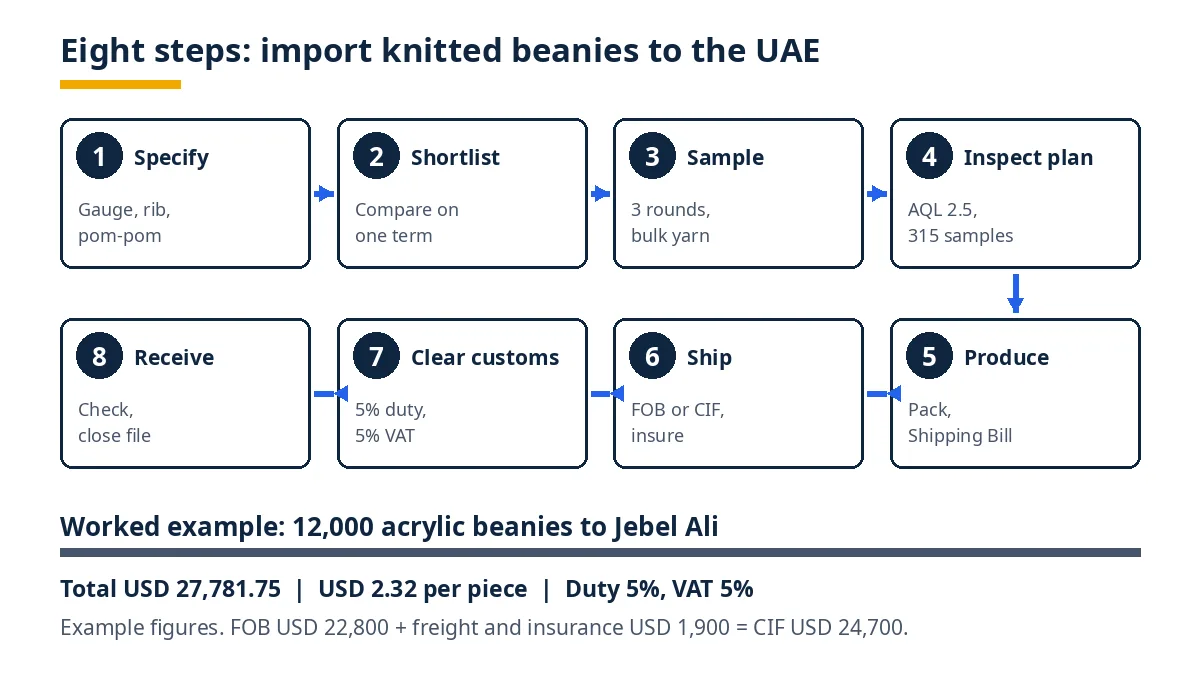
Put the beanie on paper, in numbers. 2. Find makers and weigh their quotations on one delivery term. 3. Approve the sample in rounds. 4. Fix the inspection plan before production starts. 5. Make, pack and file the Bangladesh export papers. 6. Ship, insure and follow the sailing. 7. Clear UAE customs and pay the duty and VAT. 8. Take delivery, check the goods and close the file.
Step 1: Write the beanie specification in numbers
Draft the specification before any maker is contacted: style, yarn fibre, weight category and ply, gauge with tolerance, rib type and cuff depth, lining, pom-pom material and fixing, labels, sizes, colours, packing, quantities and delivery term. Send one document to every candidate. Add a test list with a pass mark beside each test.
Step 2: Find makers and weigh quotations on one term
Shortlist three to five makers whose range covers your gauge, yarn and quantity, and check knitting, rib work, linking and dyeing before price. Our knitted beanies manufacturers guide sets out the checks. Ask each maker for the minimum per style and per colour; our knitted beanies price guide shows how the FOB lines are built. Incoterms 2020 holds 11 rules, and each one divides cost, risk and duties between buyer and seller.5 Under FOB Chattogram, the seller puts the beanies on board and the sea leg and insurance are yours. Under CIF, the seller arranges carriage and insurance to your port. Under DAP, the seller brings the beanies to your warehouse.5 Put one Incoterms rule and one named place on every quotation, since a CIF price carries the sea leg and insurance inside it and an FOB price stops at the vessel. Our Incoterms guide sets out all eleven rules.
Step 3: Approve the sample in stages
Take the sample through three rounds. First a knitted swatch in the production yarn and gauge, washed and measured. Then a proto sample, to settle the crown, the cuff and the pom-pom. Then a pre-production sample in the bulk yarn, bulk colour, bulk trims and bulk labels, washed and measured after washing, with the gauge re-counted and the pom-pom pull-checked. Hold one sealed, washed pre-production sample back as the bulk and inspection reference.
Step 4: Fix the inspection plan in the order
Name the inspector and timing in the order before production starts. ISO 2859-1 sets the sampling, and General Inspection Level II is the usual level for visual checks.6 A lot of 12,000 beanies at Level II takes code letter M and a 315-piece sample: at AQL 2.5 it accepts 14 and rejects 15 major defects, and at AQL 4.0 it accepts 21 and rejects 22 minor defects.6 7 One critical defect fails the lot, since critical defects take AQL 0.6 Settle the defect classes in writing, draw the sample at random across sizes, colours and cartons, and call the inspector only when the lot is at least 80 per cent packed.6 Our knitted beanies quality control checklist turns these points into inspector checks.
Step 5: Make, pack and file the export papers
Check the finished beanies and re-count the gauge against the sealed sample. Pack as the order states: polybag each beanie, sort cartons by size and colour, and label each carton. Nothing loads until Bangladesh Customs has approved a Shipping Bill.8 The documents for it are an export letter of credit, telegraphic transfer, purchase order or approved export contract or guarantee; the signed commercial invoice; the packing list; an origin certificate issued by a Chamber of Commerce and Industry or the Export Promotion Bureau; the EXP form certified by an Authorized Dealer; the VAT registration certificate; a taxpayer identification number; and an Export Registration Certificate.8
Step 6: Book the freight, insure and follow the sailing
On FOB terms, the freight and insurance are yours to book. On CIF terms, read the insurance certificate before the vessel sails: Institute Cargo Clauses (C) is the default cover, and a higher level of cover can be agreed.5 The carrier gives the shipper the bill of lading: the receipt for the goods and the contract to carry them.8
Step 7: Clear UAE customs and pay duty and VAT
Hand your broker the code, the invoice, the packing list, the bill of lading and the certificate of origin before the vessel arrives.4 Customs charges 5 per cent duty on the CIF value, and VAT at 5 per cent on the CIF value plus the duty.4 A VAT-registered buyer recovers the import VAT as input tax. If the goods land in a free zone, confirm whether they stay bonded or move to the mainland, because the duty falls due on the move.4
Step 8: Receive, check and close the order file
On receipt, measure a sample across the size range, re-count the gauge, stretch the cuffs, pull-test the pom-poms and check the labels, before the balance is paid.
Worked example: 12,000 acrylic beanies to Jebel Ali
Example figures: 12,000 adult acrylic beanies, FOB Chattogram to Jebel Ali, delivered to a Dubai warehouse.4
Cost element | USD |
|---|---|
Product price, FOB Chattogram | 22,800 |
Freight and insurance | 1,900 |
Customs value (CIF) | 24,700 |
Duty at 5% of 24,700 | 1,235 |
Value for VAT | 25,935 |
Import VAT at 5% | 1,296.75 |
Broker, port handling and delivery | 550 |
Total cash outlay | 27,781.75 |
Cost per piece | 2.32 |
Check it: 22,800 plus 1,900 is 24,700; 5 per cent of 24,700 is 1,235; the lines add to 27,781.75, or 2.32 per piece. A VAT-registered buyer recovers the 1,296.75 as input tax.4
The cold-weather checks your inspector runs
The inspector pulls 315 beanies at random and works through the checks below.6
Check | What the inspector looks for |
|---|---|
Gauge count | Stitches per 4 inches on finished beanies, after washing, against the specification |
Cuff recovery | Rib stretched to its stated width, then measured on release |
Pom-pom fixing | Pull test on the pom-pom and its cord or snap |
A passed AQL result is a gate, not a guarantee: a lot that is truly 5 per cent defective on majors still passes about 39 per cent of the time.6
Four mistakes that cost beanie importers money
Approving the gauge on an unwashed swatch. A beanie measured before washing is a different beanie after it. The washed gauge count is the one that goes into the order.1
Letting the fibre change the code. An acrylic beanie and a wool beanie share the heading but take different national lines.3
Comparing an FOB price with a CIF price. Restate every quotation on one rule and one named place before comparing.5
Paying the balance before the inspection report arrives. Write the sample size and the accept and reject numbers in the order, and read the report before the money moves.6
Import checklist
Beanie defined as numbers: yarn category, gauge, rib, crown, lining, pom-pom, sizes, colours, packing.
UAE code settled: heading 6505, duty and VAT confirmed.
Makers shortlisted: three to five, quotations weighed on one rule.
Samples approved in three rounds, in writing, using bulk materials.
OEKO-TEX Standard 100 certificate, class and validity checked.
Inspection plan on file: level, AQL values, sample size, accept and reject numbers.
Order placed: specification, quantities, price, payment terms, packing, shipment date.
Export papers ready: Shipping Bill documents, EXP form, origin certificate.
Freight and insurance arranged, sailing followed.
Broker has the entry papers before the vessel arrives.
FAQs
What duty do knitted beanies from Bangladesh pay in the UAE?
The standard duty is 5 per cent of the CIF value under the GCC Common External Tariff, and import VAT is 5 per cent on the CIF value plus the duty.4 Confirm the full 8-digit code with your broker.4
What gauge should I specify for a winter beanie?
Worsted yarn, category 4, knits at 16 to 20 stitches over 4 inches, and bulky yarn, category 5, at 12 to 15.1
Is a certificate of origin needed?
Yes, the Bangladesh export file needs one. Ask the Export Promotion Bureau or a Chamber of Commerce and Industry for it.8
Next steps on Exportain
Confirm the code in our classification guide for beanies, read the importing from Bangladesh guide, then post an RFQ with the beanie specification, the gauge and the tariff code.
Sources
- 8 Yarn Weight Categories: Printable Chart, WPI Test, and Swatch Steps. Lion Brand, (accessed )
- OEKO-TEX STANDARD 100 for textiles tested for harmful substances. Hohenstein (accessed )
- HSN Code 6505: Hats and other headgear GST Rate. FundRaksha (accessed )
- UAE Import & Export Customs Guide — Duties & HS Codes. Dubai Practical (accessed )
- Incoterms® 2020. International Chamber of Commerce (ICC) (accessed )
- AQL Sampling Explained for Importers. Importivity, (accessed )
- AQL Calculator — Free ISO 2859-1 Sample Size Tool. SDF Clothing (accessed )
- Bangladesh Trade Portal FAQ: Export Registration Certificate (ERC). Bangladesh Trade Portal (accessed )
About the author
Sourcing from Bangladesh?
Post a request for quotation and suppliers on Exportain can send you their quotes directly.
Post an RFQ