

Quality Control Checklist for Knitted Beanies From Bangladesh
Knitted beanies quality control checklist for Bangladesh orders: gauge and stitch density, crown shape, relaxed and stretched measurements, cuff recovery, shade across body, cuff and pom, pom and lining checks, lab evidence, labels and packing, with a numbered checklist, failure fixes and a summary table.
Short answer
This knitted beanies quality control checklist covers yarn, gauge and stitch density, crown shape, relaxed and stretched circumference, height and cuff depth, cuff recovery, shade across body, cuff and pom, pom attachment and fleece lining where specified, labels, lab evidence for shrinkage, colourfastness and pilling, shape-preserving packing and the sampling decision. Use it on samples, during production and on finished, packed goods.
On this page
A knitted beanie has few measurements, and almost every one of them is stretched in use. A cap that measures correctly flat on a table can still sit too tight, ride up, lose its cuff fold, or change shape after washing. This checklist checks the cap relaxed and stretched, the cuff after release, and crown, shade, attachments, lining, labels and packing.
Why this checklist matters
Most beanie faults are small, repeated faults. One beanie account lists dropped stitches, holes, laddering, yarn joins that create thick spots, irregular ribs, waviness at the opening, inconsistent tension, and a crown that twists or puckers as the points to review at close range and in normal daylight.1 On a solid colour beanie, each fault is visible to the wearer.
Stitch density deserves its own attention. Density affects warmth, opacity, shape retention and perceived value, and a loosely knitted beanie can look acceptable before wearing yet feel flimsy, show through when stretched, or deform after washing.1 Gauge, stitch pattern, yarn specification and finished weight against an approved sample give a reference when bulk output drifts.1
Shade is a beanie problem for a second reason: the cap folds. Beanies often fold at the cuff, so shading differences become more visible in stacked layers, and one approval under office lighting is not enough.2 Check shade across body, cuff and pom under more than one light, cuff folded.
Before you start
Approved sample and tech pack. Sealed, approved beanie with yarn, gauge, stitch pattern, cuff and crown construction, lining and pom details where specified, and finished weight.
Measurement method in writing. Each point, whether the cap is measured relaxed or stretched, whether the cuff is folded or unfolded, and how the controlled stretch is applied. Ask the supplier to show both relaxed and controlled-stretch measurements by the agreed method.1
Cuff and shade specification in writing. Cuff depth, fold line position, approved shade standard, the lights used, and whether body, cuff and pom are matched together or separately.
Defect list with classes. Faults classed as critical, major or minor for this beanie, with photos for borderline cases.
Lab and sampling specification in writing. Each test named with its method and condition, and the sampling standard, level and buyer values per class, plus the action on a fail. No test result is stated here as a universal pass mark.
The full checklist (numbered, printable)
Mark each item pass, fail or not applicable, and photograph every fail.
Yarn content and count by lot. Confirmed by lot against the tech pack; blend, count or twist changes alter hand feel.2
Knit structure and stitch definition. Pattern matches the sample close up and at normal distance, with no dropped stitches, holes or laddering.1
Gauge and stitch density. Gauge, density and finished weight match the sample; a cap showing through when stretched has a density fault.1
Tension and evenness. Tension even around the cap, with no waviness at the opening, barre bands or thick spots at joins.1
Crown shape. Shape matches the sample flat and worn, with no twisting or puckering.1
Crown seams and closure. Seams and closure match the sample, with no open seams, skipped stitches or loose ends.
Seam strength at the crown, where specified. Checked at the crown closure and label attachment points.2
Relaxed circumference. Measured relaxed, in the agreed condition, against the chart and the buyer-specified tolerance.
Stretched circumference. Measured again under the agreed controlled stretch, against the chart and tolerance. Record both figures.
Height, uncuffed. From top to bottom at the centre, uncuffed, against the chart and tolerance.3
Width at the opening, uncuffed. Side to side at the hat opening, uncuffed, against the chart and tolerance.3
Cuff depth. From top to bottom at the centre of the cuff, against the chart and tolerance.3
Cuff fold and fold line. Fold line even around the cap, fold depth even, and the fold in the same position after refolding.2
Cuff recovery after stretch. Cuff stretched gently and released, then checked for return toward its original shape and position.2
Rib construction. Rib gauge consistent around the cap, stitch balance even, and no twisting or edge roll.2
Shade across body, cuff and pom. Body, cuff and pom matched against the approved standard under daylight and a second light, cuff folded.2
Surface faults. No holes, snags, pulls, stains, oil marks or distortion, checked front, back, inside and at the cuff edge.
Loose threads and finishing. Loose threads trimmed, no protruding ends, and layers aligned cleanly at the crown and opening on double-layer styles.1
Pom-pom, where specified. Size, colour and centre position match the sample, and attachment is secure under the buyer-specified attachment check.2
Fleece lining, where specified. Present only where the tech pack specifies it, fully in place, with no twisting, bunching or exposed edges.3
Decoration and logo, where specified. Embroidery, patch or print clear, correctly positioned and securely attached, compared against the knit body and the artwork.
Labels. Fibre, care, size and origin labels correct in content, spelling and position; size label matches the measured size, barcodes scan.
Shrinkage evidence, where specified. Lab report names the method and condition, such as dimensional stability after conditioning and light washing, and records the result against the buyer specification.2 No universal shrinkage percentage is stated here.
Colourfastness and pilling evidence, where specified. Lab report names the method, such as colourfastness to rubbing, perspiration and washing, and records the result against the buyer specification.2 Pilling assessed by wear simulation, before or after washing as specified.
Shape-preserving packing and sampling decision. Packing by the specified method keeps the crown shape, with no permanent cuff crease. The agreed sampling plan is applied to the finished, packed lot, decided only on counts against the agreed acceptance and rejection numbers.
Common failures and how to fix them
Cuff that stays stretched. A cuff that does not return toward its original shape after stretching has lost recovery. Check rib gauge and stitch balance, then the bulk yarn lot.
Crown that twists or puckers. A crown that looks even flat but twists when worn points to construction or tension, not to pressing. Check crown seams, closure and tension against the sample.
Shade split between body, cuff and pom. A cuff or pom matching under one light and differing under another is a light and lot problem. Re-check under daylight and a second light, cuff folded, and hold unmatched lots.
Pom that wobbles or comes loose. A pom that moves as a separate piece has an attachment fault. Check centre position worn, and re-run the attachment check after correction.
Lining that twists or bunches inside. A lining correct flat but bunching when worn was not checked in the worn position. Check lining at the crown and opening, and correct size or attachment before packing.
Relaxed size correct, stretched size wrong. A cap passing relaxed and failing stretched was measured in only one condition. Record both figures from the start, and correct density or yarn lot.
Packing that crushes the crown or sets the fold. A cap arriving with a flattened crown or a permanent cuff crease has a packing fault. Pack by the specified method, check an unpacked cap against the sample, and change the fold.
Downloadable template / summary table
No file download is offered or promised with this article. Copy the table into your own inspection sheet, add your buyer-specified values, and use one row per group.
Checklist group | What to record | Decision |
|---|---|---|
Yarn, gauge, density | Content, count, gauge, weight | Match or correct |
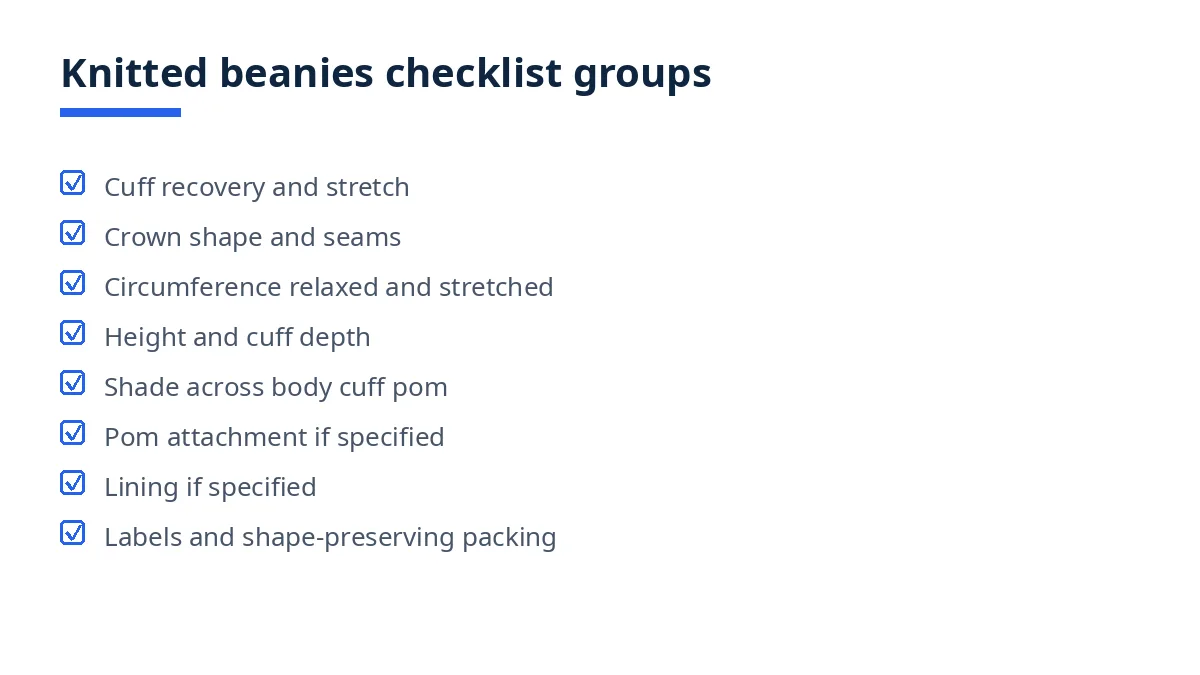
Crown | Shape, seams, closure, tension | Pass or rework |
Measurements | Relaxed and stretched circumference, height, cuff depth | Tolerance |
Cuff | Fold line, depth, recovery, rib balance | Pass or correct |
Shade | Body, cuff, pom, lights, folded check | Match or hold |
Pom and lining, where specified | Position, attachment, lining placement | Specification |
Decoration and labels | Logo, label content, position, barcode | Pass or correct |
Surface and finishing | Holes, snags, stains, loose ends, alignment | Pass or rework |
Lab evidence | Shrinkage, colourfastness, pilling methods, results | Specification |
Packing and sampling | Fold method, crown shape, assortment, Ac/Re | Accept or reject |
For the sampling row, use the standard table values. As a published example only, lot 26 to 50 at General Inspection Level II gives code letter D and sample size 8, with acceptance and rejection numbers of 0 and 1 for major defects at AQL 2.5 and 1 and 2 for minor defects at AQL 4.0.4 Those numbers are buyer-agreed purchase-order values, not standard-mandated values for beanies.
How Exportain helps
Exportain does not inspect goods itself, and its supplier checks are document and photo reviews, not factory inspections. Use Exportain to put the checklist into the order: post the requirement, including yarn, gauge, crown, cuff, measurement method, shade, pom, lining, lab methods, packing and sampling plan. Note that the Exportain inspection services category page currently renders "No services published in this category yet", so arrange inspection directly with a provider and record the booking in the purchase order.
FAQs
When should this checklist be used?
Use it on the first sample, during production, and on finished, packed goods before shipment. Gauge, cuff recovery and shade are settled at the sample stage.
Who should complete it?
The buyer, the supplier and any third-party inspector should all work from the same checklist. The supplier checks its own work in production; the buyer, or an inspector working to the buyer's checklist, makes the sampling decision.
What are the most common failures?
The most common failures here are a cuff that stays stretched, a crown that twists or puckers, a shade split between body, cuff and pom, a pom that wobbles or comes loose, a lining that twists or bunches, a stretched size differing from the relaxed size, and packing that crushes the crown or sets the fold. Each is listed above with its fix.
Can a third party do it?
Yes. Arrange inspection through an independent third-party firm, and give it the purchase order, specification, sample details, measurement chart, shade standard, pom and lining details where specified, lab methods and packing requirements. Booked by you, the inspector works to your checklist and pass criteria.
Next steps on Exportain
Write the beanie specification into one requirement, then read the AQL guide and the pre-shipment inspection guide before you set values.
Sources
- Custom Knit Beanies Made in China: Quality Guide. RCGeotech (accessed )
- Custom Knit Beanies Cuffed: Bulk Quality Checks. RCGeotech (accessed )
- Fleece-Lined Knit Cap CP90L Spec Sheet and Measurements. Port Authority (accessed )
- AQL Calculator | Sample Size and ISO 2859-1 Tool. AQMBD (accessed )
About the author
Sourcing from Bangladesh?
Post a request for quotation and suppliers on Exportain can send you their quotes directly.
Post an RFQ


