HS Code for Knitted Beanies: Classification Guide for Importers
Knitted beanies are headgear under heading 6505, at subheading 6505.00. This guide explains the Chapter 65 gate, the 6504 and 6506 boundaries, and the US, EU and UK national codes to confirm.
Short answer
A knitted beanie is headgear, not a garment. The indicative heading is 6505, hats and other headgear, knitted or crocheted, or made up from lace, felt or other textile fabric in the piece, whether or not lined or trimmed, at subheading 6505.00. Material and wearer details change only the national 8-10 digit lines. Confirm the full code for the destination before filing.
On this page
A purchase order may call the product a beanie, a watch cap, or a toque, but customs does not classify a retail name. It classifies the article in front of it: a close-fitting cap covering the crown of the head, knitted, crocheted, or made up from textile fabric. The Harmonized System, developed by the World Customs Organization (WCO), comprises more than 5,000 commodity groups, each identified by a six-digit code, and is used by more than 200 countries and economies.1 For a beanie, the first question is whether the article is headgear at all.
Quick answer: indicative HS heading (with verify note)
The indicative heading is 6505, at subheading 6505.00. The United States schedule describes heading 6505 as hats and other headgear, knitted or crocheted, or made up from lace, felt or other textile fabric, in the piece (but not in strips), whether or not lined or trimmed, and hairnets of any material, whether or not lined or trimmed.2
Article | Indicative treatment |
|---|---|
Knitted or crocheted beanie | Heading 6505, subheading 6505.00 |
Beanie made up from felt or textile fabric in the piece | Heading 6505, subheading 6505.00 |
Beanie plaited or assembled from strips | Test against heading 6504 first |
Safety helmet or hard hat | Heading 6506, safety headgear |
Treat 6505 as indicative and confirm the full national code before filing.
How HS codes are structured (2-4-6 digits)
The Harmonized System runs in sections, chapters at two digits, headings at four, and subheadings at six, with countries subdividing the six-digit categories further.3 The current version is HS 2022.3 Heading 6505 has a single six-digit subheading, 6505.00, so fiber details change only the national lines after them.
Level | Digits | For a knitted beanie |
|---|---|---|
Chapter | 65 | Headgear and parts thereof |
Heading | 6505 | Hats and other headgear, knitted or crocheted, or made up from textile fabric |
Subheading | 6505.00 | The same headgear, with no further international split |
National extension | 8 to 10 digits | Set by the importing country, by material and statistical detail |
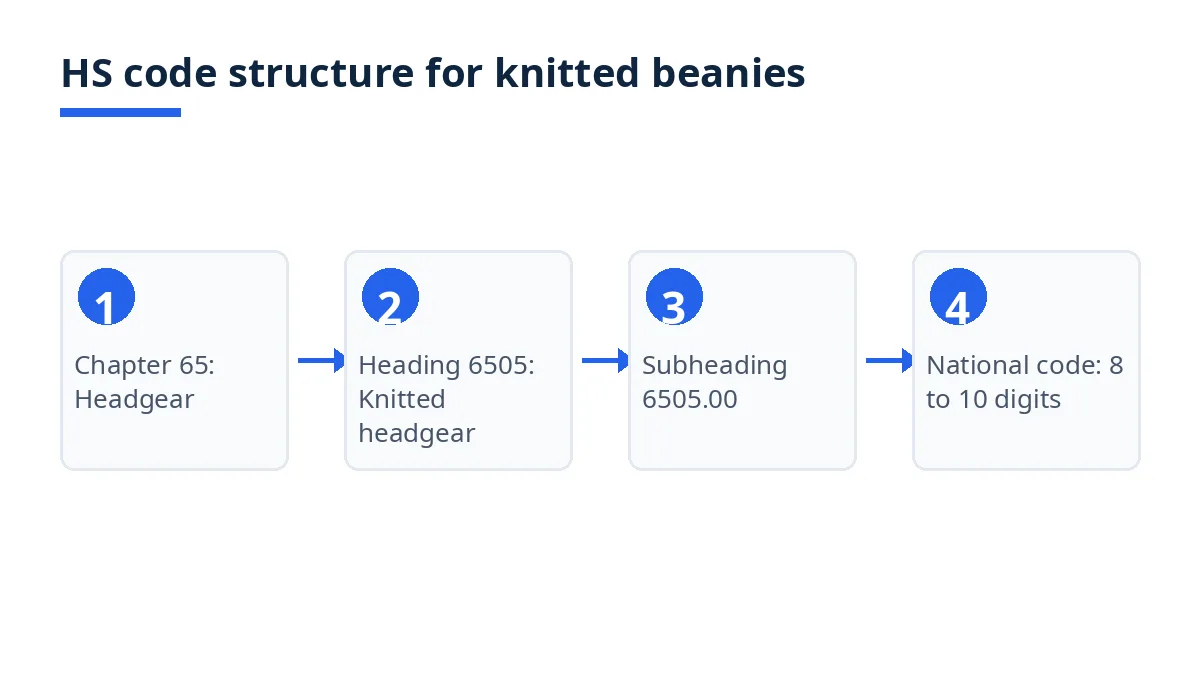
Two beanies can therefore share 6505.00 and still need different full codes.
Factors that decide the code for knitted beanies
Headgear first, garment chapters second. Chapter 61 covers knitted or crocheted garments, and Chapter 62 covers woven or non-woven clothing.4 A knitted beanie does not belong in Chapter 61: Chapters 61 and 62 cover body garments, while Chapter 65 covers headgear, and heading 6505 names knitted headgear.2
Three routes into 6505: knitted, crocheted, or made up. Knitted and crocheted beanies all start at 6505.00, and crochet is not a separate heading. A beanie cut and sewn from knitted fabric, lace, felt, or other textile fabric in the piece also sits in 6505, provided it is made up from fabric in the piece rather than from strips.2 The United States schedule also carries felt headgear made from heading 6501 hat bodies, hoods, or plateaux inside 6505.2
Lining and trim stay in 6505; parts shipped separately do not. The heading text ends with whether or not lined or trimmed, so a fleece lining, pom-pom, ear flaps, or folded brim leaves the beanie in 6505.2 By contrast, heading 6507 covers headbands, linings, covers, hat foundations, hat frames, peaks (visors), and chin straps, for headgear.2 A spare lining, headband, or chin strap shipped on its own is filed there, not under 6505.
The plaited and strips test is the 6504 boundary. Heading 6504 covers hats and other headgear, plaited or made by assembling strips of any material, whether or not lined or trimmed.2 A beanie assembled from plaited material or strips is tested there first, because 6505 covers fabric in the piece but not in strips.2 Construction, not silhouette, decides.
Heading 6506 is the other-headgear boundary. Heading 6506 covers other headgear, whether or not lined or trimmed, and its first subheading is 6506.10, safety headgear.2 A helmet, hard hat, or reinforced protective cap belongs in 6506, as do headgear of rubber or plastics, including bathing caps, and headgear of furskin.2 A knitted beanie is none of those.
The crown-cover test, and baby sizes. The United States schedule carries statistical lines for visors and other headgear which provides no covering for the crown of the head, inside the 6505 lines.2 A beanie covers the crown, so it does not take a visor line, and a headband or sun visor alone is not a beanie. The same lines carry a babies statistical suffix, under the cotton and wool knitted lines.2 A baby beanie takes a babies suffix inside 6505, not a move to the babies garment headings.
What Chapter 65 does not cover. The United States chapter notes add that Chapter 65 does not include mufflers, shawls, scarves, mantillas, veils, and the like, which sit at heading 6117 or 6214.2 A scarf tail or neck warmer sold with a beanie needs separate attention. Chapter 65 also does not cover worn headgear of heading 6309, asbestos headgear of heading 6812, or dolls hats, other toy hats, or carnival articles of Chapter 95.2
Material decides the national line, not the heading. A cotton, wool, and acrylic beanie all share 6505.00, and the material split appears only in the national lines. State the fiber composition by weight for every style, for the broker to read the material block.
National codes: US HTS, EU CN/TARIC, UK commodity code
United States: HTS, ten digits. The United States schedule splits 6505.00 by material and construction.2 Hairnets take their own line, 6505.00.01, and are not beanies. Felt headgear made from heading 6501 bodies takes 6505.00.04 for fur felt and 6505.00.08 for other felt.
Beanie | United States line |
|---|---|
Cotton or flax, knitted | 6505.00.15 |
Cotton, not knitted, certified handloomed or folklore | 6505.00.20 |
Cotton, not knitted, other | 6505.00.25 |
Wool, knitted or crocheted | 6505.00.30 |
Wool, other | 6505.00.40 |
Man-made fibers, knitted or crocheted, in part of braid | 6505.00.50 |
Man-made fibers, knitted or crocheted, not in part of braid | 6505.00.60 |
Man-made fibers, other, in part of braid | 6505.00.70 |
Man-made fibers, other, not in part of braid | 6505.00.80 |
Other materials | 6505.00.90 |
Read the statistical suffix inside the chosen line, and read the line for the entry date.2 A typical adult knitted acrylic beanie, not in part of braid, is read at 6505.00.60; the same beanie in wool, at 6505.00.30.
European Union: CN at eight digits, TARIC for measures. The Combined Nomenclature integrates the HS and adds EU subdivisions, producing eight-digit codes.3 Start from 6505.00 and read the CN and TARIC lines for the beanie type, material, and entry date. This guide publishes no EU eight-digit beanie line, so read the EU line in TARIC for the entry date.
United Kingdom: commodity code. The United Kingdom builds its commodity code on the same first six digits, with its own extension after them.3 The UK tariff shows the ten-digit format in use, for example commodity 6505001000 for fur felt headgear made from heading 6501 bodies, shown for export as 6505 0010.5 That felt line shows the format, not a beanie line. Read the full UK code from the UK Trade Tariff for the entry date.
How to confirm the code officially
Write a precise description: construction route; fiber composition by weight; lining and trim; crown coverage; wearer size, including baby sizes; and any safety function.
Start from the official tariff for the destination: the USITC HTS, TARIC, or the UK Trade Tariff, and read the heading text and chapter notes.
Check published rulings for similar headgear, such as CROSS for the United States.6
For a borderline beanie, apply for a binding decision before you ship. In the EU, a Binding Tariff Information application needs a separate application for each product type and a detailed description.7 In the United Kingdom, an Advance Tariff Ruling is generally valid for 3 years.8 In the United States, if the merchandise is not described in any ruling on CROSS, you may request a binding ruling from U.S. Customs and Border Protection.6
Give your broker the description and confirmed code for each style and material.
Common classification mistakes
Filing a knitted beanie as a knitted garment. Chapter 61 covers knitted garments, but a beanie is headgear, and 6505 names knitted headgear directly.2 4
Filing every head-shaped article under 6505. A plaited cap belongs in the 6504 test, a safety helmet in 6506.10, and a bathing cap in the rubber or plastics lines of 6506.2
Filing a lined or trimmed beanie as a different article. The heading covers headgear whether or not lined or trimmed.2
Filing a baby beanie as babies clothing. The United States schedule carries a babies suffix inside the 6505 lines.2
Filing a visor, headband, or separate lining as a beanie. Visors take their own statistical lines, and parts shipped separately sit in heading 6507.2
Filing neckwear on the beanie code. Mufflers, shawls, and scarves sit outside Chapter 65, at heading 6117 or 6214.2
Copying a code from another country. The EU extends the six digits to eight,3 and the United States and United Kingdom split 6505 further by material.2 5
Related duties and documents
This guide states no duty rates: the code decides which duty line customs applies, and a rate on one line does not carry to another. Read the rate beside your confirmed code for your origin and entry date, and check what proof of origin a preference claim requires. A change of fiber, construction, or protective function each changes the line, so re-check the code when the specification changes.
Keep the regulatory boundary separate from classification. An ordinary knitted beanie is textile headgear, not safety equipment. A beanie marketed with a protective claim needs its function tested against heading 6506.10 before it is filed. Keep the style description, fiber composition, confirmed codes, any binding decision, and origin evidence together in the shipment file, with beanies, neckwear, and parts as separate invoice lines.
FAQs
What is the HS code for knitted beanies?
The indicative heading is 6505, at subheading 6505.00, for hats and other headgear, knitted or crocheted, or made up from lace, felt or other textile fabric in the piece, whether or not lined or trimmed.2
Is the HS code the same in every country?
Only the first six digits are harmonized: eight digits in the EU Combined Nomenclature,3 and ten digits in the United States and the United Kingdom, where the 6505 lines split by material.2 5 A beanie shares 6505.00 everywhere, with a different full code in each destination.
How do I confirm the correct code?
Describe the beanie precisely, read the heading text and chapter notes in the destination tariff, and check published rulings, such as CROSS for the United States.6 For a borderline beanie, apply for a binding decision before shipping: a BTI in the EU,7 an Advance Tariff Ruling in the United Kingdom,8 or a CBP binding ruling in the United States.6
What happens if I use the wrong code?
Duty, licensing, and quota treatment follow the code on the declaration, so a wrong code brings the wrong treatment. A binding decision taken in advance helps you calculate the duties and restrictions that will apply.8
Next steps on Exportain
Browse Bangladeshi suppliers on Exportain, and post a free RFQ at Exportain RFQs with the confirmed codes stated per style. For the general structure, read the HS code hub, and for the method, read the step-by-step classification guide. Exportain is not a party to the goods contract and does not inspect goods, book freight, or clear customs.
Sources
- What is the Harmonized System (HS)?. World Customs Organization (accessed )
- Harmonized Tariff Schedule of the United States, Chapter 65 (2026 Revision 16). U.S. International Trade Commission (accessed )
- Harmonised System. European Commission (accessed )
- Classifying textile apparel. HM Revenue & Customs (GOV.UK), (accessed )
- Commodity code 6505001000: Of fur felt or of felt of wool and fur, made from the hat bodies, hoods or plateaux of heading 6501 00 00 - UK Integrated Online Tariff. GOV.UK (accessed )
- MTB 2019: Get Out Ahead of the Pack with a Binding Ruling from CBP. U.S. International Trade Commission (accessed )
- European Binding Tariff Information (EBTI). European Commission, Taxation and Customs Union, (accessed )
- Check what you'll need to get a legally binding decision on a commodity code. GOV.UK, HM Revenue and Customs (accessed )
About the author
Sourcing from Bangladesh?
Post a request for quotation and suppliers on Exportain can send you their quotes directly.
Post an RFQ