

Knitted Beanies Price in Bangladesh: FOB Cost Breakdown for Buyers
An FOB cost breakdown for knitted beanies from Bangladesh: how yarn weight, gauge, color runs and quantity tiers build the unit price, what sits outside FOB, and how to audit a quotation line by line. All figures are labelled examples.
Short answer
There is no single knitted beanies price in Bangladesh. An FOB quotation is a build-up: yarn by weight, knitting at a stated gauge, dyeing per color, trims, labels, packing, testing and inland transport to loading on board at the named port. Compare quotations only on the same specification, quantity basis and delivery term, re-add every line, and treat all figures in this guide as labelled examples, not market prices.
On this page
Key takeaways
There is no single knitted beanies price in Bangladesh: an FOB quotation is a build-up of yarn by weight, knitting at a stated gauge, dyeing per color, trims, labels, packing, testing and inland transport to loading.
Weigh the approved sample and reconcile grams, yarn rate and waste allowance against the yarn line; a yarn line with no weight behind it cannot be checked.
Machine gauge is the number of needles per inch, and yarn count mainly depends on gauge; a finer gauge knits more courses per centimeter and runs slower, which is a cost line.
Example figures show structure only: in the worked example the FOB total is USD 1.20 per beanie, and a larger order across a tier break can cost less in total than a smaller one.
FOB ends at loading on board at the named port; freight, insurance, duty and onward delivery sit outside the price, and badges are document and photo reviews, not factory inspections.
A knitted beanies price in Bangladesh is not a single market figure. It is a quotation for one beanie, knitted to one specification, in one color, at one quantity, on one delivery term. Read it that way and you can check every line. Read it as a headline number and you end up comparing beanies that were never the same product.
Beanies sit inside a large knitwear trade. Knitwear exports grew by 6.88 percent to US$5.963 billion in the first quarter of fiscal 2026-27, within ready-made garment exports of US$10.578 billion, on Export Promotion Bureau (EPB) data reported by The Financial Express.1 That scale sets no shared beanie price: each factory prices your yarn, gauge, color count and quantity. This guide audits an FOB quotation from the yarn weight up.
What an FOB beanie quotation must state before you read the price
A usable quotation states the specification, the quantity and how it is counted, the unit price and currency, the Incoterm and the named port of shipment, the payment terms, the validity dates, and the cost lines the price contains. A quotation that states only a unit price and a total has not yet told you what the price buys. Ask for the lines itemized, and ask for every excluded line to be named as excluded, before you compare any two offers.
Under FOB, the price covers the goods, export packing, transport to the named port of shipment, export clearance, and loading on board the vessel nominated by the buyer. It does not cover ocean freight, cargo insurance, import clearance, import duty, or onward transport at destination, which you budget separately.2 The named port matters because inland transport and loading lines differ by port, so a quote without a named port cannot be compared with another FOB quote. For the full line-by-line meaning of the term, see the FOB price guide.
On Exportain, every quotation is versioned: unit price, MOQ, lead time, Incoterm, payment terms and validity are stated in each version, and you counter-offer in the same thread.3 Treat that version as the record.
Reading a knitted beanies price in Bangladesh as a knitting calculation
Start with weight. A beanie is knitted yarn, so its largest cost line usually follows the grams of yarn in the finished beanie. Weigh the approved sample, in grams, and ask the supplier to state the yarn weight per beanie, the yarn rate, and the waste and shrinkage allowance separately. Yarn cost per beanie is weight multiplied by rate, plus the allowance.
The example build-up below uses example figures only, in US dollars per beanie, to show the structure. The figures are not a quote and not a market price.
Cost line | Example figures, per beanie |
|---|---|
Yarn, dyed, per beanie | USD 0.42 |
Knitting and crown closing | USD 0.28 |
Washing, drying and finishing | USD 0.16 |
Pom-pom, lining, labels and trims | USD 0.14 |
Packing, testing and setup | USD 0.11 |
Inland transport, export clearance and port handling | USD 0.09 |
Total FOB, example figures | USD 1.20 |
Example figures: an order of 2,400 beanies at USD 1.20 totals USD 2,880. Example figures: if the yarn line rises to USD 0.50 and every other line stays fixed, the total rises to USD 1.28. A small move in the yarn line moves the whole quotation, because yarn is the heaviest input in the beanie. Ask which line moved whenever a revised quotation arrives, and re-add the lines yourself.
Yarn, dye lots and fiber: why the largest line moves first
Fiber choice sets the yarn rate, and the dye lot sets whether the color repeats. Acrylic, wool and wool blends are different yarns with different rates, and a quotation that names only "yarn" has not specified the largest line. Name the fiber composition by weight, the yarn count, and the color standard for each color, and require a washed sample in the production yarn before bulk knitting.
Dyeing is charged per color run. A stocked yarn in a standard color can cost less than a dyed-to-order color, because the lot already exists and no dye run is started for your order. A custom color starts a dye run, its own lot, and its own shade approval. Ask for each color whether the yarn is stocked or dyed to order, and price the dye run as its own line. Dropping a color, or adding one, changes the runs, and the price must change with them.
Gauge ties the yarn to the machine. Machine gauge is the number of needles per inch of needle bed, and the selection of yarn count and type for knitting mainly depends on the gauge of the machine.4 In circular machines the gauge runs from 5 to 40 needles per inch, and in flat bar machines from 5 to 14.4 A finer gauge machine knits smaller loops and needs more courses per centimeter, so production runs slower than on a coarser gauge machine.4 That slower rate is a cost line: the same beanie knitted finer takes longer.
The sector behind these quotations is broad: the Bangladesh Knitwear Manufacturers and Exporters Association (BKMEA) states that it represents approximately 2,540 knitwear member factories.5 Factories differ in machines, gauge range, yarn stocks and dye capacity, and each prices the specification in front of it.
Gauge, style and crown closing: where machine time enters the price
Gauge decides fineness, and fineness decides time. A fine, low-profile beanie knitted at a high gauge carries more stitches per inch, smaller loops and more courses than a chunky beanie at a low gauge. State the gauge on the specification, ask which machines will knit the order, and ask for the sample at that gauge in the production yarn. If the sample arrives at a different gauge from the quotation, the price was set for a different beanie.
Style changes the knitting work, and each style changes it in a different place. A cuffed beanie adds rib rows and cuff depth: extra yarn, extra knitting time, and cuff recovery to check after washing. A slouchy beanie adds body length, which is more yarn and more courses for the same cuff. A lined beanie adds a second material, its attachment, and a shrinkage match to the body, or the finished beanie distorts after washing. Price each style on its own specification: a single unit price across four styles hides which style carries the cost.
Crown closing is the last knitting operation and a common failure point. The crown can be gathered, seamed or shaped, and each method takes a different amount of machine and hand time. Name the closing method on the specification and check it on the washed sample. A pom-pom hides the crown but does not remove the closing: the pom-pom is a separate input, priced and tested separately, and its attachment must survive washing.
Color runs, pom-poms, labels and packing: the small runs that move the total
Small inputs arrive in their own runs, each with a minimum and a setup cost. Dye runs, label print runs, hang-tag runs and carton runs are ordered separately from the knitting, and a small order can meet the knitting minimum while still carrying a surcharge on one of these runs. Ask for the dye, label, tag and carton lines apart from the unit price, and check the label proof word for word before the label run starts.
Splitting colors splits the runs. Example figures: a setup charge of USD 60 spread over one color of 1,200 beanies adds USD 0.05 per beanie, while the same USD 60 spread over a color of 400 beanies adds USD 0.15 per beanie. Example figures show structure only. Ask for the minimum and the setup line per color, and for the quantity at which a color joins a shared run rather than starting its own.
Trims follow the same rule: pom-poms, linings, woven labels, hang tags and polybags each have a supplier, a minimum and a lead time of their own. List every trim on the specification and require a new approval if any trim changes.
Certification work is a line too, when your customer requires it. A certificate for yarn alone does not cover the finished beanie: under the OEKO-TEX STANDARD 100 system, the certificate and label are awarded only if all components of an item meet the required criteria.6 A STANDARD 100 certificate is valid for 12 months and can be renewed annually.6 Price the testing and certification work as its own line, and confirm the certificate number, product class and expiry date with the issuing body.
Quantity tiers, validity and the cost of a late change
Quantity moves the unit price through setup costs, not through yarn alone. Dye runs, label runs, carton runs and machine setup are fixed costs spread over the quantity that shares them. A smaller quantity per color carries a larger share of each setup cost, so the unit price rises as the quantity per color falls, even when the total quantity stays the same. Price tiers work the same way: a lower unit price at a higher quantity reflects fixed setup costs spread over more pieces.
Example figures: a first tier prices beanies at USD 1.20 for 1,000 to 2,999 pieces, and a second tier prices them at USD 1.12 from 3,000 pieces. Example figures: an order of 2,900 beanies at USD 1.20 totals USD 3,480, while an order of 3,000 beanies at USD 1.12 totals USD 3,360. The larger order costs less in total. Check both sides of every tier break, and agree the tier basis in writing: whether the tier applies per color or to the total, and how long the tier price stays valid.
The counting basis decides what the minimum means. A minimum can be counted per order, per style, per color or per size, and a supplier can combine a quantity minimum with a minimum order value. For the general meaning of the term, and for how to negotiate the counting basis, read the MOQ guide. Ask for the minimum per style, per color and per size in writing, and ask which line binds.
Validity is a price line in disguise. Yarn lots sell out, dye capacity books up, and a quotation priced on a stocked lot expires when the lot does. Agree the validity dates, the lot position the price depends on, and what happens to the price if the lot changes or the quantity moves across a tier break. A late change is a new quotation: new lines, a new sample where the specification changed, and a new validity period.
Where FOB ends and your budget continues
FOB fixes the finish line of the price at loading on board the vessel at the named port of shipment. The Incoterms 2020 rules give a clear allocation of cost, risk and obligations across 11 rules, used globally since 1936 and updated in 2020.7 Under FOB the seller delivers on board, cleared for export, and the buyer arranges and pays the main carriage, insurance and import clearance, and bears risk from loading. Beyond loading, you pay ocean freight, cargo insurance, destination charges outside the freight contract, import clearance, duty and tax, and inland delivery.
Duty follows classification, not the supplier name. The Harmonized System comprises more than 5,000 commodity groups, each identified by a six-digit code, and is used by more than 200 countries and economies as a basis for customs tariffs and trade statistics.8 Heading 6505 covers hats and other headgear, knitted or crocheted, or made up from lace, felt or other textile fabric, in the piece, whether or not lined or trimmed.9 Treat that heading as indicative and confirm the full national code with your broker. For the classification detail, read the HS code guide for knitted beanies.
For containerized cargo handed over at a terminal, check whether FCA fits better than FOB, since the seller typically delivers containers to a terminal rather than on board the vessel, and they may sit there for days before loading.2 The choice of term changes which lines sit inside the price, so agree the term, the named place and the handover point in the same document as the price.
The export set sits inside the FOB price as handling. Goods shall not be loaded for export unless an export declaration, the Bill of Export, is submitted to Customs and approved, with enclosed documents including the export contract or purchase order where there is no export letter of credit, the commercial invoice, the packing list, the EXP form certified by an authorized dealer, and a certificate of origin issued by the EPB or a Chamber of Commerce and Industry.10 Ask the supplier to state which of these documents sit inside the quoted handling lines.
Inspection is the last line to agree before production. AQL stands for Acceptance Quality Limit, the maximum average percentage of defective items considered acceptable during random sampling, and ISO 2859-1:2026 provides sampling schemes indexed by AQL for lot-by-lot inspection.11 Name the AQL, inspection level, defect classifications and inspector in the order document, and keep one sealed sample as the shipment reference.
Quote audit: six checks before you accept
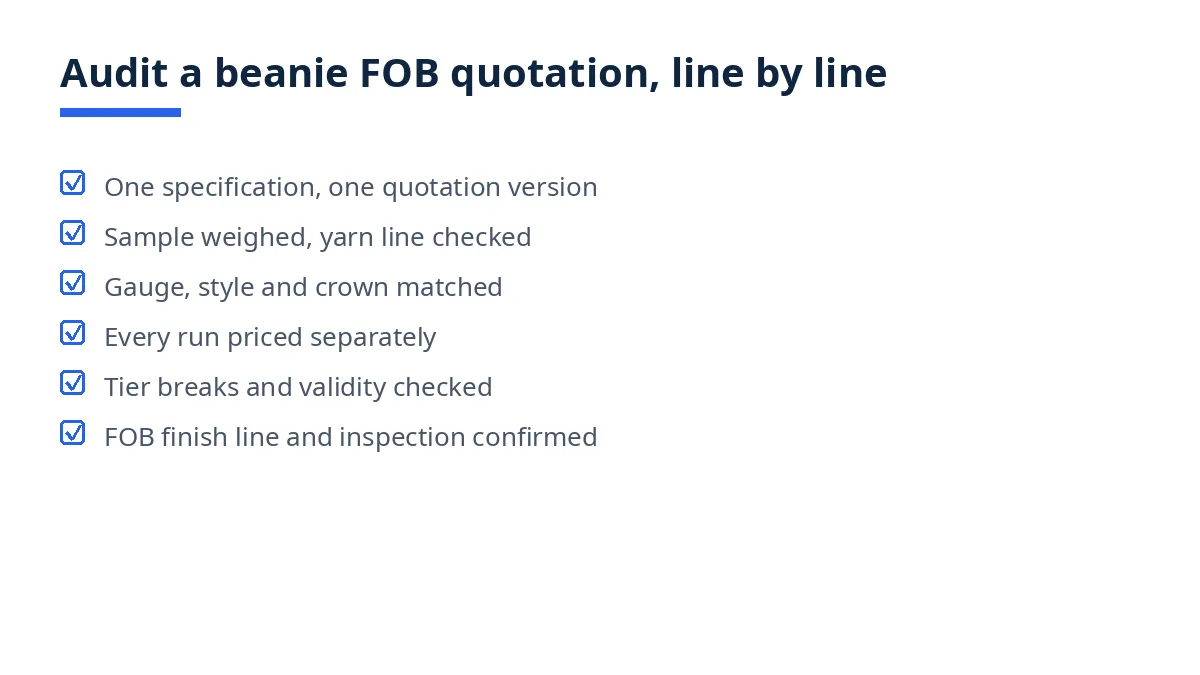
Run these six checks on every beanie quotation, in order, before you accept it. A quotation that fails one check is not ready to accept.
Re-add the lines. The unit price must equal the sum of the stated cost lines, and the order total must equal the unit price multiplied by the quantity. Check the currency, the quantity basis and the validity dates on the same version.
Weigh the sample. Reconcile the grams per beanie, the yarn rate and the waste allowance against the yarn line. A yarn line with no weight behind it is an estimate, not a price.
Match the specification line by line. Gauge, yarn count, fiber composition, color standards, cuff depth, crown closing, pom-pom and lining details, labels and packing must read the same on the quotation as on your specification.
Price every run separately. Dye runs, label and tag runs, carton runs and pom-pom runs each carry a minimum and a setup line. A quotation that folds them into one line cannot be re-priced when a color or trim changes.
Check both sides of every tier break. Confirm the tier basis, per color or total, the counting basis of the minimum, and the validity period. Price the order just below and just above each break before you settle the quantity.
Confirm the finish line and the evidence. One Incoterm, one named port or place, the excluded lines stated, the inspection standard named, and the export document set listed, all in the accepted version. Capability checks behind the quotation sit in the knitted beanies manufacturers guide.
On Exportain, supplier profiles carry document and photo review badges. A badge is not a guarantee of production capacity, product quality or delivery, and verification is a document review by Exportain staff, not a factory inspection.12 Read each badge for what it records, then check the documents, the sample and the quotation lines yourself.
Next steps on Exportain
Browse Bangladeshi suppliers and send every shortlisted supplier the identical beanie specification, then post the same specification as a free RFQ on the RFQ board so quotations arrive on the same basis. Before you shortlist, read how supplier verification works on Exportain so each badge is read for the checks behind it.
What should I know first before comparing knitted beanie prices?
Know the price as a build-up, not a headline. Yarn by weight, knitting at a stated gauge, dyeing per color, trims, labels, packing, testing and inland transport to loading each carry a line. Stating the gauge, yarn, color count, quantity basis and delivery term yields comparable quotations.
How are beanie costs and lead time quoted?
Costs are quoted per beanie on a stated delivery term, with the quantity basis, tier breaks and validity dates in the same version. There is no typical FOB price or lead time for beanies as a category: yarn, gauge, color runs, quantity and destination each move the figure. Ask for an itemized build-up and a lead time by approval gate. One total price and one total lead time, without the lines and gates, cannot be held to account when a line or gate moves.
Which documents support a beanie price quotation?
Three sets support it: the order set, with the specification, the accepted quotation version, the purchase order and the sample approval record; the product set, with the measurement chart, label proofs and certificate evidence; and the shipment set, with the commercial invoice, packing list, EXP form, certificate of origin and the Bill of Export approved by Customs.10 Keep all three in one record, under one legal name for each party.
What pricing mistakes do buyers repeat with beanies?
Comparing headline prices on different specifications, gauges or color counts. Accepting a total quantity with no counting basis, so one color fails its minimum. Letting a trim or label change pass verbally, with no new quotation version. Treating the FOB price as a landed cost, with freight, insurance, duty and onward delivery still to pay.2 And approving a quotation before weighing the sample, so the yarn line is never checked.
Sources
- Merchandise exports rise 6.34pc to $13.09b in Q1 FY27: EPB. The Financial Express, (accessed )
- FOB Price Meaning: What Your Quote Covers and Excludes. Exportain, (accessed )
- How to source and buy from Bangladesh. Exportain (accessed )
- Machine Gauge - an overview. ScienceDirect (accessed )
- BKMEA at a Glance. BKMEA (accessed )
- OEKO-TEX STANDARD 100 for textiles tested for harmful substances. Hohenstein (accessed )
- Incoterms® 2020. International Chamber of Commerce (ICC) (accessed )
- What is the Harmonized System (HS)?. World Customs Organization (accessed )
- HS, 2017 - Code 6505 Classification Detail. United Nations Statistics Division (accessed )
- Customs Clearance Procedures for Export. Bangladesh Customs, National Board of Revenue (accessed )
- ISO 2859-1:2026 - Sampling procedures for inspection by attributes — Part 1: Sampling schemes indexed by acceptance quality limit (AQL) for lot-by-lot inspection. ISO (accessed )
- Trust & Safety Center. Exportain (accessed )
About the author
Sourcing from Bangladesh?
Post a request for quotation and suppliers on Exportain can send you their quotes directly.
Post an RFQ


