How to Import Fruit Juices From Bangladesh in 2026: Complete Buyer Guide
Buy fruit juice from Bangladesh by specification: Brix, pulp share and acidity on the sheet, BSTI and Codex limits checked, aseptic or chilled pack chosen for the route, and documents confirmed before payment.
Short answer
To import fruit juices from Bangladesh, write a specification sheet first: fruit, form, Brix, acidity, pulp share, pack and shelf life, with the test method for each number. Check the product against BSTI standards and the Codex minimum Brix for its fruit, choose aseptic cartons for sea freight or chilled bottles with a full cold chain, and confirm the HS 2009 code, labels and health certificate before paying.
On this page
Key takeaways
Write the specification sheet first: fruit, form, Brix, acidity, pulp share, pack and shelf life, with the test method for each number.
Check the name against the rules: Codex sets a minimum Brix per fruit, and BSTI requires 88 per cent pulp for a product sold as juice in the home market.
Aseptic cartons travel by sea in a dry container with 6 to 12 months of shelf life, while chilled juice needs refrigeration at every step.
Fruit juices sit in HS heading 2009, split by fruit and Brix, and the health certificate comes from the Bangladesh Food Safety Authority where the destination asks for one.
Pay the balance only after samples, a pre-shipment inspection and the final lab results match the specification sheet.
A fruit juice order fails or succeeds on the specification sheet, not on the price. Two cartons can look identical on a shelf and still differ in Brix, pulp share, acidity, pack type and shelf life, and each difference changes what the buyer may call the product and how long it survives the voyage. Bangladesh grows mango, guava, pineapple, litchi and citrus in volume, and its processors pack juice, nectar, drinks and concentrate.
What belongs on a juice specification sheet?
A specification sheet is the one document every supplier prices against, so it must name the fruit, form, Brix, acidity, pulp share, pack, shelf life and test method for each number. A sheet that says only "mango juice, 1 litre" invites four different products at four different prices.
Specification item | What to state |
|---|---|
Fruit and form | Single fruit or blend; juice, nectar, drink or concentrate |
Brix | Minimum degrees Brix at 20 degrees C, with the test method |
Acidity | Titratable acidity as citric acid, with a range |
Pulp share | Percentage of fruit pulp or juice content |
Heat treatment | Pasteurised, UHT, or high pressure processed |
Pack | Aseptic carton, PET bottle, glass bottle, can or drum, with size |
Shelf life | Months from production, with storage conditions |
Labelling | Language, nutrition panel and origin statements |
Ask the supplier to return the sheet with a value against every line, plus the lab report behind each value. A blank line is a question to settle before you agree a price.
Juice, nectar, drink or concentrate: what does each name promise?
The product name is a claim about composition, and each name carries a different minimum. Under the Codex standard for fruit juices and nectars, fruit juice is the unfermented but fermentable liquid from the edible part of sound, mature, fresh fruit, and juice from concentrate is that juice reconstituted from concentrated juice with potable water.1 Concentrated juice has enough water removed to raise its Brix at least 50 per cent above the minimum for reconstituted juice from the same fruit, and a nectar is juice or purée with water added, meeting the minimum juice content for that fruit in the annex.1
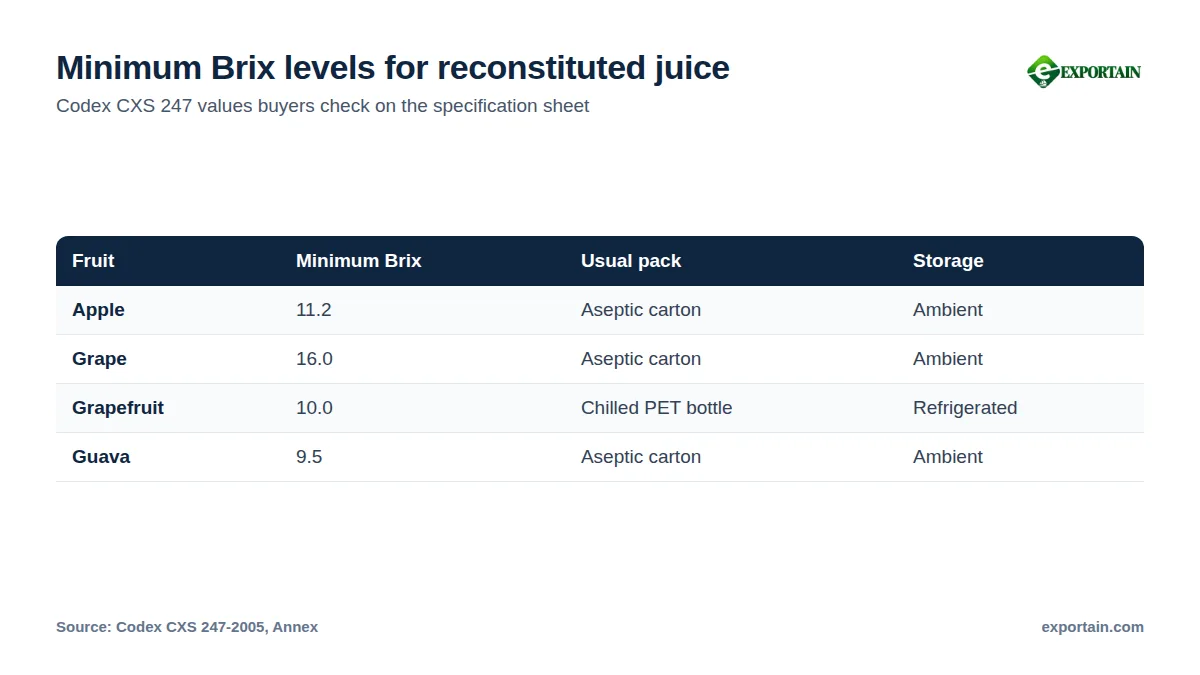
Four minimum Brix values buyers quote most often are apple at 11.2, grape at 16.0, grapefruit at 10.0 and guava at 9.5 degrees Brix.1 Put the value for your fruit on the sheet and ask the lab to report Brix against it.
Bangladesh adds its own naming line. The Bangladesh Standards and Testing Institution raised the fruit pulp minimum for a product sold as juice in the home market to 88 per cent, up from 25 per cent; firms that could not meet it rebranded as fruit drinks, for which the minimum is 10 per cent.2 That is why many Bangladeshi juice brands are labelled drinks. In the European Union, the fruit juice directive requires the words "from concentrate(s)" or "partially from concentrate(s)" close to the product name whenever the product is made wholly or partly from concentrate, and a nectar label must state "fruit content: ... % minimum" in the same field of vision as the product name.3
Which Bangladeshi fruits suit juice orders, and in what form?
Mango leads Bangladeshi juice exports by recognition, and it usually ships as juice from concentrate, nectar or a ready-to-drink product in aseptic cartons, because fresh mango pulp is seasonal and concentrate stores and ships far more cheaply than single-strength juice. Guava and pineapple follow the same pattern. Citrus suits not-from-concentrate juice in chilled PET where the buyer has a cold chain, and concentrate where the buyer does not. Litchi is best ordered as nectar or a blended drink.
Ask the processor which form they actually run: a factory with an aseptic line and a concentrate evaporator can offer all four forms, while a small packer may buy concentrate from a larger processor and only fill and label it. The mango guide for fresh fruit buyers covers the harvest side of the same supply chain: how to import mangoes from Bangladesh.
Aseptic cartons, chilled bottles or frozen concentrate: which pack fits the route?
Pack choice is a logistics decision dressed as a marketing decision. Aseptic cartons suit sea freight and warm warehouses: the juice is sterilised by ultra-high temperature treatment, typically 135 to 150 degrees C for 2 to 5 seconds, then filled into a sterile pack, and the sealed carton keeps for 6 to 12 months or longer at room temperature without preservatives or refrigeration.4 PET bottles suit chilled retail and food service, and they need refrigeration from the factory to the shelf. Glass bottles suit premium retail; drums suit concentrate sold to a bottler near the market.
Match the pack to the route before you match it to the shelf. An aseptic carton order can travel by sea in a dry container, while a chilled PET order needs a reefer container with power at every handover, and a frozen concentrate order needs a reefer held below freezing. State the pack, carton size and cases per pallet on the sheet.
When does chilled juice need a cold chain, and when does it not?
Chilled juice needs refrigeration at every step: factory cold store, refrigerated truck to the port, reefer container on the vessel, cold store at destination, and chilled trucks to the retailer. A gap at any step shortens shelf life and can spoil the load. Ask the supplier who owns each leg and whether a data logger travels with the load.
Aseptic juice needs no cold chain before opening, which is the main reason it dominates long-distance juice trade from Bangladesh.4 Keep cartons dry, out of direct sun, and stacked within the pallet limits the supplier states. Shelf life runs from production, not from shipment.
What do BSTI, Codex and your destination market each ask for?
BSTI sets the Bangladesh standard for the product: fruit juice and nectars fall under BDS CAC 247:2008, concentrated fruit juice under BDS 527, fruits and vegetables juices under BDS 513, and fruit drinks under BDS 1581, and each sits on the mandatory certification list, so the product needs a BSTI licence and the certification mark before it is sold.5
Codex sets the international reference that most destination markets use to judge composition. CXS 247 defines juice, juice from concentrate, concentrated juice, purée and nectar, and sets the minimum Brix levels in its annex.1 Your destination market adds its own layer: the European Union applies Directive 2001/112/EC, the United States applies its juice HACCP rule, and Gulf markets apply their own food safety and labelling rules.
In the United States, the juice HACCP regulation at 21 CFR Part 120 requires processors to run a written hazard analysis and a HACCP plan, and to include control measures that consistently produce at least a 5-log, or 100,000-fold, reduction in the pertinent microorganism, the most resistant microorganism of public health significance in the juice.6 The plan must be validated within 12 months of implementation and at least annually after that, and records must be kept for at least 1 year for refrigerated products and 2 years for shelf-stable products.6
Which HS code and papers travel with the juice?
Fruit juices sit in HS heading 2009, which covers fruit and vegetable juices, unfermented and without added spirit, with or without added sugar or other sweetening matter.7 The subheadings split by fruit and by Brix: not-frozen orange juice with Brix not over 20 falls under 2009.12, pineapple juice with Brix not over 20 under 2009.41, grape juice with Brix not over 30 under 2009.61, apple juice with Brix not over 20 under 2009.71, and juice of any other single fruit or vegetable under 2009.81 and its following lines.7 Brix here means the direct reading of degrees Brix at 20 degrees C.7 Juice shipped from Bangladesh carries no export duty.7
Put the same full HS code on every shipping document: invoice, packing list and letter of credit alike. The document set runs to the commercial invoice, packing list, bill of lading, certificate of origin, the BSTI licence copy, the certificate of analysis, and a health certificate where the destination asks for one. The Bangladesh Food Safety Authority issues health certificates for agro-processed food exports after sampling and testing them, a role it took over from the Export Promotion Bureau in 2022.8 Sanitary officers collect random samples at loading, seal them and send them to the laboratory, and the certificate follows once the tests are done.8
How do you place a first juice order and check it before paying?
Tie each payment to a check you can see.
Send the specification sheet to three suppliers and compare the returned sheets line by line.
Ask the shortlisted supplier for the BSTI licence, the HACCP or food safety certificate, and a recent certificate of analysis.
Order samples of the exact pack and size you will buy, and test Brix, acidity and taste against your sheet on arrival.
Agree the order in writing: product, quantity, pack, Incoterm, payment terms, inspection point and lab limits.
Book a pre-shipment inspection that pulls cartons from across the load, checks the label, the pack count and the dates, and takes a retained sample.
Pay the balance only after the inspection report and the final lab results match the order.
The Incoterm decides who carries the freight and the risk on each leg, and the processed food Incoterm note explains which term fits a food shipment from Bangladesh and why. FOB Chattogram suits a buyer with their own freight; CIF or CFR suits a buyer who wants the supplier to carry the sea leg.
A worked example: one mango juice order, priced in parts
Example figures: a retailer in the Gulf orders 12,000 litres of mango juice from concentrate in one-litre aseptic cartons, bought FOB Chattogram. At 0.62 US dollars per litre, the goods come to 7,440 dollars. Inspection and lab retest cost 420 dollars, documents and the health certificate 180 dollars, and sea freight and insurance 500 dollars. The landed cost before destination duty comes to 8,540 dollars, or about 0.71 dollars per litre.
Before payment, the lab report shows Brix at 13.8 degrees, acidity at 0.42 per cent as citric acid, and pulp share at 30 per cent, each inside the limits on the sheet, and the cartons were produced six days before loading with 11 months of shelf life remaining. The numbers above are illustrative, but the sequence stays the same: specification, sample, inspection, documents, then payment.
Which buying errors waste the most money on juice?
The costliest error is ordering by fruit name alone and discovering at the border that the product is a drink, not a juice, because the pulp share or the Brix sits below the limit your market sets for the name on the label. The second is approving label artwork before checking destination rules, leaving a container that cannot be sold without relabelling. The third is choosing chilled PET for a market with no reliable cold chain. The fourth is paying in full before inspection.
Each of these errors has the same cure: a written specification, a sample tested against it, an inspection before payment, and a document check before the vessel sails. The same discipline applies to chilled produce and baked goods: how to import fresh vegetables and how to import biscuits and cookies.
Next steps on Exportain
Send your juice specification sheet with a request for quotation so Bangladeshi juice processors price the same product, the same pack and the same shelf life, and compare their returned sheets line by line before you shortlist anyone. The suppliers listed on Exportain include food processors you can approach directly, and the potato import guide shows the same method for another agro product.
Sources
- General Standard for Fruit Juices and Nectars, CXS 247-2005. FAO and WHO, Codex Alimentarius Commission (accessed )
- Firms shift to 'fruit drinks' as BSTI tightens rules. The Daily Star, (accessed )
- Council Directive 2001/112/EC relating to fruit juices and certain similar products intended for human consumption. EUR-Lex, (accessed )
- Aseptic Packaging: Enhancing Food Safety and Shelf Life. The Packaging Edge, (accessed )
- List of 155 Products Brought Under Mandatory Certification Marks Scheme. Bangladesh Trade Portal (accessed )
- FDA 483 for Juice HACCP (21 CFR Part 120). A.P. Lyon, (accessed )
- Bangladesh Customs Tariff, Chapter 20: Preparations of vegetables, fruit, nuts or other parts of plants. Bangladesh Trade Portal (accessed )
- Obtaining health certificates for agro-processed food exports just got easier. The Business Standard, (accessed )
- Cold chain
- BSTI
- fruit juice imports
- Bangladesh fruit juice
- Brix
- aseptic packaging
- fruit juice labelling
- HS code 2009
About the author
Sourcing from Bangladesh?
Post a request for quotation and suppliers on Exportain can send you their quotes directly.
Post an RFQ