Best Incoterm for Importing Agro & Processed Food From Bangladesh
A food-first Incoterm guide for buyers importing agro and processed food from Bangladesh, covering cold chain, health and phytosanitary certificates, insurance and a decision table by food type.
Short answer
For most agro and processed food from Bangladesh, FCA or CIP is the right Incoterm. FCA gives the buyer control of the reefer and the cold chain from handover, while CIP adds seller-arranged carriage and all-risks insurance. FOB or CIF suits dried spices with long shelf life, and CIF minimum cover is too thin for frozen food.
On this page
Key takeaways
FCA or CIP fits most food from Bangladesh: FCA gives the buyer control of the reefer, while CIP adds all-risks insurance.
Frozen food must stay at minus 18 degrees Celsius or below, and a reefer maintains temperature instead of cooling warm cargo.
Health certificates for processed food are issued by the Bangladesh Food Safety Authority after sample testing, and phytosanitary certificates come from the plant protection authority.
CIF requires only minimum Institute Cargo Clauses (C) cover, which does not cover thawing or water damage, while CIP requires all-risks Clauses (A).
Use FCA, CPT, CIP, DAP or DPU for containerised food, not the sea-only terms FOB, CFR and CIF.
Food changes the Incoterm decision in a way that dry goods never do. A container of frozen shrimp that loses its cold chain arrives worthless, and a spice lot that fails an aflatoxin test never clears the border at all. This guide chooses the Incoterm from the food first: how fast it spoils, who keeps it cold, and who holds the certificate that lets it enter your market.
Incoterms® 2020 is the current edition of the trade rules published by the International Chamber of Commerce, in effect since 1 January 2020, and it contains 11 rules.1 Each rule sets the place of delivery, the point where risk passes from seller to buyer, who pays which costs, who contracts the transport, and who handles export and import formalities.2 The full set of 11 rules is covered in our Incoterms guide for shipments from Bangladesh.
Why food changes the Incoterm decision
Four food risks sit outside the Incoterm text, yet the Incoterm decides who carries each one. First, perishability: frozen seafood and fresh produce lose value by the hour once temperature control fails, while dried spices lose value slowly through moisture and mould. Second, shelf life: a buyer who takes risk early also takes the remaining shelf life, so transit time inside the chosen term is part of the price. Third, certification: health and phytosanitary certificates are issued in Bangladesh before shipment, and a missing certificate stops the goods at the destination border even when the freight was paid in full. Fourth, packaging and fumigation fall to the seller under some terms and to the buyer under others.
The practical rule is simple: the party who controls a risk should carry it, so trace each risk through the journey instead of copying the term from the last garment order.
Which certificates travel with the food, and who arranges them
For plant products entering the European Union, certain plants and plant products must carry a phytosanitary certificate guaranteeing that they were properly inspected, are free from quarantine pests, and meet EU plant health requirements, and the certificate is issued by the exporting country's national plant protection authority.3 Five fruits are exempt: pineapples, coconuts, durians, bananas and dates.3
For processed food, the Bangladesh Food Safety Authority issues health certificates for agro-processed food exports, after collecting samples and testing them in its laboratories.4 It collects random samples at loading, seals them and tests them before issuing the certificate.4 Not every product requires this certificate; the test depends on the importing country.4
For seafood, Bangladesh applies the Fish and Fish Products (Inspection and Quality Control) Act, 2020, under which the Department of Fisheries carries out processing plant inspection, export consignment inspection, health certification, hygiene and sanitation control, and food safety compliance.5 The government targets US$1 billion in annual fish export earnings by 2030, focused on value-added items such as peeled and deveined shrimp and individually quick frozen seafood.5
For the United States, the foreign facility that manufactures, processes, packs or holds the food must register with the Food and Drug Administration and renew that registration between 1 October and 31 December of every even-numbered year.6 The importer must file Prior Notice for each shipment before the food arrives, and must run a Foreign Supplier Verification Program for each food and each foreign supplier.6 A DDP seller who cannot register a facility or file Prior Notice should not accept DDP.
Cold chain: who owns each handover
Frozen food must be maintained at minus 18 degrees Celsius or below from the moment it leaves the factory cold store until it reaches the buyer warehouse, and every link in the chain must hold that temperature.7 Even a brief excursion above minus 18 degrees causes partial thawing that damages product quality, because ice crystals formed during refreezing rupture cell walls, leading to texture loss, moisture loss and colour change.7 A reefer container maintains temperature; it is not designed to pull warm cargo down to the set point, so product must be pre-cooled to minus 18 degrees or below before loading, and the temperature should be checked with a probe thermometer on sample cartons.7
That chain has six or more handovers, from factory cold store to buyer cold store, and each one is a point where the temperature can break.
Under FCA, risk passes when the goods are handed to the buyer carrier at the agreed place, and the term works for any mode of transport including multimodal container shipments.2 Under FOB, risk passes once the goods are loaded onto the vessel at the named port of shipment, and the term is for sea and inland waterway transport only.2 For a reefer stuffed and sealed at the factory, FCA hands risk to the buyer before the port handovers, while FOB keeps it with the seller through the port leg. A buyer who wants control of the reefer from the factory gate should choose FCA; a buyer who wants the seller to carry the port risk should choose FOB or a D term and pay for that cover.
The decision table: food type against Incoterm
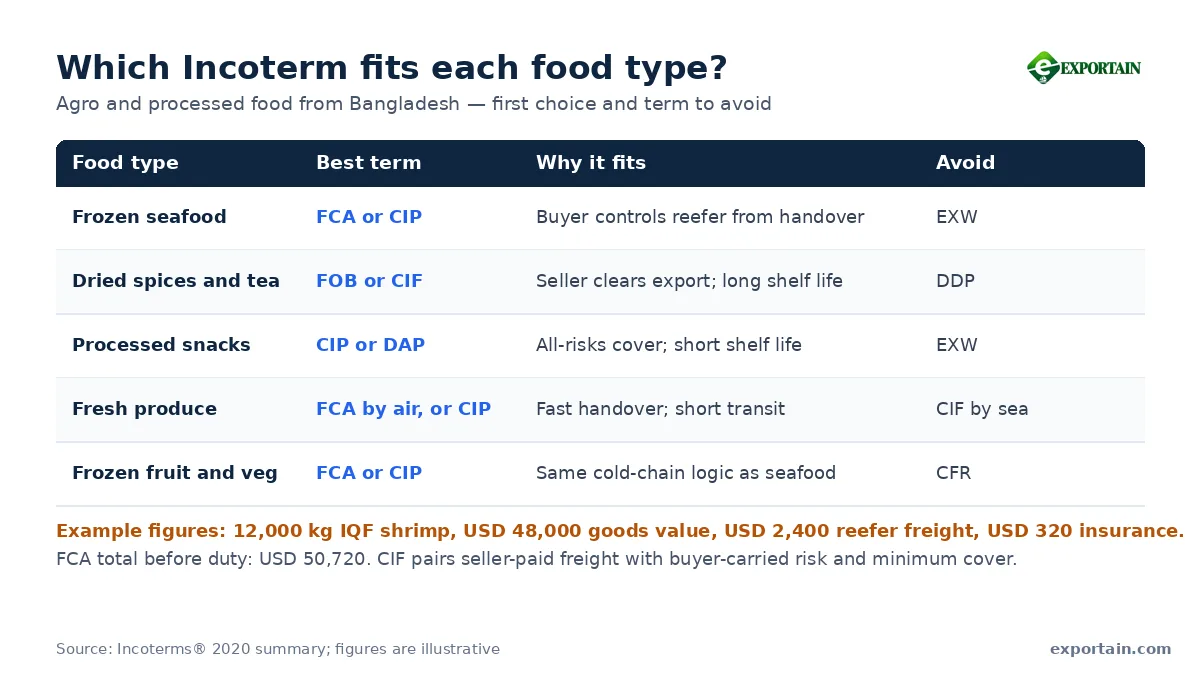
Use the table below as a starting point, then check the certificate and cold-chain sections for the product you are buying.
Food type | First choice | Why it fits | Term to avoid |
|---|---|---|---|
Frozen seafood and fish | FCA or CIP | Buyer controls the reefer from handover; CIP adds all-risks cover | EXW, where the buyer must arrange export clearance in Bangladesh |
Dried spices and tea | FOB or CIF | Seller handles export clearance; long shelf life absorbs transit | DDP, unless the seller can clear food imports |
Processed snacks and ready-to-eat food | CIP or DAP | All-risks cover or seller-carried risk suits short shelf life | EXW, where the buyer inherits packing and export paperwork |
Fresh produce | FCA by air, or CIP | Fast handover, short transit, certificate named in the contract | CIF by sea, where risk passes on loading but produce keeps ripening |
Frozen fruit and vegetables | FCA or CIP | Same cold-chain logic as frozen seafood | CFR, where the seller pays freight but the buyer carries risk without insurance |
Frozen seafood: buy control with FCA or CIP
Frozen shrimp, particularly the Bagda and Golda varieties, account for the largest share of Bangladesh fish exports, and the sector is moving toward peeled and deveined shrimp, individually quick frozen seafood and consumer-packed products.5 For frozen seafood, FCA is the working term for most buyers. See our frozen seafood Incoterm guide for the product detail. The seller delivers the sealed reefer container to the buyer carrier, completes export clearance, and hands over the health certificate and the temperature log. The buyer books the reefer, sets the temperature, and insures from handover. CIP suits a buyer who wants the seller to arrange carriage and all-risks insurance to a named destination. FOB is workable when the seller loads the reefer at Chattogram and the buyer accepts risk on board, but it is a sea-only term that fits bulk and breakbulk better than containers handed over at a terminal.8
Dried spices and tea: moisture, aflatoxin and fumigation
Dried spices look forgiving next to frozen shrimp, and that is exactly why they are rejected. The risk is not temperature but moisture, mould and residue, and the failure shows up at the destination laboratory rather than on the quay. For chillies and cardamom going to the EU, the benchmark aflatoxin limits are 10 micrograms per kilogram in total, with aflatoxin B1 at 5 micrograms per kilogram, and black pepper must stay at or below 12 percent moisture with Salmonella absent in 25 grams.9 For cumin and seed spices, the EU ethylene oxide limit is 0.1 milligrams per kilogram.9 Fumigation is part of the preparation for chilli shipments, and the document set for spice trade includes a certificate of analysis for aflatoxin, a phytosanitary certificate, a bill of lading and a certificate of origin.9
The Incoterm consequence is that the seller should carry the risk through drying, testing and packing, because only the seller can control moisture at the warehouse and order the lab test on the lot that is actually shipped. FOB does that for sea shipments: risk passes on loading, after the lot has been tested and packed. CIF adds seller-paid freight and minimum insurance, which suits a buyer who wants one price to the destination port. CIP is the stronger choice when the cargo is high-value spice, because its insurance is broader, as the insurance section below explains. See also our tea and spices sourcing guide. ## Insurance: why CIF minimum cover is thin for food
The insurance gap is the most expensive misunderstanding in food importing. Under Incoterms 2020, a CIF seller must buy at least Institute Cargo Clauses (C) cover, while a CIP seller must buy at least Institute Cargo Clauses (A) cover, in both cases for at least 110 percent of the contract price.10 Clauses (A) cover all risks of loss or damage except those excluded, while Clauses (C) cover only named major casualties such as fire, sinking and collision, and do not cover water entering the container or packages dropped during loading.10
For food, that difference decides claims. A reefer that loses power and lets shrimp thaw is not a named major casualty, and a spice container that takes in water through a damaged seal is not covered under Clauses (C). A buyer who accepts CIF should either upgrade the cover to Clauses (A) in the contract or buy a separate policy from the point where risk passes. Under CFR and CIF, the seller pays the ocean freight, but risk has already passed to the buyer once the goods are on board, so the buyer carries the exposure for the whole voyage even though the seller booked the vessel.8 That split between who pays freight and who bears risk is the detail that food buyers miss most often. See our CIF versus CIP guide.
A worked example: frozen shrimp to Rotterdam
The figures below are illustrative example figures, not a quotation.
Example figures: a buyer in Rotterdam orders 12,000 kilograms of individually quick frozen peeled shrimp from a processor in Khulna, at a goods value of USD 48,000. Ocean freight in a 20-foot reefer from Chattogram to Rotterdam is USD 2,400, and all-risks insurance at 110 percent of the goods value costs USD 320. The shrimp must stay at minus 18 degrees Celsius or below The shrimp must stay at minus 18 degrees Celsius or below, and the buyer requires a health certificate and a temperature log.
Under FCA Khulna, the seller delivers the sealed reefer to the buyer carrier at the factory, completes export clearance and hands over the health certificate. The buyer pays USD 2,400 for freight and USD 320 for insurance, and carries the risk from the factory gate. The buyer total before duty is USD 50,720. Under CIF Rotterdam, the seller pays the freight and buys minimum Clauses (C) cover, but the buyer carries the risk from loading at Chattogram. Under CIP Rotterdam, the seller pays the same freight and buys Clauses (A) cover, so the buyer pays more than under FCA and less in risk, with all-risks cover running to the named destination.
The example points to FCA for a buyer with a forwarder and a cold store in Rotterdam, and to CIP for a buyer who wants the seller to arrange the reefer and the insurance. CIF is the weakest of the three for this cargo, because it pairs seller-paid freight with buyer-carried risk and the narrowest cover.
Next steps on Exportain
Start with the product, not the term: confirm the certificate your market requires, the temperature your food needs, and the shelf life you will accept on arrival, then choose the Incoterm that puts each risk with the party who controls it. You can find Bangladeshi food suppliers, post a request for quotation with the Incoterm, temperature and certificate written into it, and read how to buy from Bangladesh before you place the order.
Sources
- ICC announces launch date for Incoterms® 2020. International Chamber of Commerce, (accessed )
- FCA & FOB Incoterms 2020 explained: Key differences. ICC Academy (accessed )
- Trade in plants & plant products from non-EU countries. European Commission, (accessed )
- Obtaining health certificates for agro-processed food exports just got easier. The Business Standard, (accessed )
- Bangladesh steps up efforts to boost fish export; eyes bigger share of global seafood market. The Financial Express, (accessed )
- How to Import Food Products into the U.S.. Reidell Law Firm (accessed )
- Cold Chain Logistics for Frozen Produce: Port-to-Warehouse Guide. Crestwood Global (accessed )
- Incoterms 2020 Explained: A Shipper's Quick Reference. Delman Shipping, (accessed )
- Why Indian Spice Shipments Get Rejected at the Border. Prime Harvest Global (accessed )
- Cargo Insurance: Institute Cargo Clauses A, B and C Compared, 110% Cover and CIF vs CIP. TriplicateDocs, (accessed )
About the author
Sourcing from Bangladesh?
Post a request for quotation and suppliers on Exportain can send you their quotes directly.
Post an RFQ