How to Import Cardigans From Bangladesh in 2026: Complete Buyer Guide
A step-by-step import guide for buyers: US duty on acrylic cardigans, one specification for every supplier, staged sample approval, an agreed inspection plan, the Bangladesh export file, and a worked landed-cost example for 1,200 zip-front cardigans to New York.
Short answer
To import cardigans from Bangladesh, classify the style under heading 6110 and work out the US duty for its fiber: women’s cardigans of man-made fibers pay 32% under subheading 6110.30.30. Send one specification to several suppliers, compare quotations on a single delivery term, approve a pre-production sample in bulk materials, agree the inspection plan in the order, and clear US customs with the Bangladesh export file behind the shipment.
On this page
Key takeaways
Women’s cardigans of man-made fibers enter the US at a 32% MFN duty rate under subheading 6110.30.30, against 16.5% for cotton cardigans — the fiber and blend decide the duty.
Cardigans sit under HS heading 6110, with the first six digits shared worldwide and the full ten-digit US code confirmed with your customs broker.
One specification goes to every supplier, quotations are compared on a single delivery term, and the sample is approved in stages in bulk materials.
The worked example lands 1,200 women’s acrylic zip-front cardigans in New York at US$15,472.80, or US$12.89 per piece, with duty at the 32% MFN rate.
The United States is the largest single-country market for Bangladeshi apparel: in July to September 2026 it took US$2,220.86 million of apparel from Bangladesh, and knitwear shipments to the US grew 11.61 percent to US$881.28 million in the same quarter, according to Export Promotion Bureau (EPB) data.1 A first cardigan order rewards a buyer who settles the duty, the specification and the inspection plan first.
This guide walks through that import in eight steps, using a women's acrylic zip-front cardigan bound for the United States.
How a cardigan import runs, in eight steps
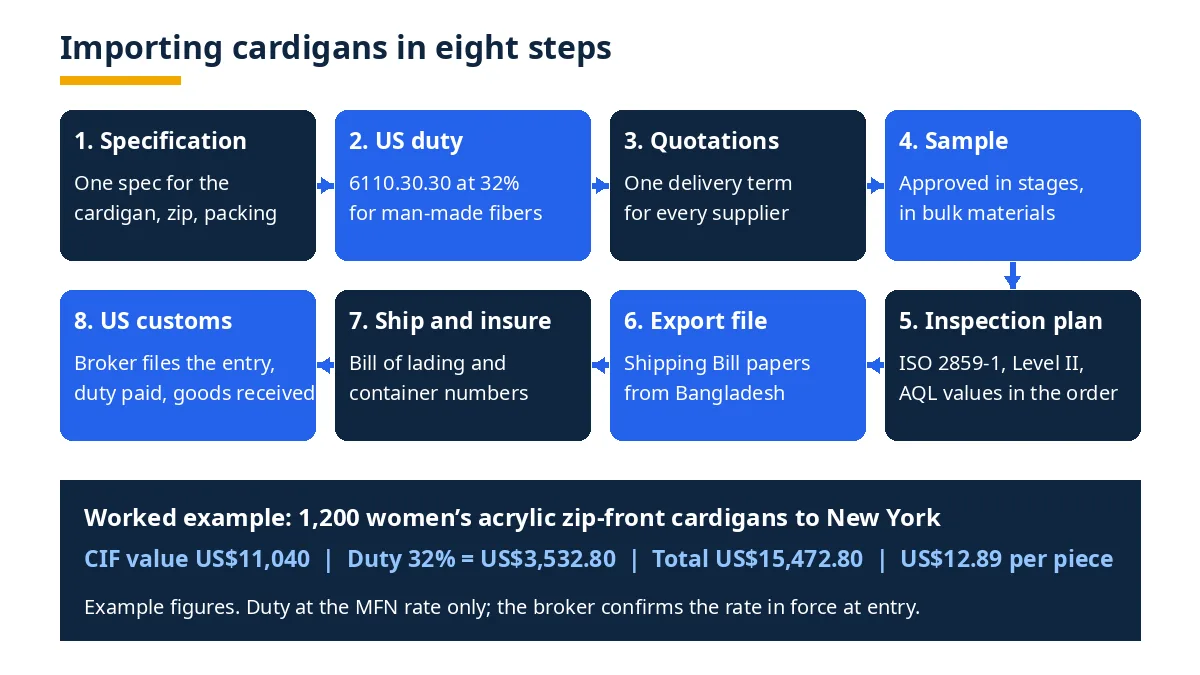
Write one specification: cardigan, zip, packing.
Work out the US duty for the fiber.
Compare quotations on a single delivery term.
Approve the sample in stages, in writing.
Agree the inspection plan before production starts.
Produce, pack and file the Bangladesh export papers.
Ship, insure and track the container.
Clear US customs, pay the duty and take delivery.
Step 1: Fix the garment on paper before you ask for a price
Write the specification before you contact any supplier: style and silhouette, zip-front opening, gauge, fiber and blend by generic name, yarn count, stitch structure, size chart with tolerances, color references, zip details, trims, labels, packing, quantity per style, color and size, tests, delivery term and destination port. Give every candidate the same document and ask each one to quote the same term and packing. Ask each supplier to state the minimum per style and per color. Read our cardigans MOQ guide before you negotiate.
State the intended wearer: gender designation affects the tariff code, and a cardigan that closes right over left is generally classed as women's apparel.2 Do not label the style unisex: a garment that cannot be clearly identified as men's or women's is generally placed in the women's category.2 State the fiber content from mill test data: the blend decides the duty.
Step 2: Work out the US duty before you compare quotations
Cardigans sit under Harmonized System heading 6110. The edition in force is HS 2022, the seventh edition, which took effect on 1 January 2022.3 The first six digits match in every country; each destination adds further digits for its own national code, so confirm the ten-digit US code with your customs broker.
A women's cardigan of man-made fibers falls under US subheading 6110.30.30 at a 32 percent most-favored-nation (MFN) duty rate; a cotton cardigan under subheading 6110.20.20 carries 16.5 percent.2 The fiber decision therefore changes the duty by about half. The importer of record stays responsible for the classification declared at entry.2
Treat the MFN rate as the starting point: additional tariffs and trade measures may apply on top of it, including a temporary 10 percent baseline tariff on a broad range of imports, and measures can change, so verify the latest status before filing entries.2 The worked example uses the 32 percent MFN rate, and your broker confirms the rate in force at entry. For the six-digit lines, read our HS code guide for cardigans.
Step 3: Choose the delivery term, then compare quotations
Shortlist three to five suppliers that cover your gauge, fiber and quantity, and ask each for an itemized quotation: yarn and knitting, linking, the zip, dyeing, trims, testing, packing and the freight to the named place. Fix the delivery term before you compare prices: Incoterms 2020 gives 11 rules that divide cost, risk and obligations between buyer and seller.4 With FOB, the seller puts the goods on board and you handle the sea leg and the insurance; with CIF, the seller handles carriage and insurance; with DAP, the seller brings the goods to your warehouse and you handle customs clearance.4 For the full comparison, read our Incoterms guide.
Under CIF, check the insurance certificate when it arrives: the default cover is Institute Cargo Clauses (C), and the parties can agree a higher level.4 If the cardigans will move in a container, ask whether FOB or FCA fits the handover. For help reading a cardigan quotation, read our cardigans price guide.
Step 4: Approve the sample in stages, in writing
Work through the samples in order, with each approval in writing: first a knitted swatch in the production yarn and gauge, then a proto sample to check construction and the zip, then a pre-production sample made from bulk yarn, bulk color, bulk zip, bulk trims and bulk labels, washed and measured after washing. Check each lab dip against the physical reference you hold. Test the zip through its full length: it must run cleanly, close flat and hold after washing. Check shade on a washed sample with both fronts present: the opening puts any difference on display. Keep one sealed, washed sample as the reference for bulk and inspection, and hold bulk until the approved sample is in the production yarn, washed, and fitted with the production zip.
Step 5: Write the inspection plan into the purchase order
Put the inspection terms in the purchase order before production starts: name the inspection firm, the stage it attends, the reference sample, and what happens if the lot fails. Base the sampling on ISO 2859-1, use General Inspection Level II for the visual checks, and set the acceptance quality limit (AQL) value for each defect class, with zero tolerance for critical defects. Ask the inspection firm to confirm the sample size and the accept and reject numbers for your lot size before production starts.
Name the defect classes in the order: a zip that sticks or separates; shade difference between the fronts; a band that will not lie flat; measurements outside tolerance; loose threads; labels with the wrong fiber wording or origin. Have the inspector pull pieces at random from every size, color and carton. Our cardigans quality control checklist turns these points into inspector checks.
Step 6: Production, packing and the Bangladesh export file
Check the work at three points: panels after knitting, bodies after linking, finished cardigans before packing. Pack as the order states: folded, in polybags, assorted by size and color, with carton marks and gross weights that match the packing list.
Goods cannot leave Bangladesh until the Shipping Bill is approved: it is the mandatory document for customs clearance and loading, applied for with the papers below.5
Export paper | What it is |
|---|---|
Export letter of credit, telegraphic transfer or purchase order | Payment basis, or the export contract or guarantee approved by the negotiating bank5 |
Commercial invoice | Signed by the exporter5 |
Packing list | Quantity, weight, packing5 |
EXP form | Certified by Authorized Dealers5 |
Certificate of origin | The EPB or a Chamber of Commerce and Industry issues it5 |
VAT registration certificate | VAT registration5 |
Taxpayer identification number (TIN) | From the Income Tax Department5 |
Export Registration Certificate (ERC) | Exporter registration5 |
Ask for the file as one set before production finishes.
Step 7: Ship, insure and track
Under FOB, book the sea freight and the insurance yourself and confirm the sailing date in writing. Under CIF, check the insurance certificate against the agreed cover before the vessel sails. The bill of lading is the carrier's receipt for the goods and the contract to carry them.5 Get the bill of lading and container numbers the moment they are issued.
Step 8: Clear US customs and take delivery
Give your broker the tariff code and the entry papers before the vessel berths. Ask the broker to confirm the duty, the entry documents and the rate in force at entry in writing, since additional US trade measures can apply on top of the MFN rate.2 Pay the duty as the broker directs, and keep the entry papers, bill of lading and inspection report in the order file.
Before the goods leave the warehouse, check the cartons against the packing list and open a sample. Confirm the fiber, origin and care wording on the labels with your compliance contact, approve the label wording on a printed proof, and close the order file when the goods are received, checked and counted.
Worked example: 1,200 women's acrylic zip-front cardigans to New York
Every number below is an example figure only. Example figures: 1,200 women's acrylic zip-front cardigans, CIF New York, duty at the 32 percent MFN rate for subheading 6110.30.30.2
Cost element | Amount (USD) |
|---|---|
Product price, FOB Chattogram (1,200 x US$8.00) | 9,600 |
Freight and insurance to New York | 1,440 |
Customs value (CIF) | 11,040 |
Duty at 32% of 11,040 | 3,532.80 |
Customs broker fee | 300 |
Port handling | 280 |
Delivery to warehouse | 320 |
Total cash outlay | 15,472.80 |
Cost per piece | 12.89 |
Check it: 1,200 at US$8.00 is US$9,600; plus US$1,440 freight and insurance, the CIF value is US$11,040; 32 percent of that is US$3,532.80; the lines add to US$15,472.80, or US$12.89 per piece. The duty line uses the MFN rate only, so the broker confirms the rate at entry before you fix the landed cost.2
Four mistakes that add cost to a cardigan import
Letting the blend cross 50 percent. A small change in the fiber blend can move a cardigan from the cotton subheading at 16.5 percent into the man-made fiber subheading at 32 percent.2 Fix the fiber and the blend in the specification from mill test data.
Comparing quotations on different delivery terms. A CIF price carries the sea leg and the insurance inside it; an FOB price ends at the vessel. Fix one Incoterms rule and one named place on every request.4
Letting a paper hold the container. Loading waits on the Shipping Bill, which needs the EXP form and certificate of origin alongside the invoice and packing list.5 Confirm the full file before production finishes.
Paying the balance before the inspection report is read. Once the balance is paid, a failed lot turns into a negotiation instead of a rejection. Keep the final payment behind the inspection report.
Import checklist
Keep the evidence for each line.
Duty and code settled: heading 6110, fiber and blend, US code, 32 percent rate, broker confirmation.
One specification sent to every candidate: zip, fiber, gauge, term, packing, destination.
Three to five quotations on the same term, MOQ per style and color stated.
Samples approved in writing at each stage: swatch, proto, then pre-production in bulk materials, washed.
Inspection terms agreed before production: standard, level, AQL values, defect classes.
Order confirmed: specification version, quantities, price, payment terms, packing, shipment date.
Export file complete: Shipping Bill papers, EXP form, origin certificate, invoice, packing list.
Freight and insurance booked, bill of lading and container numbers received.
Broker holds the code and the entry papers before the vessel berths.
Goods received and checked; order file closed with the entry papers and inspection report.
FAQs
What duty do cardigans from Bangladesh pay in the US?
Women's cardigans of man-made fibers fall under subheading 6110.30.30 at a 32 percent MFN rate; cotton cardigans fall under subheading 6110.20.20 at 16.5 percent.2 No preference is claimed in this guide: ask your broker to confirm the rate and any additional measures at entry.2
Do I need a US customs broker?
A licensed broker is the safer choice for a first import: the broker checks the code and the rate in force and files the entry papers, and you may file the entry yourself once you know the process.
What papers does the Bangladesh side need before the goods can load?
The Shipping Bill is the mandatory document for customs clearance and loading.5 The exporter applies for it with the export letter of credit or purchase order, the signed invoice, the packing list, the EXP form, the certificate of origin, the VAT certificate, the taxpayer identification number and the Export Registration Certificate.5
Next steps on Exportain
Start with how to import from Bangladesh for the wider process, read the cardigans manufacturers guide to shortlist suppliers, and post an RFQ with your specification, quantities and delivery term.
Sources
- RMG exports rise 6.10 percent to US$10.58b in July-Sept of FY27. Bangladesh Sangbad Sangstha, (accessed )
- Apparel HS Code Classification Guide: How Knit vs. Woven, Fiber Type, and Gender Drive Your Duty Rate. Gaia Dynamics (accessed )
- HS Nomenclature 2022 edition. World Customs Organization (WCO) (accessed )
- Incoterms® 2020. International Chamber of Commerce (ICC) (accessed )
- Bangladesh Trade Portal FAQ: Export Registration Certificate (ERC). Bangladesh Trade Portal (accessed )
About the author
Sourcing from Bangladesh?
Post a request for quotation and suppliers on Exportain can send you their quotes directly.
Post an RFQ