Cardigans Price in Bangladesh: FOB Cost Breakdown for Buyers
No single cardigans price in Bangladesh: how the front band, buttons, gauge, and dye lots shape the FOB figure, and how to audit a quotation line by line before comparing suppliers.
Short answer
A cardigan FOB price from Bangladesh is the sum of the cost lines up to loading on the vessel: yarn, knitting and linking, dyeing and finishing, the front band and buttons, labor and overhead, testing and packing, and inland freight and export handling. Under FOB, the seller delivers the goods on board the vessel at the named port. Compare quotations line by line on the same front construction, color count, packing, and named port.
On this page
Key takeaways
A cardigan FOB price is a sum of lines up to loading: yarn, knitting and linking, dyeing and finishing, the front band and buttons, labor and overhead, testing and packing, and inland freight and export handling.
The front decides much of the price: band construction, button count and stance, gauge, and color count must be specified together and priced as separate lines.
Under FOB the seller delivers the goods on board the vessel at the named port; compare quotations only on the same specification, color count, packing, port, and term.
Every number in the worked example is illustrative structure only, labelled Example figures, and must be replaced with each supplier's own split.
Exportain verification is a document and photo review, not a factory inspection, and a badge is not a guarantee.
A buyer who searches for cardigans price bangladesh usually receives one number per supplier and tries to pick the lowest. That number hides the decisions that set it. A cardigan is an open-front garment, so the price is set as much at the front as in the yarn: two fronts that must match, a band that must hold its shape, buttons and buttonholes that must line up after washing, and a gauge that sets the drape. This guide shows how to take one FOB quotation apart, line by line, so you can see which decision moves the price.
Ask every supplier to answer the same specification, front construction, color count, named port, and delivery term.
Why a cardigan quotation moves on the front, not only on the yarn
What should I know first about cardigans?
A cardigan opens at the front and fastens there, so the front is a separate piece of work inside the garment. The two fronts are knitted as panels, joined to the body, and finished with a band. If the band stretches, the fronts do not meet. If the button stance is wrong, the cardigan gaps or pulls.
Gauge sets how fine or chunky the knit reads, and it changes knitting time and drape. Gauge, yarn, and front construction must be specified together, because a supplier who quotes a fine-gauge cardigan at a chunky-gauge price has quoted a different garment.
Reading the cardigans price Bangladesh quotation, step by step
Work through a quotation in this order: specification first, then the price split, then dates and papers.
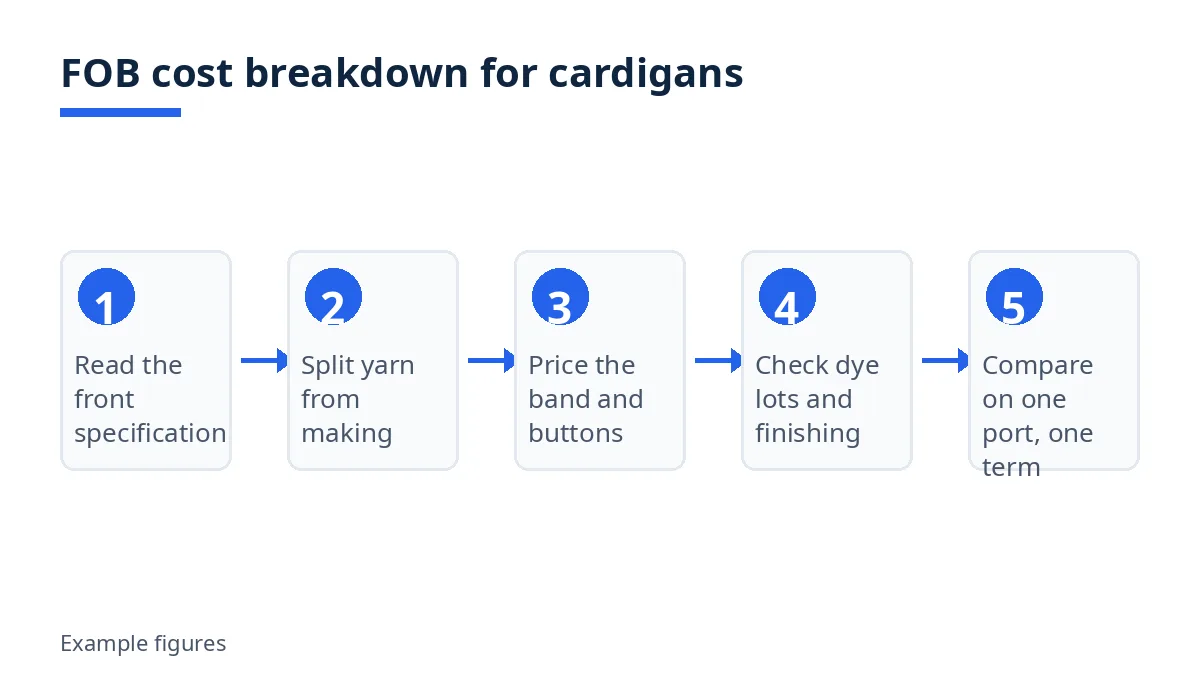
Read the front specification first. Confirm the opening type, band construction, button count and size, buttonhole method, collar or neck shape, pocket type, and gauge. If any of these is missing, the quotation is incomplete.
Split yarn from making. Ask the supplier to show the yarn line apart from the knitting and linking line. That split shows whether a price difference comes from the fiber or from the work.
Price the band and the buttons apart. Ask for the band construction, button material and count, and buttonhole work as a separate line. A button-front cardigan and a zip-front cardigan are different prices, and the quotation should show why.
Check dye lots and finishing. Confirm the color count, whether each color is dyed to order or taken from stock, and what finishing the cardigan receives. Confirm shade approval on a washed sample in the bulk yarn and color.
Check testing, packing, and overhead. Ask what testing, inspection, packing, and carton work the price includes, and whether any of it is charged apart.
Compare on one port and one term. Compare only quotations that name the same port of shipment and the same Incoterms rule. Under FOB, the seller delivers the goods loaded on board the vessel nominated by the buyer at the port of shipment, and risk transfers to the buyer at that point.1 The seller handles transport to the port, loading, and export formalities, while the buyer contracts the carrier and pays the freight.1
If a supplier will not split the quotation, ask again in writing with the lines listed. If the split still does not come, treat the quotation as uncomparable and keep it out of the shortlist.
FOB cost breakdown: yarn, knitting, trims, labor, overhead, freight
Under the Incoterms 2020 rules, each of the 11 rules gives a clear allocation of cost, risk, and obligations between seller and buyer.2 FOB is one of the rules for sea and inland waterway transport only: the seller delivers the goods on board the vessel, and the buyer takes over the main carriage from there.1
One caution belongs here. The ICC Academy notes that when goods are containerized, the seller usually delivers them to a container terminal rather than on board the vessel. In that case FCA is the more appropriate rule.1 If your cardigans will move in containers, ask whether FOB or FCA fits the actual handover.
The table below names the lines inside a cardigan FOB price. Use it as a checklist for the split you request, not as a price list. No line has a standard value.
Cost line | What it pays for in a cardigan | Ask the supplier to show |
|---|---|---|
Yarn | Fiber, yarn count, and weight per piece at the stated gauge | Fiber and blend, yarn count, weight, stocked or dyed to order |
Knitting and linking | Panel knitting, shaping, and joining of fronts, sleeves, and body | Gauge, linking method for the band |
Dyeing and finishing | Dye lot work and the finishing that sets hand feel and size | Color count, dye lot per color, finishing steps |
Front band, buttons, and trims | Band construction, buttons, buttonholes, labels, and pocket work | Band method, button material, count and size, label spec |
Labor and overhead | Cutting, sewing and linking labor, line time, and factory overhead | Whether band and buttonhole set-up is inside the unit price |
Testing and packing | Lab checks, inspection support, polybags, tags, and cartons | Which tests, packing method, carton spec, separate charges |
Inland freight and export handling | Transport to the port, port handling, and export formalities to loading | Named port, handling included to loading, documents included |
Example figures: the worked example below shows structure only. The shares are illustrative, not prices and not typical values. Read them to see how a front decision shifts weight between lines, then replace every share with the supplier's own split.
Example figures: one cardigan style, quoted twice. The first quote has a ribbed button band with five buttons. The second has a wider linked band with seven buttons and a different button material. Yarn, gauge, color count, packing, port, and term stay the same.
Example figures: cost line | Quote A: five buttons, ribbed band | Quote B: seven buttons, linked band |
|---|---|---|
Yarn | 38 | 36 |
Knitting and linking | 16 | 17 |
Dyeing and finishing | 11 | 11 |
Front band, buttons, and trims | 12 | 15 |
Labor and overhead | 12 | 11 |
Testing and packing | 4 | 4 |
Inland freight and export handling | 7 | 6 |
Total | 100 | 100 |
The total in Quote B is higher, but the yarn line is lower as a share because the band and button work takes more of the total. A buyer who reads the lines sees a different front construction, and can decide whether the wider band and extra buttons are worth paying for.
Three levers move a cardigan FOB price more than the rest. First, gauge: a finer gauge changes yarn use, knitting time, and drape together, so a gauge change is a new quotation. Second, the button stance: the number, size, and spacing of buttons change the band and buttonhole work. Third, the color count: each color can carry its own dye lot, and a color added late can delay the whole order. Ask for each lever to be priced as a decision, not buried in the total.
Timelines and documents
What are the typical costs and timelines?
There are no typical costs or timelines a guide can state as fact for cardigans from Bangladesh. Each supplier prices your yarn, gauge, front construction, button work, color count, finishing, packing, and delivery term, and sets its own dates for sampling, dyeing, production, and inspection.
Ask for the dates as separate lines: sample, yarn ready, production, inspection, and port dates. Ask which date depends on the dye lot and which depends on button delivery, since a delay in buttons holds a finished cardigan.
Which documents are needed?
For the order, keep the tech pack, the itemized quotation, and the purchase order naming the specification, color and size split, named port, and Incoterms rule. For the shipment, Bangladesh Customs requires clearance for export: goods must not be loaded unless an export declaration, known as the Bill of Export or Shipping Bill, is submitted to Customs and approved.3 The documents enclosed with the Bill of Export for all export consignments include the export letter of credit or, where there is no export letter of credit, the export contract, purchase order, or export guarantee approved by the negotiating bank, the commercial invoice, the packing list, the EXP form certified by Authorized Dealers, and a certificate of origin issued by the Export Promotion Bureau (EPB) or a Chamber of Commerce and Industry.3
Cardigans fall under HS heading 6110, which covers jerseys, pullovers, cardigans, waistcoats, and similar articles, knitted or crocheted.4 Treat that heading as indicative, and verify the full code with your customs broker and the destination tariff before you declare it.
If you sell into the European Union, check Regulation (EU) No 1007/2011, which covers textile fiber names and the labelling and marking of fiber composition, against your buyer's requirements before production.5
Bangladesh-specific rules and tips
Confirm association claims at the source. The Bangladesh Knitwear Manufacturers and Exporters Association (BKMEA) describes itself as the apex trade body for the knitwear sector, established in 1996, representing approximately 2,540 knitwear member factories.6 If a supplier claims BKMEA membership, confirm it with the association. Membership does not set the price or guarantee delivery.
Keep one legal name across every paper. The export declaration names the exporter and the foreign buyer,3 so the name on the trade licence, quotation, proforma invoice, and payment account should match.
Ask which inputs are imported for your order. Buttons, zips, and some yarns may be bought in for your specification, and an imported button can set the earliest production date. Agree the size ratio per color before production, and ask whether a Utilization Declaration for goods under bonded warehouse applies to your order, since Bangladesh Customs lists it among the documents that can be required.3
Mistakes and red flags
What are the most common mistakes?
Comparing quotations without a named port. An FOB price without a named port of shipment is incomplete. The port decides the inland freight inside the price, and two quotations for different ports are not comparable.1
Leaving the front out of the tech pack. A sketch without the band construction, button count and size, buttonhole method, and gauge invites each supplier to price a different cardigan.
Approving shade on an unwashed sample. Cardigan fronts show shade differences at the opening. Approve shade on a washed sample in bulk yarn and bulk color, with both fronts present.
Reading a badge as an inspection. A badge records a document and photo review. It does not test whether the supplier can knit your gauge, link your band, or hold your shade. Sample approval and inspection stay with you.
Paying for the band twice. If band and buttonhole set-up was paid as a separate line on the first order, keep that record for the repeat enquiry, or the same set-up can appear again inside the second unit price.
Treating the total as the negotiation. Haggling over the total without naming a line forces the supplier to cut something you cannot see. Negotiate a named line: fewer colors, a stock yarn, standard buttons, or a simpler band, and get the revised split in writing.
Checklist
Before you confirm a cardigan order, every line should be answered in writing.
Tech pack sent: gauge, yarn, front opening, band, buttons, buttonholes, collar, pockets, labels, packing.
FOB split received: yarn, knitting, dyeing, band and buttons, labor, testing and packing, freight.
Color count and dye lot status confirmed per color.
Washed sample approved, with both fronts, buttons, and labels as bulk.
Named port and Incoterms rule on the quotation and purchase order.1
Timeline split: sample, yarn ready, production, inspection, and port dates.
Export set agreed: Bill of Export, invoice, packing list, EXP form, certificate of origin.3
HS heading checked as indicative only and verified with the broker.4
Inspection agreed before production.
Paid set-up lines recorded for any repeat enquiry.
How Exportain helps
On Exportain, browse suppliers on Exportain and post a request for quotation on the RFQ board with your tech pack summary, front construction, color count, and delivery term, so suppliers on Exportain quote against the same cardigan. Ask each reply for the FOB split in the table above, with the band and buttons shown apart.
Read the badges for what they record. Exportain Verified means Exportain has checked identity, phone, email, and business registration, and Export Verified means it has checked the Export Registration Certificate (ERC). Factory Verified means it has reviewed photos of the manufacturer's factory, while Trading Company Verified means it has reviewed photos of the trading company's office or warehouse.7 Verification is a document review by staff, free, and never granted by membership plans, and it is not a factory inspection.7 8 The washed sample, the shade check, and the pre-shipment inspection stay with you. See how supplier verification works on Exportain.
For the MOQ side of the same order, read the MOQ guide and the cardigans MOQ guide before you fix the color count.
FAQs
What should I know first about cardigans?
A cardigan is an open-front knitted garment, so the front band, the buttons, and the gauge decide much of the price and the fit. Cardigans sit under HS heading 6110, as an indicative heading to verify before declaration.4 Specify the opening, band, buttons, and gauge together, and ask for the FOB price split into lines.
What are the typical costs and timelines?
There are no typical figures a buyer can rely on, because each supplier sets its price and dates for your yarn, gauge, front construction, button work, color count, and delivery term. Ask for the FOB split and the timeline as separate lines, and compare only quotations that share the same specification, port, and term.1
Which documents are needed?
The order documents are the tech pack, the itemized quotation, and the purchase order. The export set is the Bill of Export, commercial invoice, packing list, EXP form certified by an Authorized Dealer, and certificate of origin issued by the EPB or a Chamber of Commerce and Industry.3
What are the most common mistakes?
The most common mistakes are comparing FOB prices without a named port,1 leaving the band and buttons out of the tech pack, approving shade on an unwashed sample, reading a badge as an inspection,7 and negotiating the total instead of a named line.
Next steps on Exportain
Browse suppliers on Exportain, then post your tech pack summary, front construction, and color count on the RFQ board and ask for the FOB split in this guide. Before you confirm, read the MOQ guide so the color count you approve matches the minimum and the dye lot behind it.
Sources
- FOB & FAS Incoterms® 2020 explained: Key differences. ICC Academy (accessed )
- Incoterms® 2020. International Chamber of Commerce (ICC) (accessed )
- Customs Clearance Procedures for Export. Bangladesh Customs, National Board of Revenue (accessed )
- Classification Detail — HS Code 6110. United Nations Statistics Division (accessed )
- Regulation (EU) No 1007/2011 on textile fibre names and related labelling and marking of the fibre composition of textile products. European Union, (accessed )
- BKMEA at a Glance. BKMEA (accessed )
- Trust & Safety Center. Exportain (accessed )
- Supplier verification: Earn trust badges buyers can see. Exportain (accessed )
About the author
Sourcing from Bangladesh?
Post a request for quotation and suppliers on Exportain can send you their quotes directly.
Post an RFQ