HS Code for Cardigans: Classification Guide for Importers
Knitted or crocheted cardigans sit in heading 6110, decided by the full front opening, fibre at six digits and wearer group, with US, EU and UK national codes running to 8-10 digits.
Short answer
Cardigans are classified under heading 6110 when they are knitted or crocheted garments with a full length opening at the front. The six-digit line follows fibre: 6110.11 for wool, 6110.12 for cashmere, 6110.20 for cotton, 6110.30 for man-made fibres and 6110.90 for other materials. The wearer line follows the front closure, and the full 8- to 10-digit national code must be confirmed for the destination before filing.
On this page
A supplier lists a style as a knit cardigan, a buyer calls it a button jacket, and the invoice calls it a sweater. Customs classifies none of those names: it classifies the garment in front of it, by construction, opening, fibre mix and wearer. The Harmonized System is a multipurpose international product nomenclature developed by the World Customs Organization (WCO), comprising more than 5,000 commodity groups, each identified by a six-digit code, and used by more than 200 countries and economies as a basis for their customs tariffs.1 This guide follows the cardigan alone, because its full front opening is also its main source of error.
Quick answer: indicative HS heading (with verify note)
The indicative heading for cardigans is 6110. In the United States schedule, heading 6110 covers sweaters, pullovers, sweatshirts, waistcoats and similar articles, knitted or crocheted, and its statistical note extends the sweater provisions to cardigans.2 The United Kingdom tariff names cardigans directly, and European guidance gives the test in words: waistcoats and cardigans that have a full length opening at the front sit inside heading 6110.3 4
Six-digit line | Fibre |
|---|---|
6110.11 | Of wool |
6110.12 | Of Kashmir (cashmere) goats |
6110.19 | Of other wool or fine animal hair |
6110.20 | Of cotton |
6110.30 | Of man-made fibres |
6110.90 | Of other textile materials |
Treat 6110 as indicative: it covers only knitted or crocheted articles, and the full 8- to 10-digit national code must be read from the importing country's tariff before you file.
How HS codes are structured (2-4-6 digits)
The Harmonised System runs from sections to chapters at two digits, headings at four digits and sub-headings at six digits, with approximately 5,000 six-digit product categories, and the current version is HS 2022.5 Countries then subdivide the six-digit categories into national subheadings; the Combined Nomenclature of the European Union uses eight-digit codes.5
Chapter 61 is knitted or crocheted apparel, heading 6110 narrows that to jerseys, pullovers, cardigans and waistcoats, subheading 6110.20 to cotton, and the national extension adds the importing country's digits.
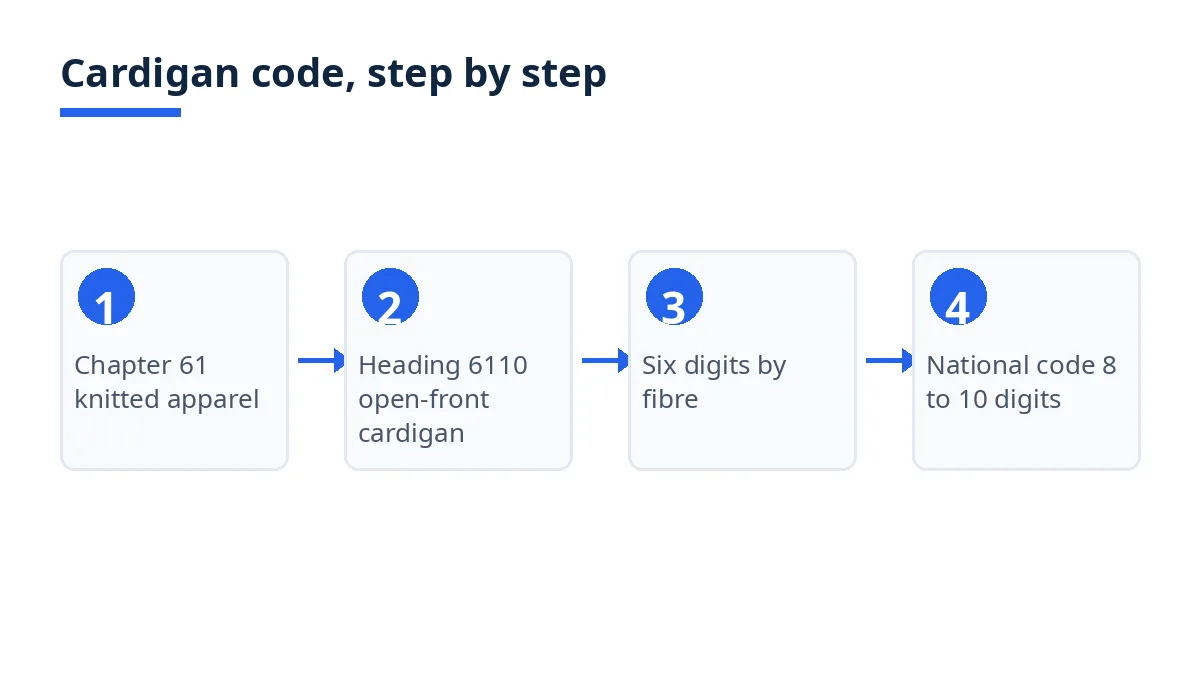
Two shipments can therefore share 6110.20 and still need different full codes.
Factors that decide the code for cardigans
Check these factors in order.
The full front opening comes first. A cardigan is an upper-body garment that opens all the way down the front, from neckline to hem. European guidance lists waistcoats and cardigans that have a full length opening at the front inside heading 6110, alongside garments pulled over the head with no opening or only a partial neckline opening.4 A half-open style, fastened only at the neck, is not a cardigan on this test.
Knitted or crocheted construction is a condition, not a detail. Chapter 61 applies only to made up knitted or crocheted articles.2 United Kingdom guidance states the same split: Chapter 61 covers knitted or crocheted fabric, Chapter 62 woven or non-woven fabrics.6 A woven open-front jacket leaves Chapter 61 altogether, and crochet counts the same way as knitting.2
Closure type does not change the heading, but it can decide the wearer group. Buttons, a zip, toggles, press studs, a tie belt or no closure at all all leave the garment inside 6110. What the closure does decide is the men's or women's line. Chapter 61 note 9 provides that garments designed for left over right closure at the front are men's or boys' garments and those designed for right over left closure are women's or girls' garments.2 United Kingdom guidance repeats the rule and adds the fallback: garments that cannot be identified as either sex are classified in the women's or girls' headings.6 That fallback matters for cardigans, because many are sold open, with no overlap to read: for one with no fastening, record the wearer group from the cut and the order.
Fibre decides the six-digit line, and blends follow weight. The subheading follows fibre: 6110.11, 6110.12 and 6110.19 for wool or fine animal hair, 6110.20 for cotton, 6110.30 for man-made fibres and 6110.90 for other textile materials.2 For a blend, record the composition in percentages by weight. Section XI note 2 classifies a mixture as the material that predominates by weight, or, when none predominates, as the material covered by the heading occurring last in numerical order.7 A button-front cardigan of 62 percent acrylic and 38 percent cotton sits on 6110.30, because acrylic predominates by weight; a zip-front cardigan of 58 percent cotton and 42 percent polyester sits on 6110.20, because cotton predominates.
Stitch count is a boundary test, not a cardigan test. In the United States, the sweater provisions cover garments with 9 or fewer stitches per 2 centimeters on the outer surface, and garments known as sweaters where those stitches cannot be counted, which covers open-work crochet.2 Separately, headings 6105 and 6106 exclude garments averaging less than 10 stitches per linear centimeter in each direction.2
Length, sets, age and coating are the remaining boundaries. European guidance excludes garments similar to pullovers but longer, which are generally classified as dresses.4 A twinset does not take one combined code: textile garments of different headings are classified in their own headings even if put up in sets for retail sale, and both pieces sit in 6110 with their own fibre and wearer lines.7 A sleeveless open-front style is a waistcoat, still inside 6110. A cardigan for a child of a body height not exceeding 86 centimeters that is classifiable both in heading 6111 and in other headings is classified in heading 6111.2 A knitted or crocheted fabric with a visible non-cellular coating on one surface moves to heading 6113.6
Against a blouse, the tests are the knit construction, the 10-stitch threshold and pockets below the waist.4 Against a jacket, the test is the panelled shell: a jacket or blazer outer shell, excluding sleeves, comprises three or more panels sewn together lengthwise.4 The sweaters guide covers the pullover side of this boundary in full.
National codes: US HTS, EU CN/TARIC, UK commodity code
United States: HTS, ten digits. The United States schedule lists its 6110 suffixes under sweaters, and statistical note 3 extends those provisions to cardigans.2 For wool, a men's cardigan takes 6110.11.0015 and a women's cardigan 6110.11.0030.2 For cotton, the other line is 6110.20.20, with men's cardigans at 6110.20.2010 and women's at 6110.20.2020; for man-made fibres, the other line is 6110.30.30, with 6110.30.3010 and 6110.30.3020.2 Detail lines matter too: cotton with 36 percent or more by weight of flax fibres sits on 6110.20.10, and cashmere wholly of cashmere on 6110.12.10.2
European Union: CN at eight digits, TARIC for measures. The Combined Nomenclature uses eight-digit codes.5 On the EU tariff, wool cardigans containing at least 50 percent wool by weight and weighing 600 g or more per article sit at 6110 11 10; other men's or boys' wool garments sit at 6110 11 30 and women's or girls' at 6110 11 90.8 For cotton, other men's or boys' garments sit at 6110 20 91 and women's or girls' at 6110 20 99, with the same pattern for man-made fibres at 6110 30 91 and 6110 30 99; the ten-digit form adds a further pair of digits, shown as 6110 1130 00.8 Caution: the fine-knit lines at 6110 20 10 and 6110 30 10 are worded for roll, polo or turtleneck jumpers and pullovers, where fine knit means at least 12 stitches per centimeter in both directions,6 so an open-front cardigan should not be filed on one on stitch count alone.
United Kingdom: commodity code. On the United Kingdom tariff, the wool lines run to 6110 1110 00, 6110 1130 00 and 6110 1190 00, and the cotton lines to 6110 2091 00 and 6110 2099 00, with the same pattern under man-made fibres at 6110 3091 00 and 6110 3099 00.3 The United Kingdom page opened for this guide is dated 1 January 2023, so re-check the current tariff at filing time.
How to confirm the code officially
Write a precise description: construction, fibre percentages by weight, opening and closure type, wearer group and how it was determined, length, stitch count, and any coating.
Start from the official tariff for the destination: the USITC HTS, TARIC or the United Kingdom Trade Tariff, and read the heading text and chapter notes.
Check published rulings for similar garments. For the United States, the USITC advises traders to use the Customs Rulings Online Search Service (CROSS).9
For a borderline cardigan, apply for a binding decision before you ship: an EU BTI needs a separate application per product type with a detailed description,10 a United Kingdom Advance Tariff Ruling is generally valid for 3 years,11 and in the United States you may request a CBP binding ruling if no CROSS ruling covers the merchandise.9
Give your broker the description and confirmed code for each style, and use the same code on the invoice and declaration.
Common classification mistakes
Filing a woven open-front jacket under 6110. Chapter 61 applies only to made up knitted or crocheted articles.2 A woven garment belongs in Chapter 62.
Filing a pullover as a cardigan, or the reverse. The test is the full front opening:4 a pullover with a short neckline zip is not a cardigan, and a cardigan worn open is still a cardigan.
Letting the closure choose the heading. Buttons, zips, toggles and ties do not move a cardigan out of 6110: the closure matters for the wearer line under note 9, not for the heading.2
Guessing the fibre line for a blend. A mixture is classified as the material that predominates by weight,7 so a man-made-fibre-predominant cardigan filed on the cotton line takes the wrong six-digit line.
Filing a twinset as one code. Garments of different headings keep their own headings even in retail sets, so file the cardigan and the pullover as separate lines.7
Copying a code from another country. The EU extends the six digits to eight,5 and the United States and the United Kingdom split the 6110 lines further at ten digits.2 3 A six-digit match does not mean the national code also matches.
Related duties and documents
This guide states no duty rates: read the rate beside your confirmed code for your origin and entry date, and check what proof of origin a preference claim requires. Keep the style description, fibre composition, opening and closure details, confirmed codes, any binding decision and origin evidence in the shipment file, with each style as a separate invoice line.
FAQs
What is the HS code for cardigans?
The indicative heading is 6110, for jerseys, pullovers, cardigans, waistcoats and similar articles, knitted or crocheted.3 The six-digit line follows fibre: 6110.11 wool, 6110.12 cashmere, 6110.20 cotton, 6110.30 man-made fibres, 6110.90 other materials.2 The cardigan test is the full length opening at the front.4
Is the HS code the same in every country?
Only the first six digits are harmonised. Beyond six digits, each country adds its own lines: eight digits in the EU Combined Nomenclature,5 and ten in the United States and the United Kingdom.2 3
How do I confirm the correct code?
Describe each cardigan precisely, read the destination tariff's heading text and chapter notes, and check published rulings such as CROSS.9 For a borderline garment, apply for a binding decision: a BTI,10 an Advance Tariff Ruling,11 or a CBP binding ruling.9
What happens if I use the wrong code?
Duty, licensing and quota treatment are worked out from the code on the declaration, so a wrong code brings the wrong treatment. Taking a binding decision in advance helps you calculate the duties and restrictions that will apply.11
Next steps on Exportain
Browse Bangladeshi suppliers on Exportain, and read the HS code explainer and how to classify your product before confirming codes with your broker. Exportain is not a party to the goods contract and does not inspect goods, book freight or clear customs.
Sources
- What is the Harmonized System (HS)?. World Customs Organization (accessed )
- Harmonized Tariff Schedule of the United States, Chapter 61: Articles of apparel and clothing accessories, knitted or crocheted (Revision 17, 2026). United States International Trade Commission (accessed )
- Jerseys, pullovers, cardigans, waistcoats and similar articles, knitted or crocheted - UK Integrated Online Tariff, heading 6110. GOV.UK, HM Revenue and Customs (accessed )
- Classifying textiles. European Commission, Access2Markets (accessed )
- Harmonised System. European Commission (accessed )
- Classifying textile apparel. HM Revenue & Customs (GOV.UK), (accessed )
- Harmonized Tariff Schedule of the United States, Section XI Notes (2025 Revision 11). U.S. International Trade Commission (accessed )
- Jerseys, pullovers, cardigans, waistcoats and similar articles, knitted or crocheted - Northern Ireland Online Tariff (EU tariff), heading 6110. GOV.UK, HM Revenue and Customs (accessed )
- MTB 2019: Get Out Ahead of the Pack with a Binding Ruling from CBP. U.S. International Trade Commission (accessed )
- European Binding Tariff Information (EBTI). European Commission, Taxation and Customs Union, (accessed )
- Check what you'll need to get a legally binding decision on a commodity code. GOV.UK, HM Revenue and Customs (accessed )
About the author
Sourcing from Bangladesh?
Post a request for quotation and suppliers on Exportain can send you their quotes directly.
Post an RFQ