Cardigans Manufacturers in Bangladesh: How to Find and Verify Them
Cardigan factories in Bangladesh are sorted by construction checks, not by ranking: the front opening, gauge, yarn, linking, fit, shade and trims, plus the evidence checks before payment.
Short answer
To find cardigans manufacturers in Bangladesh, judge factories on seven cardigan construction checks: the front opening and button band, gauge and drape, yarn and fiber, panels and linking, fit and button stance, color and dye lots, and trims and packing. Then check documents and certificates, approve a washed sample as a pair, and agree the inspection standard in writing. Exportain badge checks are document and photo reviews, not factory inspections.
On this page
Key takeaways
A cardigan is an open-front knitted garment fastened at the front, so the band, buttons and buttonholes decide whether it closes, matches and washes correctly.
Cardigans sit in the knitwear segment: knitwear exports earned US$5,963.76 million in Q1 FY2026-27, and BKMEA represents approximately 2,540 knitwear member factories.
Gauge, yarn and dye lot must be specified together; a sample in substitute yarn or an unwashed shade approval does not prove bulk will match.
Exportain badge checks are document and photo reviews by the Exportain team, not factory inspections or guarantees; samples and an agreed AQL inspection remain the buyer's checks.
Buyers searching for cardigans manufacturers in Bangladesh need a way to tell which factory can knit a cardigan that holds its shape at the front opening, keeps its buttons in place after washing, and matches shade across two fronts. Knitwear, the segment cardigans sit in, earned US$5,963.76 million in the first quarter of fiscal 2026-27, up 6.88 per cent year on year, according to Export Promotion Bureau (EPB) data.1 The Bangladesh Knitwear Manufacturers and Exporters Association (BKMEA) says it represents approximately 2,540 knitwear member factories.2 This article gives you the method: seven construction checks, plus price, minimum order quantity (MOQ) and evidence checks.
What a cardigan is, and why the front opening changes the order
A cardigan is a sweater that opens like a jacket and is fastened in the front with buttons.3 That feature changes how you specify and check the garment. A pullover is judged as one closed shape. A cardigan is judged as two fronts that must meet, stay closed, and look like one garment when buttoned. The opening can be a button front, a zip front, or an open front with no fastening, with a V-neck, crew neck, or shawl collar, in lengths from cropped to longline. Each choice adds a part that can fail.
State the opening type, fastening type, button number, size and material, button spacing, band width, neck shape and pockets, alongside the gauge, yarn and stitch structure. If you leave the opening out, suppliers will fill the gap with their own standard practice. See the HS code for cardigans guide for classification.
The list: seven cardigan checks that sort factories before price
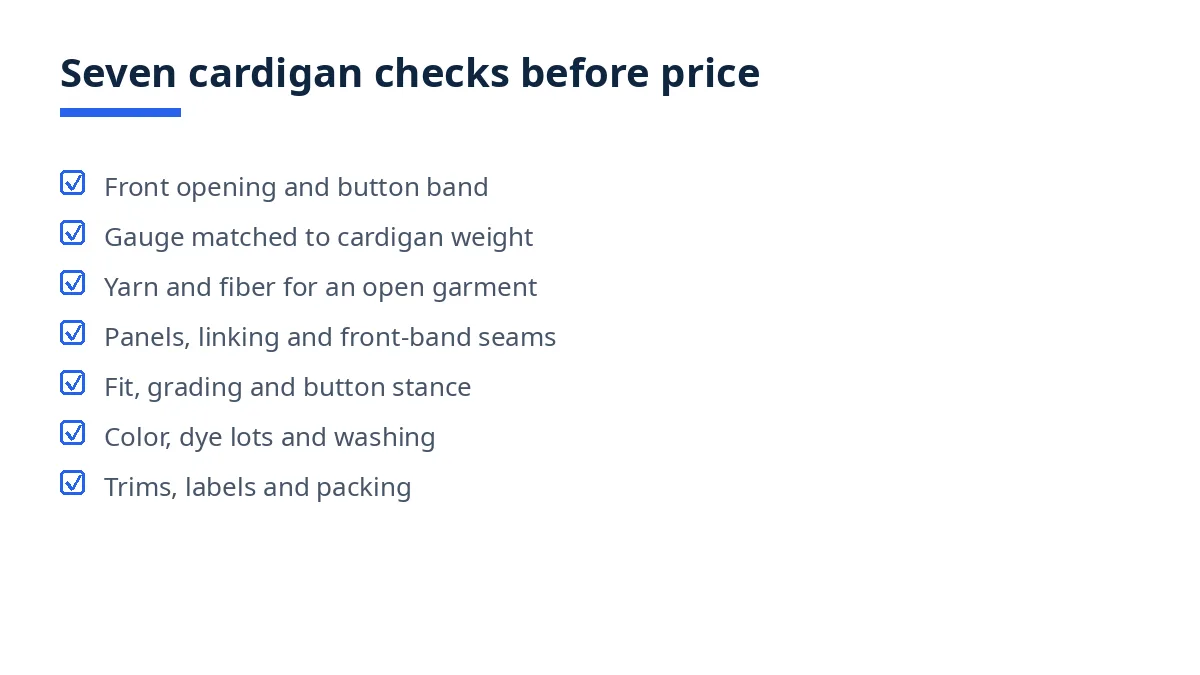
The seven items below are not companies and are not a ranking. Each is a construction check on the cardigan itself, with what it is, why it matters, and how to fix a failure before bulk production.
1. Front opening and button band
What it is. The button band, or placket, is the finished strip down the center front carrying the buttons on one side and the buttonholes on the other. It must stay flat and hold its width after washing.
Why it matters. The band takes the stress of every buttoning. A band that stretches, twists, or narrows after washing makes the fronts gape or overlap unevenly.
How to fix it. Specify the band width, button count, size, material and spacing, and the buttonhole type. Wash the sample buttoned as the care label directs, and measure it again. Check that spare buttons match the sewn buttons in size, color and material.
2. Gauge matched to cardigan weight and drape
What it is. Gauge is the needle density of the knitting machine, the number of knitting needles per inch, with lower numbers producing coarser stitches and higher numbers producing finer stitches.4 As a practical starting point, 3GG to 5GG is commonly used for chunky knitwear, 7GG to 10GG for mid-gauge products, and 12GG to 18GG for finer knitwear, although yarn, stitch structure and finishing still change the final fabric.4
Why it matters. Gauge sets the weight, drape and hand feel of the cardigan, and decides whether an open front hangs straight or pulls. A chunky open cardigan needs a gauge and yarn that hold the fronts apart without sagging.
How to fix it. State the gauge together with the yarn count, fiber and stitch structure, never as a number on its own. Ask for a knitted swatch in your gauge and yarn before a full sample, and judge it on a hanger as well as flat.
3. Yarn and fiber for a garment worn open
What it is. The yarn is the fiber, count and ply the cardigan is knitted from. The fiber blend decides warmth, weight, pilling, shrinkage and wash behavior. A cardigan worn open shows both faces of the fabric, the inside of the fronts, and the edges at the cuffs, hem and band, so yarn faults have nowhere to hide.
Why it matters. Pilling shows first at the front edges and cuffs, where the garment rubs during wear. Shrinkage and twisting show first at the two fronts, which must stay the same length as each other.
How to fix it. Name the fiber and blend percentages, the yarn count and ply, and the dye method. Wash the swatch and the sample as the care label directs, and check the front edges, cuffs and band for pilling, shrinkage and twist. OEKO-TEX STANDARD 100 testing covers all components of an article, including buttons, rivets and zips.5 Require the same yarn for bulk as for the approved sample.
4. Panels, linking and front-band seams
What it is. Panels are the knitted front, back and sleeve pieces. Linking joins them at the shoulders, armholes and side seams, with the front band attached along the center front.
Why it matters. An open front pulls at its joins every time it is put on and taken off. A weak link at the shoulder or armhole, or a band attached with uneven tension, opens under wear rather than at inspection. Ribbing that does not recover leaves the hem and cuffs stretched after the first wash.
How to fix it. Ask which joins are linked and which are sewn, and whether linking, washing and finishing are in-house or sent out. Inspect the sample inside and out: linking should be even, the band join should lie flat, and ribbing should spring back after a gentle stretch.
5. Fit, grading and button stance across sizes
What it is. Grading is the step-by-step change of measurements from one size to the next. Button stance is the position of the buttons down the front. Both must move with size: the V depth, body length, sleeve length and button positions for the smallest size are not the same as for the end sizes.
Why it matters. A cardigan graded only at the side seams, with button positions copied unchanged across sizes, gaps at the bust on larger sizes and pulls at the neck on smaller ones.
How to fix it. Specify the full measurement chart for every size, including button positions, V depth and body length. Require the sample in the smallest and end sizes as well as the middle size, and measure each sample after washing, buttoned, flat and on a hanger.
6. Color, dye lots and washing across two fronts
What it is. A dye lot is one batch of yarn or fabric dyed together, and shade is the color result of that batch. The left front, right front, sleeves and band must match each other.
Why it matters. Shade differences between panels are easy to miss on a single sample and obvious in a shipment, when hundreds of garments are laid out together.
How to fix it. Keep each color to one dye lot where the order allows, and approve the shade on the washed sample, not on the unwashed one. Check the two fronts, sleeves and band together in daylight, and check the buttons against the body after washing.
7. Trims, labels and packing for a garment with parts
What it is. Trims are the parts beyond the knitted panels: buttons, spare buttons, labels, care labels, hangtags and any zip or toggle. Packing is the folding and carton method that carries the cardigan to the buyer.
Why it matters. A cardigan has more parts to lose, mismatch or mislabel than a pullover. A missing spare button, a care label with the wrong washing instruction, or a front band creased across the buttonholes each turns into a customer return or a relabeling job.
How to fix it. List every trim with its material, size and color, including the number of spare buttons per garment and where they are attached. Check the label position, wording and care instruction on the sample.
Summary table
Check | What it proves | Fix before ordering |
|---|---|---|
Front opening and button band | The fronts meet, close and stay flat after washing | Band, buttons and buttonholes specified; sample washed buttoned |
Gauge and drape | The factory knits your cardigan weight | Gauge stated with yarn; swatch judged on a hanger |
Yarn and fiber | The open garment keeps its hand feel and edges | Fiber, count and ply named; swatch and sample washed |
Panels, linking and seams | The joins hold under daily wear | Linking method stated; sample checked inside and out |
Fit, grading and button stance | Every size closes and fits | Full size chart; end sizes measured after washing |
Color, dye lots and washing | The two fronts match in bulk | One dye lot per color; shade approved on the washed sample |
Trims, labels and packing | No part is missing, mismatched or mislabeled | Every trim listed; packing checked on the sample |
What sets the price and MOQ for a cardigan order
A cardigan quotation is built from parts, so compare quotes part by part instead of by the final number. Yarn is often the main cost, and a coarser gauge uses more yarn per garment than a fine gauge at the same size. The front opening adds the band, buttons and buttonholes, and the labor of finishing them. Quantity spreads the fixed costs of pattern work, dye lots and line setup over more pieces, which is why the unit price falls as quantity rises and why each style and color carries its own MOQ.
Example figures, for structure only: one style in one color needs one dye lot and one shade approval, while the same style in four colors needs four dye lots and four shade approvals, even at the same total quantity. That structure is why a supplier may accept a smaller quantity in one color and require more when colors multiply. Every price and MOQ is set per style by the supplier quoting your specification. Quote the same specification, Incoterm and packing from each supplier. For how MOQ works, read the guide to MOQ, or minimum order quantity.
How to check the evidence before you pay
Run the checks below in order, and keep the record in one thread.
Match names and addresses across every document. Check the company name and factory address on the BKMEA record, the quotation and the invoice against each other.2
Read what each Exportain badge actually covers. Exportain badges record which documents and photos its staff have reviewed, including identity, phone, email, business registration, the Export Registration Certificate (ERC) and factory or office photos.6 Verification is a document and photo review, not a factory inspection, and a badge is not a guarantee of production capacity, product quality or delivery.6 Membership never grants a badge.
Check certificates with the body that issued them. Get the number and issuing body, then check the holder, site, product scope and expiry date in the issuer's own record. OEKO-TEX STANDARD 100 certificates are valid for 12 months and can be renewed annually, so an out-of-date certificate is not a current claim.5
Approve a washed sample as a pair. Approve the pre-production sample in the exact production yarn, buttons and labels, in your sizes, washed and dried as the care label directs. Check the two fronts together, buttoned, for length, shade, band width and button alignment, and measure after washing. The cardigans quality control checklist turns these checks into steps for an inspector.
Agree the inspection standard and the order terms in writing. The acceptance quality limit (AQL) is the quality level that is the worst tolerable process average when a continuing series of lots is submitted for acceptance sampling, under ISO 2859-1.7 Set the inspection level, AQL values and accept and reject numbers in the order, and name who inspects and what happens on rejection. Put payment terms and the producing factory in the same written terms.
How Exportain helps
Exportain is a B2B marketplace for sourcing from Bangladesh. Buyers search published products, and suppliers answer requests for quotation (RFQs) against the buyer's specification. Profiles show badge checks, location, main products and declared certifications.6 A public RFQ never shows the buyer's name, company, message or target price.
Run the construction and evidence checks in this article on your shortlist. Keep the exchange in the RFQ thread. When you are ready, post an RFQ on Exportain and ask suppliers to quote your cardigan specification, quantity, destination and Incoterm, and compare the quotations on gauge, yarn, band construction and packing before you approve a sample.
FAQs
What is the biggest mistake?
Ordering a cardigan on a pullover specification. A specification naming only yarn and sizes leaves the opening, band and buttons to the factory's standard practice.
How can I avoid it?
Write one specification covering the opening type, band, buttons, gauge, yarn, stitch structure, size chart with button positions, labels and packing, and send the identical document to every supplier you quote. Approve a washed sample as a pair, in the end sizes, and set the inspection standard in writing before production starts. Require a new sample whenever the yarn, gauge or dye lot changes.
Who is responsible?
Both sides, at different points. The factory is responsible for making cardigans to the specification and the approved sample, . The buyer is responsible for making that specification complete and checkable, and for inspecting against it before shipment. Exportain's badge checks record document and photo reviews by its team; they do not take over the buyer's inspection or the factory's production responsibility.6
Where can I get help?
Start with the records that exist: BKMEA member listings for registration, the certificate issuer for any audit or fiber claim, and an inspection provider for the pre-shipment check.2 On Exportain, read what each badge covers, and message the supplier through its profile so your questions and answers stay in one thread.6
Next steps on Exportain
Browse Bangladeshi suppliers and filter by badge, MOQ and capability, then read how supplier verification works on Exportain to learn what each badge covers. When your specification is ready, post an RFQ with the opening, gauge, yarn and button details, and compare quotations on the same fields before you approve a sample.
Sources
- RMG exports rise 6.10pc to US$10.58b in July-Sept of FY27. The Financial Express, (accessed )
- BKMEA at a Glance. BKMEA (accessed )
- Cardigan Definition & Meaning. Britannica Dictionary (accessed )
- Sweater Knitting Gauge Guide: 3GG-18GG. KnitSeek (accessed )
- OEKO-TEX STANDARD 100 for textiles tested for harmful substances. Hohenstein (accessed )
- How Supplier Verification Works on Exportain. Exportain, (accessed )
- SIST ISO 2859-1:2003 - Sampling procedures for inspection by attributes, Part 1: Sampling schemes indexed by acceptance quality limit (AQL). International Organization for Standardization, (accessed )
About the author
Sourcing from Bangladesh?
Post a request for quotation and suppliers on Exportain can send you their quotes directly.
Post an RFQ