Handicrafts & Eco Products Sourcing Guide for Bangladesh
Handicraft exports were USD 32.13 million in FY2025-26 on the EPB fiscal-year series, down about 15 percent. This sourcing guide covers eco products and clusters, supplier checks, MOQ, pricing, compliance, Incoterms and duties for buyers.
Short answer
Bangladesh is a practical source for handwoven baskets, natural-fibre home decor, terracotta and handloom textiles, bought through exporters who aggregate home-based artisan networks. Buyers succeed by specifying material, construction and packing in writing, checking the exporter and its artisan map, sampling and testing production goods, and agreeing MOQ, itemised price, Incoterm and staged lead time per order.
On this page
Key takeaways
On the EPB fiscal-year series, handicraft exports fell to USD 32.13 million in FY2025-26, down about 15 percent from USD 37.68 million in FY2024-25, after USD 42.83 million in FY2021-22, USD 29.71 million in FY2022-23 and USD 34.96 million in FY2023-24.
The BBS 2022 survey counted 73,542 handicraft establishments, 97.6 percent household-based, engaging 148,656 people; women own 51.2 percent of establishments and make up 55.8 percent of the people engaged.
Bangladesh Bank's receipts series (USD 39.4 million for 2024-25) must never be blended with the EPB customs-based shipment series; the two differ by timing, valuation and coverage.
There is no industry-wide MOQ, price or lead time for handicrafts; all three are quoted per exporter, per product and per order against a written specification, with the artisan group setting the minimum.
For the EU, fibre labelling under Regulation (EU) No 1007/2011 and REACH Annex XVII Entry 72 chemical limits govern textile handicrafts, and environmental claims need material evidence behind them.
Bangladesh sells handicrafts and eco products made largely by hand from bamboo, cane, seagrass, hogla, jute, clay and handloom textiles. This sourcing guide is for importers, retailers, brands and sourcing agents in the United States, the United Kingdom, the European Union and the United Arab Emirates who buy baskets, home decor, tableware, textiles and similar goods from Bangladesh. It covers the latest export data, products and clusters, supplier checks, MOQ, pricing and lead times, compliance, shipping, Incoterms and duties, and a step-by-step buying process. In this guide, "eco products" means goods positioned on natural, plant-based or low-impact materials, such as bamboo, cane, seagrass, hogla, water hyacinth, jute and clay. That is a working scope for buying, not a certification: a product earns an eco claim only through the material evidence and labelling rules in the compliance section.
Market overview with latest data
Handicrafts are a small export line with a volatile recent record, and the first discipline for a buyer is to keep the statistical series separate. On the Export Promotion Bureau (EPB) fiscal-year series, which runs from July to June, handicraft export earnings were USD 42.83 million in FY2021-22, fell to USD 29.71 million in FY2022-23, recovered to USD 34.96 million in FY2023-24 and USD 37.68 million in FY2024-25, then fell again to USD 32.13 million in FY2025-26, a fall of about 15 percent on the year.1 The causes named for the FY2025-26 contraction are weaker global demand, rising input and freight costs, reduced cash incentives and limited access to finance, alongside limits in design and development, stronger regional competition and a growing scarcity of skilled workers.1 The recorded total understates handicrafts because not every line has a clean HS code, a point made by both BFTI and Banglacraft.2 3
Bangladesh Bank publishes a different number for an overlapping year, and the difference is methodological, not an error to average away. In its Annual Export Receipts for 2024-25, Bangladesh Bank records handicraft export receipts of USD 39.4 million, up 14.3 percent on the year before.4 That is a receipts series, recording foreign exchange as proceeds are received through authorised dealers. Bangladesh Bank states in the same publication that its receipts data may differ from customs-based data compiled by the Bangladesh Bureau of Statistics (BBS) and the EPB because shipment recording and receipt of proceeds happen on different dates, and because valuation and coverage differ.4 Use the EPB series for shipment trend and the Bangladesh Bank series for receipts, and never add them together or blend them into a single total. A third compilation points the same way: BFTI reports handicraft exports of US$29.75 million for FY2022-23, close to but not identical with the EPB figure of USD 29.71 million for the same year.2
The production base is household production, not factory production. The BBS Survey on Handicraft Establishment Bangladesh 2022, reported by BFTI, counted 73,542 establishments, of which 97.6 percent are household-based, engaging 148,656 people, 95.8 percent of them in household-based businesses.2 Women own 51.2 percent of establishments and make up 55.8 percent of the people engaged, and about 44 percent of establishments are bamboo and cane based.2 A Palli Karma-Sahayak Foundation (PKSF) workshop presentation in December 2025 gave the same picture in rounded form: around 148,000 artisans, 56 percent of them women, with 95.8 percent of production home-based.5 Your counterparty is therefore usually an exporter standing in front of a network of home-based artisans. Treat larger employment figures on association pages as the association's own: Banglacraft's page carries far higher employment claims than the BBS survey count, so use the BBS survey for capacity planning.3
Two wider figures need careful handling. Reporting in the Financial Express puts the global handicrafts market at around USD 1.1 trillion in 2024, projected to exceed USD 2.0 trillion by 2032, driven by demand for eco-friendly and sustainable products, and puts Bangladesh's share at only 1.18 percent.1 Estimates of the global market vary widely by definition, so this guide rests no buying decision on a global total. Banglacraft puts the domestic market at around Tk 10,000 crore and the export market at around 50 countries across North America, Europe and the Middle East.3 Those are the association's own figures.
Policy support exists but has thinned, and the incentive rate you hear depends on the speaker and the period. Handicrafts are a special development sector in the Export Policy 2021-24 and the National Industrial Policy 2022, while the National Handicraft Policy 2015 has not been implemented, according to BFTI.2 BFTI reports an 8 percent cash incentive under the Bangladesh Bank circular for FY2023-24, down from 20 percent in 2020.2 Banglacraft, speaking through the FY2025-26 reporting, says incentives have been slashed from 20 percent to 6.0 percent.1 The incentive is paid to the exporter, so ask which rate applies to your line and shipment date. Raw materials are the other pressure: cane and bamboo supply is declining, and producers are turning to hogla, water hyacinth, coconut fibre and date palm leaves.1
Main products and production clusters
Handicrafts do not sit in one chapter of the Harmonized System, because the system follows material and stage of manufacture. The core basketware chapter is Chapter 46, manufactures of straw, of esparto or of other plaiting materials; basketware and wickerwork. Its note defines plaiting materials to include straw, bamboos, rattans, rushes, reeds, strips of wood and strips of other vegetable material.6 Heading 46.01 covers plaits and similar products, including mats, matting and screens of vegetable materials, and heading 46.02 covers basketwork and wickerwork made directly to shape, including 4602.11 of bamboo, 4602.12 of rattan, 4602.19 of other vegetable materials and 4602.90 other.6 Beyond Chapter 46, jute bags and rugs, terracotta tiles, carpets and mats, and nakshi kantha classify in other chapters by material and construction.2 BFTI names insufficient HS code-wise identification among the sector's weaknesses.2 Agree the six-digit subheading with your supplier and broker before you order, because the heading decides the duty line at destination.
The product offer, grouped by material, is:
Product family | Typical Bangladesh products | Notes for buyers |
|---|---|---|
Bamboo and cane | Baskets, storage, trays, furniture components and mats under Chapter 46 | About 44 percent of BBS-surveyed establishments are bamboo and cane based, and supply of cane and bamboo is declining 2 1 |
Other natural fibres | Seagrass, hogla, water hyacinth, coconut fibre and date palm baskets, bags and home decor | The growth materials as cane and bamboo tighten; hogla is now a major raw material 1 |
Jute goods | Jute bags, rugs, carpets and mats | Read the jute pillar in Related guides; the two categories are counted separately |
Clay and terracotta | Terracotta handmade tiles, clay products and pottery | Fragile and heavy relative to value; packing decides the freight economics 2 |
Textiles | Nakshi kantha, jamdani, shataranji and handloom home textiles | Fibre-composition labelling applies on retail sale in the EU, covered in the compliance section 2 |
Mixed lifestyle goods | Metal crafts, stone carvings and lifestyle products from palm and banana fibres | Named in the EPB-based export basket reporting 1 |
For Chapter 46 goods, BFTI names Spain, the United Kingdom, Australia, Germany, France and Italy among the major destinations.2 Key export products named at the PKSF workshop were nakshi kantha, clay products, bamboo and cane crafts, jamdani, jute goods and terracotta, with major markets in the United States, Europe and the Middle East.5
Clusters in this industry are craft geographies, not industrial estates. SME mapping counts 38 handicraft clusters among the 177 SME clusters in Bangladesh.2 The craft belts described in current commentary are Narayanganj-Sonargaon for jamdani, Tangail for sarees, Sirajganj for handlooms, Rajshahi for silk, Rangpur for shataranji, and Sylhet and Jhalakathi for shital pati.7 Jamdani is UNESCO-listed and was Bangladesh's first Geographical Indication (GI) product, Tangail saree and Rajshahi silk hold GI status, shital pati is UNESCO-listed, and Rangpur shataranji has GI protection.7 Support institutions include the SME Foundation, the Jute Diversification Promotion Centre, the Joyeeta Foundation and BSCIC.2
Key players fall into three groups: exporters and aggregators that collect from artisan networks and run finishing, quality control and packing; Banglacraft, the association that speaks for the sector and publishes the sector data above;3 and the artisan base itself, the 73,542 establishments of the BBS survey.2 When a supplier calls itself a manufacturer, ask which stages it performs in its own unit and which sit with home-based artisans.
How to find and verify suppliers
Find suppliers through more than one channel so you can cross-check what an exporter tells you. Start with Banglacraft and the support institutions above, add Bangladesh export data and Exportain trade intelligence for market context, then work Bangladeshi suppliers listings by product family and material, and ask each candidate for its export markets and reference products in your heading.
Verification is a document exercise first and a visit exercise second. Ask for, and read, the following before you discuss price in detail:
Trade licence and export registration in the company's own name, and association membership where claimed.3
The production map behind the offer: which products are made by which artisan groups, in which districts, and which stages, such as dyeing, finishing and packing, are done in the exporter's own unit.2
Export history: anonymised bills of lading or shipment summaries for your target market, showing heading, product family and recency.
The raw material source for your product, stated by material, because cane and bamboo supply is declining and exporters are substituting hogla, water hyacinth and other fibres that change weight, strength and appearance.1
Sample-to-bulk controls: who inspects artisan output, against what written standard, and what rejection rate the exporter works to.
Test reports for the exact construction you plan to buy, including the chemical evidence in the compliance section where dyed textiles will touch skin.
On Exportain, read badges for what they are. Supplier profiles carry document and photo review badges: the badge records that documents and photos were reviewed by Exportain staff, verification is free, and membership never grants a badge.8 A badge is not a factory inspection, a certification or a guarantee. Exportain is a B2B marketplace and is not a party to the contract for goods between buyer and seller; it does not inspect goods, book freight or clear customs.8 Use the badge as a first filter, then run the document checks above yourself or through an inspection firm you appoint.
Two red flags end a conversation early: an exporter that quotes a firm bulk price before seeing your full specification is not pricing your product, and an exporter that cannot describe its artisan network has not answered the first capacity question.2
MOQ, pricing and lead times
There is no industry-wide MOQ, standard price or standard lead time for handicrafts from Bangladesh, and no official body publishes one. All three are quoted per exporter, per product and per order, against a written specification. What follows is how each of the three is built, so you can compare quotes on equal terms.
MOQ. The minimum order quantity is set by the production unit, which in this sector is the artisan group, not the machine. A basket order carries the minimum the exporter can place with a weaving group for one design, size and material; a nakshi kantha order carries the embroidery group's minimum per design and size; a dyed order carries the dye-lot minimum per colour. State your target quantity per product, size, design and colour in your enquiry and ask the exporter to quote its MOQ on the same basis.
Pricing. Your unit price is built from raw material, hand labour, dyeing and finishing where they apply, inspection and rejection allowance, packing, and export costs to the agreed Incoterm point. Two inputs are moving: cane and bamboo supply is declining, pushing substitution toward hogla, water hyacinth, coconut fibre and date palm, and production remains largely manual, which Banglacraft contrasts with competitors in China, Vietnam and India that use small tools alongside handwork.1 Compare quotes only at the same Incoterm, material and specification, and ask each exporter to state the material by name and the price-validity period in writing: a quote in seagrass and a quote in hogla are not the same product at two prices.
Example figures. For illustration only: a buyer specifies 5,000 seagrass storage baskets in two sizes, natural finish, packed 10 per carton. Supplier A quotes USD 4.20 per basket itemised as material and weaving USD 2.90, finishing and inspection USD 0.60, and packing and export costs USD 0.70. Supplier B quotes USD 3.60 per basket with no itemisation. The worked example totals are USD 21,000 from Supplier A and USD 18,000 from Supplier B. The example shows the method, not a market price: the buyer asks Supplier B for the same itemisation, and for the fibre and weave weight behind the quote, before treating the USD 3,000 gap as a saving, because an unitemised gap is usually a lighter weave, a substituted fibre or a skipped inspection step.
Lead times. A lead time is a chain, not a single number: raw material collection and preparation, weaving or making-up by artisan groups, dyeing and finishing where they apply, inspection and packing, then booking and transit. The first stage is the least predictable, because the material is gathered and prepared by hand and the workforce is dispersed across household units.2 Ask for the lead time broken into its stages, with the artisan-production stage stated separately, and agree what starts the clock, normally written order confirmation plus approved sample, not the first enquiry.
Quality, certifications and compliance
Quality in handicrafts is decided by three layers: the destination market's product law, the product-specific evidence your buyers require, and your own specification and testing. Write the specification so an inspector can measure it: material by name, weave or construction, dimensions and weight, colour and finish, stitch or join type where it applies, and packing into cartons with pieces per carton. Approve a pre-production sample and a counter-sample, inspect before cartons are closed, and test production goods, not showroom samples.
EU fibre labelling. Regulation (EU) No 1007/2011 governs textile fibre names and the labelling and marking of fibre composition for textile products placed on the EU market.9 In EU law, "jute" is the fibre obtained from the bast of Corchorus olitorius and Corchorus capsularis, and bast fibres from named related species, including Hibiscus cannabinus and Hibiscus sabdariffa, are treated in the same way as jute for fibre naming.9 A handloom textile, rug or home textile sold to consumers in the EU therefore needs its fibre composition stated with the fibre names the regulation lists, in the destination language set. Agree the label artwork at sampling stage, because a textile woven from a fibre blend cannot be labelled as a single pure fibre.
Chemical limits on dyed textiles. Where textiles will touch skin, the chemical file matters as much as the weave. Under the EU REACH Regulation, Annex XVII Entry 72 restricts carcinogenic, mutagenic or toxic for reproduction substances of category 1A or 1B in clothing, other textiles and footwear, including heavy metals, phthalates, polycyclic aromatic hydrocarbons, formaldehyde and certain azo dyes, and the restriction has applied since 1 November 2020.10 The published limits include extractable cadmium, chromium VI, arsenic and lead at 1 mg/kg each, benzene at 5 mg/kg, and formaldehyde at 75 mg/kg.10 Ask for a test report for the production batch against the entry that covers your product, and name the entry in the purchase specification rather than asking for a general statement that goods are chemical-safe.
Eco claims. An eco claim is a claim about a product, and buyers in the EU should expect it to be evidenced. The European Parliament adopted its position at first reading on 12 March 2024 on the proposed Green Claims Directive, which would require explicit environmental claims to be substantiated with reliable, comparable and verifiable information, assessed across the product life cycle without omitting relevant environmental aspects.11 The directive is a proposal, not a finished rule, but its direction is clear: name the material, state what part of the product the claim covers, and hold the evidence behind it. Do not accept "eco-friendly" on a hangtag as a substitute for a material declaration, and do not let a supplier transfer a claim from one material to a substituted one: a basket quoted in seagrass and delivered in hogla is a different product, whatever the label says.
Heritage marks. GI and UNESCO listings, covered in the clusters section, support origin storytelling and must not be used as quality marks.7 If a buyer wants to use a GI name on retail packaging, confirm the right to use it before printing, because the listing belongs to the origin, not to every shipment from the country.
Shipping, Incoterms and duties
Handicraft goods are bulky and fragile relative to value, so packing drives the freight economics. Confirm carton dimensions, pieces per carton, weight per carton and the packing method in the specification, because those numbers set your freight cost per unit under any Incoterm. State the load port in the order, for example Chattogram, and agree who books the freight and who carries the risk at each stage.
Incoterms® 2020 is the current edition of the ICC rules, in force since 1 January 2020. The rules are eleven three-letter trade terms that clarify the tasks, costs and risks involved in the delivery of goods from sellers to buyers, and they are recognised as the global standard for interpreting the most common terms in foreign trade.12 In your own words, the four rules you will meet most often on handicraft orders work as follows:
Rule | Who arranges and pays main freight | Where risk passes to the buyer | Practical note for handicrafts |
|---|---|---|---|
EXW (Ex Works) | Buyer | At the seller's premises | Buyer carries export clearance workload; rarely suitable for a first order |
FOB (Free On Board) | Buyer | When goods are on board the vessel at the named loading port | The common Bangladesh term; name the port, for example FOB Chattogram, Incoterms® 2020 |
CIF (Cost, Insurance and Freight) | Seller, plus minimum insurance | When goods are on board at the loading port | Seller's freight is convenient, but risk still passes at loading, not at arrival |
DAP (Delivered at Place) | Seller | At the named destination place, ready for unloading | Buyer still clears import and pays duty unless the contract says otherwise |
Always write the rule with its named place and edition, for example "FOB Chattogram, Incoterms® 2020". Exportain does not book freight or clear customs, so the freight forwarder and customs broker are separate appointments to name in the order paperwork.8
Duties are decided by the heading from the products table, the origin of the goods and the destination's preference scheme, in that order. As a least developed country, Bangladesh benefits from the Everything But Arms (EBA) arrangement under the EU's Generalised Scheme of Preferences, which grants duty-free, quota-free access to the EU for exports of all products except arms and ammunition, and 91 percent of Bangladesh's exports to the EU enter duty- and quota-free.13 Bangladesh is the largest beneficiary under the EBA arrangements, with EUR 19 billion in exports benefitting from these preferences in 2024 at a 96 percent utilisation rate.13 Handicraft goods that meet the EBA rules of origin and are shipped with the required proof of origin therefore enter the EU without customs duty while Bangladesh holds that status. Two cautions apply. First, preference is a property of the consignment, not the country: if the origin evidence fails, the standard third-country duty for the heading applies. Second, EBA is an EU scheme: for the United States, the United Kingdom and the UAE, read the duty beside your confirmed six-digit code in the destination tariff for the entry date; this guide states no rate for them.
Step-by-step buying process
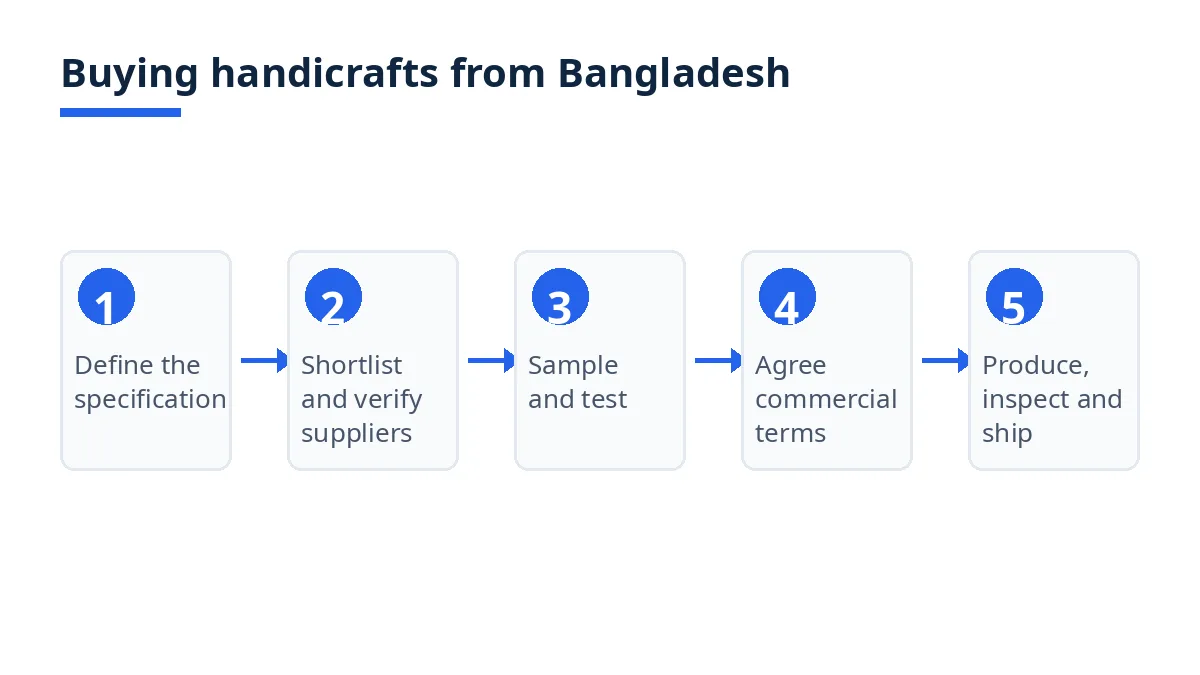
Define the specification. Write the product before you shop for it: HS heading, material by name, construction and dimensions, colour and finish, packing, target quantity per product, size and design, and destination market.
Shortlist and verify suppliers. Build a shortlist from association lists and supplier listings, confirm which stages sit with the exporter and which sit with artisan groups, then run the document checks in the verification section.3 8
Sample and test. Order samples against the specification, test production-representative goods for fibre composition and chemical limits where they apply, and approve a counter-sample in writing.9 10
Agree commercial terms in writing. Fix MOQ per product, size and design, itemised unit price with its validity period, the Incoterm with its named place, the staged lead time and its start point, payment terms and the inspection point, all in the purchase order.12
Produce, inspect and ship. Monitor the artisan-production stage first, inspect finished goods against the approved counter-sample and specification, then ship with the origin evidence your duty position depends on.13
Related guides (links to cluster articles)
Read the handicrafts industry in Bangladesh pillar for the category data, the jute products industry in Bangladesh pillar for the neighbouring jute category, and the home textiles industry in Bangladesh pillar for handloom home textiles. Read how to import from Bangladesh for the general import sequence behind the steps above, the Incoterms guide for shipments from Bangladesh for the delivery terms in more detail, and Bangladesh export data for category scale.
FAQs
Is Bangladesh a good place to source handicrafts & eco products?
Bangladesh is a credible sourcing option for handwoven baskets, natural-fibre home decor, terracotta and handloom textiles where the specification, material and compliance file are managed actively. The country holds 73,542 handicraft establishments, 97.6 percent of them household-based, and exported USD 32.13 million of handicrafts in FY2025-26 on the EPB fiscal-year series.2 1 The constraints to price in are the fall from USD 37.68 million the year before, declining cane and bamboo supply, thin design and finance support, and stronger regional competition.1 Source exporter by exporter, not on the country label.
What is the typical MOQ?
There is no published typical MOQ for handicrafts from Bangladesh, and no official body sets one. Each exporter quotes its MOQ from its production unit: a weaving group's minimum per basket design, size and material, an embroidery group's minimum per design and size, or a dye-lot minimum per colour. State your target quantity on the same basis in your enquiry.
How long is the lead time?
There is no standard lead time: yours is the sum of its stages, raw material collection and preparation, artisan weaving or making-up, dyeing and finishing where they apply, inspection and packing, and transit. The artisan stage is the least predictable, because production sits in dispersed household units.2 Ask for the stages separately and agree in writing what starts the clock, normally written order confirmation plus approved sample.
Which certifications matter?
The requirements that matter are the ones your destination market and your buyers require for the exact product. For the EU, fibre composition labelling under Regulation (EU) No 1007/2011 is a legal requirement for textile products, using the regulation's fibre names.9 For textiles that touch skin, the REACH Annex XVII Entry 72 limits on CMR substances apply, including formaldehyde at 75 mg/kg.10 Environmental claims need material evidence behind them, and the proposed Green Claims Directive points toward life-cycle substantiation for explicit claims.11 Buyers may also name management, environmental or social audits in their own vendor manuals; those audits sit on top of the legal file and do not replace it.
Next steps on Exportain
Browse Bangladeshi suppliers by handicraft product family and material, use Exportain trade intelligence to check the market picture behind this guide, and post a free RFQ at Exportain RFQs with your specification, target quantity and destination market so Bangladeshi suppliers can quote against the same written brief.
Sources
- FY26 handicraft exports fall 15pc amid weak demand. The Financial Express, (accessed )
- Handicraft sector of Bangladesh: employment, exports and policy support. Bangladesh Foreign Trade Institute (accessed )
- Handicrafts advancement and export potentiality from Bangladesh. Bangladesh Handicrafts Manufacturers and Exporters Association (Banglacraft) (accessed )
- Annual Export Receipts of Goods and Services 2024-25. Bangladesh Bank (accessed )
- Strategic policy measures needed to tap billion-dollar global handicrafts market: Speakers. Bangladesh Sangbad Sangstha (BSS), (accessed )
- Chapter 46: Manufactures of straw, of esparto or of other plaiting materials; basketware and wickerwork. Sri Lanka Customs (accessed )
- Accelerating artisanal economy. New Age (accessed )
- Supplier verification: Earn trust badges buyers can see. Exportain (accessed )
- Regulation (EU) No 1007/2011 on textile fibre names and related labelling and marking of the fibre composition of textile products. European Union, (accessed )
- Restriction on CMRs in clothing, textiles and footwear published. TÜV SÜD (accessed )
- Position of the European Parliament on the proposed Green Claims Directive. European Parliament, EUR-Lex, (accessed )
- Incoterms® rules. International Chamber of Commerce (ICC) (accessed )
- EU trade relations with Bangladesh. European Commission, (accessed )
- Incoterms
- quality control
- Bangladesh Export Data
- Category Pillars
- Supplier Sourcing
- Handicrafts Bangladesh
- Eco products
About the author
Sourcing from Bangladesh?
Post a request for quotation and suppliers on Exportain can send you their quotes directly.
Post an RFQ