

Shipping FOB From Bangladesh: How It Works, Costs and Pitfalls
FOB shipping from Bangladesh means the seller loads your goods on board the vessel you nominate at Chattogram or Mongla. This guide follows that loading sequence, who books what, and the mistakes that leave cargo waiting at the port.
Short answer
Under FOB shipping from Bangladesh, the seller delivers the goods loaded on board the vessel the buyer nominates at the named port of shipment, such as Chattogram, after export clearance. The buyer contracts the carrier and pays ocean freight, and risk passes at loading. FOB applies only to sea and inland waterway transport. Most export cargo moves through an inland container depot, where it is stuffed, sealed, and weighed before loading.
On this page
Key takeaways
FOB shipping from Bangladesh requires one named port of shipment and a vessel the buyer nominates in time; the seller loads the goods on board after export clearance.
The buyer contracts the carrier and pays ocean freight, while the seller covers inland movement, depot handling, export clearance, and loading.
Nothing is loaded or stuffed for export until the Bill of Export is submitted to Customs and approved.
A packed container is not loaded without a verified gross mass filed before the carrier cut-off, and FOB never applies to air freight.
FOB shipping from Bangladesh is a sea shipment in which the seller delivers your goods loaded on board the vessel you nominate, at the named port of shipment, after clearing them for export. The buyer contracts the carrier, pays the ocean freight, and takes the risk once the goods are on board. This guide follows that single movement, from the factory gate to the vessel, so you can see who must act at each point and where a shipment stalls.
FOB stands for Free On Board. It is one of the Incoterms 2020 rules published by the International Chamber of Commerce (ICC), and it applies only to sea and inland waterway transport. The FOB meaning guide explains the term itself; this article stays with the operation.
The short version
Name one port of shipment and one vessel nomination window in the contract. "FOB Bangladesh" names no port and settles nothing.
The buyer nominates the vessel and contracts the carrier. The seller moves the goods to the port, clears them for export, and loads them on board.
Nothing is loaded or stuffed for export until the Bill of Export is submitted and approved by Customs.
Most export cargo for Chattogram passes through a private inland container depot (ICD), where it is stuffed, sealed, weighed, and moved to the port for loading.
A packed container is not loaded without a verified gross mass (VGM). File it before the carrier cut-off, not at the gate.
Why this matters for buyers and sellers
FOB divides control at the vessel. The seller controls everything up to loading: production, packing, inland movement, export clearance, and loading. The buyer controls everything from the vessel onward: the carrier contract, freight, insurance, and import clearance. Under FOB, the buyer must inform the seller in time of the vessel name and the specific loading place and point within the port.1 If the buyer fails to do so and the goods cannot be loaded, the risk passes to the buyer, and so do the added costs.1
For the seller, FOB is a promise about readiness: goods at the named port, cleared for export, inside the agreed period, ready for the nominated vessel. For the buyer, it is a promise about information. The ICC Academy notes that if the nominated vessel is delayed and the seller cannot load at the agreed time, the buyer bears the risk and cost of storage at the port until the vessel arrives.1 Check before signing that the booking, vessel schedule, and cut-off dates fit the production date. See the Incoterms guide for shipments from Bangladesh for how FOB sits beside the other rules used on the same routes.
Step-by-step: how FOB shipping from Bangladesh works
The sequence below is the normal container movement for an FOB shipment out of Bangladesh. Bulk cargo follows the same nomination and loading logic, but it is delivered to the vessel rather than stuffed at a depot.
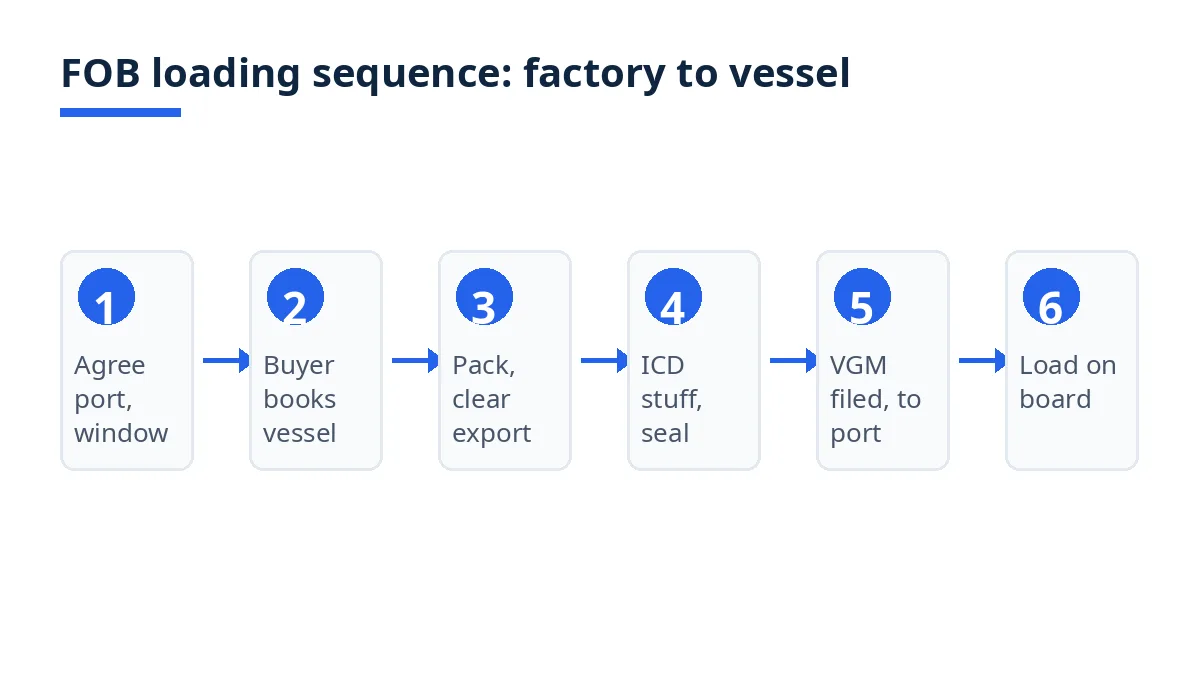
Agree the named port, the term, and the nomination window. Write "FOB Chattogram, Incoterms 2020", never "FOB Bangladesh". Add the delivery date or period, the deadline for naming the vessel, and who pays storage if the vessel is late.
The buyer contracts the carrier and books the space. The buyer, directly or through a forwarder, contracts the carrier and pays the freight to the port of destination.1 Send the vessel name and loading point to the seller at once.
The seller prepares, packs, and marks the goods. Marks, carton counts, and weights on the packing list must match the goods, because the packing list is enclosed with the Bill of Export.2 Agree inspection, if any, before the goods leave the factory.
Export clearance is completed before loading. Goods must not be loaded or stuffed for export unless the Bill of Export is submitted to Customs and approved.2 The declaration specifies the goods, value, exporter, foreign buyer, and transport operator.2 The seller, usually through a clearing and forwarding (C&F) agent, handles this step.
The goods move to an inland container depot and are stuffed and sealed. Export goods bound for Chattogram Port must first be taken to ICDs for loading into containers, and once ship schedules are confirmed, containers move from the depots to the port hook points for loading.3 Record the container and seal numbers against the shipment.
The verified gross mass is filed and the container moves to the port. The shipper named on the bill of lading is responsible for the VGM: the total verified weight of the packed container, including cargo, packaging and securing material, and container tare weight.4 A packed container will not be loaded unless the VGM has been provided in time to prepare the stowage plan.4 Confirm the carrier VGM cut-off in writing; it is a separate deadline from cargo gate-in.
The container is loaded on board and the buyer takes over. The seller delivers the goods loaded on board the vessel nominated by the buyer, and at that point the risk of loss or damage transfers to the buyer.1 From loading onward, the buyer bears freight, insurance, and import formalities.1
In container trade, the seller often delivers the container to a terminal days before the vessel loads it. The ICC Academy notes that FCA (Free Carrier) is then the more appropriate rule, because FOB delivery is defined by loading on board.1 If the carrier takes the container at a depot or terminal, discuss FCA before signing FOB.
Costs, timelines and documents
What are the typical costs and timelines?
There is no typical FOB freight cost or transit time a guide can state as fact. The seller side is built from the factory price plus pre-loading steps: inland transport, depot handling, export clearance handling, and loading. The buyer side starts at loading: ocean freight, insurance, destination charges, import clearance, and onward transport. For the full journey cost after loading, see the landed cost guide.
Cost area | Paid by | Notes |
|---|---|---|
Production and export packing | Seller | Part of the FOB price |
Inland transport to the port or depot | Seller | Seller arranges movement to the named port |
Export clearance handling | Seller | Seller completes the export formalities |
Depot handling, stuffing, and sealing | Seller | Agree who pays depot storage if the vessel is late |
Loading on board the vessel | Seller | The FOB delivery point |
Ocean freight to destination | Buyer | Buyer contracts the carrier |
Marine insurance | Buyer to arrange | No insurance obligation under FOB; arrange cover before loading |
Import clearance, duties, and onward transport | Buyer | Buyer handles import formalities |
Example figures: a seller builds an FOB price as a factory price of 100 units plus 8 units for inland transport, depot handling, export clearance handling, and loading, giving an FOB price of 108 units. The units are illustrative only, and they exclude ocean freight, which the buyer pays separately.
Manage timelines by deadlines: nomination, Bill of Export approval, VGM cut-off, gate-in, and vessel cut-off, each confirmed in writing.
Which documents are needed?
The clearance set enclosed with the Bill of Export includes the export letter of credit, or the export contract, purchase order, or export guarantee where there is no letter of credit, the commercial invoice, the packing list, the EXP form certified by an Authorized Dealer, the certificate of origin issued by the Export Promotion Bureau (EPB) or a Chamber of Commerce and Industry, the VAT registration certificate, and the Taxpayer Identification Number.2 Some products need added certification, such as a phytosanitary certificate for agricultural goods.2 Beyond clearance, hold the booking confirmation, VGM declaration, seal record, and on-board bill of lading. The full checklist is in the documents required for FOB shipments guide.
Bangladesh-specific rules and tips
Start from the port. Chattogram is Bangladesh's main seaport, handling around 90% of the country's seaborne import and export trade.5 Most export cargo for Chattogram moves through private ICDs rather than straight to the quay: 19 private ICDs handle about 95% of the country's export shipments.3
Allow time at peak periods. In March 2025, the ICDs housed 14,516 TEUs of export containers after a pre-holiday surge, against a stated collective capacity of 10,000 TEUs, and some covered vans waited two to three days to unload against a typical 8 to 12 hours.3 Send goods to the depot with time to spare before the vessel cut-off.
Check the customs hold position early. Chattogram Port's terminal operating system is connected to the National Board of Revenue's ASYCUDA World system, and a customs hold or block on a container appears in the port system and stops further processing until clearance is given.5 Ask the C&F agent to confirm the Bill of Export position and any hold before the container leaves the depot.
Name Mongla only when you mean Mongla. If the contract names Mongla, every later step follows that port: the stuffing point, the vessel call, and the loading point. The port in the contract, the booking, and the bill of lading must match.
Never write FOB for air freight. FOB applies only to sea and inland waterway transport.1 A shipment by air from Dhaka airport cannot be an FOB shipment. The Dhaka airport wording appears here only as an invalid example. For air cargo, use FCA. The FOB for air freight guide sets out the rule and the FCA alternative.
Keep one set of numbers across the papers. The Bill of Export names the exporter, foreign buyer, and transport operator, and describes the goods and value.2 The invoice, packing list, VGM declaration, and bill of lading should carry the same names, counts, weights, and container and seal numbers.
Mistakes and red flags
What are the most common mistakes?
Naming no port. "FOB Bangladesh" leaves the port open. Name the port, and the loading point within it once the buyer confirms it.
Naming the vessel late. Late notice that leaves goods unloaded can shift risk and costs to the buyer.1 Put the notice deadline in the contract.
Assuming the seller booked the freight. Under FOB the buyer contracts the carrier and pays the freight.1 Confirm the booking number exists before goods leave the factory.
Using FOB for a terminal handover. When the carrier takes the container days before loading, FCA fits the handover better.1 Agree the rule that matches the actual handover, in writing.
Filing the VGM late. The container is not loaded without a verified gross mass.4 Confirm the VGM cut-off separately from gate-in.
Treating clearance as a formality. The Bill of Export must be approved before loading or stuffing.2 A missing EXP form or wrong certificate issuer holds the shipment where it costs most time to fix.
Leaving insurance to chance. Risk passes to the buyer at loading, and neither party is obliged to insure under FOB. Arrange cover to attach at loading.
Accepting "FOB Dhaka airport" on any paper. FOB cannot apply to air freight.1 Have the wording corrected to FCA and reissued before payment or booking.
Checklist
Named port of shipment, Incoterms 2020 version, and loading point in the contract.
Vessel nomination deadline agreed; buyer to give the vessel name and loading point in time.1
Carrier booking made by the buyer, with vessel, voyage, and cut-off dates confirmed.
Packing list, invoice, and marks checked against the goods before movement.
Bill of Export submitted with the full enclosure set; approval confirmed before stuffing or loading.2
Depot, stuffing date, container number, and seal number recorded and shared.
VGM filed by the shipper named on the bill of lading, before the carrier cut-off.4
Marine insurance arranged to attach at loading.
On-board bill of lading checked against the booking, invoice, and packing list.
Storage and rebooking responsibility agreed for a late vessel, missed cut-off, or customs hold.
How Exportain helps
Post a request for quotation (RFQ) on the RFQ board and state quantity and unit, destination, Incoterm, required certifications, and deadline, so suppliers quote against the same terms.6 State the port of shipment and vessel nomination window in the RFQ. A quotation that says only "FOB" without a port cannot be compared with one naming Chattogram.
Compare quotations on the same term and port. Every quotation on Exportain is versioned, showing unit price, MOQ, lead time, Incoterm, payment terms, and validity, and accepting one creates an order record with those terms.6 Agree inspection and shipment conditions in writing first. For freight and inspection, request quotes from listed freight, customs, and inspection providers.6
Read badges for what they record. Verification on Exportain is a document and photo review by staff, not a factory inspection, and membership plans never grant a badge.7 A badge is not a capacity or quality guarantee. Exportain is not a party to the contract for the goods, and it does not book freight or clear customs. The FOB operation is carried out by the seller, buyer, carrier, C&F agent, and port; Exportain's part is the introduction, the quotation record, and the order record.
FAQs
What should I know first about FOB shipping from Bangladesh?
The seller loads the goods on board the vessel you nominate at the named port, after export clearance, and risk passes to you at loading.1 FOB applies only to sea and inland waterway transport.
What are the typical costs and timelines for FOB shipping from Bangladesh?
There are no typical freight costs or transit times to quote. The seller side covers packing, inland movement, depot handling, clearance handling, and loading; the buyer side starts at loading with freight, insurance, and import costs. Manage the shipment by the nomination, VGM, and gate-in cut-offs in writing.
Which documents are needed for an FOB shipment from Bangladesh?
The clearance set includes the export letter of credit or contract, commercial invoice, packing list, EXP form, certificate of origin, VAT registration certificate, and Taxpayer Identification Number.2 Also hold the booking confirmation, VGM declaration, seal record, and on-board bill of lading.
What are the most common mistakes in FOB shipping from Bangladesh?
Naming no port, naming the vessel late, assuming the seller booked the freight, using FOB for a terminal handover or air freight, filing the VGM late, and leaving insurance unarranged. Fix each one in the contract or booking before the goods move.
Next steps on Exportain
Post your port of shipment, vessel nomination window, and delivery term on the RFQ board so suppliers quote on the same FOB basis, then read how to buy for the eight steps from search to shipment. Before you sign, check the FOB meaning guide and the FOB for air freight guide so the contract term matches the transport mode.
Sources
- FOB & FAS Incoterms® 2020 explained: Key differences. ICC Academy (accessed )
- Customs Clearance Procedures for Export. Bangladesh Customs, National Board of Revenue (accessed )
- Pre-Eid export surge overwhelms Ctg inland container depots. The Business Standard (accessed )
- VGM (Verified Gross Mass): SOLAS Rules, Methods and Deadlines. GoFreight (accessed )
- Chattogram Port moves closer to paperless operations with automated cargo release. The Business Standard (accessed )
- How to source and buy from Bangladesh. Exportain (accessed )
- Supplier verification: Earn trust badges buyers can see. Exportain (accessed )
About the author
Sourcing from Bangladesh?
Post a request for quotation and suppliers on Exportain can send you their quotes directly.
Post an RFQ


