How to Choose the Named Place for FOB Correctly: Port Rules
FOB needs a named port of shipment, not a country, city or airport. How to choose between Chattogram, Mongla and Payra, agree the loading point, and write the line so delivery, risk and cost are fixed.
Short answer
Under FOB, the named place must be a port of shipment, written as FOB [named port], Incoterms 2020. It fixes delivery on board the vessel, risk transfer, and the point where the seller stops paying. Choose the port the buyer's carrier serves, agree the loading point inside the port and the vessel nomination deadline, and use the same line in every document. A named airport, factory or terminal cannot be an FOB named place; those cases use FCA.
On this page
Key takeaways
FOB requires a named port of shipment: the seller delivers the goods on board the vessel nominated by the buyer at that port, and risk passes on board.
A named airport, factory or container terminal cannot be an FOB named place; air freight and terminal or factory handovers use FCA.
Chattogram is Bangladesh's main seaport, Mongla is the south-western seaport, and Payra is the third seaport; name only a port the buyer's carrier serves.
Agree the loading point inside the port and the vessel nomination deadline with the named port, because a late nomination can shift risk and added costs to the buyer.
Write 'FOB [named port], Incoterms 2020' once and mirror the same port, loading point and edition in the quotation, purchase order, RFQ and booking instruction.
A quotation line reads "FOB Bangladesh" and the price looks right. The line names no port, so it does not say where the seller must load the goods, where risk passes to you, or where the seller stops paying. A buyer who accepts that line has agreed a price without agreeing the delivery point that gives the price its meaning.
This guide is for a buyer who has decided to buy on FOB terms and now has to name the place: what the named place fixes, how to choose between the ports in Bangladesh, and how to write the line.
What the named place fixes under FOB
FOB, or Free On Board, is one of the 11 rules in Incoterms 2020, and the rules give a clear allocation of cost, risk and obligations for each rule.1 Under FOB the seller delivers the goods loaded on board the vessel nominated by the buyer at the named port of shipment, having cleared them for export, and the risk of loss or damage passes to the buyer when the goods are on board.2 FOB applies only to sea and inland waterway transport.2
The named place in an FOB line is therefore a port of shipment, not a city, a factory or a terminal. The full form is "FOB [named port of shipment], Incoterms 2020", as in "FOB Chattogram, Incoterms 2020".3 Written that way, the one line fixes the delivery point, the risk transfer point, the cost split point, the carrier booking and the export clearance point.
Valid and invalid names for an FOB line
A name is valid for FOB only when it identifies a port where a vessel can take the goods on board.
Name in the line | Status for FOB |
|---|---|
FOB Chattogram, Incoterms 2020 | Valid seaport. |
FOB Mongla, Incoterms 2020 | Valid seaport. |
FOB Bangladesh, Incoterms 2020 | Vague, do not use: Bangladesh is a country, not a port. |
FOB Dhaka, Incoterms 2020 | Invalid as written: Dhaka is an inland city with no seaport, so no port of shipment is named. |
FOB Dhaka airport, Incoterms 2020 | Invalid, do not use: a named airport cannot be an FOB named place. Use FCA for air freight. |
FOB seller factory, Incoterms 2020 | Invalid as written: the factory is not a port. Use FCA for a factory handover. |
FOB container terminal, Incoterms 2020 | Invalid as written: handover at a terminal happens before loading. Use FCA for a terminal handover. |
FOB Origin or FOB Destination | Not Incoterms, do not use: these are United States domestic accounting terms, not Incoterms rules. |
The airport, factory and terminal rows appear on real quotations and cannot be fixed by adding a date. A seller who writes "FOB Dhaka airport" has written a line that cannot be performed as FOB. The correction is to change the rule to FCA and name the place where the carrier takes the goods. See the guide to FOB for air freight before accepting any FOB line for cargo that flies.
Chattogram or Mongla: choosing the port in Bangladesh
Bangladesh has three seaports. Make the choice with the carrier, not by copying a previous order.
Seaport | Location | Confirm before naming it |
|---|---|---|
Chattogram | The main seaport of Bangladesh, on the bank of the Karnaphuli River, managed by the Chittagong Port Authority.4 | Vessel calls and loading point for the buyer's carrier. |
Mongla | One of the three seaports of Bangladesh, in the south-west at the confluence of the Pashur River and Mongla Nulla, about 71 nautical miles upstream of the Bay of Bengal.4 | Vessel calls and whether the carrier serves Mongla. |
Payra | The third seaport of Bangladesh, in Kalapara Upazila of Patuakhali District, which started its journey as the third seaport in 2013.4 | Current vessel calls and handling for the cargo type. |
No throughput or capacity figure is used in this guide, because port figures change and a stale figure would mislead a port choice. Ask the carrier for the current sailing schedule and the seller for the inland route to each candidate port.
Four questions decide between Chattogram and Mongla. First, where is the factory. Goods made near Dhaka, Gazipur or Narayanganj usually travel to Chattogram, and goods made near Khulna or Jashore may travel more directly to Mongla, but factory location alone does not decide the port. Second, which port does the buyer's carrier serve. Under FOB the buyer contracts the carrier, so a port the carrier does not call at cannot be the named port. Third, what cargo type is moving. Bulk cargo loaded directly on board fits FOB cleanly, while containerised cargo handed to a carrier at a terminal days before loading fits FCA better.2 Fourth, what is the loading point inside the port. Agree the terminal or berth area with the carrier and the seller, and record it with the named port.2
Step-by-step: how to choose and write the named place
Work through the steps in order, and do not skip the carrier check.
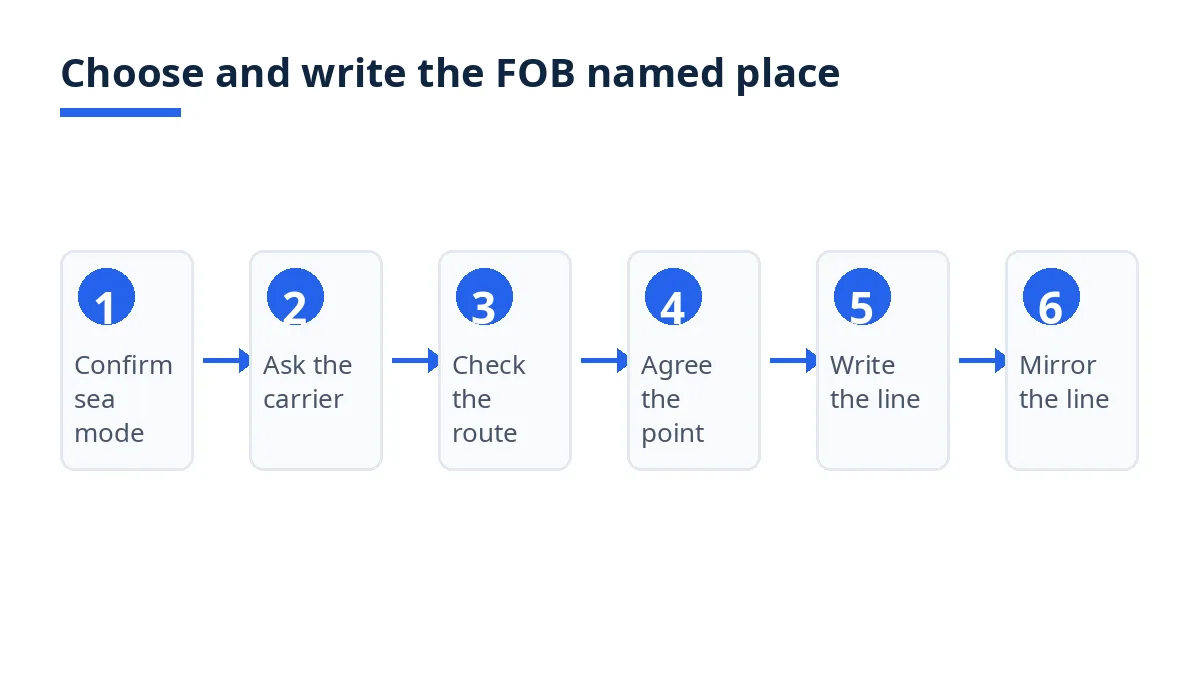
Confirm the mode is sea or inland waterway. If the cargo flies, moves by road or rail only, or is handed to a carrier at a factory or terminal, stop and use FCA.
Shortlist one or two ports with the carrier. Ask which ports the buyer's carrier serves on the sailings needed, and what loading point inside each port applies. Keep the answer in writing.
Check the inland route with the seller. Ask which port the factory normally ships from and what inland route applies.
Agree the loading point and the nomination deadline. Agree the terminal or loading point the vessel will use, and the date by which the buyer will nominate the vessel. The buyer must inform the seller in time of the vessel name and the specific loading place and point within the port.2
Write the full line in one place. Write "FOB [named port], Incoterms 2020" in the purchase order or sales contract, with the loading point and nomination deadline in the same clause. The written form used in trade is "FOB [named port of shipment], Incoterms 2020".3
Mirror the line everywhere it appears. Copy the same port, loading point and edition into the quotation, purchase order, RFQ, booking instruction and bill of lading instruction.
Why a vague or wrong named place costs money
A vague named place moves the argument to the moment when the goods are ready and the vessel is not, when storage, rebooking and damage claims cost more than a clear line would have cost at the quotation stage.
If the line names no port, the parties have no agreed on-board point, so a claim for damage during the inland leg or at a terminal has no agreed answer. If the buyer fails to nominate the vessel in time and the goods cannot be loaded, risk and added costs pass to the buyer, and if the nominated ship is delayed, the buyer bears the risk and cost of storage at the port until the vessel arrives.2
Quotations on different named ports cannot be compared by price alone. Two FOB quotations for the same goods, one named Chattogram and one named Mongla, carry different inland routes, terminal handling and ocean legs. The lower FOB price may simply reflect a shorter inland leg, while the buyer pays the difference in freight after loading. Compare quotations only when the named port, loading point and edition match. For the full price picture, read the landed cost guide.
Insurance follows the named point, not the factory gate. FOB imposes no insurance obligation on either party, so a buyer who wants cover must arrange it for the leg the buyer bears.3
Costs, timelines and documents that follow from the named port
The named port does not change the FOB cost split, but it decides where the split falls. The seller pays export packaging, export clearance, inland transport to the origin port, origin terminal handling and loading on board, and the buyer pays ocean freight, insurance where arranged, import clearance, duties and destination inland transport.3
There are no typical costs or timelines a guide can state as fact for a named port choice. Freight, handling and storage depend on the carrier, the sailing, the cargo and the season, and every figure must come from a current quotation for the named port pair. Ask for each cost as a separate line, and ask whether origin terminal handling is inside the FOB price or billed separately.
The dates that matter are the vessel nomination deadline, the cargo closing time and the sailing date, all tied to the named port. For ocean imports into the United States, the Importer Security Filing must be filed 24 hours before vessel loading at origin, and that filing is the buyer's responsibility under FOB.3
Documents follow the delivery point. Under FOB the seller provides the commercial invoice, packing list, bill of lading issued once cargo is on board, export clearance documentation and a certificate of origin where required.3 The buyer handles the freight contract, insurance certificate where cover was purchased, Importer Security Filing for United States imports, import clearance documentation, and customs entry and duty payment.3 Check that the port of loading on the bill of lading matches the named port in the contract.
Mistakes and red flags
Each mistake below is a named-place mistake.
Naming a country instead of a port. Reject "FOB Bangladesh". Use "FOB Chattogram, Incoterms 2020" or "FOB Mongla, Incoterms 2020", with the loading point recorded alongside it.
Naming an airport, a factory or a terminal as an FOB place. Reject "FOB Dhaka airport", "FOB factory" and "FOB container terminal". Use FCA and name the place where the carrier takes the goods.
Using FOB Origin or FOB Destination. Reject both terms on an international order. They are United States domestic accounting terms and are not Incoterms.3
Naming a port the carrier does not serve. Reject any named port agreed before the carrier confirms the sailing.
Naming the port but not the point or the deadline. Reject "FOB Chattogram" with no loading point and no nomination deadline.2
Letting documents carry different port names. Mirror one port name, loading point and edition in every document. See the FOB contract clause guide for how the clause should read in full.
Checklist
Use this checklist before the booking is made.
The mode is sea or inland waterway, and the cargo is delivered on board a vessel. If not, the rule is FCA, not FOB.
The line reads "FOB [named port], Incoterms 2020", with a named seaport, not a country, city, airport, factory or terminal.
The carrier has confirmed vessel calls at the named port, and the loading point inside the port is agreed.
The buyer has a nomination deadline for the vessel name and loading point, dated before the cargo closing time.
The seller has confirmed the inland route from the factory to the named port.
The quotation, purchase order, RFQ and booking instruction carry the same port name, loading point and edition.
Insurance, where wanted, is arranged for the leg from the on-board point at the named port.
The bill of lading instruction names the same port of loading as the contract.
How Exportain helps
Exportain helps a buyer fix the named place before quotations arrive. An RFQ on Exportain states quantity and unit, target price, destination, Incoterm, required certifications and deadline, so the buyer can state the named port and the edition in the requirement itself.5 Suppliers then quote against the same requirement, and every quotation is versioned with unit price, MOQ, lead time, Incoterm, payment terms and validity, so a quotation that changes the port or drops the edition shows as a different version.5
When comparing replies, ask each supplier to quote on the same named port and loading point, and treat a reply that names a different port as a different offer. Supplier profiles show the verification level, location, main products and certifications the supplier has declared.5 Trust badges record document and photo reviews by Exportain staff: supplier verification is a document review, not a factory inspection, and a badge is not a guarantee of production capacity, product quality or delivery.6 Freight, customs and inspection providers are listed on Exportain, and buyers can request quotes from listed providers for the work that follows from the named port.5
Post an RFQ that names the port, the loading point and the edition, and ask every supplier to quote on that same line.
FAQs
What should I know first about FOB?
FOB is an Incoterms 2020 rule for sea and inland waterway transport only.2 The seller delivers the goods loaded on board the vessel nominated by the buyer at the named port of shipment, clears them for export, and risk passes to the buyer when the goods are on board.2 Without a named port, the delivery point, risk point and cost split are all undefined.
What are the typical costs and timelines?
There are no typical costs or timelines for a named port choice, because freight, handling and storage depend on the carrier, the sailing, the cargo and the season. The split is fixed: the seller pays up to loading on board at the named port, and the buyer pays main carriage and the costs after loading.3 The timeline is fixed by the nomination deadline, the closing time and the sailing date.
Which documents are needed?
The seller provides the commercial invoice, packing list, bill of lading issued once cargo is on board, export clearance documentation and a certificate of origin where required.3 The buyer handles the ocean freight contract, marine insurance certificate where cover was purchased, Importer Security Filing for United States imports, import clearance documentation, and customs entry and duty payment at destination.3
What are the most common mistakes?
The most common mistakes are naming a country instead of a port, naming an airport, factory or terminal as an FOB place, using FOB Origin or FOB Destination, naming a port the carrier does not serve, and naming the port without a loading point or nomination deadline.2 3 The fix is the same in every case: write "FOB [named port], Incoterms 2020", add the loading point and deadline, and mirror the line in every document. For the risk moment itself, read the FOB risk transfer guide.
Next steps on Exportain
Start with the FOB meaning guide for the full rule, then read the Incoterms guide for shipments from Bangladesh to compare FOB with the other sea rules. When you are ready to ask for prices, follow the how to buy guide and state the named port, loading point and edition in your RFQ.
Sources
- Incoterms® 2020. International Chamber of Commerce (ICC) (accessed )
- FOB & FAS Incoterms® 2020 explained: Key differences. ICC Academy (accessed )
- FOB Incoterms Explained: A Complete Guide for Importers and Freight Forwarders 2026. GoFreight (accessed )
- Sea Ports in Bangladesh. Bangladesh Trade Portal (accessed )
- How to source and buy from Bangladesh. Exportain (accessed )
- Trust & Safety Center. Exportain (accessed )
About the author
Sourcing from Bangladesh?
Post a request for quotation and suppliers on Exportain can send you their quotes directly.
Post an RFQ