7 Costly FAS Mistakes Importers Make (and How to Avoid Them)
Seven distinct FAS mistakes importers make on Bangladesh shipments, each with a concrete example and a fix, from unnamed delivery points and late vessel nominations to missing insurance and price-only budgeting.
Short answer
Under FAS, the seller delivers alongside the buyer's nominated vessel at the named port of shipment and clears the goods for export, while the buyer loads the cargo, pays ocean freight, arranges insurance and handles import clearance. The seven costliest importer mistakes are naming no precise delivery point, nominating the vessel late, assuming the seller loads, using FAS for container cargo, leaving insurance unbought, expecting an on-board bill of lading from the seller, and budgeting only the FAS price.
On this page
Key takeaways
FAS delivery happens alongside the vessel, not on board it. Loading is the buyer's job and the buyer's cost.
The named port alone is not enough: the contract should name the point within the port and the vessel, with notice given in time.
FAS carries no seller obligation to insure the cargo. Only CIF and CIP oblige the seller to buy insurance for the buyer.
FAS suits bulk and break-bulk cargo delivered directly at the quayside. For containers handed to a terminal, FCA usually matches the real handover better.
A FAS price is only part of the landed cost. Loading, freight, insurance, destination charges and import duty all sit with the buyer.
Under FAS (Free Alongside Ship), the seller delivers the goods alongside the vessel nominated by the buyer at the named port of shipment, and risk passes to the buyer at that point.1 The seller clears the goods for export, while the buyer loads them, pays ocean freight, arranges insurance and handles import clearance.2 That split is simple on paper and expensive in practice, because every gap between the contract wording and the physical operation lands on one side. This article covers seven distinct FAS mistakes importers make on shipments from Bangladesh, with a concrete example and a fix for each one.
Key points to take away
FAS delivery happens alongside the vessel, not on board it. Loading is the buyer's job and the buyer's cost.1
The named port is not enough on its own. The contract should name the point within the port and the vessel, and the buyer must give that notice in time.1
FAS carries no seller obligation to insure the cargo. Only CIF and CIP oblige the seller to buy insurance for the buyer.1
FAS suits bulk and break-bulk cargo delivered directly at the quayside. For containers handed to a terminal, FCA usually matches the real handover better.1
A FAS price is only part of the landed cost. Loading, freight, insurance, destination charges and import duty all sit with the buyer.2
The list: 7 FAS mistakes importers make
The seven mistakes below are different failure modes, not seven wordings of one warning. Each one has its own cause, its own bill, and its own fix. Read them in order before you sign, because the first three are all decided in the contract clause, before any cargo moves.
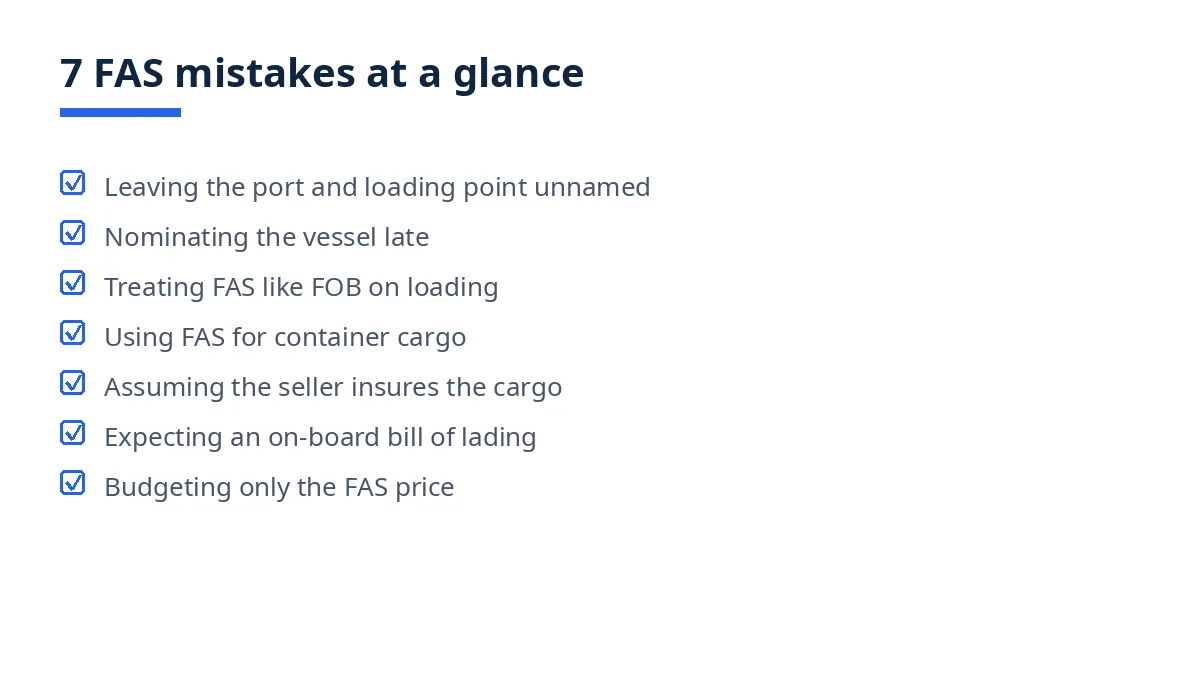
1. Naming the port but not the point within it
What happens. The contract says "FAS Chattogram, Incoterms® 2020" and nothing more. Chattogram is a large port with several berths, quays and terminals, and the seller and the buyer picture different delivery points. The seller delivers to one quay, the buyer's stevedore waits at another, and the cargo sits while both sides argue about whose point counts. The ICC Academy guidance on delivery points warns that a vague place of delivery is a common source of disputes, and that parties should specify the place and point precisely.3
Why it costs. Every day of argument is a day of port storage, and a missed loading window can mean waiting for the next vessel. The cost is not a fine imposed by the rule. It is storage, re-handling and delay, paid by whichever side the contract leaves holding the cargo.
How to fix. Write the full delivery point into the clause: port, berth or quay, and the point the buyer has named, for example "FAS Chattogram, Berth 4, Incoterms® 2020". Confirm the point with the buyer's forwarder before the cargo leaves the factory, not after it reaches the port. The guide to writing an FAS clause shows how the clause should read.
2. Nominating the vessel late, or changing it without notice
What happens. Under FAS, the buyer must notify the seller in time of the vessel's name and the specific place and point of delivery within the port.1 An importer who books late, or who switches vessels after telling the seller the first name, breaks that chain. If the vessel has closed for cargo, or if no vessel is there when the goods arrive, the consequences fall on the buyer: risk and resulting costs shift to the buyer from the moment of non-compliance.1
Why it costs. The buyer pays storage at the port until a vessel takes the cargo, and bears the risk of damage to goods sitting quayside in the meantime. A late nomination can also mean the cargo misses its sailing and the whole onward schedule slips.
How to fix. Put vessel nomination dates in the contract: the date by which the buyer names the vessel, and the notice period for any change. Send the nomination in writing to both the seller and the forwarder, and get a written acknowledgment. If the vessel changes, re-confirm the delivery point at the same time, because a new vessel may berth somewhere else.
3. Assuming the seller will load the goods
What happens. This is the mistake that separates FAS from FOB. Under FOB, the seller loads the goods on board the buyer's nominated vessel. Under FAS, the seller's job ends alongside the vessel, and the buyer handles loading and pays for it.1 An importer who has only ever bought on FOB terms often assumes the FAS seller will do the same, and arrives at the port with no stevedore, no lifting plan and no one booked to load.
Why it costs. Loading bulk or break-bulk cargo is skilled, priced work: cranes, labour, lashing and supervision. Arranged at the last minute at the quayside, it costs more than the same work booked in advance, and a vessel kept waiting can attract further charges.
How to fix. Before the cargo ships, contract the loading separately through the buyer's forwarder or a port service provider, and confirm who supplies lifting gear and lashing. Write the loading arrangement into the shipment plan, and confirm it again when the vessel nomination is sent. If the seller is willing to load, do not rely on goodwill: agree it as an added service in writing, with its own price, because the FAS rule itself does not include it.
4. Using FAS for container cargo handed to a terminal
What happens. A buyer orders containerised garments from Bangladesh on FAS terms. The seller delivers the sealed containers to a container terminal, as every container shipment requires, and the containers sit at the terminal for days before they are moved to the vessel.1 But FAS delivery is defined as placement alongside the vessel, not delivery to a terminal. The contract's delivery point never matches the physical handover, so it is unclear when risk passed if a container is damaged at the terminal.
Why it costs. The gap shows up exactly when something goes wrong: a damaged container, a claim against an insurer, or a dispute about who bears the loss. The buyer may find the insurer argues risk had not yet passed, while the seller argues delivery had already happened.
How to fix. For container cargo, use FCA (Free Carrier) instead, where risk passes when the goods are handed to the carrier the buyer nominates, which matches the terminal handover.1 FAS is generally less suitable for containerised cargo handed to a terminal before vessel loading.4 Keep FAS for bulk, break-bulk or project cargo that can genuinely be delivered directly alongside a named vessel.4
5. Leaving insurance to chance
What happens. An importer reads a FAS price, assumes insurance is included somewhere in it, and never buys cover. Under FAS, the seller has no obligation to insure the cargo. Insurance is the buyer's responsibility from the moment risk passes alongside the vessel, including the loading operation itself.5 Only CIP and CIF oblige the seller to provide insurance for the buyer.1
Why it costs. Risk passes before loading, so damage during loading and damage during the ocean voyage are both the buyer's problem. Goods sitting on a quay are exposed to rain, handling damage and theft before they are even on board. Without cover, one incident wipes out the margin on the whole order.
How to fix. Buy marine cargo insurance that starts at the alongside point, not at the destination port, and confirm it covers the loading operation. Tell the insurer the cargo is bulk or break-bulk where that applies, because handling risk differs from container risk. Keep the policy or certificate with the shipping documents so a claim can be filed without delay.
6. Expecting an on-board bill of lading from the seller
What happens. The buyer's payment terms, often a letter of credit, call for an on-board bill of lading. But under FAS the seller does not load the goods and does not contract the carrier, so the seller cannot produce an on-board bill of lading. The bill of lading is typically issued by the buyer's carrier, and the seller provides documents such as a mate's receipt as proof of pre-loading status.5
Why it costs. If payment depends on a document the seller cannot produce, payment stalls even though the seller delivered exactly as agreed. The seller waits for money, the buyer waits for documents, and the shipment waits for both.
How to fix. Match the payment documents to the Incoterm before signing. Under FAS, accept a delivery receipt or mate's receipt from the seller plus the transport document from the buyer's own carrier, and write both into the payment terms. If the bank insists on an on-board bill of lading, reconsider the Incoterm: FOB, where the seller loads, fits that document set better. Never let a standard letter-of-credit checklist override the delivery term you chose.
7. Budgeting only the FAS price
What happens. A buyer compares a FAS price with a CIF or DAP price and treats the FAS figure as the cheaper option. It is cheaper because it contains less: the seller pays only up to the alongside point. Loading, ocean freight, insurance, destination handling, import duty and onward transport are all still to come, and all sit with the buyer.2
Why it costs. The gap between the FAS price and the landed cost is the whole ocean leg plus destination costs. A buyer who priced the order on the FAS figure alone finds the margin gone before the goods reach the warehouse.
How to fix. Build the landed cost before ordering, using forwarder quotes for every leg the rule leaves to you. The table below shows the shape of that calculation with illustrative numbers.
Cost element | Who pays under FAS | Example figures |
|---|---|---|
Goods and delivery alongside the vessel | Seller | USD 20,000 |
Loading on board | Buyer | USD 400 |
Ocean freight to destination port | Buyer | USD 1,800 |
Marine cargo insurance | Buyer | USD 150 |
Destination handling and import duty | Buyer | USD 1,200 |
Onward transport to warehouse | Buyer | USD 350 |
Landed cost | Buyer total | USD 23,900 |
Example figures only, for illustration. Freight, insurance and duty change with the route, the cargo and the destination tariff, so replace every figure with a live quote for your own shipment. For the full method, read the guide to landed cost for imports from Bangladesh.
Summary table
Mistake | What goes wrong | Fix in one line |
|---|---|---|
Port named, point not named | Seller and buyer picture different delivery points | Name berth, quay and point in the clause |
Vessel nominated late | Risk and storage costs shift to the buyer | Set nomination dates and confirm in writing |
Seller assumed to load | No one booked to load at the quayside | Contract loading through the buyer's forwarder |
FAS used for containers | Delivery point never matches the terminal handover | Use FCA for container cargo |
No insurance bought | Loading and voyage damage are uncovered | Insure from the alongside point, including loading |
On-board bill of lading expected | Seller cannot produce the payment document | Match payment documents to the FAS term |
Only the FAS price budgeted | Ocean leg and destination costs erase the margin | Build the full landed cost before ordering |
How Exportain helps
Exportain is a B2B marketplace for sourcing from Bangladesh. Buyers can search Bangladeshi suppliers, post a request for quotation (RFQ) stating quantity, destination and Incoterm, and compare the quotations that come back. When you post an RFQ, state the Incoterm in full, for example "FAS Chattogram, Berth 4, Incoterms® 2020", and name the delivery point, the vessel nomination date and the loading arrangement in the requirement itself. That way every supplier quotes the same delivery point, and the differences between quotes are prices, not hidden assumptions.
Supplier profiles carry badges only for the document and photo checks the Exportain team has reviewed. Treat a badge as a starting filter, not a conclusion: run your own checks on the supplier, confirm the delivery point and the documents in writing, and keep the exchange in the RFQ and message thread so the agreed terms are recorded.
FAQs
What is the biggest mistake?
Assuming FAS works like FOB. The two rules share the sea-only scope and the buyer-paid freight, but they differ at the decisive step: under FOB the seller loads, under FAS the buyer loads.1 Every other mistake on this list is easier to avoid once that one difference is clear.
How can I avoid it?
Write the delivery point, the vessel nomination date and the loading arrangement into the contract before the cargo moves, buy insurance from the alongside point, and match the payment documents to the term. Then build the landed cost from forwarder quotes, not from the FAS price alone.
Who is responsible?
The seller is responsible for the goods, export clearance and delivery alongside the vessel at the named port of shipment.2 The buyer is responsible for loading, main carriage, insurance, import clearance and duty, and onward delivery.2 Risk passes when the goods are placed alongside the vessel.1
Where can I get help?
Start with the rule itself: the ICC Academy explanations of FAS and FOB set out each side's obligations and the consequences of late vessel nomination.1 For the wider choice of terms, read the guide to Incoterms for shipments from Bangladesh. If you are comparing FAS with a seller-insured term, the guide to CIF (Cost, Insurance and Freight) shows what seller-bought cover looks like.6
Next steps on Exportain
Read the guide to Incoterms for shipments from Bangladesh to compare FAS with the other ten rules before you commit to a term. If you want the clause wording right, the guide to how to write an FAS clause sets out the clause in full. Then post a free RFQ with your specification, quantity, destination and Incoterm, naming the delivery point and the vessel nomination date in the requirement.
Sources
- FOB & FAS Incoterms® 2020 explained: Key differences. ICC Academy (accessed )
- FAS vs. FOB Incoterms: Key Differences Explained. Ship4wd (accessed )
- Place of delivery & risk transfer in trade contracts. ICC Academy (accessed )
- FAS Incoterms 2020: Free Alongside Ship Responsibilities, Risk & Example. SCMANA (accessed )
- FAS Incoterms | Free Alongside Ship Explained. Greentime (accessed )
- CIF Meaning (Cost, Insurance & Freight). Exportain (accessed )
About the author
Sourcing from Bangladesh?
Post a request for quotation and suppliers on Exportain can send you their quotes directly.
Post an RFQ