

FAS Pros and Cons: When Should Importers Use It?
FAS pros and cons for importers: when buyer control of freight and loading saves money, when it adds cost and risk, and how FAS compares with FOB, FCA and CIF for shipments from Bangladesh.
Short answer
FAS suits importers who control their own ocean freight and loading: the seller delivers the goods alongside the nominated vessel at the named port and clears them for export, and the buyer takes over loading, freight, insurance and risk from that point. It is the wrong term for containerized cargo, for buyers without freight arrangements, and for anyone who wants the seller to handle the main journey.
On this page
Key takeaways
FAS hands the buyer control of loading, ocean freight and insurance from the alongside-ship point, which saves money only when the buyer's freight rate beats what the seller would charge for arranging the same movement.
FAS covers sea and inland waterway transport only and is not recommended for container transport: containers reach terminals days before loading, so container shipments should use FCA instead.
The buyer bears risk from the moment goods are placed alongside the vessel, including during loading, and FAS obliges neither party to insure, so cover must be arranged from the alongside point in writing.
Name the port and the loading point precisely in the contract, since handling charges and quay-to-ship movement vary with port practice and an unnamed loading point invites disputes.
Compare total landed cost under FAS, FOB, FCA and CIF on identical goods and destination before signing, and agree a waiting-cost rule for a late vessel.
FAS, or Free Alongside Ship, is one of the few Incoterms 2020 rules that hands the buyer control of the main sea journey while leaving the seller responsible for getting the goods to the side of the ship. That split is the whole decision. If you have the freight contacts, the loading arrangements and the insurance cover to take over at the quayside, FAS can cut out a layer of seller-arranged shipping cost. If you do not, the same split leaves you paying for loading, ocean freight and risk from a point where you have the least control over timing.
The rule is narrow by design. FAS applies only to sea and inland waterway transport, and it is not recommended for container transport.1 The seller delivers by placing the goods alongside the ship nominated by the buyer at the named port of shipment, and risk passes to the buyer at that moment.1 The seller also handles export clearance under Incoterms 2020.2 Everything after the alongside point, loading included, sits with the buyer. This guide weighs that bargain honestly: where FAS earns its place, where it costs more than it saves, and which alternative to pick instead.
Why this matters for buyers and sellers
For the buyer, FAS is a control play. You choose the carrier, negotiate the freight rate and arrange the loading, instead of accepting a freight rate chosen by the seller and folded into the price. For a buyer moving regular bulk volumes on a route it already serves, that control can be worth real money across a year of shipments. It also keeps the seller's price clean: the quotation covers the goods and delivery to the port, not a freight market the seller may price cautiously.
For the seller, FAS is a limited commitment. The seller must still pack, mark, transport and deliver the goods to the named port, clear them for export and give proof of delivery, and must inform the buyer in advance of delivery.1 The seller does not contract the main carriage: the buyer concludes the contract of carriage from the named port of shipment, and must notify the seller of the ship name, loading point and delivery date in advance.1 The Incoterms 2020 rules are published by the International Chamber of Commerce to give a clear allocation of cost, risk and obligations between the parties.3
The stakes rise because the handover point is unforgiving. Once the goods sit alongside the vessel, the buyer bears the cost and risk of loading and everything that follows, and FAS obliges neither party to insure the cargo.2 A buyer that has not arranged cover from the alongside point carries uninsured risk during loading itself.
What should I know first about FAS?
Know the delivery point before you ask for a price. FAS delivery is complete when the goods are placed alongside the ship indicated by the buyer, at the named port of shipment, and the loading point at that port should be fixed as clearly as possible, because handling charges and the movement of goods from quay or barge can vary with port practice.1 A quotation that says only "FAS Chittagong" without a named loading point leaves the most expensive part of the handover undefined.
Know what you are taking on. The buyer pays for loading onto the vessel, ocean freight, destination handling, import clearance and onward transport, and decides whether to insure the shipment.4 The seller's obligations end at the alongside point, apart from export clearance and delivery documentation.2 If any of those buyer-side items is outside your capability, FAS is the wrong term even when the seller's price looks lower.
Know the cargo test. FAS suits bulk, breakbulk, liquid or heavy cargo that can be delivered directly to the dock, and container shipments should use FCA instead, because containers are normally delivered to terminals days before loading rather than alongside a vessel.2 If your Bangladesh order ships in containers, stop here and compare FCA and FOB instead.
Step-by-step: how it works
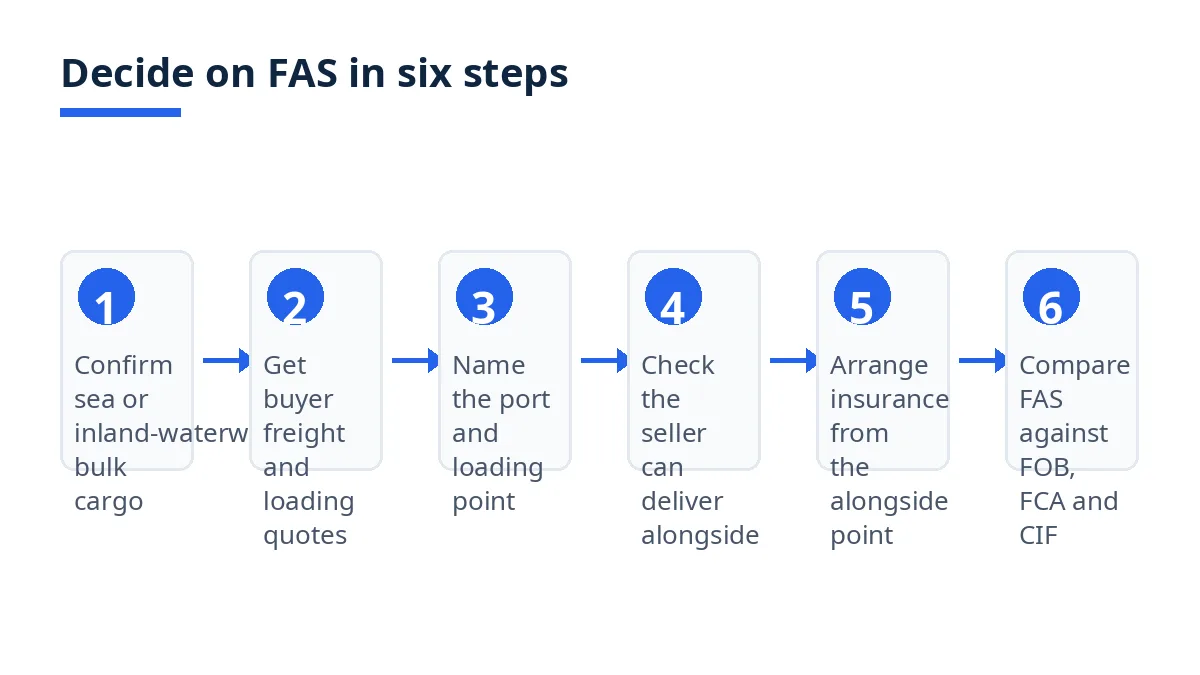
Use these steps as a decision sequence, not as a shipping manual. Each step is a gate: a "no" at any gate points to a different term.
Confirm the cargo and the mode fit FAS. Sea or inland waterway only, non-containerized cargo that can be placed directly alongside a vessel. Containerized goods, air freight and multimodal door-to-door movements fail this gate.
Test your freight position honestly. Get a buyer-side freight and loading quotation for the route before you accept an FAS price. FAS only saves money when your freight rate beats what the seller would charge for arranging the same movement.
Name the port and the loading point in writing. The contract should name the port of shipment and, as precisely as the port allows, the loading point where goods transfer from quay or barge to ship.1 Vague delivery points create disputes over handling charges.
Check the seller can deliver alongside on schedule. Confirm the seller's inland transport to the port, export clearance capability and delivery timing against the vessel's arrival. The seller must inform the buyer of delivery in advance, and the buyer must give the vessel and loading details in advance.1
Arrange insurance from the alongside point. FAS requires no insurance from either party, so the buyer should obtain cover that begins at the agreed alongside-delivery point rather than only after vessel loading.2 Confirm this start point with the insurer in writing.
Compare FAS against FOB, FCA and CIF on the same shipment. Price all four on identical goods, quantities and destination, and compare total landed cost, not seller price alone. Choose the term with the lowest total cost at an acceptable level of control and risk.
Costs, timelines and documents
What are the typical costs and timelines?
There are no typical FAS costs or timelines a guide can state as fact: freight, loading and handling rates vary by route, cargo, vessel and season, and each seller prices its own goods and inland delivery. What is fixed is the split. The seller bears packaging, inland transport to the port, export clearance and delivery alongside the vessel; the buyer bears loading, ocean freight, destination handling, import clearance and onward transport, plus any insurance it chooses to buy.4 Compare quotations only when the delivery point, cargo form and destination match, and always compare the full landed cost, not the seller's FAS price against a CIF price that already includes freight and insurance.
Timelines work the same way. The seller's delivery date must align with the vessel the buyer nominates, and a late vessel can leave goods waiting at the quayside with storage or handling charges falling on the buyer.4 Agree in writing what happens if the vessel is late and who pays for waiting time.
Which documents are needed?
For the decision itself, the essential documents are the sales contract naming the FAS rule, the named port and the loading point, the commercial invoice and packing list, the export clearance set, proof of delivery alongside the vessel, and the buyer's carriage contract and insurance cover. For export clearance in Bangladesh, goods may not be loaded unless an export declaration, the Bill of Export or Shipping Bill, is submitted to Customs and approved, with enclosed documents including the export contract or purchase order where there is no export letter of credit, the commercial invoice, the packing list, the EXP form certified by an authorized dealer, and a certificate of origin issued by the Export Promotion Bureau or a Chamber of Commerce and Industry.5 The buyer should also hold evidence of delivery alongside the vessel, to trigger its carriage and insurance arrangements. A separate documents article covers the full FAS checklist; do not let a short list here substitute for it.
Bangladesh-specific rules and tips
Name Chittagong or Mongla with a loading point, not just a port city. Bangladesh's sea exports move chiefly through these ports, and handling practice differs between terminals and berths. Because handling charges and quay-to-ship movement can vary with port practice,1 the contract should pin down the loading point as far as the port allows, and the buyer should confirm with its carrier or agent that the nominated vessel can actually berth and load there on the agreed date.
Use the seller's export-clearance strength, and verify it. Under Incoterms 2020 the seller handles export clearance,2 and Bangladesh clearance requires the approved Bill of Export set described above.5 That is an advantage of FAS for a foreign buyer: the party closest to Bangladeshi customs handles the export formalities. Ask the seller to confirm which documents it will provide, and in what form, before the shipment date, so the buyer's carrier is not waiting on papers at the quayside.
Match FAS to the cargo Bangladesh actually ships this way. FAS fits bulk and breakbulk movements, such as bulk commodities or oversized pieces loaded directly to a vessel, where the buyer's own stevedores or vessel gear handle loading.2 Most of Bangladesh's garment, textile and consumer-goods exports move in containers, and for those shipments FCA is the better term. Choosing FAS for a container shipment creates a delivery point that container logistics cannot meet, because the container reaches a terminal days before the vessel does.2
Build buffer into the delivery window. FAS leaves waiting time at the quayside on the buyer's account, so agree the waiting-cost rule before signing rather than after a vessel slips.
Mistakes and red flags
What are the most common mistakes?
Choosing FAS for containerized cargo. This is the most common and most avoidable error. Containers go to terminals, not alongside vessels, so the FAS delivery point cannot be performed as written. Use FCA for container shipments instead.2
Comparing an FAS price with a CIF price as if they were the same thing. An FAS price excludes loading, freight and insurance; a CIF price includes freight and insurance arranged by the seller. The comparison that matters is total landed cost under each term, on identical goods and destination.
Leaving the loading point unnamed. A contract that names only the port leaves handling charges and the quay-to-ship transfer open to dispute, since these vary with port practice.1 Name the loading point as precisely as possible.
Forgetting insurance during loading. FAS obliges neither party to insure,2 and the buyer's risk starts at the alongside point, before loading. Cover that starts only after the goods are on board leaves the loading operation itself uninsured. Confirm the cover start point in writing.
Accepting FAS without a freight quotation in hand. The saving under FAS is the difference between your freight rate and the seller's. If you have no freight rate, you have no saving, only extra work and extra risk. Get the buyer's freight and loading quotes before signing.
Red flags in a seller's FAS offer. A seller that cannot name the port loading point, confirm export clearance documents or commit to a delivery window tied to the vessel's arrival is signaling that the alongside delivery may not happen cleanly. Treat any FAS quotation without a named port and loading point as incomplete.
Checklist
Every line below should be answered "yes" in writing; a "no" points to FOB, FCA or CIF instead.
Cargo is non-containerized bulk, breakbulk, liquid or heavy cargo moving by sea or inland waterway.
You hold, or your forwarder holds, a firm freight quotation and loading arrangement for the route.
The named port of shipment and the loading point are written into the contract.
The seller has confirmed inland delivery to the port, export clearance and advance notice of delivery.
Insurance cover is arranged from the alongside-delivery point, confirmed in writing with the insurer.
A waiting-cost rule covers a late vessel, including who pays for quayside waiting time.
Total landed cost under FAS has been compared with FOB, FCA and CIF on identical goods and destination.
Proof-of-delivery documents and the export clearance set are agreed before the shipment date.
If any line fails, the term is changed before signing, not after the goods reach the port.
How Exportain helps
On Exportain, post the cargo, quantity, port and loading requirements on the RFQ board, and ask each reply to quote FAS alongside FOB and FCA where the cargo allows it, so you compare total landed cost rather than seller price alone. State the named port and the loading point in the RFQ itself, and ask each supplier to confirm export clearance documents and delivery timing against your vessel window. Read how to buy before you post, and keep the agreed term, port, loading point, insurance start point and waiting-cost rule in the same written file as the order. Post a free RFQ on Exportain and get quotes from Bangladeshi suppliers through the RFQ board.
FAQs
What should I know first about FAS?
FAS means the seller delivers by placing the goods alongside the ship you nominate at the named port of shipment, and risk passes to you at that moment.1 You then pay for loading, ocean freight, destination handling, import clearance and onward transport, and you decide on insurance.4 The rule covers sea and inland waterway transport only and is not recommended for container transport.1
What are the typical costs and timelines?
No typical figures apply: freight, loading and handling rates vary by route, cargo and season. The fixed part is the split: the seller pays up to and including delivery alongside the vessel and export clearance, while the buyer pays loading, freight, destination handling, import clearance and any insurance.4 Timelines depend on aligning the seller's delivery with your nominated vessel, so agree a waiting-cost rule for a late vessel before signing.
Which documents are needed?
The decision documents are the contract naming the FAS rule, port and loading point, the commercial invoice and packing list, the export clearance set, proof of delivery alongside the vessel, and your carriage contract and insurance cover. In Bangladesh, export clearance requires an approved Bill of Export with the commercial invoice, packing list, EXP form certified by an authorized dealer and certificate of origin, among other documents.5 A separate documents article covers the full checklist.
What are the most common mistakes?
The most common mistakes are choosing FAS for containerized cargo, comparing an FAS price with a CIF price as if they were equivalent, leaving the loading point unnamed, leaving loading uninsured, and accepting FAS without a freight quotation in hand.1 2 4 Each is preventable in writing before the goods reach the port.
Next steps on Exportain
Compare this decision framework with the Incoterms guide for shipments from Bangladesh, then read what an FAS price includes and when risk transfers under FAS before you sign. When you are ready to test the market, post your cargo, port and loading-point requirements on the RFQ board and compare FAS, FOB and FCA quotes on total landed cost.
Sources
- FAS - Free alongside ship (Named Place) Incoterms 2020. Export Council of Australia (accessed )
- FAS Incoterms (Free Alongside Ship): Meaning and Use. iContainers (accessed )
- Incoterms® 2020. International Chamber of Commerce (ICC) (accessed )
- FAS Incoterm: Free Alongside Ship explained. IncoDocs (accessed )
- Customs Clearance Procedures for Export. Bangladesh Customs, National Board of Revenue (accessed )
About the author
Sourcing from Bangladesh?
Post a request for quotation and suppliers on Exportain can send you their quotes directly.
Post an RFQ


