Insurance Under EXW: Who Must Insure the Cargo and for How Much?
Under EXW, no party must insure the cargo, so the buyer must arrange cover from the factory gate. Learn who insures, how to set the insured value, and how Clause A, B and C differ.
Short answer
Under EXW, neither the seller nor the buyer is obliged to buy cargo insurance. Because risk passes to the buyer when the goods are placed at the named place, the buyer who wants protection must arrange it, starting at the factory gate rather than at the port. There is no EXW minimum amount, so set the insured value and the clause level in the contract and the policy before collection.
On this page
Key takeaways
Under EXW, neither the seller nor the buyer is obliged to insure the cargo, so a buyer who wants protection must arrange cover starting at the named place, not at the port.
There is no EXW minimum insured amount or required clause level, unlike CIF, where the seller must insure for at least 110 percent of the contract price at Clause C minimum.
Set the insured value on a stated basis, such as cost plus freight plus a 10 percent uplift, and declare the full value before the goods move to avoid underinsurance.
Choose the clause level for the cargo: Clause A is the widest standard cover, Clause B is mid-level named perils, and Clause C is the narrowest named perils cover.
Use one continuous policy from the named place to the buyer's warehouse, and check the certificate against the policy wording before collection.
Under EXW, neither the seller nor the buyer is obliged to buy cargo insurance. Because risk passes to the buyer when the goods are placed at the named place, the buyer who wants protection must arrange it, starting at the factory gate rather than at the port. There is no EXW minimum amount, so set the insured value and the clause level in the contract and the policy before collection.
This guide covers only the insurance question. For the full rule, read the EXW guide, and for all 11 rules, read the Incoterms guide.
Who must insure under EXW
The short answer is that no one must. The Incoterms 2020 rules are 11 rules published by the International Chamber of Commerce (ICC), and only two oblige the seller to buy insurance for the buyer: CIF and CIP.1 Under every other rule, including EXW, insurance is for the parties to arrange or agree in the contract.1
That distinction matters because the buyer under EXW carries risk for almost the whole journey. The live EXW guide states that risk passes when the goods have been placed at the buyer's disposal at the named place and the buyer has been notified, even though the goods may still be sitting inside the seller's warehouse, and that neither party is obliged to insure under EXW.2 The buyer therefore needs cover that starts at that point, not at the port of loading.
The seller is not the fallback. A seller may hold its own storage or transit policy, but that does not automatically cover the buyer's risk after delivery. Ask who is named as the insured, which journey is described, and whether the buyer can claim directly.
The buyer has three practical routes: a single cargo policy arranged by the buyer or the buyer's forwarder for the full journey to the buyer's warehouse; a forwarder-arranged policy placed with an insurer on standard clause wording;3 or a contract term under which the seller arranges a named level of cover at the buyer's expense, with the certificate handed over before collection. Under the third route, still check the wording, not only the certificate.
Why this matters for buyers and sellers
For the buyer, the insurance gap under EXW is wider than under most other terms. Under FOB, risk passes on board the vessel, so the uninsured stretch before the port is short. Under EXW, it can include loading, inland transport in Bangladesh, export handling, the main sea or air leg, destination handling, and final delivery. Damage found at the buyer's warehouse may have happened on any of those legs, and without one continuous policy it can be hard to show which leg caused it.
For the seller, the point is narrower. The seller does not have to insure, and agreeing to arrange cover without a written instruction creates a dispute about clause level, insured value and deductible. Record those points and hand over the certificate before the goods move.
The insurance question also changes the landed cost. The landed cost guide treats cargo insurance as its own cost line, separate from freight and duty, and warns that skipping it moves the full loss onto the buyer.4
How much cover: valuation and Clause A, B and C
There is no minimum insured amount under EXW. That is the point buyers most often miss, because the neighbouring CIF rule does set one. Under CIF, the seller must obtain insurance for the buyer's benefit for at least 110 percent of the contract price, in the contract currency, at Institute Cargo Clauses (C) minimum unless broader cover is agreed.5 Under CIP, the seller must buy wider cover, compliant with Institute Cargo Clauses (A).6 EXW sets neither a percentage nor a clause level.
Start with the valuation basis. A commonly used policy valuation is cost plus freight plus a 10 percent uplift, where cost is the commercial invoice value and freight covers transportation-related expenses.7 The uplift addresses exceptional claim-related expenses, not a payment above the loss, and a claimant generally cannot collect more than the originally insured value.7 Ask the insurer to state the basis in writing, including whether duty and inland delivery sit inside the insured value.8
Example figures: goods 20,000, freight 1,800, cost plus freight plus 10 percent gives an insured value of 23,980. Insuring only the 20,000 goods value leaves freight and uplift outside the policy. Example figures only, not a premium or rate.
Next, choose the clause level. The Institute Cargo Clauses are standard insurance terms issued by the Lloyd's Market Association and the International Underwriting Association, and they form the foundation for most marine cargo insurance contracts.3 Clause A is the broadest, described as all risks cover, insuring against all risks of loss or damage during transit except for specific exclusions listed in the policy, such as wilful misconduct, ordinary leakage, inherent vice, delay, war, strikes or nuclear incidents.3 Clause B is a named-perils cover, limited to listed risks such as fire, grounding, collision, discharge at a port of distress, earthquake, lightning, general average sacrifice, jettison and washing overboard.3 Clause C is the narrowest standard cover, covering fewer risks than Clause B, while certain natural disasters and water damage are not covered under Clause C.3
Clause | Cover type | What it means for an EXW buyer |
|---|---|---|
Clause A | All risks, except listed exclusions | Widest standard cover |
Clause B | Named perils, mid-level | Listed sea and water perils only |
Clause C | Named perils, narrowest | Major listed perils only, closest to the CIF minimum |
War and strikes are commonly excluded from the standard clauses and handled through separate Institute War Clauses and Institute Strikes Clauses, so ask whether those extensions are included or excluded.3 For air freight, a separate set of Institute Cargo Clauses (Air) applies, typically a single all-risks style policy, rather than the A, B and C choice for sea cargo.3 Read the exclusions, deductible, storage limits and notice conditions in the actual policy wording.3
Underinsurance carries its own warning. Where a shipment is insured for less than the value that should have been insured under the policy valuation clause, the owner effectively acts as a co-insurer for the uninsured portion, and a partial-loss settlement can be reduced in proportion to the insured share.7
Step-by-step: how it works
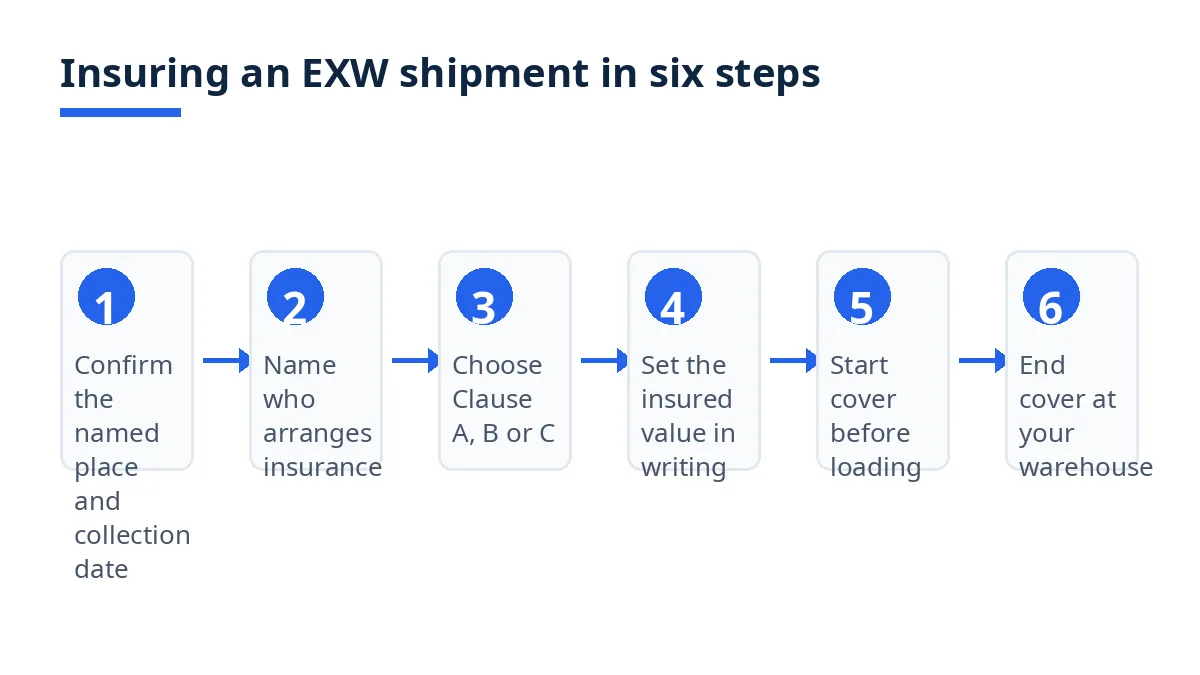
Name the place and collection date in the contract, using the full factory or warehouse address, and confirm who loads the goods.
Decide who arranges insurance before collection: buyer, buyer's forwarder, or seller at the buyer's expense.
Choose the clause level: Clause A, B or C for sea cargo, or air cargo wording for air freight, and ask about war and strikes extensions.
Set the insured value, the currency and the valuation basis in writing, covering the goods, the freight and the uplift.
Confirm the cover start point in the policy: the named place, before loading, not the port.
Check the cover end point: the buyer's warehouse, subject to the policy termination provisions.8
Collect the certificate or policy evidence before the goods move, and keep it with the invoice, packing list and transport document.
Where cover is arranged under Institute Cargo Clauses (A), (B) or (C), insurance typically operates on a warehouse-to-warehouse basis, extending beyond the port to the final delivery point, subject to termination provisions.8
Costs, timelines and documents
What are the typical costs and timelines?
There is no typical premium, rate or timeline this guide can state as fact. Premium depends on the cargo, clause level, insured value, route, mode and insurer, and is quoted per shipment or per policy, not set by the Incoterm. Ask for a written quote stating the clause, insured value, currency, deductible, start and end points, and exclusions or extensions.
For timelines, the insurance step that matters is before collection. The certificate, clause confirmation and valuation agreement should be in hand before the collecting vehicle arrives. After a loss, follow the notice steps in the policy itself. A certificate alone may not include every term that affects a claim, so review it alongside the policy wording.5
Which documents are needed?
For export clearance in Bangladesh, goods may not be loaded unless an export declaration, the Bill of Export or Shipping Bill, is submitted to Customs and approved.9 Enclosed documents include the export contract or purchase order where there is no export letter of credit, the commercial invoice, the packing list, the EXP form certified by an authorized dealer, and a certificate of origin issued by the EPB or a Chamber of Commerce and Industry.9 The invoice and packing list also anchor the insurance valuation, so their figures should match the insured value basis.
The insurance and claim file to keep with the shipment is:
Sale contract, stating the EXW named place and insurance arrangement
Commercial invoice and packing list, matching the insured value basis
Insurance certificate or policy evidence, stating insured party, amount, currency, clause and journey
Transport document, such as the bill of lading or air waybill, for the same shipment
Photographs before collection, and of any damage on arrival
Survey report, where appointed, and the written notice of loss
Before shipment, compare the insurance evidence with the transaction documents and check that they describe the same goods and movement, and that the amount and currency meet the agreed valuation basis.5
Bangladesh-specific rules and tips
The Bangladesh export step does not change who must insure, but it changes where an uninsured gap can appear. Under EXW, the buyer is responsible for export clearance, and the export declaration must be approved before goods are loaded for export.9 If collection, loading and export handling are arranged by different parties, confirm that the insurance start point covers each step, including waiting time at the factory. A policy that starts at the port does not cover the factory leg.
Keep one legal name across every paper. The export declaration names the exporter and the foreign buyer,9 so the name on the trade licence, quotation, proforma invoice, insurance certificate and payment account should match. Resolve any mismatch before shipment, not after a claim.
For destination checks in the USA, UK, EU and UAE, the policy itself does not change by destination, but the import side does. Confirm with the destination broker whether freight and insurance sit inside the customs value in that country, because countries define customs value differently.4 Confirm importer registration and broker requirements before collection, and that the policy end point reaches the buyer's warehouse, not only the arrival port.
Mistakes and red flags
What are the most common mistakes?
Starting cover at the port. Risk passes at the named place, so a port-start policy leaves the factory and inland legs uninsured.
Assuming the seller is insured for you. Under EXW, the seller has no insurance duty, and a seller policy does not cover the buyer unless the buyer is named and the journey matches.
Copying the CIF minimum into an EXW deal. The CIF minimum of 110 percent of the contract price under Clause C is a CIF rule, not an EXW rule.5 It does not apply to EXW unless the contract adopts it.
Insuring only the goods value. Freight and inland delivery can sit outside a goods-only insured value. State the valuation basis, including the uplift, before the goods move.7
Accepting a certificate without the wording. The clause, exclusions, deductible, storage limits and notice steps sit in the policy wording, and a certificate alone may not include every term that affects a claim.5
Splitting cover at the destination port. Two policies with an unwritten handover at the port create an attribution dispute when damage is found after arrival.8 Use one continuous policy where possible.
Treating a profile or a badge as insurance. A badge records checks that have been reviewed, not a guarantee of the goods, and it does not insure the cargo.10
Checklist
Before the collecting vehicle arrives, every line should be answered in writing.
EXW named place and collection date in full, with loading agreed.
Insurance arranger named: buyer, forwarder, or seller at the buyer's expense.
Clause level confirmed: A, B or C for sea cargo, air wording for air freight.
War and strikes extensions confirmed as included or excluded.
Insured value, currency and valuation basis stated, including freight and uplift.
Cover start confirmed at the named place, before loading.
Cover end confirmed at the buyer's warehouse.
Deductible, exclusions and storage limits read in the wording.
Certificate received before collection, with party and shipment matched.
Invoice, packing list, transport document and photographs filed with the certificate.
Destination broker confirmed.
How Exportain helps
On Exportain, browse suppliers and post a request for quotation with the EXW named place and delivery term stated. State the insurance arrangement in the same enquiry: who arranges cover, which clause level is wanted, and whether the seller is asked to arrange cover at the buyer's expense.
Read the badges for what they record. The buying guide states that badges record which checks the Exportain team has reviewed, and that a badge is not a capacity or quality guarantee.10 Verification is a document and photo review, not an inspection, and it does not insure the cargo.
FAQs
What should I know first about EXW?
Under EXW, no party is obliged to insure the cargo. Only CIF and CIP oblige the seller to buy insurance for the buyer, at Clause C minimum for CIF and Clause A for CIP.6 Under EXW, the buyer must arrange it, starting at the named place, not at the port.
What are the typical costs and timelines?
There are no typical premiums or timelines a guide can state, because premium depends on the cargo, clause level, insured value, route, mode and insurer. The clause, valuation and certificate should be agreed before collection, and any claim follows the notice steps in the policy itself.
Which documents are needed?
The export set for Bangladesh is the Bill of Export, commercial invoice, packing list, EXP form certified by an authorized dealer, and certificate of origin issued by the EPB or a Chamber of Commerce and Industry.9 The insurance file adds the sale contract, certificate or policy evidence, transport document, photographs, and any survey report.
What are the most common mistakes?
The most common mistakes are starting cover at the port, assuming a seller policy covers the buyer, copying the CIF Clause C minimum into an EXW deal, insuring only the goods value, accepting a certificate without the wording, and splitting cover at the destination port.5 8
Next steps on Exportain
Read the EXW guide, the Incoterms guide, and the landed cost guide, then follow how to buy to post your enquiry with the named place and insurance arrangement stated in writing.
Sources
- Incoterms® 2020. International Chamber of Commerce (ICC) (accessed )
- EXW Meaning (Ex Works): Costs, Risks and Example. Exportain (accessed )
- What are Institute Cargo Clauses (A, B, and C)?. Ship4WD (accessed )
- Landed Cost for Imports from Bangladesh. Exportain (accessed )
- CIF Contracts and the 110% Invoice Valuation Rule for Marine Insurance. Cargo Insure Online (accessed )
- CIF Insurance: Who Insures the Cargo. Exportain (accessed )
- Explaining Insured Value and Co-Insurance in a Policy. Azure Risk (accessed )
- Why Cost, Insurance and Freight shipping terms can be a risky proposition for importers. Howden Group (accessed )
- Customs Clearance Procedures for Export. Bangladesh Customs, National Board of Revenue (accessed )
- How to source and buy from Bangladesh. Exportain (accessed )
About the author
Sourcing from Bangladesh?
Post a request for quotation and suppliers on Exportain can send you their quotes directly.
Post an RFQ