DDP Shipping From Bangladesh to USA: Costs, Steps and Timeline
DDP from Bangladesh to USA is a seller-side test first: who stands as US importer of record, how duty is priced, and what breaks a DDP deal before delivery.
Short answer
Under DDP, a Bangladeshi seller delivers goods to the buyer at a named place in the United States, cleared for import, with duties and taxes paid, bearing risk until delivery. The deal stands or falls on the seller's US importer-of-record setup: a US entity or an appointed provider, a licensed broker and a customs bond, with duty priced on the confirmed HTSUS code. Confirm that setup, the bond and the duty code in writing before accepting a DDP price.
On this page
Key takeaways
Under DDP, the seller delivers goods to the named US place cleared for import, with duties and taxes paid, bearing risk until delivery.
A DDP offer stands or falls on the US importer-of-record setup: a seller US entity or an appointed provider, a licensed broker and a customs bond.
Duty is priced on the confirmed HTSUS code and customs value; no seller should promise a duty rate before the code is confirmed.
For ocean cargo, eight ISF elements are due no later than 24 hours before lading at the foreign port, with stuffing location and consolidator due before US arrival.
Exportain verification is a document and photo review, not a factory inspection, and a badge is not a guarantee of capacity, quality or delivery.
A DDP price looks like the simplest quote a buyer can receive: one figure, delivered to a named place in the United States, with duties and taxes already paid. The hard part is not the freight. It is the legal setup behind the price: under DDP the seller must be able to clear the goods for import in the United States, pay the duty, and carry the risk until delivery. If that setup is not settled before the order, the price can unravel at the US border.
Why this matters for buyers and sellers
What should I know first about DDP?
Under Delivered Duty Paid (DDP), the seller delivers the goods to the buyer at the named place, cleared for import, with all duties and taxes paid, and the buyer takes delivery ready for unloading. The Incoterms 2020 rules, published by the International Chamber of Commerce (ICC), set out 11 rules with a clear allocation of cost, risk and obligations for each rule.1 DDP places the greatest obligation on the seller: carriage, export and import clearance, import duties and taxes, and risk until delivery.2
For the buyer, that means one price and very little import paperwork, but also total dependence on the seller's US import setup. For the seller, DDP means managing both ends of the shipment, including acting as the importer of record where required.2 A seller that cannot act as importer of record, or has not appointed someone who can, has not really offered DDP. Under Delivered at Place (DAP), by contrast, the buyer clears the import and pays the duty. Read the Incoterms for shipments from Bangladesh guide to check each split. Insurance needs a separate contract line: DDP does not require the seller to insure the cargo, although the seller bears the risk until delivery and should insure accordingly.2
Step-by-step: how it works
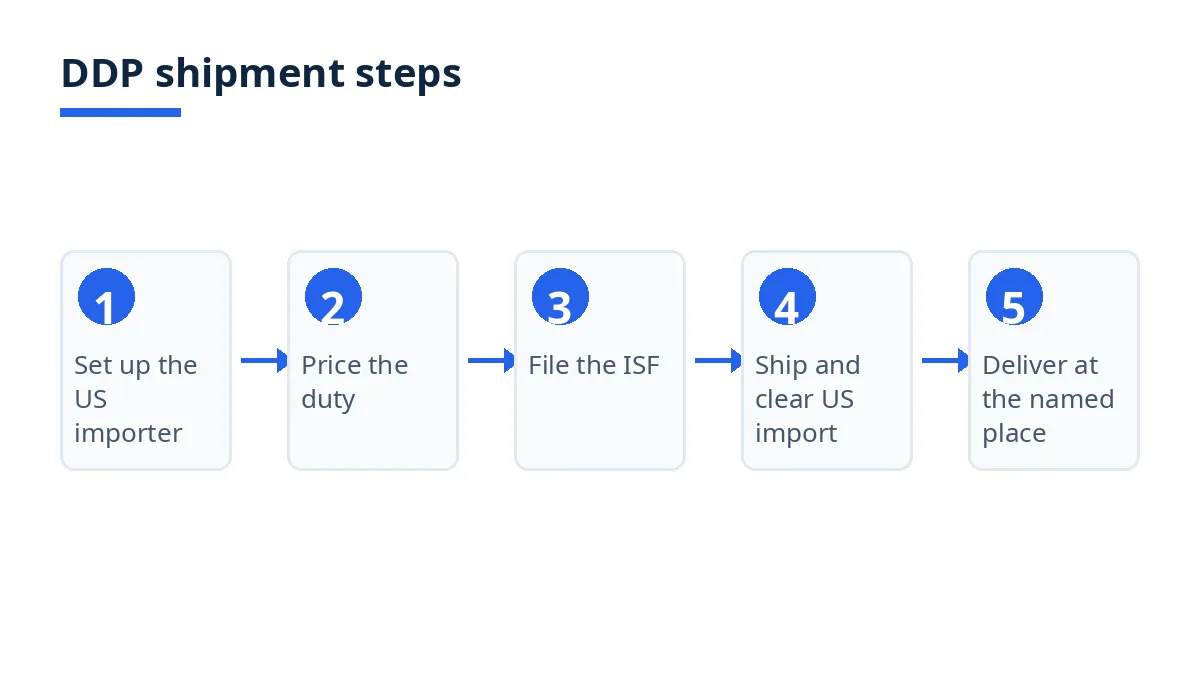
Name the place in full and state the rule. Write "DDP (Incoterms 2020)" followed by the complete delivery address, not a city alone. The DDP contract clause guide shows how that wording looks in a sales contract.
Settle the US importer setup before pricing. The seller, or its appointee, must be able to stand as importer of record, file the US entry and answer for the declaration. The three workable setups are in the table below. Do not price freight until one setup is confirmed in writing.
Classify the goods and price the duty on the real code. The seller, with a licensed US customs broker, confirms the Harmonized Tariff Schedule of the United States (HTSUS) code, the customs value and any additional duties or fees for that code and origin. No seller should promise a duty rate before the code is confirmed.
Complete Bangladesh export clearance. Goods may not be loaded or stuffed for export until an export declaration, the Bill of Export or Shipping Bill, is submitted to Customs and approved.3 The export set includes the export contract or purchase order without an export letter of credit, the commercial invoice, the packing list, the EXP form certified by an authorized dealer, and a certificate of origin issued by the EPB or a Chamber of Commerce and Industry.3 Keep names and descriptions identical across every paper.
Book the carriage and file the Importer Security Filing (ISF) on time. For ocean cargo to the United States, the ISF, known as "10+2", gives US Customs and Border Protection (CBP) advance cargo data before arrival.4 Eight elements must reach CBP no later than 24 hours before the cargo is laden aboard the vessel at the foreign port, while the stuffing location and consolidator must be sent as early as possible and no later than 24 hours before the vessel arrives at a US port.4 5
Clear the US import and pay the duty. A formal consumption entry is generally required for commercial shipments valued at 2,500 US dollars or more, or for goods subject to restrictions, quotas or anti-dumping duties, and the entry summary, CBP Form 7501, is filed within ten working days after release from CBP custody.6 A continuous or single transaction bond is required for this process, as a financial guarantee that the importer of record will meet its legal obligations, including payment of estimated duties, taxes and fees.6
Deliver, unload and close the file. The seller arranges inland carriage to the named place, the buyer unloads on taking delivery, and both parties keep the entry, duty receipts, bill of lading and delivery proof on file.
US importer setup | Who stands as importer of record | When it fits | Confirm in writing |
|---|---|---|---|
Seller's own US entity | The seller's US entity | Repeat US sales | Entity, broker and bond details |
Third-party importer of record provider | An appointed provider | A first or occasional US order | Fee, reassessment liability, written appointment |
Buyer acts as importer | The buyer | Only when the seller cannot clear US import | Then DAP, not DDP; price must drop duty |
A seller that cannot use either of the first two setups should not quote DDP.
Costs, timelines and documents
What are the typical costs and timelines?
There is no typical DDP cost a guide can state as fact, because duty turns on the HTSUS code and origin, freight turns on the route, and the importer setup turns on whether the seller already holds a US entity, bond and broker relationship. The table below is labelled as example figures only: it shows how the lines stack, not what your shipment will cost.
Example figures: a single container of garments valued at 20,000 US dollars, shipped from Chattogram to a named warehouse in the United States.
Cost line | Example figure (US dollars) | Who pays it under DDP |
|---|---|---|
Goods value | 20,000 | Buyer, as the purchase price |
Ocean freight, Chattogram to US port | 2,400 | Seller |
Cargo insurance | 180 | Seller, where agreed in the contract |
US import duty at an illustrative 8 percent of customs value | 1,600 | Seller |
Broker, bond and port fees, combined | 650 | Seller |
Inland delivery to the named place | 900 | Seller |
DDP landed total | 25,730 | Buyer pays the single DDP price |
Example figures: the timeline below illustrates sequence, not a promise for any shipment. The setup stage should be finished before production ships, not while the container is at sea.
Stage | Example timing | What can extend it |
|---|---|---|
US importer setup and broker appointment | 1 to 3 weeks | New entity or bond application |
Bangladesh export clearance and loading | Days, once documents are ready | Document mismatch |
Ocean carriage, Chattogram to a US port | Several weeks, route dependent | Transshipment or congestion |
US entry, release and inland delivery | Days, once the entry is filed | Examination or incomplete ISF |
Delivery at the named place | On the agreed date | Unloading delay |
The landed cost for imports from Bangladesh guide lists the same cost lines from the buyer's side, and the DDP quotation guide shows how to reprice competing headlines onto one comparable total.
Which documents are needed?
Document | Why it matters under DDP |
|---|---|
Sales contract stating DDP (Incoterms 2020) and the full named place | Fixes who clears import, pays duty and bears risk |
Commercial invoice and packing list | The entry is built from these descriptions, values and weights |
Bill of Export, EXP form and certificate of origin | Export clearance, approved before loading3 |
Bill of lading or air waybill | The carrier's receipt and contract for the carriage |
ISF data set, 10 importer plus 2 carrier elements | Advance security data, filed before loading4 |
Broker power of attorney and customs bond | Lets the broker file and guarantees duty payment6 |
Entry summary, CBP Form 7501, and duty receipts | Legal record of classification, value and duty paid6 |
Proof of delivery at the named place | Shows DDP delivery was performed |
Bangladesh-specific rules and tips
Treat the Bill of Export as a gate, not a formality. Export clearance in Bangladesh requires the Bill of Export to be submitted and approved before goods are loaded or stuffed,3 and Chattogram declarations move through the ASYCUDA World system.7 Build the timetable backwards from document readiness, with the contract, invoice, packing list, EXP form and certificate of origin agreed before booking. Since July 1, 2025, the Bangladesh Single Window system covers certificates, licences and permits from its bodies.7
Keep the EXP form and origin papers ready early. The EXP form is certified by an authorized dealer bank to support realisation of export proceeds, and the certificate of origin is issued by the EPB or a Chamber of Commerce and Industry.3 Under DDP the buyer rarely sees these papers, but a missing EXP form or a certificate naming a different exporter can still hold the shipment.
Give the ISF the true manufacturer, not only the trading name. The ISF data set names the manufacturer or supplier, seller, buyer, importer of record number, consignee, ship-to party, origin, HTSUS number, stuffing location and consolidator.4 An inaccurate filing carries the same liquidated damages exposure as a late one, at 5,000 US dollars per violation.4 Ask for the manufacturer name and address, in full, at quotation stage.
Mistakes and red flags
What are the most common mistakes?
Accepting DDP without naming the importer of record. A quotation that never names the importer of record, the filing broker and the securing bond is unfinished. Ask for all three in writing before paying a deposit.
Treating a duty estimate as a fixed duty. Duty follows the HTSUS code, customs value and any additional duties or fees for that code and origin. A round duty figure with no code named is a guess, and under DDP that guess is the seller's risk.
Filing the ISF late or from incomplete data. The 24-hour-before-lading deadline runs from loading at the foreign port, not from sailing or arrival.4 5 Confirming the manufacturer, HTSUS number and stuffing location after loading misses the window.
Assuming a low-value shipment needs no entry or bond. Entry and bond requirements turn on value, restrictions and agency rules, and a formal consumption entry is generally required for commercial shipments valued at 2,500 US dollars or more.6 Confirm the entry type and bond with the broker.
Leaving insurance out of the contract. DDP places risk on the seller until delivery, but does not itself require the seller to insure the cargo.2 A damaged container with no insurance clause becomes a dispute about who bears the loss.
Paying the full DDP price before US entry is confirmed. Stage payments against documents: contract, export clearance, bill of lading, US entry filing and delivery proof.
Checklist
Before you confirm a DDP order from Bangladesh to the United States, every line below should be answered in writing.
Named place stated in full, with "DDP (Incoterms 2020)" in the contract.
Importer of record named: seller's US entity or an appointed provider.
Licensed US customs broker named, with power of attorney in place.
Customs bond confirmed: continuous or single transaction, sized for the entry.
HTSUS code, customs value and duty treatment confirmed by the broker.
Bangladesh export set ready: contract or purchase order, invoice, packing list, EXP form, certificate of origin.3
Bill of Export approved before loading or stuffing.3
ISF data supplied before the 24-hour-before-lading deadline, including the true manufacturer and stuffing location.4
Inland delivery to the named place included in the DDP price; unloading by the buyer.
How Exportain helps
On Exportain, browse suppliers and post a request for quotation on the RFQ board stating DDP (Incoterms 2020), the full named place in the United States and the product specification, then ask each reply to name its importer setup, broker and bond in writing.
Read the badges for what they record. Exportain Verified covers identity, phone, email and business registration, and Export Verified covers the Export Registration Certificate (ERC).8 Factory Verified covers photos of the manufacturer's factory, and Trading Company Verified covers photos of the trading company's office or warehouse.8 Verification is a document review by staff, free, and never granted by membership plans.9 It is not a factory inspection,8 9 so the importer setup, duty code and delivery checks stay with you and your broker. When you accept a quotation, Exportain creates one order and issues one proforma invoice from the accepted terms.8
FAQs
What should I know first about DDP?
DDP is the Incoterms 2020 rule under which the seller delivers goods to the buyer at the named place, cleared for import, with duties and taxes paid, and bears the risk until delivery.2 First confirm who will stand as importer of record in the United States, because that setup decides whether the offer can be performed at all.
What are the typical costs and timelines?
There are no typical DDP costs or timelines a buyer can rely on, because duty turns on the HTSUS code and origin, freight turns on the route, and the importer setup turns on the seller's existing US entity, bond and broker relationship. Use the example figures in the costs section to see how the lines stack, then have a broker price your code and named place.
Which documents are needed?
The order documents are the DDP contract with the full named place, the commercial invoice, the packing list and the bill of lading. The Bangladesh export set is the Bill of Export, the EXP form certified by an authorized dealer, and a certificate of origin issued by the EPB or a Chamber of Commerce and Industry.3 The US set is the ISF data, the broker power of attorney, the customs bond and CBP Form 7501.4 6
What are the most common mistakes?
The most common mistakes are accepting DDP without naming the importer of record, treating a duty estimate as a fixed duty, filing the ISF late or from incomplete data, and leaving insurance out of the contract. A DDP quotation that leaves US duty, the bond or the import entry to the buyer is not a DDP price, and should be repriced as DAP before any deposit is paid.
Next steps on Exportain
Browse suppliers, then post your product specification, full US named place and DDP requirement on the RFQ board, asking each reply to name its importer of record setup in writing. Before comparing replies, read the DDP quotation guide so every headline is repriced onto one comparable total.
Sources
- Incoterms® 2020. International Chamber of Commerce (ICC) (accessed )
- DDP Shipping (Delivered Duty Paid) Explained. TecEx (accessed )
- Customs Clearance Procedures for Export. Bangladesh Customs, National Board of Revenue (accessed )
- U.S. Importer Security Filing (ISF): Requirements, Deadlines, and Penalties. GHY International (accessed )
- 19 CFR 149.2 - Importer security filing, requirement, time of transmission. Cornell Law Institute (accessed )
- CBP Entry Types: Formal, Informal, and Conditional. LegalClarity (accessed )
- Custom Clearance in Bangladesh: Port Procedures and C and F Agent Guide. Bizmend (accessed )
- Trust & Safety Center. Exportain (accessed )
- Supplier verification: Earn trust badges buyers can see. Exportain (accessed )
About the author
Sourcing from Bangladesh?
Post a request for quotation and suppliers on Exportain can send you their quotes directly.
Post an RFQ