

DAP Freight Cost: Who Pays and How It Is Calculated
A DAP freight figure combines several calculations: a container rate, a chargeable-weight rate or a weight-or-measure rate, plus surcharges and inland transport. This guide splits seller-paid carriage from the buyer-side remainder, with a worked calculation and landed total.
Short answer
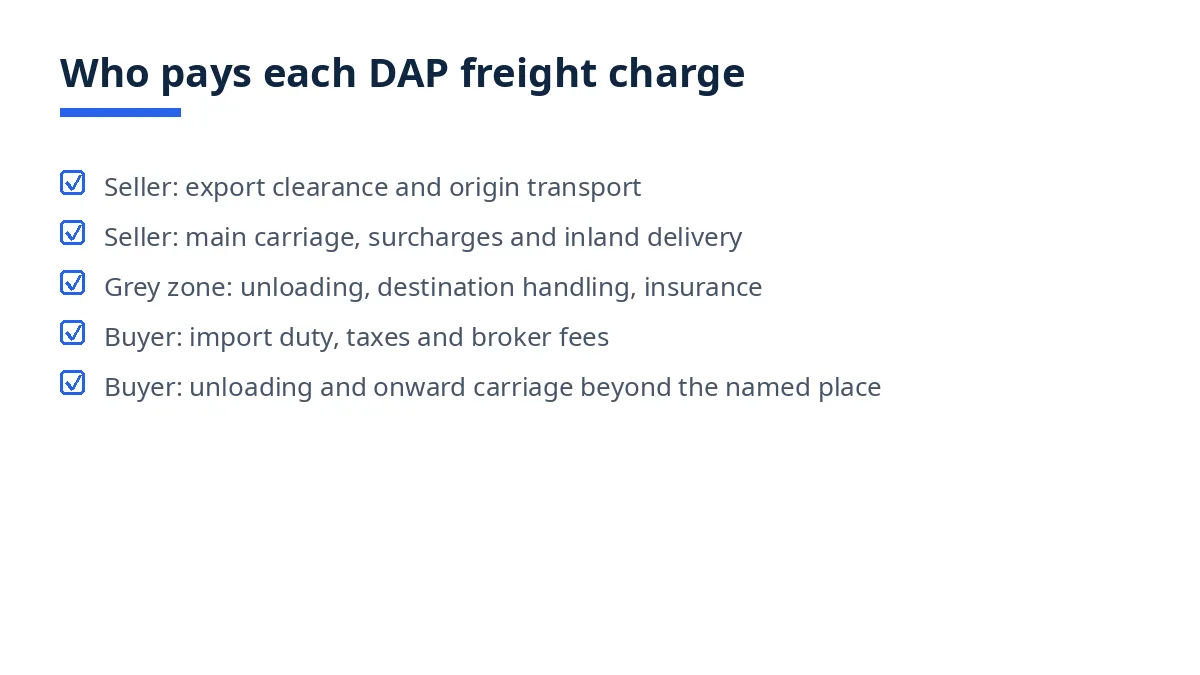
Under DAP (Delivered at Place), Incoterms 2020, the seller pays carriage to the named place, including main carriage, surcharges and inland transport to that place, and bears transit risk until the goods arrive ready for unloading. The buyer pays import clearance, duty and taxes, broker fees and unloading, plus any destination charge outside the carriage contract. DAP imposes no insurance obligation on either side, so cover must be agreed separately.
On this page
Key takeaways
Under DAP the seller pays carriage to the named place, including main carriage, surcharges and inland transport to that place, and bears transit risk until the goods arrive ready for unloading.
Carriage is calculated on different bases: FCL at a flat container rate, LCL per cubic metre or per 1,000 kilograms whichever yields more, and air freight on the greater of actual weight and volumetric weight at the IATA divisor of 6,000.
The buyer pays import clearance, duty and taxes, broker fees and unloading, plus destination charges outside the carriage contract and onward transport beyond the named place.
Unloading cost, destination terminal handling and insurance sit in a grey zone: each must be named in the contract, because DAP imposes no insurance obligation on either party.
No duty rate is stated in this guide: duty depends on the classification of the exact goods and the destination tariff, so the broker must confirm it before any quotation is ranked.
A DAP quotation gives you one freight figure for a journey priced in several different ways. The ocean or air leg may be charged per container, per chargeable kilogram or per cubic metre, surcharges may be added as a percentage or as a fixed amount per container, and the inland leg to your warehouse may be priced separately again. Until you know which basis each part uses, two DAP figures cannot be compared.
This guide is for buyers in the United States, the United Kingdom, the European Union and the United Arab Emirates who are reading DAP freight quotations from Bangladeshi suppliers. It explains how that figure is built and how to read it through to a landed total.
What a DAP freight price is answering
Under DAP (Delivered at Place), Incoterms 2020, the seller must arrange and pay for transportation to the agreed place and point of destination, and bears the risk for loss or damage throughout the journey. Delivery happens when the goods are made available to the buyer, ready for unloading from the arriving means of transport, at that place. The buyer unloads, completes import formalities, and arranges any onward transport beyond the named place.1
The seller pays all costs until delivery, except the buyer's costs in the buyer's cost article. The buyer pays unloading, unless the seller paid it under the contract of carriage, plus duties, taxes and other import clearance costs, and all costs from delivery onward.2 Incoterms 2020 collects all costs for a rule in article A9/B9 of that rule, so the full expected cost list for DAP sits in one place.3
A DAP freight price is therefore not a single rate: it is a carriage bargain to a named place, not a landed total.
The seller-paid side: how the freight figure is built
The seller-paid side has four parts: the goods with export packing; origin charges, including inland transport, export clearance and documentation; main carriage with its surcharges; and inland transport to the named place. A forwarder guide to DAP lists the same seller-paid elements as freight charges, inland transport, export formalities and optional insurance, with the buyer covering import duties, taxes, customs clearance fees and unloading labour.4
The seller also pays checking, packaging, weighing and counting costs needed for delivery, at its own cost unless it is usual for the particular goods to be sold unpackaged.2 Ask whether packing, palletising, stuffing and origin handling sit inside the freight figure or as separate lines.
Export clearance is the seller's: all export formalities required by the country of export, and any transit formalities before delivery, at its own risk and cost.2 Main carriage moves most, with route, mode, volume, fuel prices, seasonal demand and congestion. Ask for the validity dates in writing, and which surcharges are included.
Inland transport to the named place is the part most often left vague. Where the named place is only a city, the seller can select the point that suits its purpose, usually the cheapest option, such as a cargo terminal.1 A DAP price to a terminal and a DAP price to your warehouse are different prices. Read the named place in full, with the dock or gate, before you read the freight figure. The DAP price guide sets out the same inclusion list; this guide explains how each line is calculated.
How the carriage charge itself is calculated
Carriers do not all charge on the same basis, and the basis changes the price more than the rate does. There are three common bases, and a DAP quotation may use more than one across its legs.
For a full container load (FCL) by sea, the shipment is generally billed at a flat container rate rather than by chargeable weight, per container by size and type for the named route.5 For less-than-container-load (LCL) sea freight, cargo is billed per cubic metre or per 1,000 kilograms, whichever yields the greater revenue.5 For air freight, the carrier charges the greater of the shipment's actual weight and its volumetric weight. Volumetric weight converts the space the cargo takes up into kilograms using the IATA standard divisor of 6,000: multiply length by width by height in centimetres and divide by 6,000.5 Some express couriers use a different divisor, commonly 5,000, so check the carrier's terms before you quote.5
Take six cartons, each 70 by 50 by 40 centimetres, actual weight 132 kilograms in total. Each carton is 140,000 cubic centimetres, or 23.33 kilograms volumetric weight. Six cartons give 140 kilograms, so the chargeable weight is 140 kilograms, not 132. Carton dimensions therefore belong in the quotation request, beside weight and quantity.
Surcharges sit on top of the base charge, each with its own basis: fuel surcharges per TEU or FEU or as a percentage of the base rate; currency adjustment as a percentage; peak season as a percentage increase plus additional charges; congestion per container per day; terminal handling as a fixed amount per container; equipment imbalance as a flat rate per container.6 An all-in quote and an itemised quote can both be fair, but a low headline rate with heavy surcharges can cost more than an all-in quote with a higher base figure.6 Ask for the surcharge list in writing, named, with basis and validity.
The buyer-paid side after the named place
The buyer-paid side starts where the seller's carriage ends. The buyer pays import clearance and the duties, taxes and other import clearance costs, the broker's work, unloading, and onward transport beyond the named place.2 Landed cost is the total cost of getting the goods from the supplier price to your own warehouse, divided by the good units received, and the Incoterms rule in the quotation decides which cost lines are already inside the price.7
Duty is charged by your own country, normally as a percentage of the customs value, depending on classification, customs value and origin. There is no single duty rate to copy for goods from Bangladesh.7 State no duty rate until your broker confirms it on the exact classification. The worked example below shows duty and taxes as one example lump sum, with no rate stated.
Broker fees are normally charged per shipment or per declaration, including charges for extra tariff lines or examinations, so obtain the broker fee schedule in advance.7 Appoint the broker before departure, with the invoice, packing list and transport document sent in transit. Unloading is yours under DAP, in cost and in risk, unless the carriage contract includes the charge, so book the dock and labour for the arrival window.
Destination charges most often appear twice or not at all: the port or terminal charges for handling, documentation and release, and late collection can attract storage and demurrage. Confirm which the freight already covers.7 Onward transport beyond the named place is yours in full.7
The grey zone: charges in neither list until the contract says so
Several charges sit in a grey zone under DAP. Name them in the contract before shipment.
The first is the unloading charge itself. Under DAP, the unloading cost may or may not be included in the seller's transportation contract. If it is not included, the buyer bears the cost, and the contract should say so.1 The second is destination terminal handling. Terminal handling charges are fixed amounts per container for physical container handling at the terminal.6 Under DAP, the seller pays transport costs resulting from the contract of carriage, including costs of loading the goods and any transport-related security.2 Whether destination handling results from the contract of carriage depends on the freight terms bought. Ask for the named list of terminal charges included.
The third is insurance. DAP imposes no insurance obligation on either party. The seller has no obligation to insure the goods for the buyer, and the buyer has none to insure for the seller, despite the seller bearing the risk to delivery.2 Only CIF and CIP oblige the seller to buy insurance for the buyer, at different levels of cover: Institute Cargo Clauses (C) remains the default for CIF, while CIP requires the higher Clause (A) level.3 Agree cover in writing before shipment, with any premium shown as its own line.
Time-based charges are a further grey area. Demurrage is the charge for holding a container inside the terminal beyond free time, detention outside the terminal beyond free time, and storage for terminal space beyond the free threshold.6 Confirm in writing who bears them if clearance is slow, and the free time allowed.
Worked example: reading one DAP quotation to a landed total
Example figures only, for one shipment of cotton bed linen sets from Chattogram to a buyer's warehouse in Rotterdam, quoted DAP the warehouse, Incoterms 2020. They are not a quotation or a market price. The buyer-side lines are added on the same basis as the landed cost guide.7
Element of the DAP price | Example figure (USD) |
|---|---|
Goods, including export packing | 7,620 |
Export clearance and documents | 185 |
Ocean carriage, Chattogram to Rotterdam port | 1,640 |
Surcharges on the ocean leg | 230 |
Inland carriage, port to the warehouse | 390 |
DAP price to the warehouse | 10,065 |
Buyer-side cost | Example figure (USD) |
|---|---|
Import clearance and broker | 240 |
Duty and taxes, example lump sum | 685 |
Unloading at the warehouse | 140 |
Destination terminal charge outside the carriage contract | 95 |
Buyer-side total | 1,160 |
Landed total at the warehouse | 11,225 |
Arithmetic: 1,640 + 230 + 390 = 2,260; 7,620 + 185 + 2,260 = 10,065; 240 + 685 + 140 + 95 = 1,160; 10,065 + 1,160 = 11,225. No duty rate is stated: duty depends on classification and destination rules. Compare DAP prices only for the same named place, specification, quantity and carriage inclusions.
DAP beside CPT, CIP, CFR and CIF on cost only
Only the cost and risk points are compared here. The full comparison of all eleven rules is in the Incoterms guide.
Four rules, FAS, FOB, CFR and CIF, are for sea and inland waterway transport only, because delivery under those rules is defined by the vessel, alongside it or on board it. Seven rules, including CPT, CIP and DAP, work for any mode or modes of transport.8 Under CPT, the seller also pays carriage to a named destination, but delivery and risk pass at handover to the first carrier, so the buyer carries transit risk from that point. Under CIP, the position is the same, plus seller-bought insurance at the higher Clause (A) level.3 Under CFR, the seller pays freight to the named destination port, but risk passes on board at origin. Under CIF, the seller pays freight and minimum insurance to the destination port, and risk still passes on board at origin.8 A CIF price includes only goods, insurance and freight, ending at the destination port. It excludes unloading, destination handling, import clearance, duty and onward transport.9
Bangladesh origin notes: what moves the freight figure
No separate Bangladesh rule changes the DAP cost split. What moves the freight figure is the origin leg and the export gate, and both should be confirmed in writing before the price is accepted.
Export clearance must come before loading. Goods must not be loaded or stuffed in containers or a ship for export unless an export declaration, known as a Bill of Export or Shipping Bill, has been submitted to Customs in the prescribed format and approved by the Customs authority.10 Enclosures include the export letter of credit or equivalent export contract, signed invoice, packing list, EXP form certified by Authorised Dealer banks, certificate of origin, VAT certificate and taxpayer identification number.10 Factory-to-port distance and stuffing point change the inland lines. Confirm the departure port and stuffing point in every quotation compared. Product-specific papers sit on top of the standard set where they apply, including an Export Registration Certificate for jute, jute goods and tea, and a phytosanitary certificate for agricultural goods where the destination requires one.10
Mistakes that turn a freight price into a second bill
Reading the headline as all-in. A DAP price stops at the named place. Duty, taxes, broker fees, unloading and onward transport are still to come.2
Accepting a city as the named place. The seller can select the cheapest point, such as a terminal.1
Comparing figures on different bases. FCL, LCL and air chargeable-weight rates are three different calculations.5
Treating surcharges as included. Surcharges are per container, per TEU/FEU, as a percentage, or per container per day.6
Assuming unloading or handling is included. Unloading may or may not be in the carriage contract; handling depends on the freight terms.1 2
Assuming insurance is included. DAP imposes no insurance obligation; only CIF and CIP oblige the seller to buy cover.2 3
Ranking DAP against CIF or FOB. CIF ends at the port with risk passed on board; DAP ends at the named place.8
Leaving time-based charges unagreed. Demurrage, detention and storage follow delay and free time.6
Freight-cost checklist before you accept a DAP price
Work through this list with the quotation in front of you, and do not rank the quotation until every line is answered.
Named place in full, identical across quotations, written as "DAP (named place), Incoterms 2020", with the dock or gate.
Carriage split shown: main carriage, each surcharge named with basis, inland transport, validity dates.
Billing basis stated: FCL rate with container size, LCL weight-or-measure, or air chargeable weight with dimensions and divisor.
Origin lines stated: packing, stuffing, inland transport, export clearance and documents.
Unloading stated: in the carriage contract or buyer-paid; buyer bears the risk either way.
Destination terminal charges named: in the freight figure or billed at destination.
Insurance stated: who buys cover, for which legs, premium separate, or no cover agreed.
Buyer-side lines estimated: broker fees, duty estimate on the confirmed classification, unloading, onward transport.
Time-based charges agreed: free time, and who bears demurrage, detention and storage if clearance is slow.
Currency, validity and payment terms confirmed in writing.
What should I know first about DAP freight cost?
Know the boundary. The seller pays carriage and export and transit clearance costs until delivery at the named place, ready for unloading.2 The buyer pays unloading unless the carriage contract includes it, import clearance, duty and taxes, and every cost from delivery onward.2 DAP imposes no insurance obligation on either party.2
What are the typical costs and timelines for DAP freight?
There are no typical costs or timelines under DAP: the rule fixes who pays, not how much or how long. Seller-paid: origin charges, main carriage with surcharges, inland transport. Buyer-paid: import clearance, duty and taxes, broker fees, unloading, destination charges outside the contract, onward transport.4 7
Which documents are needed to check a DAP freight quotation?
The quotation itself, with named place, billing basis, surcharge list and validity dates, is the first document. Behind it: invoice, packing list, transport document, and the export file headed by the approved Bill of Export.10 The buyer holds the broker's duty estimate, fee schedule, and haulier quote. Keep the quotation, inclusions list, and broker estimate under one order number.
What are the most common mistakes with DAP freight cost?
Treating the headline price as duty-paid, accepting a city as the named place, comparing freight figures calculated on different bases, assuming surcharges, unloading or destination handling are included, assuming insurance is included, ranking a DAP price against a CIF or FOB headline price, and leaving demurrage, detention and storage unagreed. Read the named place first, then the inclusions, then the buyer-side remainder.
Next steps on Exportain
Read the Incoterms guide and the DAP documents checklist before you book. When the named place and specification are fixed, post an RFQ stating the DAP term and named place in full, and check how to buy. Exportain is a B2B marketplace where buyers find Bangladeshi suppliers and post requests for quotation. It is not a party to the contract for the goods, and it does not inspect goods, book freight or clear customs.
Sources
- DAP & DPU Incoterms 2020 explained: Key differences. ICC Academy, (accessed )
- Delivered at Place (DAP) – Incoterms® 2020 Rules. Trade Finance Global (accessed )
- Incoterms® 2020. International Chamber of Commerce (ICC) (accessed )
- DAP in Shipping: A Guide to Delivered at Place Incoterms. FreightAmigo, (accessed )
- Chargeable Weight Calculator: Air & Sea. Freightos, (accessed )
- Understanding Shipping Surcharges in Ocean Freight Shipment. Al Sharqi, (accessed )
- Landed Cost for Imports from Bangladesh. Exportain (accessed )
- Incoterms for Shipments From Bangladesh. Exportain (accessed )
- CIF Meaning (Cost, Insurance & Freight). Exportain (accessed )
- Customs Clearance Procedures for Export. Bangladesh Customs, National Board of Revenue (accessed )
About the author
Sourcing from Bangladesh?
Post a request for quotation and suppliers on Exportain can send you their quotes directly.
Post an RFQ


