

7 Costly DAP Mistakes Importers Make (and How to Avoid Them)
Seven DAP mistakes that cost importers money, from a vague named place to uninsured cargo, each with the fix to agree before booking a shipment from Bangladesh.
Short answer
Under DAP, the seven mistakes are naming a city as the delivery place, treating arrival as a handover, leaving import clearance until arrival, budgeting the DAP price as the landed price, assuming the seller insured the cargo, assuming unloading is included, and naming the buyer as consignee while documents disagree. Fix each before booking by writing the named place with the edition, preparing clearance, pricing the buyer-side remainder, agreeing cover and unloading in writing, and checking a single document set.
On this page
Key takeaways
DAP delivery happens at the named place, ready for unloading; a city name alone lets the seller pick the cheapest point in that city.
The buyer bears the risk during import clearance and from arrival, and must clear import customs and pay duty and taxes.
A DAP price excludes import clearance, duty and taxes, unloading and onward transport; price every quote to the warehouse door.
DAP requires no insurance from either side; agree the clause, sum insured, payer and certificate in writing before shipment.
Name the seller as consignee where onward movement remains, and build every document from one data set checked against the invoice.
DAP looks like a delivered price. The seller pays carriage to a named place, carries the risk of the journey, and hands the goods over ready for unloading.1 2 The mistakes below are where buyers read more into that promise than the rule gives: a place that is not fixed, clearance that is not ready, a price that leaves the buyer-side costs out, cover that was never bought, unloading that was never booked, and papers that do not agree. Each states what happens, what it costs, and the fix to agree before booking, for buyers importing from Bangladesh into the USA, the UK, the EU and the UAE.
The diagram below lists the seven checks in the order to run them, from the contract wording to the document set.
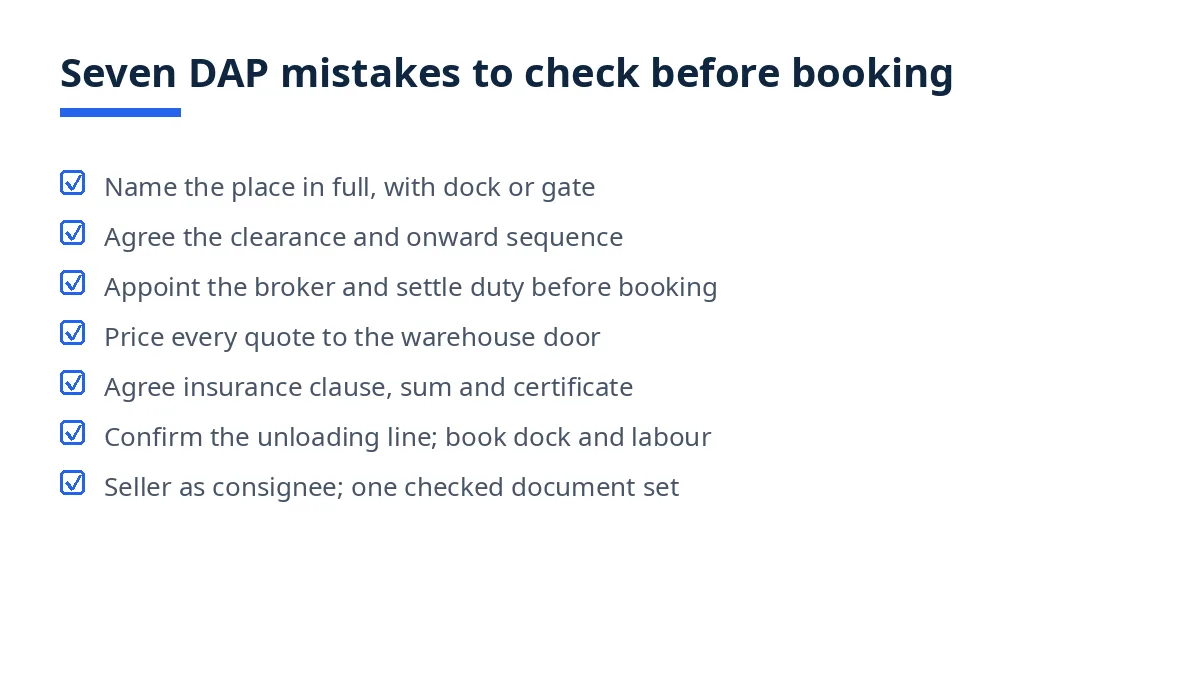
1. Writing "DAP" with no edition and only a city as the named place
What happens. The order or quotation says "DAP London", "DAP Dubai" or simply "DAP", with no edition and no address. The named place is the point where delivery happens and risk passes, so a city name leaves the delivery point open to argument.3
What it costs. Where the exact point is not specified, the seller can select the point that suits its purpose, usually the cheapest option, such as a cargo terminal.3 The buyer pays the inland leg from that terminal and the time spent arguing about a point that should have been fixed in one line. Trade guidance gives the possible answers for one large city: the buyer's premises, a building site, the carrier's premises, the airport, the container yard, or a quay.3
Fix it before booking. Write the rule, the named place and the edition together in every document, in the form "DAP [full address, dock or gate], Incoterms 2020", with access details, and check the same full place appears on the quotation, contract, invoice and transport document.4 A bare term leaves the governing rules open to argument.5 Read the Incoterms guide for how the named place fixes the end of the seller's carriage.
2. Treating arrival as one handover, when clearance sits in the middle
What happens. The buyer plans a single receipt at the warehouse, but the goods first arrive at an airport or port, where import clearance must be carried out by the buyer while the goods sit there. Once cleared, the seller's carrier must be given the paperwork to move the cargo to its final destination.3
What it costs. Under DAP, the buyer bears all risks of loss or damage during the import clearance process.2 If the buyer cannot import-clear promptly, it bears the risk while the goods sit in customs control, and the seller cannot deliver as contracted.3 If the goods are damaged or lost before the final destination, the seller may be unable to deliver, while the buyer has already paid import duty and tax.3 Delivery and destination coincide under the "D" rules, unlike the "C" rules.6
Fix it before booking. Agree the sequence in writing: arrival notice, clearance, onward movement, and who pays storage and demurrage during a clearance delay; do not assume the rule settles that bill. Name the clearance point and the final place as two separate lines. See the DAP risk guide for the arrival moment.
3. Leaving import clearance until the goods arrive
What happens. No broker is appointed, no import identifier is in place, licenses are unchecked, and classification and the duty estimate are left until the arrival notice. Under DAP, the buyer must carry out and pay for all import formalities, including licenses, security clearance and pre-shipment inspection where required.3 The seller must assist at the buyer's cost where asked, but the filing stays with the buyer.3
What it costs. In the UK, an importer needs an EORI number that starts with GB for England, Wales and Scotland, and goods may be held at the border where the right duty or VAT has not been paid, licenses are missing, or the goods did not pass inspection.7 In the EU, an importer normally needs to be established in the EU and to hold an EORI number valid throughout the EU, and EORI registration can take some time, so the guidance is to apply well ahead.8 An Entry Summary Declaration must be presented before arrival, temporary storage under customs supervision lasts no longer than 90 days, and a customs representative is appointed by the importer.8 In the USA and the UAE the filing steps differ: confirm each one with your broker. Where the buyer fails to obtain a necessary import permit, it bears the risk from the agreed delivery date or period.3
Fix it before booking. Appoint the broker before booking, give written authority, and send the broker the invoice, packing list and transport document in transit. Settle classification, the duty estimate, licenses and inspection before the goods move, and confirm the duty and tax money is ready before arrival.
4. Budgeting the DAP price as the landed price
What happens. A DAP headline price is ranked against an FOB or CIF headline price, or entered as the full cost at the warehouse. Under DAP, import clearance, duty and taxes, unloading and onward transport stay with the buyer.2 Never compare FOB, CIF and DAP headline prices directly: price every quote to the same point.5
What it costs. The remainder includes duty and tax, the broker's fee, destination handling the freight contract does not cover, unloading, and any onward leg. A CIF value is a customs valuation basis, not a landed cost: landed cost adds duty, non-recoverable tax, destination charges, broker fees and onward transport.9 Price on the good units received, not the units ordered, because damaged or rejected units raise the cost of each saleable unit.10
Fix it before booking. Build one comparison sheet: the same named place, specification, quantity, currency and validity, with the buyer-side lines added from broker and forwarder figures, and the insurance line shown separately. Work the remainder through the landed cost guide with your broker's figures.
5. Assuming the seller insured the cargo
What happens. The buyer sees that the seller bears transit risk to the named place and assumes a policy travels with the goods. Under DAP, the seller has no obligation to arrange insurance for the buyer, even though the seller bears the risk of transportation up to the agreed destination.2 None of the "D" terms obliges the seller to arrange insurance for the buyer.6 Only CIF and CIP oblige the seller to buy insurance for the buyer, at different levels of cover.5
What it costs. Damage at the named place becomes a claim against the seller under the sales contract, not a prompt insurance payment. The clause wording decides whether a policy would have paid: Clauses (A) cover all causes except those specifically excluded, while (B) and (C) cover only listed perils, with (C) the narrowest.11 Theft, malicious damage, rough handling, washing overboard and water entry are covered under (A) only in the clause comparison, and (C) does not cover earthquake, volcanic eruption, lightning, washing overboard or water entry.11 The 110 percent figures sometimes copied into a DAP contract belong to other rules: CIF requires Clause (C) cover for at least 110 percent of the contract price, and CIP requires Clause (A) at the same percentage.9 Neither is a DAP requirement.
Fix it before booking. State in the contract who buys the cover, for which leg, under which clause, for what sum and currency, who pays, and who holds the certificate. Hold the certificate before shipment, confirm cover runs through unloading and any onward leg, and brief the receiving team: inspect, note damage, notify carrier and insurer, preserve goods and packaging.12 See the DAP insurance guide for how to buy cover.
6. Assuming unloading is included in the carriage price
What happens. The truck arrives, the goods sit on the vehicle, and no dock, labor or equipment is booked, because the buyer assumed the carriage price included unloading. Under DAP, the buyer is responsible for the costs and risks of unloading, unless the transport contract includes unloading costs for the seller, in which case the buyer still assumes only the risks during unloading.2 DPU is the only "D" rule that requires the seller to unload.6
What it costs. A vehicle waits, labor is hired at short notice, and the buyer pays twice where an unloading charge was already inside the freight price. The seller should state any unloading charge in the transport contract, to avoid double payment.2 Where the site has no unloading equipment, or the goods need specialized equipment, DPU is likely to be preferable to DAP.3 The buyer bears the risk during unloading even where the seller paid the unloading cost.2
Fix it before booking. Ask the seller, in writing, whether the carriage contract includes the unloading charge, and record the answer on the quotation. Book the dock, labor and equipment for the arrival window before the vehicle arrives. Where the site cannot unload, agree DPU instead of DAP before booking, rather than arguing about unloading at the gate.
7. Naming the buyer as consignee and letting the documents disagree
What happens. The buyer is named as consignee on the bill of lading or air waybill, and the figures on the invoice, packing list and transport document do not match. The buyer should not be the consignee where the seller still has to arrange onward movement: that should be the seller, since it is the seller who has to arrange for its forwarder to take possession of the goods and arrange local inland transport.3 In Bangladesh, goods must not be loaded or stuffed in containers unless a Bill of Export has been submitted to Customs and approved, with the export contract or letter of credit, signed invoice, packing list, EXP form certified by an Authorized Dealer bank, certificate of origin, VAT certificate and Taxpayer Identification Number enclosed.13
What it costs. The seller's forwarder cannot take possession of the goods, and clearance stalls. Customs compares the invoice, bill of lading, insurance certificate and packing list, and where the freight or insurance figures cannot be identified, the declaration can be delayed.9 A claim later needs the same set, plus the delivery receipt noting damage, photographs and carrier correspondence.12
Fix it before booking. Name the seller as consignee and the buyer or broker as notify party. Build every document from one data set, starting with the invoice, name one checker on each side, and ask for Bill of Export and certificate of origin copies before loading. Use the DAP documents checklist, and recheck the set after any correction, at the source document.
Summary table: the seven mistakes, the cost and the fix
There is no separate file to download: this table is the summary. Copy it into the order file.
Mistake | What it costs | Fix before booking |
|---|---|---|
City only, no edition | Seller picks the cheapest point | Full address, dock or gate, "Incoterms 2020" |
Arrival read as one handover | Buyer bears risk during clearance; duty already paid | Agree the clearance sequence and waiting charges |
Clearance left until arrival | Goods held; buyer bears risk in customs control | Broker, licenses and duty estimate settled before booking |
DAP price read as landed price | Duty, tax, broker and unloading land as a surprise | Price every quote to the warehouse door |
Insurance assumed included | No insurer to claim from | Clause, sum, payer and certificate agreed in writing |
Unloading assumed included | Vehicle waits; unloading paid twice or not booked | Carriage line confirmed; dock and labor booked |
Buyer as consignee; documents disagree | Forwarder cannot take possession; declaration delayed | Seller as consignee; one data set, one checker each side |
Worked example: pricing the buyer-side remainder
Example figures. Every figure below is illustrative arithmetic for one shipment of men's woven shirts from Chattogram to a warehouse in Manchester, quoted DAP the warehouse, Incoterms 2020. No duty rate is stated: duty and tax are example lump sums only, and the broker must calculate both on the exact classification.10
Line | Example figure (USD) |
|---|---|
Goods, including export packing | 24,600 |
Export clearance and documents | 420 |
Carriage to the named place | 3,180 |
DAP price to the warehouse | 28,200 |
Import duty, example lump sum | 1,860 |
Import tax, example lump sum | 2,240 |
Customs broker and clearance | 310 |
Unloading at the warehouse | 290 |
Buyer-side total | 4,700 |
Landed total at the warehouse | 32,900 |
The arithmetic is 24,600 plus 420 plus 3,180 equals 28,200, and 1,860 plus 2,240 plus 310 plus 290 equals 4,700, giving 32,900. A buyer that budgeted the DAP price as the landed price would be 4,700 short before any insurance premium, inspection fee or bank charge. Replace every line with a broker, forwarder or insurer figure. The CIF guide shows why a port-based price needs the same remainder added.
What is the biggest DAP mistake an importer can make?
The vague named place, because it moves the point where cost and risk pass without either side noticing until arrival. A city name lets the seller select the cheapest point, usually a cargo terminal, and leaves the inland leg and clearance sequence to be settled while the goods wait.3 Fix the place first, in full.
How can I avoid DAP mistakes before I book?
Run five checks, and do not book until each has a written answer: the contract states the full named place and edition; the broker is appointed and the duty estimate is in hand; every quotation is priced to the warehouse door; the insurance clause, sum, payer and certificate are agreed; and the consignee and document set are checked against the invoice. A rule does not set the price, payment terms or ownership, so those points belong in the sales contract.5
Who is responsible when a DAP shipment goes wrong at the destination?
Responsibility follows the stage. The seller bears the cost and risk of carriage to the named place and carries out export and transit formalities, and the buyer unloads, clears import customs and pays duty and taxes.2 The buyer bears the risk during import clearance and from arrival at the named place, and the seller bears the risk of the journey to that point.2 6 Where the contract agrees a variation, its wording governs that point.
Where can I get help with a DAP quotation from Bangladesh?
A customs broker settles classification, valuation, duty and tax, a forwarder settles the carriage and unloading lines, and an insurer settles the clause, sum insured and claim route. Ask each for its figure in writing, on the same comparison sheet. On Exportain, post a request for quotation stating quantity and unit, target price, destination, Incoterm, required certifications and deadline.14
Next steps on Exportain
Fix the named place and the edition first, then price the buyer-side remainder with your broker before ranking any DAP quotation. Exportain is a B2B marketplace where buyers find Bangladeshi suppliers and post requests for quotation. It is not a party to the contract for the goods, and it does not inspect goods, book freight or clear customs. Read how to buy for the buying steps, then post a free RFQ on Exportain with the named place in full, the mode and the document list in the requirement.
Sources
- Incoterms® 2020. International Chamber of Commerce (ICC) (accessed )
- DAP & DDP Incoterms 2020 explained: Key differences. ICC Academy (accessed )
- Delivered at Place (DAP) – Incoterms® 2020 Rules. Trade Finance Global (accessed )
- DAP in Shipping: A Guide to Delivered at Place Incoterms. FreightAmigo, (accessed )
- Incoterms for Shipments From Bangladesh. Exportain (accessed )
- Incoterms® 2020 C rules vs D rules: Risk transfer explained. ICC Academy (accessed )
- Get UK customs clearance when importing goods into the UK: step by step. GOV.UK (accessed )
- Guide to import goods. European Commission, Access2Markets (accessed )
- CIF Meaning (Cost, Insurance & Freight). Exportain (accessed )
- Landed Cost for Imports from Bangladesh. Exportain (accessed )
- Institute Cargo Clauses (A), (B), (C) Explained. VoyageCover (accessed )
- Step-by-Step Guide to Filing a Successful Cargo Claim. FreightAmigo, (accessed )
- Customs Clearance Procedures for Export. Bangladesh Customs, National Board of Revenue (accessed )
- How to source and buy from Bangladesh. Exportain (accessed )
About the author
Sourcing from Bangladesh?
Post a request for quotation and suppliers on Exportain can send you their quotes directly.
Post an RFQ


