Custom Organic Cotton T-Shirts Manufacturer in Bangladesh: OEM Process From Tech Pack to Bulk
How to source a custom organic cotton T-shirt in Bangladesh: check certification scope at each step, approve dye and print on the actual fabric, develop cut and weight, and secure a transaction certificate for the shipped quantity.
Short answer
A custom organic cotton T-shirt manufacturer in Bangladesh should be chosen on certified scope first: the knitter, dyer, printer and garment maker must each sit inside the certification scope, dye and print inputs must be approved for the scheme, and a transaction certificate must cover the shipped quantity. Specify yarn, fabric weight, colour and print in the tech pack, approve samples in the actual organic fabric, and confirm the minimum per style, per colour and per dye lot in writing.
On this page
Key takeaways
Choose on certified scope first: the knitter, dyer, printer and garment maker must each sit inside the certification scope for the steps your shirt needs.
Approve dye and print on the actual organic fabric at the actual weight, because colour matched on a conventional substitute can shift and an unapproved input can break the claim.
Develop the T-shirt cut and weight together, and re-measure after washing on the pre-production sample, since a weight change alters drape, yarn use and cost.
A transaction certificate must match the shipped style, colour, quantity and invoice, or part of the shipment carries no organic claim.
Exportain verification is a document and photo review, not a factory inspection, and it does not replace the certifier's scope and transaction certificates.
A custom organic cotton T-shirt order fails in a different place from a conventional T-shirt order. The cut, the neckline and the stitching may be right, yet the order still cannot be sold as organic if the yarn was not in scope, the dye was not approved for the claim, or the shipment has no transaction certificate to carry the claim forward. Buyers who treat organic as a fabric choice, rather than a chain of custody, discover the gap only when the finished shirts are ready to ship.
The Bangladesh Knitwear Manufacturers and Exporters Association (BKMEA), established in 1996, is the apex trade body for the knitwear sector and represents approximately 2,540 knitwear member factories.1 That base does not by itself settle whether a given factory, knitter, dyer or printer sits inside a certified organic scope for a particular order.
Why this matters for buyers and sellers
For the buyer, the organic claim is part of the product. A hang tag, a website claim or a retail specification that says organic has to be backed by certificates that match the fibre content, the processing steps and the quantity shipped. If any link is outside scope, the claim must be dropped or the order reworked, and rework on a finished garment is usually impossible.
For the seller, an organic order carries extra handling that a conventional order does not. Organic yarn and fabric must be kept separate from conventional material, approved dyes and auxiliaries must be used, and every movement must be recorded so the certifier can reconcile the volume that went in against the volume that went out.
The Global Organic Textile Standard (GOTS) sets published material, processing, environmental, social, traceability and labelling requirements for activities within the certified scope.2 Its standard states that transaction certificates are the key enablers of traceability and transparency of the GOTS supply chain, and that certified entities purchasing GOTS goods must receive and maintain scope and transaction certificates for the whole quantity purchased.2
Step-by-step: how it works
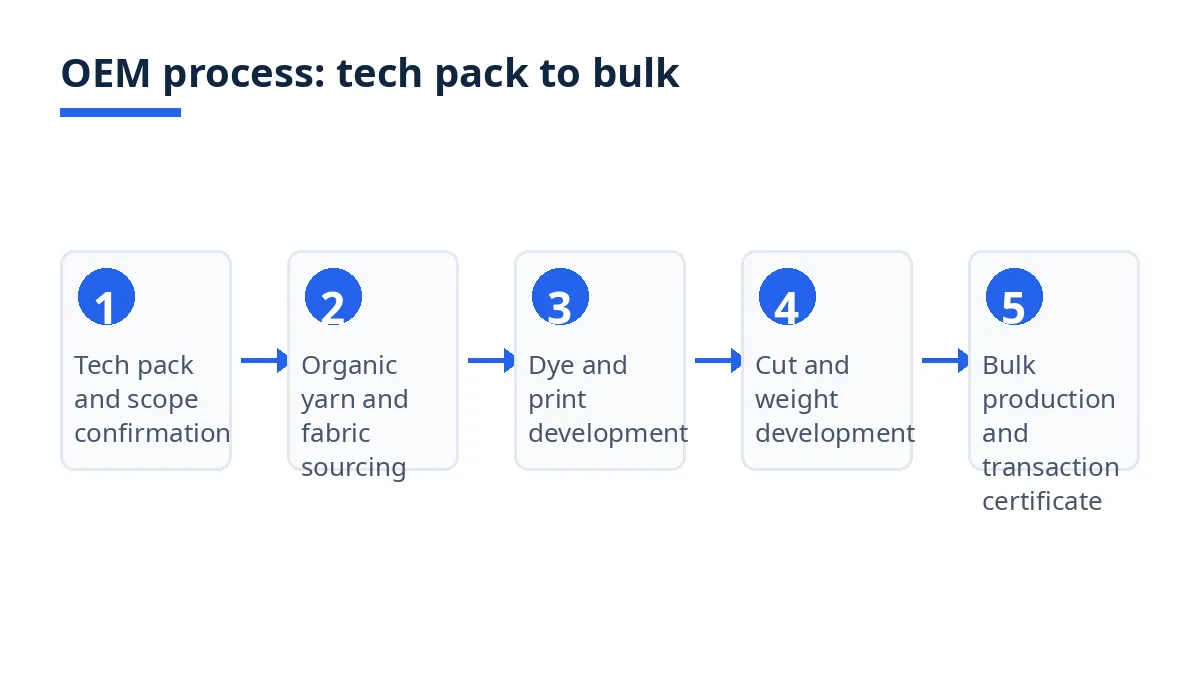
Fix the claim before the tech pack. State the exact claim you intend to make, the fibre composition, and which certification scheme it rests on. A shirt described as organic cotton must name the scheme, because GOTS, OEKO-TEX ORGANIC COTTON and a farm-only certificate are not interchangeable. Since 1 April 2025, OEKO-TEX STANDARD 100 certification has not included claims of "GMO-free" or "organic" cotton in its certificate scopes, and certifying cotton as organic is achievable through OEKO-TEX ORGANIC COTTON instead.3
Check scope at every processing step. Ask for the scope certificate of the knitter, the dyer, the printer and the garment maker, and check that each step your shirt needs is listed. A garment maker in scope does not make an out-of-scope dyer acceptable, and a subcontracted print step must also sit inside the certified chain.
Develop the organic yarn and fabric first. State the yarn count, the knit construction, the fabric weight in grams per square metre, the fibre composition and the colour for each style. Confirm whether the organic yarn is stocked or must be ordered, and whether the fabric will be knitted from yarn already covered by a transaction certificate. Record the lot identity so the fabric can be traced back to the yarn.
Develop the dye and print separately from the garment. Organic dye and print development is its own approval stage. Ask which dyes, pigments and auxiliaries are approved for the scheme you are claiming, and approve colour on the actual organic fabric, not on a conventional substitute. A print colour matched on conventional cotton can shift on organic fabric, and a substitute print paste can break the claim even when the colour looks right.
Develop the T-shirt cut and weight. A T-shirt is a simple garment, which makes small changes visible. Approve the body length, chest width, shoulder, sleeve length and neckline construction on a proto sample, then re-measure after washing on a pre-production sample in the actual organic fabric, colour and print. A change in weight after approval is a change in cost and in the volume reconciliation.
Approve samples in writing, in the right order. Order a proto sample for fit and construction, a lab-dip or strike-off for colour and print, and a pre-production sample in the final fabric, colour, print, labels and packing. Approve or list corrections in writing at each stage, and do not move a stage forward on a verbal approval.
Agree inspection, labels and the transaction certificate before bulk. Write the inspection plan, the fibre-composition label, the certification label wording and the transaction-certificate request into the purchase order, so the buyer receives a claim that survives the shipment.
See the organic cotton T-shirts quality control checklist for wash, measurement and print points, and the HS code for organic cotton T-shirts guide for classification.
Costs, timelines and documents
What are the typical costs and timelines?
There is no typical price or lead time a guide can state for a custom organic T-shirt, because each order prices its own yarn, dye lot, print set-up, cut and certification handling. Ask for sampling, yarn ready, fabric ready, dye and print approval, production, inspection and certificate dates as separate lines, not a single delivery week.
What drives the price is structure, not only quantity. A small number of colours in a stocked organic yarn, one print placement and a single fabric weight shared across styles all lower the cost per shirt. A wide colour range, a custom-dyed shade, a multi-colour print and a separate label run each add a lot or a set-up that must be recovered across the order.
Example figures: a buyer orders 2,400 shirts in three colours at 800 per colour, and the factory quotes a dye-lot minimum of 1,000 shirts per colour. The total of 2,400 clears a 2,400-piece order minimum, yet each colour at 800 sits below the 1,000-piece dye minimum, so one colour must be dropped, increased to 1,000, or dyed at a surcharge. The same 2,400 shirts in two colours at 1,200 per colour clear both lines. The example shows structure only, not a typical MOQ, price or lead time.
Which documents are needed?
Hold loading until Customs approves the export filing. The pack your exporter prepares is the standard commercial set — order or contract, invoice, packing list, authorised-dealer-certified EXP form, and an EPB or Chamber certificate of origin.4
On top of that export set, an organic order needs its certification set: the scope certificates for each processing step, the transaction certificates for the yarn and fabric bought in, the approved dye and auxiliary records, and the transaction certificate for the finished shirts. Customs asks whether the goods may leave; the certification set asks whether the goods may be called organic when they arrive.
In the Harmonized System, heading 6109 covers T-shirts, singlets and other vests, knitted or crocheted.5 If you sell into the European Union, Regulation (EU) No 1007/2011 states that a textile product shall be labelled or marked with the name and percentage by weight of all constituent fibres in descending order.6 The fibre-composition label and the organic claim label are therefore two different labels, and both must be correct before the shirts ship.
Decision | What to specify | What it protects |
|---|---|---|
Claim and scheme | Exact claim wording and certification scheme | The right to use the word organic on the product |
Yarn and fabric | Yarn count, construction, weight, composition, lot identity | Traceability from yarn to finished shirt |
Dye and print | Approved dyes, auxiliaries, colour on actual organic fabric | Colour approval that does not break the claim |
Cut and weight | Measurements before and after washing, fabric weight | Fit and quantity per shirt after wash |
Labels | Fibre composition and certification label wording | Legal labelling and the retail claim |
Shipment paper | Transaction certificate for the shipped quantity | A claim that survives the shipment |
Bangladesh-specific rules and tips
Confirm scope, not only membership. If a supplier claims BKMEA membership, confirm it with the association itself. BKMEA represents the knitwear sector and its member factories,1 so membership signals an active knitwear business, not organic scope, dye approval or capacity for your order. Ask for the scope certificate itself, and check the listed processes and the expiry date.
Keep organic and conventional material apart on paper and on the floor. Segregation is a condition of the claim, not a housekeeping preference. Ask how organic yarn, greige fabric and finished shirts are stored and identified. A factory that cannot describe its segregation in plain terms is not ready for an organic order.
Ask which inputs are bought in for your order. Organic yarn, approved dyes and some trims may be bought in for your specification, and a bought-in input can set both the minimum and the earliest production date.
Match every name across every paper. The export declaration names the exporter and the foreign buyer,4 so the name on the trade licence, quotation, proforma invoice, transaction certificate and payment account should match. A mismatch between the transaction certificate and the invoice is a common reason a claim is questioned at the destination, even when the shirts themselves are correct.
Mistakes and red flags
What are the most common mistakes?
Claiming organic from a fabric name alone. A fabric described as organic cotton, without a scope certificate for the processing steps and a transaction certificate for the quantity, is an unbacked claim. Ask for both documents before you approve bulk.
Approving colour on the wrong fabric. A lab-dip on conventional cotton, or a print strike-off on a different weight, does not approve the organic shirt. Colour and print must be approved on the actual organic fabric at the actual weight.
Changing weight after approval. A heavier or lighter fabric changes drape, wash behaviour, yarn consumption and cost. Treat any weight change as a new approval, with a new sample and a revised quotation.
Accepting a transaction certificate for a different quantity. A certificate that covers less than the shipped quantity leaves part of the shipment without a claim, and a certificate for a different style or colour does not cover your shirts. Check style, colour, quantity and invoice number line by line.
Treating a profile or a badge as certification. A profile is a starting point for enquiries. Exportain supplier verification is a document review by its team, not a factory inspection, and a badge is not a guarantee of production capacity, product quality or delivery.7 Organic certification is a separate check, held by the certifier, not by a marketplace badge.8
Skipping the pre-production sample to save time. The pre-production sample is the last point at which a dye, print, weight or fit problem can be fixed without reworking finished stock.
Checklist
Before you confirm, every line should be answered in writing.
Claim and scheme stated exactly, with the label wording agreed.
Scope certificates collected for knitting, dyeing, printing and garment making, with processes and expiry dates checked.
Organic yarn status per colour recorded: stocked or ordered, with lot identity.
Fabric construction, weight and composition specified, and colour approved on the actual organic fabric.
Dye and print inputs confirmed as approved for the scheme, with strike-offs approved in writing.
T-shirt cut approved before washing and re-measured after washing on the pre-production sample.
MOQ confirmed per style, per colour and per dye lot, with the binding line named.
Transaction certificate requested for the shipped quantity, matching style, colour, invoice and packing list.
Fibre-composition label checked against the destination labelling rule, apart from the organic claim label.
Inspection plan, delivery term and certificate dates written into the purchase order.
How Exportain helps
Exportain is a marketplace where buyers can find Bangladeshi suppliers and request quotations; it is not a party to the goods contract and does not inspect goods. Supplier verification on Exportain is a document and photo review, not a factory inspection, and approved checks earn trust badges shown on a supplier profile.7 8 Use that review as a starting screen, then run the organic checks in this guide yourself: scope certificates, approved inputs, samples in the actual fabric, and a transaction certificate for the shipped quantity.
FAQs
What should I know first about organic cotton T-shirts?
Know the claim before you know the shirt. State the certification scheme, the fibre composition and the exact label wording first, then check that every processing step sits inside scope and that a transaction certificate can be issued for the shipped quantity.
What are the typical costs and timelines?
There are no typical costs or timelines for a custom organic T-shirt order. Price and time follow the yarn, the dye lot, the print set-up, the fabric weight and the certification handling for your specification. Ask for each stage as a separate dated line.
Which documents are needed?
The customs set and the certification set are both needed. The customs set centres on the Bill of Export, the commercial invoice, the packing list, the EXP form and the certificate of origin.4 The certification set centres on scope certificates for each processing step and transaction certificates for the yarn, fabric and finished shirts.2 Keep the two sets in one file, with names matching across both.
What are the most common mistakes?
The most common mistakes are claiming organic from a fabric name alone, approving colour on conventional fabric, changing fabric weight after approval, and accepting a transaction certificate that does not match the shipped style, colour and quantity.
Next steps on Exportain
Start with the organic cotton T-shirts manufacturers in Bangladesh guide, check the organic cotton T-shirts MOQ in Bangladesh guide for how minimums are structured, and use the minimum order quantity definition guide to frame the per-colour question. Then post your specification through Exportain suppliers or Exportain RFQs, with the claim, the fabric weight, the dye and print method and the transaction-certificate requirement stated in the enquiry itself.
Sources
- BKMEA at a Glance. BKMEA (accessed )
- Global Organic Textile Standard (GOTS) Version 8.1. Global Standards (accessed )
- OEKO-TEX New regulations 2025 press release. OEKO-TEX (accessed )
- Customs Clearance Procedures for Export. Bangladesh Customs, National Board of Revenue (accessed )
- Knit T-shirts (HS: 6109) Product Trade, Exporters and Importers. Observatory of Economic Complexity (accessed )
- Regulation (EU) No 1007/2011 on textile fibre names and related labelling and marking of the fibre composition of textile products. European Union, (accessed )
- Trust & Safety Center. Exportain (accessed )
- Supplier verification: Earn trust badges buyers can see. Exportain (accessed )
About the author
Sourcing from Bangladesh?
Post a request for quotation and suppliers on Exportain can send you their quotes directly.
Post an RFQ