Quality Control Checklist for Organic Cotton T-Shirts From Bangladesh
A numbered QC checklist for organic cotton t-shirts from Bangladesh: organic claim documents, measurements, neck rib and seams, wash tests, color fastness, labels and packing, with fixes for common failures.
Short answer
Use this organic cotton t-shirts quality control checklist to check the organic claim documents, measurements, neck rib, shoulders and seams, fabric and shade, dimensional change after washing, color fastness, prints, labels and packing on t-shirts from Bangladesh before shipment. Agree tolerances, test methods and AQL acceptance numbers first, and hold any lot whose documents or garments fail.
On this page
Key takeaways
Check the organic claim before the garments: match the scope certificate and transaction evidence to this lot, and confirm the label grade wording matches the grade ordered.
Agree the approved sample, size chart tolerances, wash-test methods and AQL acceptance numbers before inspection, and draw the sample randomly across sizes, colors and cartons.
Stretch the neck rib and pull-test shoulder seams on every sample, because fit faults on a t-shirt concentrate at the neck and shoulders.
Wash a sample set and re-measure it, because shrinkage and side-seam spiral only show after washing and drying, not on the inspection table.
If you import organic cotton tees, this organic cotton t-shirts quality control checklist lets you check both the garment and the organic claim before a shipment leaves Bangladesh. The two checks are linked: a well-sewn shirt with the wrong fibre documents is not the product you ordered. Under the Global Organic Textile Standard (GOTS), products must contain a minimum of 70% certified organic fibres, with two label grades: organic, at least 95% certified organic fibres, and made with organic materials, at least 70%.1 The Organic Content Standard (OCS), developed by Textile Exchange, verifies the presence and quantity of organic material in a final product and traces the flow of raw materials from origin to final product.2 Sampling should follow an agreed plan rather than pieces the factory selects. ISO 2859-1 defines acceptance sampling plans for inspection by attributes, using the acceptance quality limit (AQL) to determine sample sizes and acceptance and rejection thresholds.3
Why this checklist matters
An organic cotton t-shirt is a basic garment sold on a specific claim. The buyer pays for certified organic fibre, for processing that keeps it separate from conventional cotton, and for a shirt that fits and washes as specified. A general t-shirt check covers only the last part. A written checklist removes interpretation. Either a measurement sits inside the agreed tolerance or it does not, and either the documents name this lot and claim wording or they do not. Set acceptance numbers for critical, major and minor defects in the purchase order.3 The AQL acceptance quality limit explainer sets out how those limits work.
Before you start
Do not begin until the reference material is complete: the approved pre-production sample, the purchase order and technical pack, the size chart with tolerances, the approved fabric and rib references, the artwork files, the packing specification, and the organic claim documents.
Check the claim documents before you check garments. GOTS combines independent certification, annual on-site audits, transaction verification and strict chain-of-custody requirements, using physical segregation and volume reconciliation rather than a mass balance approach.1 Ask for the scope certificate covering the facility and product, and the transaction evidence for this lot. Under OCS, certification applies across the supply chain, including manufacturing, packaging and labelling, and to products containing at least 5% organically grown material, excluding accessories and trimmings.2 OCS focuses on traceability and does not impose chemical restrictions or social audits, so an OCS document does not by itself support a wider processing claim.2
Agree the sampling plan in advance, using the AQL approach described above.3 A during-production check catches neck and print problems early, while the final check verifies finished, packed goods. The guide to pre-shipment inspection explains how a final check is timed. Check the label plan before bulk labels are printed. Under Regulation (EU) No 1007/2011, a textile product sold in the EU must be labelled with the name and percentage by weight of all constituent fibres in descending order.4 Elastane in a neck rib changes that wording, and the fibre label alone does not prove an organic claim.
The full checklist
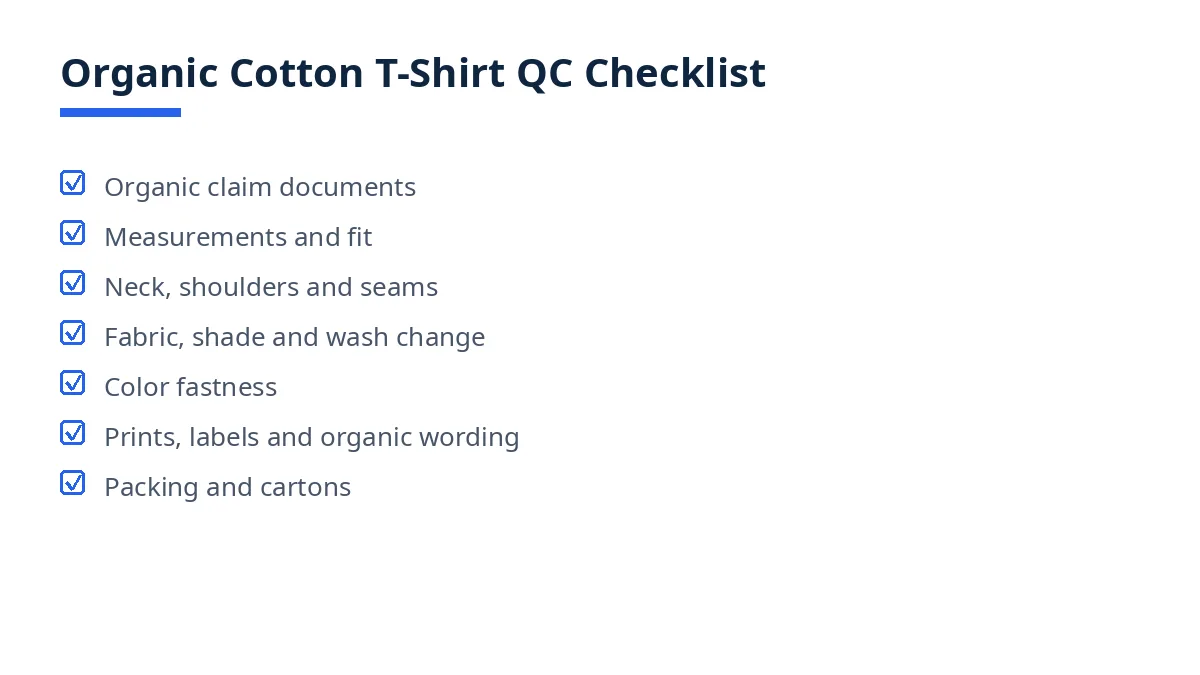
Work through each section in order and mark every line pass, fail or not applicable, with a photo for every failure.
Organic claim and documents
Match the scope certificate to the factory name and address, product category and validity dates.
Match the transaction evidence to the fibre, yarn and fabric quantities in this lot, and check that the quantities reconcile with the garments produced.
Confirm that claim wording on labels, hangtags and cartons matches the grade ordered: organic or made with organic materials under GOTS, with the fibre percentages that grade requires.1
Check that organic fabric and garments were stored and packed separately from conventional cotton goods, with lot identification following the goods to the carton.
Measurements and fit
Select pieces across all sizes and colors and measure body length, chest width, hem width, sleeve length and opening, shoulder width and neck drop.
Compare every measurement with the chart tolerance, and record actual values rather than ticks.
Lay paired pieces flat and confirm the two sleeves match, and that the neck opening sits centered.
Try the base size and the largest size on a form or model, and check that the neck rib sits flat and the hem hangs level.
Neck, shoulders and side seams
Stretch each neck rib by hand and check that it returns evenly, with no rippling or wavy edge.
Check shoulder seams and shoulder tape for skipped stitches and uneven stitch density.
Check side seams, where the style has them, for seam opening, puckering and spiral, holding each garment up so the seams hang from armhole to hem.
Pull-test the joins that carry load: shoulder seams, armhole seams and hem corners.
Where seam strength is tested in a laboratory, confirm the method and limit were agreed in advance. ISO 13935-1 specifies a strip test for the maximum force to seam rupture, with force applied perpendicularly to the seam, for straight seams.5
Fabric, shade and dimensional change
Hold each sampled garment to the light and check body, sleeves and neck rib for holes, slubs, dropped stitches, oil marks and shading.
Compare shade within each garment, between garments and against the approved lab dip under the same light, and separate any piece in a different shade band.
Check fabric weight and hand feel against the approved reference for each color, including the rib.
Wash and dry a sample set by the method named in the pack, then re-measure length and chest width and re-check side seams and neck rib. ISO 5077 specifies a method for determining the dimensional change of fabrics, garments and other textile articles after specified washing and drying procedures.6 Judge the result against the change limit in the purchase order.
Color fastness: washing, rubbing and perspiration
Review washing fastness evidence where the order requires it. ISO 105-C06 specifies methods for the resistance of color to domestic and commercial laundering using a reference detergent, and a single test closely approximates one laundering.7
Review rubbing fastness evidence for dark and printed colors. ISO 105-X12 specifies a method for the resistance of color to rubbing off and staining other materials, with one dry and one wet rubbing test.8
Review perspiration fastness evidence, because a t-shirt is worn against the skin. ISO 105-E04 specifies a method for determining the resistance of the color of textiles to human perspiration.9
Confirm that every test report names the bulk fabric, the color tested and this production lot.
Prints, labels and trims
Stretch every chest print by hand and check for cracking, fading and distortion, then rub the print and check the edges for lifting.
Check print placement against the pack: distance below the neckline, centering and level.
Verify that size, care, fibre and origin labels are present, legible and correctly positioned. For the EU, check fibre names and percentages against Regulation No 1007/2011.4
Check that any organic wording on a print, hangtag or polybag matches the approved claim wording exactly.
Packing and cartons
Check that barcode stickers scan and match size, color and style on the purchase order.
Confirm that folding, polybags, hangtags and size ratios match the packing specification.
Weigh and measure sample cartons, and check markings, ratios and carton count against the packing list.
Common failures and how to fix them
The most frequent failure is a claim and document mismatch: the garments are correct, but the transaction evidence covers a different fabric lot, or the hangtag states a stronger grade than the order. Stop packing, reconcile the documents against the fabric used, and correct the wording before cartons are sealed.
Neck rib trouble is next: a rib that ripples after one stretch, or a neck opening off center. Compare bulk rib against the approved reference, sew and stretch-test a corrected sample, and only then restart. Side-seam spiral and shrinkage appear only after washing, so catch them with the wash-and-re-measure step above.
Shade banding between body and neck rib usually traces to the rib being dyed separately without a joint shade check. Require a body-and-rib check together before bulk cutting.
When failures exceed the agreed acceptance level, the usual options are re-inspection after sorting or rework, partial acceptance for minor documented defects, or rejection of the lot.
Summary table
Section | What is checked | Typical evidence |
|---|---|---|
Organic claim and documents | Scope, transaction evidence, grade, segregation | Certificates, lot reconciliation |
Measurements and fit | Size chart points, sleeve and neck symmetry | Recorded measurements per size |
Neck, shoulders and seams | Rib recovery, shoulder tape, seam spiral | Stretch checks, defect photos |
Fabric and shade | Panel faults, shade bands, wash change | Wash-test measurements |
Color fastness | Wash, rubbing and perspiration results | Lab reports per color |
Prints, labels and trims | Print stretch, placement, label wording | Placement checks, label files |
Packing and cartons | Barcodes, ratios, folding, markings | Packing list, carton count |
How Exportain helps
Exportain connects buyers with Bangladeshi suppliers of organic cotton t-shirts and other knitwear, so specifications and claim documents can be agreed at the enquiry stage. Browse suppliers and use inspection services when you plan how a shipment will be checked. Supplier profiles show which document and photo checks have been recorded: reviews of documents and photos, not factory inspections, which do not replace your own inspection, testing or contract.
FAQs
When should this checklist be used?
Use it at least at final inspection, when goods are finished and largely packed. For larger and first orders, also use it during production, and check the claim documents before bulk fabric is cut.
Who should complete it?
The buyer, the buyer's local agent or an independent inspector can complete it, using the approved sample, size chart, packing specification and claim documents, and recording measurements and defects.
What are the most common failures?
Claim and document mismatches, rippled or off-center neck ribs, side seams that spiral after washing, shade differences between body and neck rib, and shrinkage outside the agreed limit.
Can a third party do it?
Yes. A third-party inspector can apply it independently, provided you share the references, tolerances, test methods, sampling plan and claim documents in advance.
Next steps on Exportain
Before production starts, agree your size chart, tolerances, label wording, claim grade and sampling plan, then read how to import organic cotton t-shirts from Bangladesh and compare this list with the cotton t-shirts quality control checklist for mixed orders.
Sources
- GOTS - All key features at a glance. Global Standards (accessed )
- OCS – Organic Content Standard. Control Union (accessed )
- ISO 2859-1:2026 - Sampling procedures for inspection by attributes — Part 1: Sampling schemes indexed by acceptance quality limit (AQL) for lot-by-lot inspection. ISO (accessed )
- Regulation (EU) No 1007/2011 on textile fibre names and related labelling and marking of the fibre composition of textile products. European Union, (accessed )
- ISO 13935-1:2014 - Textiles — Seam tensile properties of fabrics and made-up textile articles — Part 1: Determination of maximum force to seam rupture using the strip method. International Organization for Standardization (accessed )
- ISO 5077:2007 - Textiles — Determination of dimensional change in washing and drying. International Organization for Standardization (accessed )
- ISO 105-C06:2010 Textiles — Tests for colour fastness — Part C06: Colour fastness to domestic and commercial laundering. International Organization for Standardization, (accessed )
- ISO 105-X12:2016 - Textiles — Tests for colour fastness — Part X12: Colour fastness to rubbing. International Organization for Standardization (accessed )
- ISO 105-E04:2013 - Textiles — Tests for colour fastness — Part E04: Colour fastness to perspiration. International Organization for Standardization, (accessed )
- knitwear
- pre-shipment inspection
- quality control
- aql inspection
- bangladesh garments
- Organic cotton t-shirts
About the author
Sourcing from Bangladesh?
Post a request for quotation and suppliers on Exportain can send you their quotes directly.
Post an RFQ