

Typical MOQ for Organic Cotton T-Shirts in Bangladesh (and How to Negotiate It Down)
No single organic cotton T-shirt MOQ in Bangladesh: how certified yarn lots, approved dye lots and transaction-certificate batches set the minimum per colour, and how buyers can restructure a small order.
Short answer
There is no single typical MOQ for organic cotton T-shirts from Bangladesh. Each factory sets its minimum per colour for your specification, driven by certified organic yarn lots, approved dye lots, transaction-certificate batches, rib and label runs and cutting efficiency. Ask for every floor in writing, then restructure the split or pay set-up costs separately to lower it.
On this page
Key takeaways
There is no single typical MOQ for organic cotton T-shirts from Bangladesh, because each factory sets its minimum per colour for your specification.
Certified organic yarn lots, approved dye lots and transaction-certificate batches set the floor, and a small size in a small colour can fall below a cutting or rib minimum even when the colour total looks comfortable.
Under GOTS, the label grade needs at least 95 percent certified organic fibres for Organic, or at least 70 percent for Made with Organic Materials, and every certified shipment needs a transaction certificate.
Ask for the yarn lot, dye lot and TC minimums line by line, with the binding line named, and get any agreed lower minimum in writing on the quotation and purchase order.
Lower the minimum by cutting the palette, sharing one yarn and colour across styles, using stocked inputs, or paying certification and set-up costs apart from the unit price.
A first range of organic cotton T-shirts usually stalls before sewing starts. The buyer has a style, a color palette and a total quantity in mind, yet the factory replies with questions about yarn counts, approved dyes and certificate batches. In an organic order, the quantity that can actually run is decided upstream, in the spinning mill, the dyehouse and the certification paperwork, long before fabric reaches a cutting table.
Bangladesh offers a wide knitwear base to search within. The Bangladesh Knitwear Manufacturers and Exporters Association, established in 1996, represents approximately 2,540 knitwear member factories.1 Wider export trade has also grown, with total exports up over 6 percent to $13.1 billion in the first quarter of the current fiscal year.2 A wide base helps a buyer find bidders, but it creates no shared quantity floor: each bidder buys certified inputs separately and prices their leftover risk alone.
The practical consequence is that a buyer should design the order around batches, not around a headline total. Choose the certification route, narrow the color list, and bundle styles onto shared yarn before asking for a price.
The certified-fiber pipeline sets the quantity
What should I know first about organic cotton t-shirts?
Begin with the spinning run. A spinner produces a yarn count and blend in one run, which cannot be split across buyers without leaving certified yarn no other buyer can use. When a buyer specifies a count or blend that no spinner holds in stock, that spinning run becomes the first quantity floor for the whole order. Name the yarn count, fabric weight and knit construction in the enquiry, and ask whether the yarn is held in stock or must be spun for this order.
Next, settle the label grade before sampling. Under the Global Organic Textile Standard (GOTS), a product labeled Organic must contain at least 95 percent certified organic fibers, while a product labeled Made with Organic Materials must contain at least 70 percent.3 Only approved dyestuffs, auxiliaries and finishes may be used, so a shade straightforward in conventional cotton can need a different recipe, a trial, or a larger first batch.4 A grade fixed late can leave sampled fabric unable to support the planned retail label.
The certificate batch is a separate constraint that buyers often miss. Every shipment of GOTS-certified goods must be accompanied by a transaction certificate from an approved certification body, recording product, quantity, scope and parties.4 A quantity split awkwardly across certificate batches adds fees and waiting time unrelated to the shirt count, so ask how the proposed quantity maps onto certificate batches, and request that mapping in writing.
Dyeing adds its own vessel floor: each color dyed to order carries that vessel quantity, while stocked colors avoid part of it. The size curve then applies a final squeeze: a small size inside a small color can fall below a cutting or rib quantity even when the color total looks adequate, because neck rib, cuffs and labels are produced per color rather than per order. Give the quantity for every color and every size, not a total with a size range attached.
Batch | How it binds the order | Put this in the enquiry |
|---|---|---|
Spinning run | One count and blend per run, held or spun to order | Yarn count, fabric weight, knit, stock status |
Certificate batch | One transaction certificate per certified shipment | Label grade, certifier, batch mapping |
Dye vessel | One vessel batch per color, approved inputs only | Quantity per color, stocked or dyed to order |
Rib and label run | Neck rib, cuffs and labels produced per color | Rib, trim and label specification per color |
Cutting marker | Marker efficiency across the size curve | Size range and ratio for each color |
Example figures: an order of 2,400 shirts spread across eight colors gives 300 shirts behind each color, while the same 2,400 shirts spread across four colors gives 600 behind each color. The arithmetic shows structure only, not a typical MOQ, price or lead time.
Buyers selling into the European Union should also settle fiber labeling early. Regulation (EU) No 1007/2011 requires textile products to be labeled with fiber names and percentages by weight in descending order.5 See the HS code for organic cotton t-shirts guide.
Why this matters for buyers and sellers
For a buyer, the batch logic decides how much certified stock is committed before any sales data exists. A wide palette locks cash into slow colors, and a test color that cannot fill a vessel or a certificate batch either disappears or arrives with a surcharge that erases its margin. A palette planned as batches keeps a first range testable.
For a seller, the floor is protection against inputs that have no onward certified use. Yarn spun to a buyer's blend, a dye recipe for a buyer's shade, and labels printed with a buyer's brand cannot transfer to the next buyer as certified goods if the first order shrinks. A short run still consumes the spinning run, the vessel and the certificate work, so the cost of each shirt rises as the quantity behind a color falls. That sharing of a real batch cost is what makes a lower quantity negotiable.
Step-by-step: how it works
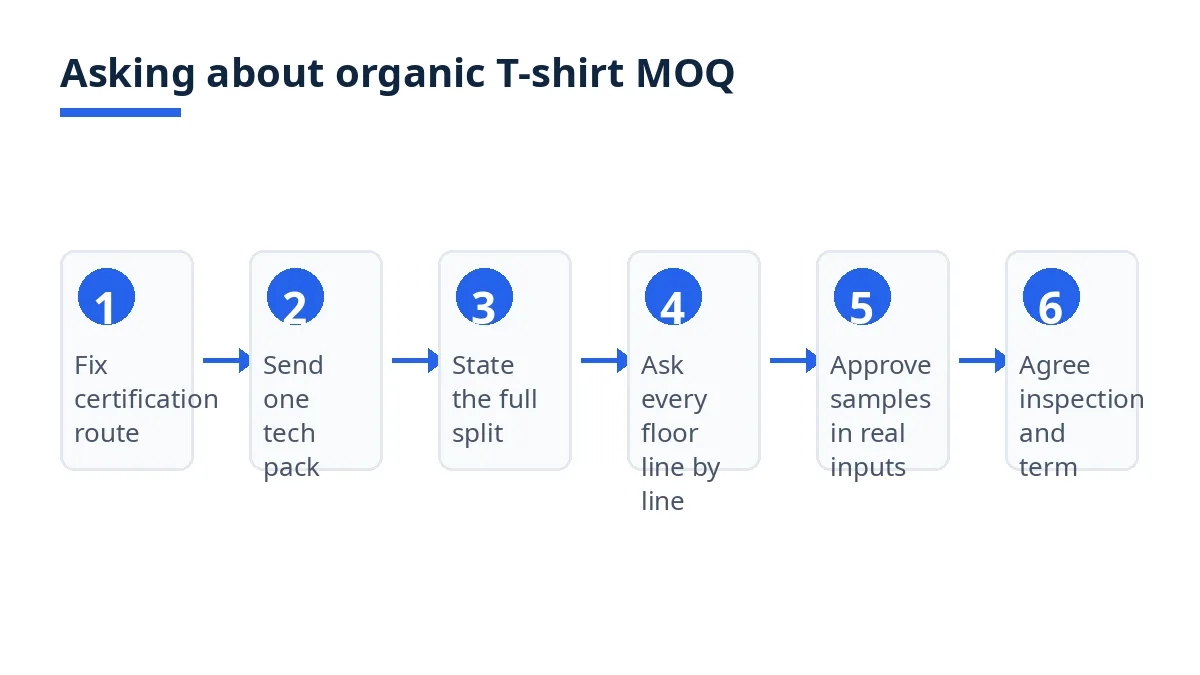
Lock the certification route. Name the label grade, and ask for the scope certificate before sampling. Confirm that the spinner, dyer, printer and sewer all sit inside the same certified chain, since a single uncertified link breaks the claim for the finished shirt.
Circulate one tech pack to every candidate. Include yarn count, fabric weight and knit, fiber percentage, neck and sleeve shape, size chart, artwork method and placement, rib and trim specification, labels and packing, identical for each factory.
Tabulate the color and size grid in full. Give quantities per color, per size and per variant: a total without a grid cannot be answered with a usable quantity, since the spinning, dye and certificate floors sit below the total.
Ask for every batch floor, and name the binding one. Request the spinning minimum, dye minimum per color, certificate batch mapping, and any separate rib, label and carton minimums, then ask which line binds.
Approve samples in the real inputs. Order a proto sample, then a pre-production sample in the actual certified fabric, color, dye recipe, artwork and labels; measure, wash and shade-check it, then approve it or list corrections in writing.
Write inspection and the delivery term into the purchase order. State one Incoterm and named place on every quotation, since the Incoterms 2020 rules allocate cost, risk and obligations for each rule.6 Put the inspection plan in the purchase order before confirming.
Levers that lower the quantity
Narrow the shade list before touching the total. Colors multiply vessels, certificate paperwork and rib runs. Removing shades raises the quantity behind each surviving color at the same total, which is often enough to clear the dye and spinning floors without changing the order size.
Bundle two necklines on identical certified jersey in an identical shade. Two styles sharing one yarn and one shade can ride on a single spinning run and a single vessel. Ask the factory to confirm, on the quotation, that batch minimums may be satisfied by the two styles together.
Choose yarn and shades already in stock. A yarn count the factory already holds, in a color it already dyes, removes the spun-to-order run and part of the dye floor. Ask for the stock list while colors are still open, because a palette fixed first and checked second rarely matches what is on the shelf.
Separate certificate and set-up charges from the unit price. Where the floor comes from transaction certificate fees, dye trials, print screens or label runs, ask for those charges as separate lines, so the shirt run can be shorter.
Phase the launch, and keep repeat terms in writing. If the factory cannot move on the full palette, place a smaller first order in the strongest colors, with a written repeat price and quantity for the same specification.
Costs, timelines and documents
What are the typical costs and timelines?
No standard cost or timeline can be stated as fact for an organic T-shirt order, for the same reason no standard quantity exists. Each factory prices the yarn count and blend, the dye recipe, the print method, rib and label runs, finishing and packing, plus the delivery term chosen.6 Certification lines — scope certification, certificate issuance and dye trials — sit apart from the sewing price, so ask for them itemized.
Timelines follow the same batch logic. Sampling depends on yarn availability, dye approval and correction rounds, while bulk production depends on spinning, dyeing, certificate issuance, trim delivery and line capacity. Ask for sampling, yarn ready, fabric ready, production and inspection dates as separate lines, and put the certificate issue date on the timeline before confirming.
Which documents are needed?
The order papers are the tech pack, the itemized quotation and the purchase order, carrying the quantity per color, the label grade and the certificate arrangement on both the quotation and the order, together with the scope certificate and the written sample approval. For shipment, goods are not loaded until the export declaration, known as the Bill of Export or Shipping Bill, is submitted to Customs and approved.7
Bangladesh-specific rules and tips
Start with the scope certificate, not the supplier profile. A scope certificate names the certified entity, the products covered and the certifier, so check the entity name against the company quoting and confirm that dyeing and printing sit inside the certified chain. A profile cannot prove that the factory holds the certificate for the buyer's shade and construction.
Do not treat a substance test as an organic claim. STANDARD 100 by OEKO-TEX tests textiles for harmful substances, with product classes set by intended use, and a T-shirt falls in the class for products mostly in direct contact with skin.8 That result covers substances in the finished textile, not how the cotton was grown, so it cannot replace a scope certificate and transaction certificate.
Use the same registered business name on the trade licence, the quotation, the proforma invoice, the scope certificate and the bank account. Customs records the exporter and the foreign buyer on the declaration,7 and a mismatch between papers slows the shipment file.
Mistakes and red flags
What are the most common mistakes?
Quoting only a grand total. The floors that matter sit below the total: spinning run, dye vessel, certificate batch and rib run. An order can clear a headline total and still fail on one shade, which then carries a surcharge or drops out of the range.
Claiming a label grade the fiber mix cannot carry. A shirt described as organic on its label needs the fiber percentage and the certified chain behind it.3 If the blend, the certificate or the transaction certificate does not match the label, the claim fails at the point of sale, not at the factory gate.
Comparing quantities quoted on different routes or terms. A lower quantity on conventional cotton, on a stocked greige, without certificate coverage, or on a different delivery term is a different offer. Compare only replies to the same tech pack, label grade and Incoterm.6
Keeping an agreed reduction in messages only. Put any smaller quantity the factory agrees to on the quotation and the purchase order, tied to the exact colors and sizes it covers, before money moves. A concession that lives only in messages is hard to enforce once the vessel is booked and the yarn is spun.
Reading a listing or a badge as proof of certified capacity. A listing is a starting point for enquiries, not a test of whether a factory can run the buyer's certified style, and a badge is not a guarantee of capacity or delivery.9
Skipping the shade and wash check to save time. An organic dye recipe can shift shade between vessels, so check the pre-production sample in the real dye vessel before bulk cutting.
Checklist
Before confirming, every line should be answered in writing.
Label grade fixed, scope certificate checked, dyer and printer inside the certified chain.
Tech pack circulated: yarn count, fabric weight, fiber percentage, neck, sleeve, artwork, rib, labels.
Color-size grid tabulated per color, size and variant.
Batch floors confirmed per color and per lot, with the binding batch named.
Stock status recorded per color: yarn and color held, spun or dyed to order.
Rib, label and carton minimums confirmed apart from the garment quantity.
Certificate and set-up charges itemized apart from the unit price.
Pre-production sample measured, washed, shade-checked and approved in writing.
Inspection plan and delivery term written into the purchase order.6
Quotations compared on the same specification, label grade and Incoterm.6
Order papers and shipment file reconciled, with certificate parties matching the invoice.4 7
How Exportain helps
Browse suppliers and post a request for quotation on the RFQ board with a tech pack summary, label grade, color-size grid and delivery term, so suppliers state their spinning, dye and certificate minimums in writing. For what platform checks record, see how supplier verification works on Exportain.9
FAQs
What should I know first about organic cotton t-shirts?
Start from the batches, not the shirt count: the quantity is set by spinning runs, dye vessels, certificate batches and rib runs, per color. A GOTS label grade needs at least 95 percent certified organic fibers for Organic or at least 70 percent for Made with Organic Materials.3 Cotton T-shirts fall under HS heading 6109, subheading 610910 for those of cotton.10
What are the typical costs and timelines?
There are no reliable standard figures. Each factory sets its price, quantity and lead time for the buyer's specification, driven by yarn, dye recipe, artwork, the color and size grid, and the delivery term.6
Which documents are needed?
The order papers are the tech pack, itemized quotation and purchase order, carrying the quantity per color, the label grade and the certificate arrangement, plus the scope certificate and the sample approval. The shipment file follows the Bill of Export rules set out by Bangladesh Customs.7
What are the most common mistakes?
The most common mistakes are quoting only a grand total, claiming a label grade the fiber mix and paperwork cannot support,3 comparing quantities quoted on different routes or terms,6 leaving an agreed reduction in conversation only, and reading a badge as a guarantee.9
Next steps on Exportain
Before confirming, read how to import organic cotton t-shirts from Bangladesh and the MOQ definition guide, then post a tech pack summary, label grade and color-size grid on the RFQ board and compare suppliers replies on the same term.
Sources
- BKMEA at a Glance. BKMEA (accessed )
- Exports up over 6% to $13.1bn in Q1 of current fiscal. United News of Bangladesh (accessed )
- GOTS Key Features at a Glance. Global Standard, (accessed )
- Global Organic Textile Standard (GOTS). ECQA (accessed )
- Regulation (EU) No 1007/2011 on textile fibre names and related labelling and marking of the fibre composition of textile products. European Union, (accessed )
- Incoterms® 2020. International Chamber of Commerce (ICC) (accessed )
- Customs Clearance Procedures for Export. Bangladesh Customs, National Board of Revenue (accessed )
- Certification according to OEKO-TEX STANDARD 100. RISE, (accessed )
- Trust & Safety Center. Exportain (accessed )
- Classification Detail — HS Code 6109. United Nations Statistics Division (accessed )
About the author
Sourcing from Bangladesh?
Post a request for quotation and suppliers on Exportain can send you their quotes directly.
Post an RFQ


