Top Organic Cotton T-Shirts Manufacturers in Bangladesh: How to Find and Verify Them
Organic cotton T-shirt sourcing in Bangladesh turns on certification, not factory size: seven supplier types defined by what each one can certify, dye and sew, plus the scope and transaction certificate checks that keep an organic claim intact.
Short answer
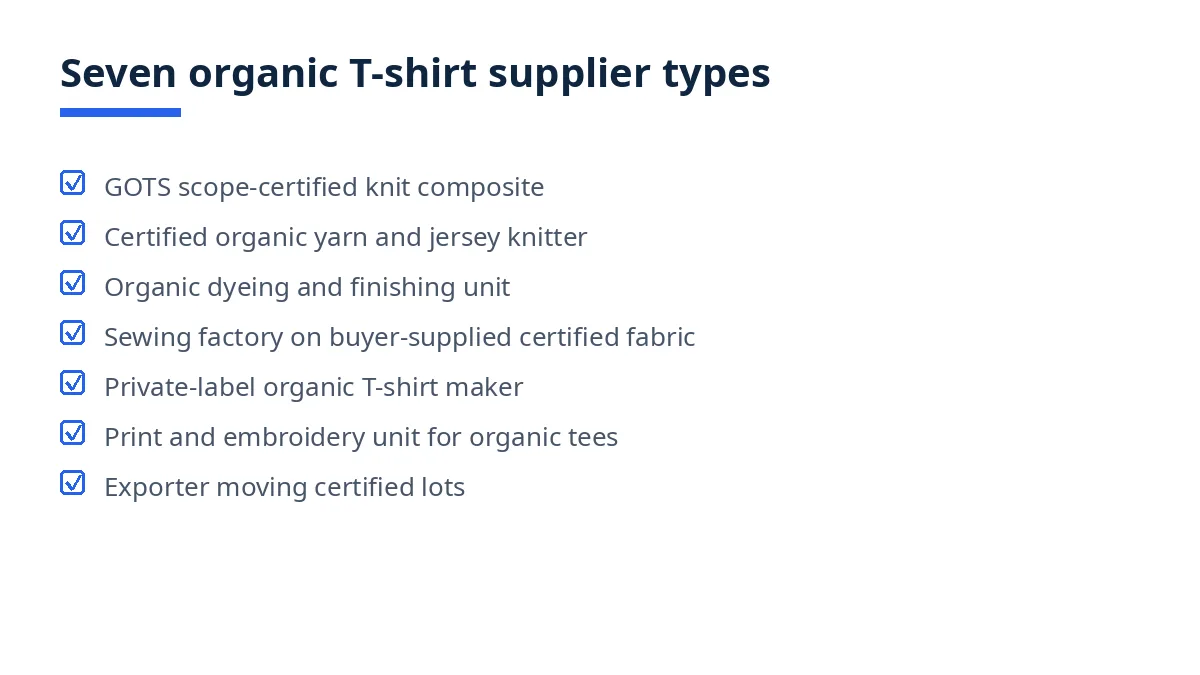
Organic cotton T-shirt manufacturers in Bangladesh fall into seven types by certification capability: GOTS scope-certified composites, certified yarn and jersey knitters, organic dyeing units, sewing factories on buyer-supplied certified fabric, private-label makers, print and embroidery units, and exporters moving certified lots. Match the type to your label grade, then check scope certificates, transaction certificates and a washed sample before paying.
On this page
Key takeaways
An organic claim is a certificate chain, not a fabric description: every unit that touches the cotton must hold a current certificate covering its own stage, or the finished tee cannot carry the label.
GOTS label grades turn on fibre content: 95 per cent or more certified organic fibre for the grade organic, and 70 to 94 per cent for made with x% organic materials, with the certification body and certification number on the label.
A scope certificate proves a site and its processes are certified; a transaction certificate proves a specific lot moved between certified parties in a volume the certified input can support. Ask for both, style by style.
Price and MOQ follow certification and dyeing as much as sewing: dye-lot size sets colour minimums, and cuts and jersey weight change fabric use, so compare quotes only on the same specification and label grade.
Exportain badges record document and photo checks reviewed by the Exportain team; they are not factory inspections or quality guarantees, and they do not replace the certificate checks in this guide.
An organic cotton T-shirt order can pass a fabric check and still fail the claim on its label. The failure point is rarely the sewing line. It is the paper chain behind the fibre: whether the cotton entered the chain as certified organic, whether every unit that touched it held a current certificate covering that work, and whether the finished lot carries a transaction certificate matching its volume. A buyer who checks only the garment may receive a well-made T-shirt that cannot be sold as organic in the buyer's market.
That chain sits inside a large knitwear base. Knitwear exports from Bangladesh earned US$5.963 billion in the first quarter of fiscal 2026-27, up 6.88 per cent year on year, within ready-made garment exports of US$10.578 billion, according to Export Promotion Bureau (EPB) data.1 The Bangladesh Knitwear Manufacturers and Exporters Association (BKMEA) says it represents approximately 2,540 knitwear member factories.2 Size alone does not sort this pool for an organic order; certification coverage does, because a claim is only as complete as its weakest uncertified step.
This guide therefore sorts suppliers by what each type can certify, dye and sew, rather than by size or sales pitch. It covers the two GOTS label grades a buyer will meet most often, the documents that prove each grade, and the T-shirt details that change with organic fabric: jersey weight, cut, neck construction and wash behaviour. For each type, the check that matters is stated before any discussion of price or quantity, because a low quote from a supplier outside the certified chain is not a comparable quote at all.
The list: organic cotton T-shirt manufacturers in Bangladesh by type
The seven types below describe capability profiles, not companies and not a ranking. One supplier can hold more than one profile, and can change profile from one order to the next if a subcontractor changes. What matters is the profile that applies to your lot, with certificates naming the site doing the work.
1. GOTS scope-certified knit composites
What this type controls. Knitting, dyeing and finishing, cutting, sewing and packing inside one certified organisation, with a scope certificate listing the products, sites and processes covered.3 That single chain is the simplest route to a finished-product claim, because fewer handoffs mean fewer places where certified and uncertified material can mix.
Check before ordering. Ask for the scope certificate itself, not a logo on a profile page, and confirm three things on it: the producing site address, T-shirts or the relevant knitwear product category, and an expiry date that covers your production window. Scope certificates are issued or renewed only after an on-site audit by an independent certification body.3 Then confirm the label grade your fibre content supports. Under the Global Organic Textile Standard (GOTS), the grade "organic" requires 95 per cent or more certified organic fibre, while "made with x% organic materials" covers 70 to 94 per cent, and a correct label also names the certification body and the certified entity's certification number.4
T-shirt point. Composites suit repeat T-shirt programs where the same jersey, shade and cut must repeat across seasons. Ask how the composite segregates certified lots during dyeing, since shade matching is where repeat orders most often drift.
2. Certified organic yarn and jersey knitters
What this type controls. The upstream end of the chain: spinning or knitting certified organic cotton into the single jersey a T-shirt is cut from. Some knitters sell fabric; others knit against a buyer's order for a sewing factory downstream. Their certificate covers their own stage only.
Check before ordering. Confirm that the knitter's scope covers the fibre and fabric you need, and that each fabric delivery will arrive with a transaction certificate. A transaction certificate records the product, quantity, buyer and seller and date of the transaction, and the certification body issues it only after checking that the seller held enough certified input material for the output described.3 Without that document, the sewing factory downstream has no certified input to pass on.
T-shirt point. State jersey weight, fibre blend and label grade in the fabric order, not only in the garment order. A blend that drops below 95 per cent certified fibre changes the label grade from "organic" to "made with x% organic materials", even when the garment looks identical.4
3. Organic dyeing and finishing units
What this type controls. Wet processing: dyeing and finishing certified jersey under the chemical and environmental criteria of the standard the buyer is claiming. GOTS sets strict chemical criteria for the textile chain and prohibits allergenic and carcinogenic chemicals and certain substances including flame retardants, PFAS and toxic dyes.4 A dyehouse outside that system can dye organic yarn and still break the claim, because the claim covers processing as well as farming.
Check before ordering. Ask whether the dyehouse is itself a certified entity with the dyeing process on its scope certificate, and whether its chemical inputs are approved for the standard claimed. Ask for a lab-dip and a bulk-dye approval in the production fabric, and wash the approved sample before confirming shade and hand feel, since organic cotton jersey can shift shade and shrink differently from conventional jersey.
T-shirt point. Dye lots set the practical minimum for colourways: a small colour run may still need a full dye lot. Example figures: a dye lot of 1,000 kilograms of jersey may cover roughly 4,000 mid-weight tees, so splitting it across eight colours leaves each colour short of a full run.
4. Sewing factories running buyer-supplied certified fabric
What this type controls. Cutting and sewing only. The buyer, or a fabric supplier the buyer nominates, supplies certified jersey and trims, and the sewing factory converts them into finished tees. This type suits buyers who already hold a certified fabric source and want sewing capacity without paying for a composite's dyeing overhead.
Check before ordering. The certificate question changes here. The sewing site itself must be a certified entity for the finished garment to carry a GOTS label, because GOTS requires every company in the process to be certified for the end product to bear the label, and a fabric sewn in an uncertified facility breaks the chain of custody.4 If the sewing site is uncertified, the honest outcome is an uncertified garment made from organic fibre, and the label and marketing copy must say so. Agree segregation in writing, with lot numbers carried onto the packing list.
T-shirt point. Neck ribbing, shoulder tape and stitch type decide whether an organic tee keeps its shape after washing. Specify rib construction and stitch density in the tech pack, and measure the washed sample against your size chart at every size, not only the sample size.
5. Private-label organic T-shirt makers
What this type controls. Finished tees under the buyer's label, either made to the buyer's tech pack or adapted from the supplier's own patterns and cuts. Unlike type 4, this supplier owns the specification work: pattern, grading, labelling and packing, as well as sewing.
Check before ordering. For a buyer-supplied tech pack, judge the counter-sample line by line against it, including label-grade wording on the care label. For a supplier-offered style, confirm who holds the pattern and grading files. Ask for washed measurements of the exact fabric and cut combination, not of a similar style, since shrinkage can differ from conventional jersey.
T-shirt point. Cuts are a specification: crew neck, V-neck, relaxed or oversized, and slim fits each change fabric consumption, grading and the risk of twisting after wash. Example figures: a relaxed-fit tee in a 180 gsm jersey uses roughly one-fifth more fabric than a slim fit in a 150 gsm jersey, so the two cuts should never be compared on unit price alone.
6. Print and embroidery units for organic tees
What this type controls. Decoration on finished or cut-panel tees: screen printing, water-based print systems and embroidery, applied either in-house or through a partner unit. Decoration is where an otherwise certified tee most often loses its claim quietly, because a print paste or thread outside the approved input list sits on the garment the label describes.
Check before ordering. Confirm whether printing or embroidery is in-house or subcontracted, and whether the decorating unit is certified for the work claimed. Ask which print inputs are approved under the standard, approve a struck-off sample of the artwork on the production jersey, and wash-test it. Agree print size and placement measurements and who owns the screens and embroidery files if you change supplier later.
7. Exporters and traders moving certified lots
What this type controls. Aggregation and export: buying certified tees or certified fabric from partner factories, consolidating mixed orders, and handling export documentation. This type suits buyers ordering several certified styles at once, or quantities too mixed for one line.
Check before ordering. Ask which factory sews each style and which unit dyes and finishes it, and get both named before paying a deposit. Then trace the documents lot by lot: the producing site's scope certificate, the transaction certificates linking each handoff, and a final transaction certificate for your shipment that reconciles with the input volume.3 A trader's own certificate, where it holds one, covers its trading activity. It does not substitute for the producing factory's certificate, and a volume that exceeds the certified input behind it should stop the order until it is explained.
T-shirt point. Keep certificates style by style, not shipment by shipment: one style without a matching transaction certificate cannot carry the claim, even when the rest of the shipment can.
Summary table
Type | Certification point | Main check before ordering |
|---|---|---|
GOTS scope-certified knit composite | Whole chain under one scope certificate | Site, product category and expiry on the scope certificate |
Certified yarn and jersey knitter | Certified input fabric | Transaction certificate with each fabric delivery |
Organic dyeing and finishing unit | Wet processing under the claimed standard | Dyeing on the unit's own scope certificate |
Sewing factory, buyer-supplied fabric | Sewing site must be certified for a labelled garment | Segregation and lot numbers through cutting and packing |
Private-label organic T-shirt maker | Finished garment and label wording | Washed measurements for the exact fabric and cut |
Print and embroidery unit | Decoration inputs under the claimed standard | Approved inputs, struck-off sample and wash test |
Exporter or trader | Chain of custody across handoffs | Style-by-style transaction certificates, volume reconciled |
How Exportain helps
Search first, message second. On Exportain, published products can be filtered by keyword, category, the Exportain Verified badge, sample availability, OEM or ODM capability, MOQ or lead time.5 Profiles display verification level, location, main products and declared certifications.5 A declared certification only shortlists — confirmation comes from the scope and transaction certificates above.
Buyers post a request for quotation (RFQ) stating quantity, target price, destination, Incoterm, required certifications and deadline, and suppliers in that category quote against it.5 Put the certification requirement in the RFQ itself: the standard, the label grade, the producing site to be named, and the transaction certificate to accompany shipment. Quotations on Exportain are versioned, stating unit price, MOQ, lead time, Incoterm, payment terms and validity for each version, so two suppliers can be compared on the same fields.5 On badges, keep the limit in mind: Exportain verification is a document and photo review by the Exportain team, not a factory inspection, and membership never grants a badge.6
The guide to MOQ in the supply chain explains how minimums are set per style and colour, and the organic cotton T-shirts quality control checklist turns the checks above into inspection points.
FAQs
What is the biggest mistake?
Accepting the word organic from a sales page or a logo image instead of from the certificate chain. A supplier can hold certified fabric, a certified dyehouse and an uncertified sewing line at the same time, and only the last fact decides what the finished tee can claim. GOTS states the point directly: fabric sewn in an uncertified facility breaks the chain of custody, and the final product is not considered certified.4
How can I avoid it?
Write the certification requirement into the RFQ and the order before discussing price. Name the standard and label grade, require the producing site's scope certificate and a transaction certificate per lot, and require a washed sample in production fabric with the exact label wording. Then check them against the shipment: site address, product category, expiry date, and a volume the certified input can support.3
Who is responsible?
Responsibility splits at the documents. The supplier is responsible for holding current certificates covering its own stage, for keeping certified lots segregated, and for issuing or passing on the transaction certificates for its handoffs. The buyer is responsible for asking for those documents before payment, for stating the label grade and fibre content the order must meet, and for checking that the finished garment's labelling matches the grade. In a dispute, the side holding the scope certificates, transaction certificates and approved sample holds the evidence.
Where can I get help?
Use a separate record for each claim: the issuing certification body confirms scope, transaction certificates confirm each lot, and OEKO-TEX Standard 100, where a buyer also wants a harmful-substance safety label, certifies that every thread, button and accessory of the article has been tested against a list of over 1,000 harmful substances.7 On Exportain, read what each profile badge covers before relying on it, and keep the certification discussion in the RFQ and message thread so the agreed terms are recorded.6
Next steps on Exportain
Browse Bangladeshi suppliers and filter the knitwear listings by badge, MOQ and OEM or ODM capability. Before you order, read how supplier verification works on Exportain so you know what each badge covers. Then post a free RFQ carrying your T-shirt specification, the standard and label grade required, the producing site to be named, and the transaction certificate to accompany shipment. For the steps after ordering, the guide to importing organic cotton T-shirts from Bangladesh covers ordering and shipping, and the cotton T-shirts manufacturers guide covers conventional jersey sourcing for comparison.
Sources
- Merchandise exports rise 6.34pc to $13.09b in Q1 FY27: EPB. The Financial Express, (accessed )
- BKMEA at a Glance. BKMEA (accessed )
- GOTS Traceability. Global Organic Textile Standard (GOTS) (accessed )
- GOTS Labelling. Global Organic Textile Standard (GOTS) (accessed )
- How to source and buy from Bangladesh. Exportain (accessed )
- Supplier verification: Earn trust badges buyers can see. Exportain (accessed )
- OEKO-TEX Standard 100. OEKO-TEX (accessed )
- MOQ
- supplier verification
- knitwear
- importing from Bangladesh
- Organic cotton t-shirts
- Private label apparel
About the author
Sourcing from Bangladesh?
Post a request for quotation and suppliers on Exportain can send you their quotes directly.
Post an RFQ