Cosmetics, Toiletries & Chemicals Sourcing Guide for Bangladesh
This sourcing guide walks buyers through finding, checking and ordering cosmetics, toiletries and soap from Bangladesh: write a brief suppliers can price, score the shortlist, approve samples, agree MOQ and terms in writing, and ship with the right compliance file.
Short answer
Sourcing cosmetics, toiletries and soap from Bangladesh starts with a complete brief: heading, formula, pack, quantity and destination market. Score suppliers on DGDA licensing, GMP scope, input route and shipment history, approve a production counter-sample, then agree MOQ, itemised price, Incoterm and staged lead time in writing before production and shipment.
On this page
Key takeaways
There is no cosmetics-only export total in an opened source: use the EPB chemical products series (Chapters 28 to 38, USD 368.32 million in FY2024-25) only as wider chemical-trade background, and keep it separate from the press-reported domestic valuation of over BDT 350 billion.
Write one brief per product before contacting suppliers: six-digit heading, formula and preservative system, label claims, pack and closure, size and shade, quantity per variant, destination market, and the tests the production batch must pass.
Score suppliers on a pass or fail gate: DGDA licence and registration for the exact product category, in-house scope, shipment history, input and pack route, test evidence, and batch and recall discipline. A failed row ends the conversation before sampling.
There is no industry-wide MOQ, price or lead time: each is quoted per maker, per formula and per pack, so compare only itemised quotes at the same Incoterm, and plan lead time backwards from the on-sale date with input procurement as its own stage.
Run samples in three stages, laboratory sample, production sample, then a written counter-sample approval, and release no shipment without that counter-sample: the EU file, the DGDA file and your own specification are three separate files.
Buyers rarely lose a cosmetics order on the headline unit price. They lose it on a brief that two suppliers read differently, a sample that was never tied to a written specification, or a delivery term that left freight, insurance and duty to assumption. This guide gives importers, brands, retailers and sourcing agents in the United States, the United Kingdom, the European Union and the United Arab Emirates a sequence to run in order, with a decision or a document required before the next stage starts. Follow it as a workflow, not as background reading, and keep every decision in one order file.
The work unit is one finished preparation at a time: one formula, one pack, one destination market. Finished cosmetics and toiletries, together with the soap and cleaning preparations sold beside them, are in scope. Bulk industrial chemicals and pharmaceutical products are not product lines here. A chemical appears only where it forms part of a finished preparation, such as a fragrance, an emulsifier or a soap noodle used to make a bar.
Market overview with latest data
Use published numbers to set expectations for your plan, and refuse to let any single number stand in for supply. The Export Promotion Bureau (EPB) publishes a broad chemical products series that spans Harmonized System Chapters 28 to 38, so it mixes cosmetics with industrial chemicals and other chemical goods. Read the table below as wider chemical-trade background only, never as a cosmetics export total, and never add it to a domestic market valuation.
Fiscal year | Chemical products exports, EPB principal-commodity series |
|---|---|
FY2020-21 | USD 280.58 million |
FY2021-22 | USD 364.07 million |
FY2022-23 | USD 302.76 million |
FY2023-24 | USD 349.73 million |
FY2024-25 | USD 368.32 million |
The latest year in that series rose by 5.32 percent.1 That movement tells you the broader chemical trade grew, not that any single cosmetics maker grew, and it says nothing about capacity for your formula, your pack or your shade range. No cosmetics-only export total is stated in this guide, because none was found in an opened source, so your evidence for export capacity must come from each candidate supplier, not from a national total.
Treat the domestic demand picture the same way, as a signal about inputs rather than a promise about your order. Press reporting on Cosmetica Dhaka 2025 put the market for cosmetics, toiletries and personal hygiene products at over BDT 350 billion, with around 90 percent of raw materials imported.2 The practical consequence for a buyer is direct: a Bangladesh-made preparation is usually formulated and filled locally from imported actives, fragrances, emulsifiers and packaging components, so exchange-rate movement and import availability sit inside your supplier's price and calendar. Ask how much of your formula's input list is held in stock, and what happens to price and timing if an imported input has to be ordered after your purchase order.
Two warnings from association reporting should change how you read quotes. First, a large grey channel, with under-declared imports, smuggled goods and counterfeit products, makes batch coding, authorised-channel evidence and traceability a commercial control, not an administrative detail.3 Second, input duty can move a soap quote more than factory efficiency can: soap noodles carry 25 percent customs duty and 3 percent regulatory duty under the 2025-26 tariff schedule, while palm-based inputs such as RBD palm stearin and crude palm kernel oil are reported at 10 percent duty with no regulatory duty.3 When two soap prices differ sharply, check the input route before you negotiate the margin. Association reporting also notes that locally produced cosmetics already reach markets including the Middle East, Sri Lanka, Thailand and the Philippines, which gives you a destination pattern to test, not a guarantee for your market.3
Main products and production clusters
Decide the lane before you write the brief, because the lane determines which tests matter, which pack fails first and which compliance file you will need. Skin care turns on stability and colour consistency at scale. Hair care turns on whether a claim changes the destination file. Oral and personal care turn on dispenser and pack performance as much as on formula. Soap and home care turn on surfactant performance, bar hardness and pack format. A mixed-basket brief that spans lanes will draw a single blended price that hides all four sets of risk, so write one brief per lane and let each supplier answer only the lanes it actually makes.
Record the heading in the brief before anything else, and confirm the six-digit subheading with your supplier and your destination broker. Chapter 33 covers essential oils and resinoids and perfumery, cosmetic or toilet preparations.4 Chapter 34 covers soap, organic surface-active agents and washing preparations.5
Heading | Products in the lane | What to write in the brief |
|---|---|---|
3303 | Perfumes and toilet waters | Fragrance concentration, bottle and spray performance |
3304 | Beauty, make-up and skin care preparations, including sunscreen | Preservative system, shade, stability ranges |
3305 | Hair preparations | Claim position, pack and dispenser behaviour |
3306 | Oral and dental hygiene preparations | Tube, seal and flavour or active specification |
3307 | Pre-shave, shaving and after-shave preparations, personal deodorants, bath preparations and depilatories | Applicator performance and label claims |
3401 | Soap and skin-washing preparations | Bar size, hardness, wrap and surfactant base |
3402 | Surface-active agents other than soap, and washing and cleaning preparations other than those of 3401 | Cleaning performance, dilution and pack format |
Build a shortlist with complementary strengths rather than four copies of the same supplier type. A large domestic manufacturer suits volume lines and held input stock. A multinational producer manufacturing locally may run group formulations and a different input route. A small or medium maker may suit a short private-label run where flexibility matters more than volume. A contract filler suits a buyer who brings a formula and needs filling, labelling and batch records done well. For each candidate, establish which type it is and which products it makes, fills or packs in-house, because undisclosed subcontracting breaks the chain of evidence your order file depends on.
Production for formulation, filling, laboratory testing, fragrance blending and packaging supply is concentrated around Dhaka, where distribution and import clearance are also concentrated, and Cosmetica Dhaka 2025 drew over 100 stalls from Bangladesh and other countries.2 Soap cost, by contrast, follows its input route more than its location: access to soap noodles, palm-based inputs and bar-making lines, together with the duty gap between input routes, decides which route a maker can afford. Treat packaging as a parallel supply chain in your plan, since bottles, pumps, tubes and printed cartons may be imported, locally made, or both, and the pack supplier's minimum can set your first-order quantity.
How to find and verify suppliers
Work through channels in an order that lets each channel check the last. Start with association contacts and producer names in trade reporting, cross-check them against export data and market context, then work supplier listings by product, and use trade events to meet makers rather than to discover them. A supplier that appears through only one channel stays on the enquiry list. A supplier that appears through two or more channels, with consistent product, market and capacity claims, earns a place on the scored shortlist.
Score every candidate with the same questions, and stop at the first failed gate. Price discussions wait until the scorecard is complete.
Licence position: does the maker hold a licence and a cosmetic registration certificate for this exact product category, for this site, and is either due to expire during your order window.
In-house scope: which products are made, filled or packed in-house, which are subcontracted, and what batch size each line runs.
Shipment record: anonymised summaries for your target market showing heading, volume and recency, rather than a list of countries with no volumes or dates.
Input and pack route: which inputs and packs are imported, which are local, and what stock is held against your order.
Test evidence: stability data, microbiological testing and preservative efficacy evidence for the exact formula and pack, not for a neighbouring product.
Batch discipline: batch coding, retained samples, a complaint and recall procedure, and a written route for handling out-of-specification product.
On the licence question, ask for documents, not descriptions. Under the Drug and Cosmetics Act 2023, responsibility for drugs and cosmetics sits with the Directorate General of Drug Administration (DGDA), and licences and cosmetic registration certificates are required to produce, distribute, import or export cosmetics.6 A general company licence does not prove registration for a specific product category, so request the category document itself, check the site named on it, and re-check the file whenever the formula, product form or manufacturing site changes.
Exportain profile badges are a starting filter only; run the scorecard above yourself or through an inspection firm you appoint.7
Stop the conversation early when any of these appear. A firm price arrives before the formula, pack, quantity and destination market have been seen. A maker will not say whether the formula is made in-house or subcontracted. Batch coding, retained samples or a recall procedure cannot be described. The input route is left blank, even though most raw materials are imported.2 Any one of these gaps predicts a later dispute that a lower price will not repay.
MOQ, pricing and lead times
Read every quote in three passes, and refuse to compare two quotes that have not passed all three on the same basis. The first pass checks quantity. The second checks the price build. The third checks the calendar. A quote that fails any pass goes back for correction before it enters your comparison.
On the quantity pass, find which minimum actually binds. A cream or lotion run is limited by the mixing vessel and the filling line. A colour run is limited per shade, since each shade is its own batch and shade-matching check. A soap run is limited per bar size and wrap. A private-label run adds a print minimum for labels, cartons and outer cases, and that print minimum can exceed the filling minimum on a small first order. Send your target quantity per product, shade, size and pack in the enquiry, and require each maker to state its minimum on exactly that basis. Where the print run binds, the print quantity is your real first-order quantity, and it should be agreed before samples are approved, not discovered after artwork is printed.
On the price pass, require an itemised build and check each line against the specification. A unit price is assembled from imported actives, fragrance, emulsifiers and surfactants, processing and labour, the pack and its print, filling, testing, and export costs to the agreed delivery point. Input duty sits inside that build, and the soap duty contrast in the market section shows why the input route must be named: a maker importing soap noodles at 25 percent customs duty plus 3 percent regulatory duty starts from a different input cost than a maker using palm-based inputs at 10 percent duty with no regulatory duty.3 Fragrance and actives are priced in foreign currency and often held in small stock, so require the price-validity period in writing and the events that trigger a re-quote. Compare only quotes at the same delivery term, formula, pack and quantity, and treat an unitemised low quote as an unanswered question about pack thickness, preservative strength or an omitted test.
Example figures. For illustration only, a specification for 24,000 bottles of 250 ml body lotion in a pump bottle is itemised as formula and inputs USD 0.58, bottle and pump USD 0.41, filling and labelling USD 0.16, and testing and export costs USD 0.09, giving USD 1.24 per unit and a worked total of USD 29,760. The example shows how to audit a build, not a market price. Use it to test a real quote line by line: if a line is missing, ask for it, and if a line looks light, ask which test, pack component or input route was left out.
On the calendar pass, build the timeline backwards from the date the goods must be on sale. Subtract transit, then inspection and booking, then labelling and packing, then testing and release, then production and filling, then input and pack procurement, then formula confirmation and sample approval. Procurement is the least predictable stage, because most raw materials are imported.2 Require the stages separately, with input and pack procurement stated as its own stage, and agree in writing what starts the clock. Written order confirmation plus approved sample and artwork is a workable start point. A first enquiry is not.
Quality, certifications and compliance
Keep three separate files in your order record, and do not let a document from one file substitute for a document in another. The first file covers the country of manufacture. The second covers the destination market. The third is your own specification and test plan. A shipment is releasable only when all three files are complete for the exact product, pack and batch.
The manufacture file starts with the DGDA position described in the verification section: licence and cosmetic registration certificate for the exact product category, filed with the purchase order and re-checked when the formula, product form or site changes.6 Add the manufacturing practice evidence to the same file. ISO 22716 provides the Good Manufacturing Practice guidelines for cosmetic products, and a certificate is a third-party audit of a site working under those practices.8 The certificate alone answers nothing until you ask its scope questions: which site, which activities, and whether filling and packing sit inside the scope or are subcontracted. A scope that excludes your pack operation does not cover your order.
The destination file is built by working backwards from the person who will be named on the label. For the European Union, Regulation (EC) No 1223/2009 on cosmetic products requires a responsible person established within the Union for each product, a safety report before the product is placed on the market, notification in the EU Cosmetic Products Notification Portal, and packaging that carries the responsible person's name and address, the contents, precautions for use and the ingredient list using common ingredient names.9 A Bangladeshi maker cannot fill the responsible-person role without an EU establishment, so agree in writing who holds it: your EU importer, your distributor, or a third-party responsible person appointed by written mandate. Freeze label artwork, the ingredient list and the safety report together at sampling stage, because a later formula change creates a new file. For other destinations, ask your destination broker at brief stage whether the product falls under drug rules as well as cosmetic rules, and add that file before sampling rather than after production.
Your own test plan is run through samples, not through assurances. Order a laboratory sample against the written formula, pack and label, and test it against the ranges you set for pH, viscosity, colour, odour, fill weight and pack and closure performance. Follow it with a production sample made on the production line with production materials, tested for microbiological quality, stability and pack compatibility, with preservative efficacy evidence where relevant. Finish with a counter-sample approved in writing and retained by both sides, and inspect the shipment against that counter-sample before cartons are sealed. Test production goods, not showroom samples. Where a batch fails, the record you need is the investigation, the authorised decision to reprocess or destroy, and the written record of that decision. No counter-sample approval means no shipment release, whatever the calendar pressure.
Shipping, Incoterms and duties
Set the pack specification before you price freight, because packing decides both freight cost and damage risk. Creams and liquids are heavy relative to volume, pumps and tubes crush under stacking, and glass packs need dividers and carton strength that a cost quote may omit. Confirm pack and carton dimensions, units per inner and outer carton, stacking strength and carton marking, including the batch code, in the specification, and check that the marking matches the counter-sample file before cartons are sealed.
Choose the delivery rule by who should control each leg, and always write it with its named place and edition. The ICC Incoterms 2020 edition is the current edition to name in the contract.10 Use this decision aid rather than a generic rule list.
Choose Ex Works when you already have a forwarder and broker who can collect from the seller's premises and handle export clearance, and accept that this is rarely the right choice for a first order.
Choose Free On Board when you want to control main freight and insurance yourself but want the seller to deliver the goods on board the vessel at a named loading port, for example FOB Chattogram, Incoterms 2020.
Choose Cost, Insurance and Freight when you want the seller to arrange and pay main freight and minimum insurance, while understanding that risk still passes when the goods are on board at the loading port, not when they arrive.
Choose Delivered at Place when you want the seller to carry the goods to a named destination place ready for unloading, while remembering that you still clear import and pay duty unless the contract states otherwise.
Freight booking and customs clearance sit outside what Exportain does as a marketplace, so the order paperwork should name the forwarder and broker you have appointed, and the delivery term should not be read as covering import clearance.7
Work out duty in three checks, in this order: the confirmed heading, the origin evidence for the consignment, and the destination tariff for the entry date. For the European Union, Bangladesh benefits from the Everything But Arms arrangement under the Generalised Scheme of Preferences, which grants duty-free, quota-free access for all products except arms and ammunition, and most of Bangladesh's exports to the EU enter duty- and quota-free.11 That preference belongs to the consignment, not to the supplier in general: goods that meet the rules of origin and travel with the required proof of origin enter without customs duty while Bangladesh holds that status, and goods whose origin evidence fails attract the standard duty for the heading. Do not carry an EU preference into another market's pricing. For the United States, the United Kingdom and the UAE, read the duty beside your confirmed six-digit code in the destination tariff for the entry date, and have your broker confirm it in writing. This guide states no rate for those markets, because a rate read against the wrong heading or the wrong entry date is worse than no rate at all.
Step-by-step buying process
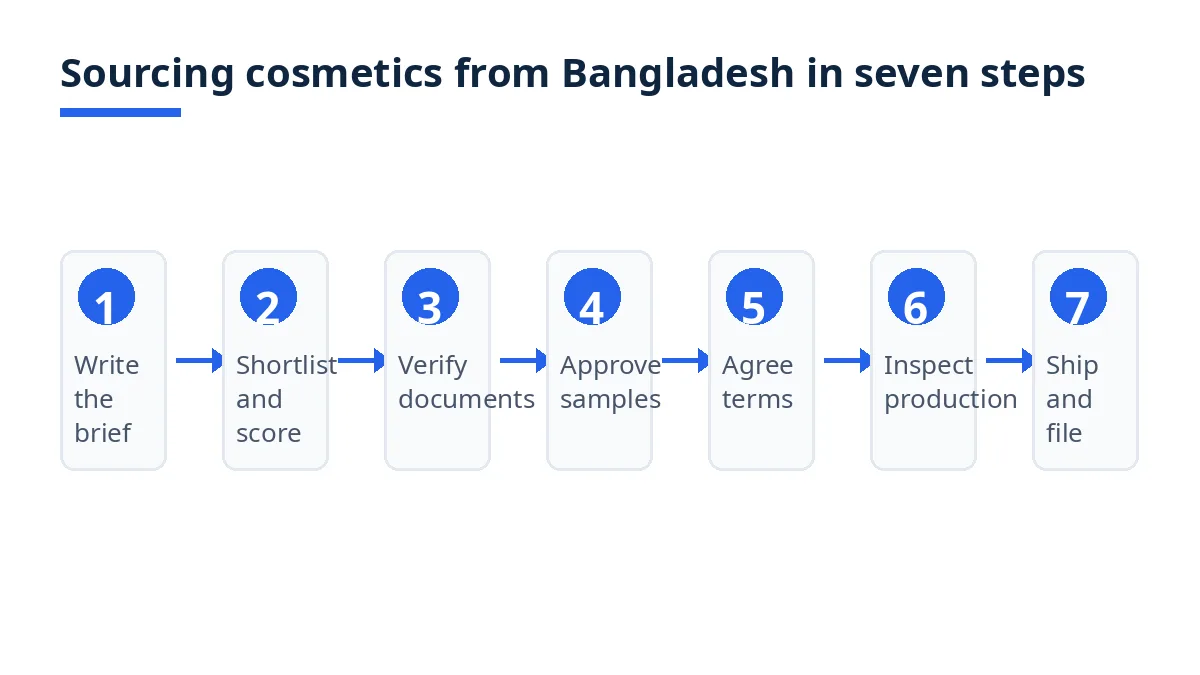
Lock the brief. Write one brief per product, formula, pack and destination: heading, formula and preservative system, function and label claims, pack and closure, size and shade, quantity per variant, destination market and the tests the production batch must pass. No supplier is contacted until the brief is complete.
Build and score the shortlist. Gather candidates through association contacts, trade reporting, export data and supplier listings, then run every candidate through the same scorecard. Only candidates that pass every gate move to sampling.
Collect documents before price talks. Obtain the DGDA licence and registration position for the product category, the manufacturing practice certificate scope, the input and pack route and the shipment history for your market, and read them before any price is discussed.6 8
Run the three-sample sequence. Approve a laboratory sample, then a production sample, then a written counter-sample, testing each against your specification for microbiological quality, stability and pack compatibility.9 8
Put every commercial term in the purchase order. Fix the minimum per product, shade and pack, the itemised unit price with its validity period and re-quote triggers, the delivery rule with its named place, the staged lead time and its start point, payment terms and the inspection point.10
Inspect against the counter-sample, then release. Monitor input and filling first, inspect finished goods against the approved counter-sample before cartons are sealed, and release only batches whose certificates of analysis match the specification.
Ship with matching documents and archive the order. Check that every document names the same product, heading, quantity and batch code set, ship with the origin evidence your duty position depends on, and archive the brief, counter-sample record, test reports and shipment file as one order record.11
Related guides (links to cluster articles)
Read how to import from Bangladesh for the general import sequence behind the steps above, the cosmetics and toiletries industry in Bangladesh pillar for the market and supplier-type picture behind this method, and the packaging industry in Bangladesh pillar for the bottles, pumps, tubes and cartons that set pack cost and lead time. Bangladesh export data gives category scale, and Incoterms for shipments from Bangladesh works through the delivery terms in more detail.
FAQs
Is Bangladesh a good place to source cosmetics, toiletries & chemicals?
Bangladesh is a workable option when you can run the process in this guide end to end: a complete brief, a scored shortlist, a three-stage sample approval and written commercial terms. Judge it maker by maker, not market by market. The press-reported domestic valuation of over BDT 350 billion and the wider chemical products export series reaching USD 368.32 million in FY2024-25 are two separate series, and the export series covers Chapters 28 to 38 rather than cosmetics alone.2 1 Price in imported-input dependence, a grey channel that makes batch traceability essential, and a destination file that must be built per product.2 3 Confirm the DGDA licence position and the destination-market file for each product before you commit.6 9
What is the typical MOQ?
Treat any single MOQ number as incomplete until the maker states what set it. Ask for the quantity basis in the enquiry: the mixing and filling minimum per formula and pack, the shade minimum per colour, the bar and wrapping minimum per soap size, and the print minimum per label and carton on private-label orders. Where the print run exceeds the filling run, the print quantity becomes the real first-order quantity. There is no published figure that replaces that per-maker answer, so state your target quantity per product, shade, size and pack and require every quote to answer on the same basis.
How long is the lead time?
Build your own calendar backwards from the on-sale date instead of accepting a single lead-time number. Subtract transit, inspection and booking, labelling and packing, testing and release, production and filling, input and pack procurement, and formula and sample approval, in that order. Procurement is the least predictable stage, because most raw materials are imported.2 Ask for each stage separately, and agree in writing what starts the clock, normally written order confirmation plus approved sample and artwork.
Which certifications matter?
Work from the destination backwards, and judge each document by whether it covers this product, this pack and this market. For an EU-bound product, confirm first that a named person established in the Union will stand behind it, then confirm the safety report and the portal notification are complete before artwork is frozen, and check the label gives ingredients under their common names.9 Separately, confirm the Bangladesh licence and registration position for the exact category under the 2023 Act.6 For factory practice, treat ISO 22716 as a scope question only: which site and which operations did the audit actually cover.8
Next steps on Exportain
Start from your written brief and post a free RFQ at Exportain RFQs, giving your target quantity per variant and destination market so suppliers quote against the same specification. Check the market picture behind this guide through Exportain trade intelligence, then browse Bangladeshi suppliers by cosmetics, toiletries or soap product and run the shortlist through the scorecard in this guide.
Sources
- Bangladesh Export Statistics 2024-2025. Export Promotion Bureau (EPB) (accessed )
- Bangladesh's Cosmetics Market Hits BDT 350 Billion Amid Heavy Reliance on Imports. Voice7 News (accessed )
- Local cosmetics makers seek VAT, duty relief. The Business Post (tob.news), (accessed )
- HS 2012 Chapter 33: Essential oils and resinoids; perfumery, cosmetic or toilet preparations. United Nations Statistics Division (accessed )
- HS 2012 Chapter 34: Soap, organic surface-active agents and washing preparations. United Nations Statistics Division (accessed )
- The Drug and Cosmetics Act 2023, Act No. 29 dated 18 September 2023. VDB Loi, (accessed )
- Supplier verification: Earn trust badges buyers can see. Exportain (accessed )
- ISO 22716 Certification: Cosmetics GMP Audits. Kiwa ASI (accessed )
- Regulation (EC) No 1223/2009 on cosmetic products: summary. European Commission, EUR-Lex (accessed )
- Incoterms® rules. International Chamber of Commerce (ICC) (accessed )
- EU trade relations with Bangladesh. European Commission, (accessed )
About the author
Sourcing from Bangladesh?
Post a request for quotation and suppliers on Exportain can send you their quotes directly.
Post an RFQ